- Purpose: A goodbye email is a strategic last impression that protects your reputation and keeps your network active.
- Scenario Map: Use the directory to pick the right template for coworkers, manager, clients, vendors, or special situations.
- Timing Rules: Send external notes 3–5 days before, close-team notes 1–2 days before, and the broad company email late on the last day.
- Core Structure: Subject clarity, Specific gratitude, Smooth handover, Simple stay-in-touch CTA with the right contact details.
- Avoid Damage: Don’t vent, humblebrag, ghost, or write a novel, use a hybrid approach with one mass email plus a few personal notes.
Your last day at work deserves more than a quiet exit or a hastily written note. A well-crafted goodbye email is a strategic career asset – it cements your professional reputation, ensures your network remains active, and leaves a lasting “recency bias” that is overwhelmingly positive. Whether you are moving to a dream job or simply seeking a fresh start, how you sign off matters just as much as how you started.
The average professional changes jobs approximately 12 times during their career. That means 12 distinct opportunities to burn a bridge or build a highway. Yet, many professionals struggle with the nuances of the farewell email. They agonize over the tone: Is it too emotional? Is it too cold? Should I include my personal number?
This comprehensive “Deep Dive” guide serves as your central hub for mastering the exit. We will move beyond generic templates to explore the psychology of parting, tailored strategies for every audience (from your “work bestie” to distant vendors), and the specific mechanics of a leaving message that resonates.
The Complete Goodbye Email Directory: Choose Your Scenario
Every departure is unique. To help you navigate your specific situation, we have organized our library of resources below. Use this directory to find the exact template and strategy that matches your context.

For Your Team & Internal Colleagues
Your immediate peers are the ones who will miss you most. These guides cover the spectrum from heartfelt to humorous.
- 👋 Goodbye Email to Coworkers: The definitive guide for your general team announcement.
- 😂 Funny Goodbye Email: Witty templates, memes, and humor for close-knit teams.
- ❤️ Emotional Goodbye Email: How to write a heartfelt farewell without getting too sentimental.
- 🏃 Short Goodbye Email: The “Irish Exit” approach – brief, classy, and professional.
- 🎨 Creative Goodbye Email: Using poems, GIFs, or videos to make a memorable exit.
- 👯 Goodbye Email to Work Bestie: A personal letter to your “work spouse” or closest ally.
- 🏢 Goodbye Email to Distant Colleagues: The BCC mass email for people you rarely worked with.
For Leadership & Management
Navigating the hierarchy requires tact. These resources ensure you leave on good terms with the powers that be.
- 👔 Goodbye Email to Manager: How to thank your direct supervisor professionally.
- 🙏 Farewell Message to Boss: What to say when your boss is the one leaving.
- 🏅 Senior Farewell Email: Strategies for executives and senior leaders stepping down.
For Clients, Vendors & Business Partners
External communications are about business continuity. Focus on the handover and trust.
- 🤝 Farewell Email to Clients: How to introduce your replacement and reassure stakeholders.
- 📦 Farewell Email to Vendors: Managing logistics and handing over supplier relationships.
- 📄 Professional Farewell Email: Formal templates for corporate and external partners.
- ↩️ Reply to a Client Farewell: How to respond professionally when a client leaves.
Special Situations & Events
Not every goodbye is a standard resignation. Cover your bases with these specialized guides.
- 👴 Retirement Farewell Email: Crafting a legacy message after decades of service.
- 📝 Goodbye and Handover Emails: Essential templates for ensuring a smooth transition of duties.
- 🔄 Internal Transfer Farewell Email: Moving to a new department? Here is how to say “See you around.”
- 🎤 Farewell Speech to Colleagues: What to say when they hand you the microphone at your party.
- 🎉 Farewell Party Invitation: Templates to get people to your send-off drinks or lunch.
- 📨 Goodbye Email Subject Line: 50+ subject lines to ensure your email gets opened.
- ✍️ Reply to a Goodbye Email: How to write a gracious response when someone else leaves.
The Psychology of Leaving: Why Your “Last Impression” Wins
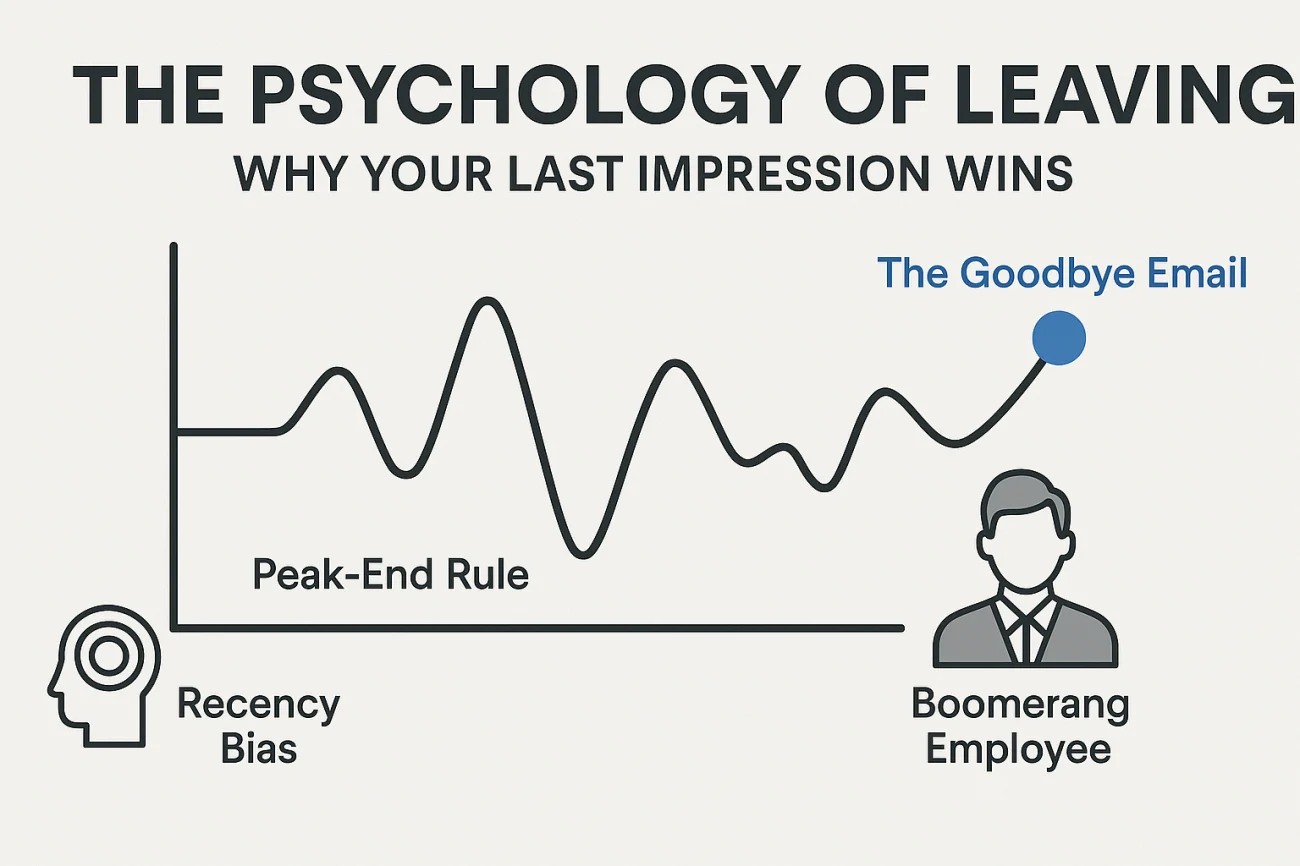
Psychologists refer to the “Peak-End Rule,” which states that people judge an experience largely based on how they felt at its peak and at its end. Your tenure might have been a mix of highs and lows, but your goodbye message to coworkers is the “End” that will color their entire memory of working with you.
Leveraging Recency Bias for Career Growth
A thoughtful, gracious exit overrides previous minor conflicts. It signals emotional intelligence and professional maturity. Conversely, a “ghosting” exit or a bitter farewell speech can undo years of high performance. Your goal is to curate a final interaction that makes former colleagues feel valued, prompting them to become future advocates for your personal brand.
Consider the “Boomerang Employee” phenomenon. HR trends show a massive spike in employees returning to former companies. Your goodbye email is effectively the first step in your potential re-hiring process years down the line. Burning a bridge doesn’t just cut off the past; it blockades a future path.
The Strategic Timing Matrix: When to Hit Send
Timing is the difference between a poignant farewell and an awkward disruption. Sending your email too early makes you a “lame duck”; sending it too late (or after you’ve left) feels like an afterthought.
| Audience Segment | Optimal Timing | Strategic Rationale |
|---|---|---|
| Clients & Vendors | 3–5 Days Before Departure | Prioritizes business continuity. Gives them time to ask questions, save your contact info, and bond with your replacement without panic. |
| Inner Circle (Close Team) | 1–2 Days Before Departure | Allows for personal conversations, lunch invitations, and genuine exchanges of memories before the chaos of the final hours. |
| The Wider Company | Last Day (2:00 PM – 4:00 PM) | Minimizes disruption. It’s the “final act” before you hand in your badge. Sending it Friday afternoon ensures you leave on a high note. |
| Executive Leadership | Last Week (Personal Note) | Sending a separate, private note to VPs or C-levels a few days early demonstrates high-level respect and career savvy. |
Anatomy of a Flawless Goodbye Email
Regardless of whether you are writing a Short Goodbye Email or a lengthy tribute, every effective message must contain four non-negotiable elements. Missing any one of these can leave your reader confused or indifferent.
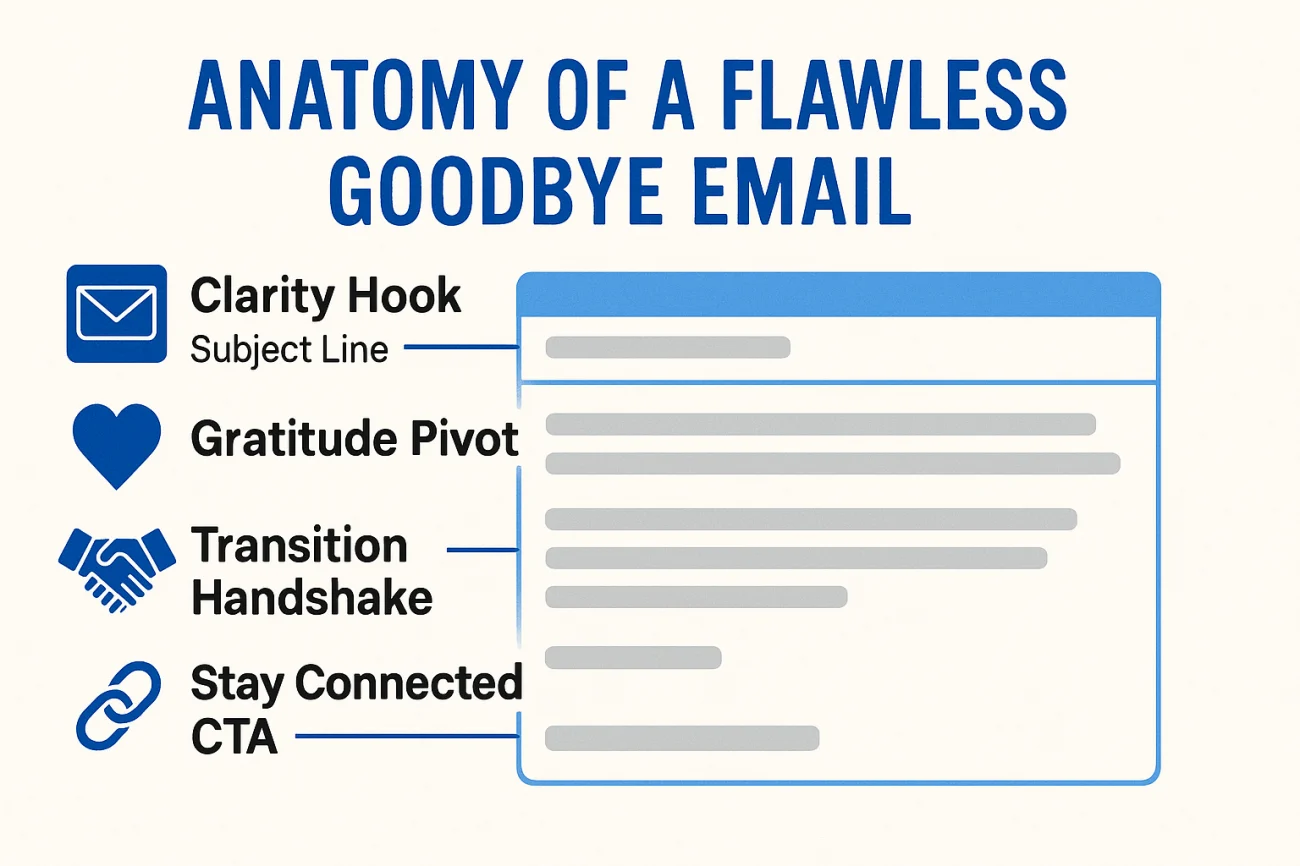
1. The Clarity Hook (Subject Line)
Don’t be cryptic. Your Goodbye Email Subject Line should be clear so people know to prioritize it. In an inbox full of “Urgent” requests, a vague subject like “Update” gets ignored.
Bad: “News”
Good: “Moving On – [Your Name]’s Last Day”
Better: “So long, and thanks for all the fish (My final day)”
2. The Gratitude Pivot
This is where you mention saying goodbye to colleagues with grace. Be specific. Instead of a generic “Thanks for everything,” try “Thank you for the support during the Q4 launch.” Specificity breeds authenticity and proves you were actually paying attention during your tenure.
3. The Transition Handshake
Especially for a Farewell Email to Clients or cross-functional teams, you must reassure them that the work continues. Name your replacement or the point of contact. This shows you care about the company’s success even after you’re gone, which is a key trait of leadership.
4. The “Stay Connected” CTA
This is the most critical part for your network. Provide non-work contact details. A LinkedIn URL is standard; a personal email is for closer contacts; a phone number is reserved for your inner circle. Make it clickable and easy to find.
Mastering Internal Goodbyes: From the Boss to the “Work Bestie”
One size does not fit all. Sending a generic “Copy/Paste” email to everyone is a wasted networking opportunity. You need to segment your audience to maximize impact.

The General Team Blast
This is your broad goodbye email to coworkers. It should be professional, positive, and brief. It’s safe for the whole department to read. Focus on shared wins and general camaraderie.
Subject: So long, and thanks for all the fish (My last day)
Hi Team,
As some of you know, today is my final day at [Company]. I’m moving on to a new adventure, but I couldn’t leave without saying a proper thank you.
Working here has been a masterclass in collaboration. I’ve learned so much from [Specific Project/Experience], and I’ll miss our [Team Ritual/Inside Joke].
Please stay in touch! You can find me on LinkedIn [Link] or reach me at [Email].
Cheers,
[Your Name]
The “Work Bestie” & Inner Circle
For the people you ate lunch with every day, a formal email feels stiff and robotic. A Goodbye Email to Work Bestie should be heartfelt, uncensored (privately), and emotional. This is where you drop the corporate mask and speak friend-to-friend. Acknowledge the coffee runs, the venting sessions, and the personal support.
The Manager & Leadership
Writing a Goodbye Email to Manager requires balance. Even if the relationship was rocky, take the high road. Thank them for specific guidance or opportunities. If they are the ones leaving, a Farewell Message to Boss should validate their impact on your career growth. Leaders remember who thanked them.
The Distant Colleagues
For those you worked with sporadically, a Goodbye Email to Distant Colleagues ensures you don’t disappear into the void. Keep it short – this is often called the “BCC Mass Email.” It puts you on their radar one last time without demanding an emotional response.
The External Strategy: Clients, Vendors, and Partners
External emails are not just goodbyes; they are business transactions. A Farewell Email to Clients or a Farewell Email to Vendors has a different goal: Trust Transfer. You are essentially “endorsing” your replacement.
| Feature | Internal Goodbye | External Farewell |
|---|---|---|
| Primary Goal | Relationship Maintenance & Closure | Business Continuity & Trust Transfer |
| Tone | Personal, Warm, potentially Humorous | Professional, Reassuring, Concise |
| Key Information | Personal contact info, memories | Replacement’s contact info, project status |
| Timing | Last Day | 3-5 Days Prior |
💡 Pro Tip: When writing a Reply to a Client Farewell (if they are leaving), always ask who your new point of contact will be immediately to avoid service gaps. Do not let the account go cold.
Choosing Your Tone: Funny, Emotional, or Strictly Business?
Your “Tone of Voice” should reflect your personal brand and the company culture. A mismatch here can be jarring and create confusion.
The Funny Goodbye
If you’re known as the office jokester, a Funny Goodbye Email is appropriate. Use GIFs, memes, or self-deprecating humor. However, know your audience – save the “I’m finally escaping!” jokes for close peers, not the CEO. Humor is a high-risk, high-reward strategy.
The Emotional & Heartfelt
For long tenures or tight-knit teams, an Emotional Goodbye Email is expected. It’s okay to say you will miss people. Vulnerability here shows strength. Mentioning specific shared struggles (“We survived the 2023 Merger!”) creates a powerful bond that lasts beyond the job.
The Creative Approach
Designers, writers, and marketers often send a Creative Goodbye Email. This could be a short video, a slide deck of “Top 10 Memories,” or a poem. This stands out and showcases your skills one last time, reminding everyone of the talent they are losing.
The “Irish Exit” (Short & Sweet)
Sometimes, less is more. A Short Goodbye Email is perfect for large distribution lists. “I’m moving on. It’s been great. Here is my LinkedIn.” It respects people’s time while checking the box of politeness. Not every goodbye needs a symphony.
Pros & Cons: The “Mass Email” Dilemma
Should you send one giant email or individual notes? Let’s weigh the strategic impact so you can make an informed decision.
| Option | Pros (Benefits) | Cons (Risks) |
|---|---|---|
| Individual Personal Emails | ✅ High emotional impact. ✅ Strengthens deep bonds. ✅ Gets a higher response rate. ✅ Allows for private jokes/memories. | ❌ Time-consuming. ❌ Risk of forgetting someone important (creating offense). ❌ Can become emotionally draining to write 20+ unique notes. |
| The “BCC” Mass Email | ✅ Efficient. ✅ Ensures no one feels “left out” publicly. ✅ Great for disseminating new contact info quickly. ✅ Sets a clear boundary. | ❌ Feels impersonal. ❌ Often ignored or deleted immediately. ❌ Low conversion on “Stay in touch” requests. ❌ Risk of Reply-All disasters (if BCC is forgotten). |
💯 Recommendation: Use a hybrid approach. Send a Mass Email to the office for coverage, and follow up with 5-10 hyper-personalized notes to your Inner Circle and Key Mentors. This gives you the best of both worlds.
Distinguishing Between Resignation and Goodbye Emails
It is crucial not to confuse a goodbye email with a resignation email. They serve different purposes, audiences, and timelines.
Your resignation email is a formal, legal notification sent to your manager and HR. Its purpose is to initiate the separation process. For guidance on this step, refer to our detailed how to write a resignation email guide or browse resignation email examples for specific templates.
In contrast, the goodbye email is a social and professional closing statement sent to your network. While resignation emails are about logistics and contracts, goodbye emails are about relationships and reputation.
Common Farewell Mistakes That Damage Reputations
We’ve seen it all. Avoid these pitfalls to ensure your legacy remains intact.
- ❌ The “Mic Drop” Venting: Using the goodbye email to air grievances or criticize management. This is career suicide.
- ❌ The “Humble Brag”: Writing extensively about how amazing your new job is or how much more money you’ll be making. It alienates your former peers.
- ❌ The “Ghost”: Leaving without saying anything. It confuses people and makes you look disorganized or ungrateful.
- ❌ The “Novel”: Writing 1,000 words. No one will read it. Keep it concise.
- ❌ The “Broken Promise”: Saying “Let’s get coffee next week” to 50 people when you have no intention of doing so. Be realistic with your commitments.
Comprehensive Template: The “All-Rounder” Professional Farewell
If you need a reliable, professional sample goodbye email that works for 90% of situations, use this framework. It strikes the perfect balance between warmth and professionalism.
Subject: Moving on to new adventures – [Your Name]
Hi Team,
I’m writing to let you know that [Date] will be my last day as [Job Title] at [Company].
It’s been a genuine privilege to work alongside this team for the past [Number] years. From [Project A] to [Project B], I’ve been constantly inspired by the dedication and talent in this room. I’m proud of what we achieved together.
While I’m excited about my next step, I will truly miss our daily collaboration. I want to ensure my departure is seamless, so I’ve handed over my responsibilities to [Colleague Name], who is fully up to speed.
The world is small, and I’d love to keep our professional paths connected. You can find me at:
- 🔗 LinkedIn: [Link]
- 📧 Personal Email: [Email]
Wishing you all continued success and big wins in the future.
Best regards,
[Your Name]
❓ FAQ: Solving Common Farewell Dilemmas
📧 How do I reply to a goodbye email from a colleague?
👔 Should I send a farewell email to senior leadership/executives?
🤐 What if I was fired or laid off? Should I still send one?
💌 How do I write a farewell message to the office if I work remotely?
📅 What is the absolute latest I can send the email?
Final Thoughts: Your Network is Your Net Worth
A goodbye email is more than a notification; it is the final chapter of your story at a company. It is a unique opportunity to curate your legacy, ensuring that the last thing people remember about you is your professionalism, gratitude, and class.
Whether you choose a Funny Goodbye Email to make them smile or a Professional Farewell Email to maintain corporate ties, the key is intention. Don’t rush it. Use the templates and strategies above to craft a message that doesn’t just say “I’m leaving,” but rather, “I was here, I contributed, and I value you.”
Your career is a marathon, not a sprint. The bridges you build today with a thoughtful goodbye message to coworkers will be the paths you walk across tomorrow. Sign off with confidence, and make your last click count.
For more career transition resources, visit our homepage.
⚠️ Legal Disclaimer: ResignSmartly provides general informational guidance about resignation, workplace communication, notice periods, handovers, and career transitions. Content does not constitute individualized legal advice. Employment laws, contracts, workplace policies, and individual circumstances vary, so review the requirements that apply to your situation and consult an appropriate qualified professional when needed.