
- Core Strategy: An internal transfer farewell is a “see you around” move that preserves alliances, not a dramatic goodbye.
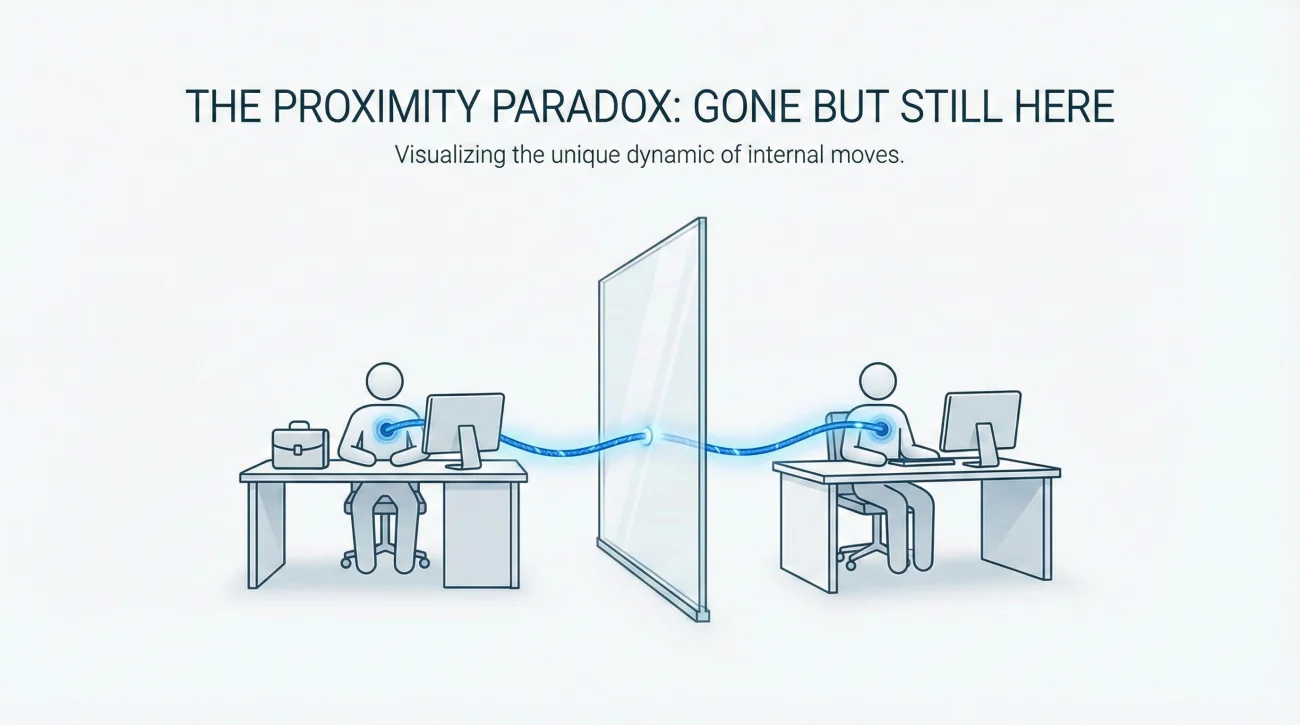
- Awkwardness Fix: The “hallway goodbye” feels weird because you are still in the building, so keep it short, specific, and timed before you disappear from daily contact.
- Tiered Protocol: Tell the right people in the right order, Manager first, then key partners, then your team, then broader channels once leadership timing is aligned.
- Tone Calibration: Stay in the Goldilocks zone, Grateful and forward-looking, without humblebrag, negativity, or “closing this chapter” theatrics.
- Zero-Burden Handoff: Leave a clear status map, owners, next steps, and the new point of contact, so your move feels seamless, not disruptive.
The “See You Around” Strategy: Mastering the Internal Transfer Farewell
I once received an internal transfer farewell email that read like a Shakespearean tragedy. The sender wrote about “closing this chapter of life” and “cherishing memories forever.” It was moving, until I remembered he was just moving to the Marketing department – literally two floors up. We saw him in the elevator the next morning. The dramatic farewell made a normal transition feel weirdly final and uncomfortable for everyone involved.
Internal transfers create a unique social dynamic. You are leaving your team, but you remain part of the tribe. This is not a goodbye; it is a “relationship pivot.” You are shifting from a daily collaborator to a cross-functional ally.
However, the casual nature of an internal move often leads people to underestimate the risks. Get this wrong, and you risk burning bridges with the very people you might need to approve your budget next quarter. This guide is your strategic playbook for crafting an internal transfer farewell message that hits the perfect note of “grateful professional” rather than “departing hero.”
The Psychology of the “Hallway Goodbye”
When you leave a company entirely, there is a clean break. When you move internally, you are navigating the “Proximity Paradox”: you are gone, but you are still here. Understanding this distinction is key to writing your moving to new department email.
Preserving Your Political Capital
In any organization, your influence is built on your network. An internal transfer is a test of that network’s durability. If you leave your current team feeling abandoned or undervalued, you are actively destroying your own political capital.
- The “Survivor Guilt” Factor: If you are moving to a “better” department (e.g., from Customer Support to Product), your former peers might feel left behind. Your email must be humble, avoiding any hint of “I made it out.”
- The “Traitor” Perception: If you are moving to a rival department (e.g., Sales to Operations), you need to frame the move as bridging a gap, not switching sides.
| Feature | Leaving Company (External) | Internal Transfer (Internal) |
|---|---|---|
| Tone | Finality & Nostalgia | Continuity & Partnership |
| Goal | Networking for the future | Reframing current relationships |
| Contact Info | Personal Email/LinkedIn | “Ping me on Slack/Teams” |
| The Risk | Burning a bridge | Creating awkwardness in the cafeteria |
The “Tiered Announcement” Protocol
Before you even draft your internal transfer farewell email, you need to manage the verbal communication. Sending an email before talking to key people is a rookie mistake.
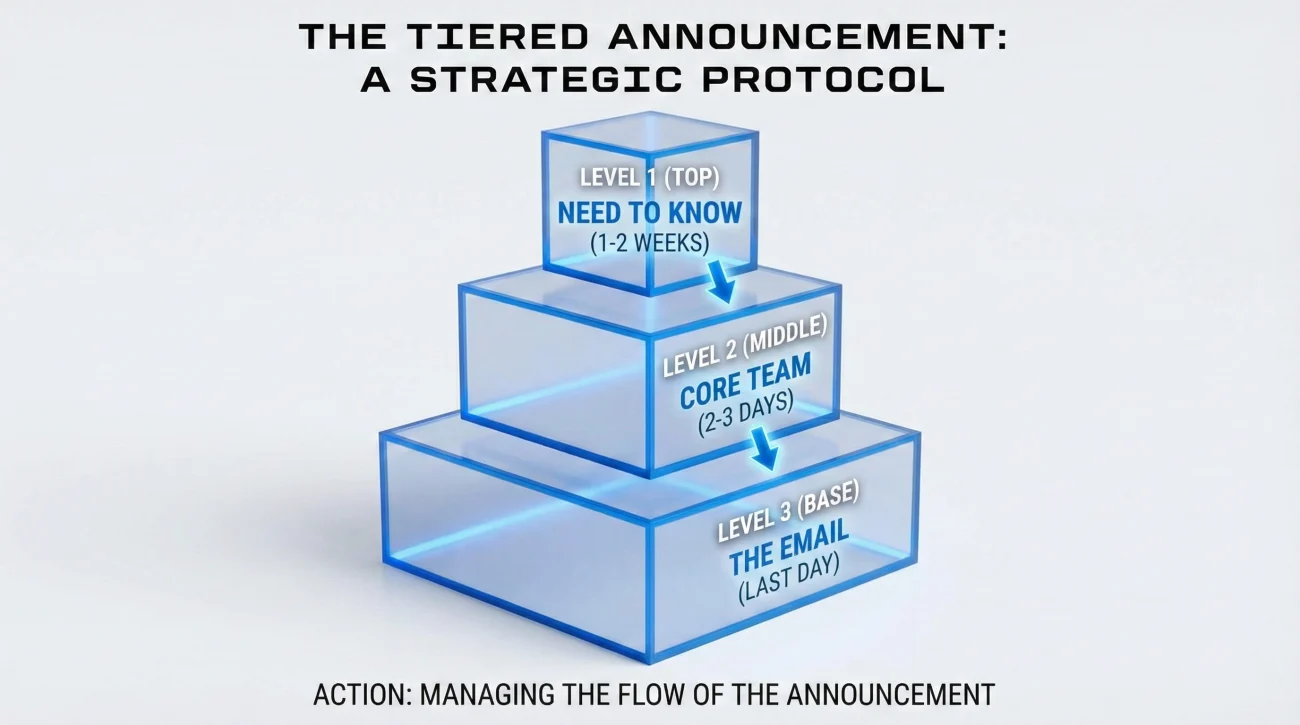
Tier 1: The “Need to Know” (1-2 Weeks Prior)
These are your direct manager and your closest work besties. They should never learn about your move from a mass email. Have a private 1:1 conversation. “I wanted you to hear it from me first…”
Tier 2: The Core Team (2-3 Days Prior)
Announce it in a team meeting or stand-up. Keep it brief. “I’m excited to share I’ll be moving to [Team], but I’m committed to a smooth handoff this week.”
Tier 3: The Email (Last Day)
This is where your written farewell comes in. It serves as the official record and a polite notification for those who missed the meeting.
Calibrating Your Tone: The “Goldilocks” Zone
Writing a leaving team for promotion email or a lateral move message requires precise calibration. You need to be warm but not sappy.
What to Avoid (The “Cringe” Factors)
- ❌ The Victory Lap: “I’m thrilled to finally move up to the Senior team where I can really shine!” (Translation: “I was too good for you people.”)
- ❌ The Ghost: Just changing your Slack status and disappearing. (This breeds resentment and confusion).
- ❌ The Over-Explanation: “I’m leaving because I need more growth than this role allows…” (Internal emails are permanent records. Keep the career counseling offline).
The Strategic “Do’s”
Focus on the “And” mindset: You are excited for the new role AND you are grateful for the current one. Use phrases like “I’m looking forward to applying what I learned here” rather than “I’m looking forward to getting out of here.”
Strategic Templates for Every Scenario
One size does not fit all. A lateral move requires a different vibe than a promotion or a relocation. Here are calibrated templates for specific situations.

Scenario 1: The Lateral Move (Same Level, New Team)
This is the most common scenario. Keep it casual and collaborative. You are signaling that you are still an equal.
Subject: Moving to [New Department] – Keep in touch!
Hi Team,
As some of you already know, I will be transitioning to the [New Department] team starting [Date].
I have genuinely enjoyed working with this group over the past [Time Period]. From [Project A] to our daily stand-ups, I’ve learned so much from you all. The collaborative spirit here is something I’ll be taking with me to my new role.
Transition Plan:
I am working closely with [Manager/Colleague] to hand off my current projects. If you need anything regarding [Specific Project] after Friday, [Colleague Name] will be the best point of contact.
Since I’m only moving to [Floor Number/Building], I’m sure I’ll see you around the coffee machine. Don’t be strangers – I’m still just a Slack message away.
Best,
[Your Name]
Scenario 2: The Promotion (Moving Up)
When writing a leaving team for promotion email, humility is your best friend. Acknowledge that your success was a team effort. Do not mention your new “authority” unless necessary.
Subject: Transition to [New Role Title]
Hi Everyone,
I wanted to share the news that I will be stepping into a new role as [New Title] in [New Department], effective [Date].
This opportunity wouldn’t have been possible without the support and growth I experienced right here with this team. I want to thank you for [Specific Support/Collaboration]. The standard of excellence we set on [Project Name] is something I plan to carry forward.
I am excited to see this team continue to thrive. While my title is changing, I’m still very much part of the [Company Name] family, and I look forward to collaborating with you all from a new perspective.
Please reach out if you ever need anything. Let’s grab lunch before I head over!
Cheers,
[Your Name]
Scenario 3: The Branch Transfer (Relocation)
If you are sending a goodbye email transfer to new branch, the “see you around” becomes digital. Focus on maintaining the virtual connection.
Subject: Off to [City Name]! / Transition Update
Hi Team,
Bittersweet news: I will be transferring to our [City Name] branch starting next month.
While I am excited about the new adventure in [City], I am going to miss the energy of this office. Thank you for making my time in [Current Location] so memorable. Special shout-out to the [Project Team] for our wins last quarter.
Even though I’ll be in a different time zone, I’m still on the company directory! I hope our paths cross on future cross-functional projects.
If you are ever in [City Name], please let me know – dinner is on me.
Warmly,
[Your Name]
Scenario 4: The “Escape” (Leaving a Difficult Team)
Sometimes you transfer just to get away. In this case, less is more. Be professional, neutral, and brief. Do not fake warmth.
Subject: Role Update – [Your Name]
Hi Team,
I am writing to let you know that I will be moving to the [New Department] team effective [Date].
Thank you for the opportunity to work together on [Project]. I wish the team all the best in the upcoming quarter.
Best regards,
[Your Name]
Scenario 5: The “Secondment” or Temporary Move
If you are only leaving for a 6-month project or a temporary rotation, you need to remind them that you are coming back.
Subject: Temporary Secondment to [Project Team]
Hi Team,
As discussed in our meeting, I will be joining the [Project Name] team for a 6-month rotation starting Monday.
While I won’t be involved in the day-to-day operations of [Current Team], I’ll still be checking email periodically. I’m excited to bring back new insights from this project when I return in [Month].
See you all soon!
[Your Name]
The Logistics of the Handoff: Don’t Be a Burden
Your emotional farewell matters, but your logistical farewell matters more for your legacy. The last thing you want is for your former team to curse your name a week later because they can’t find a file or access a dashboard.
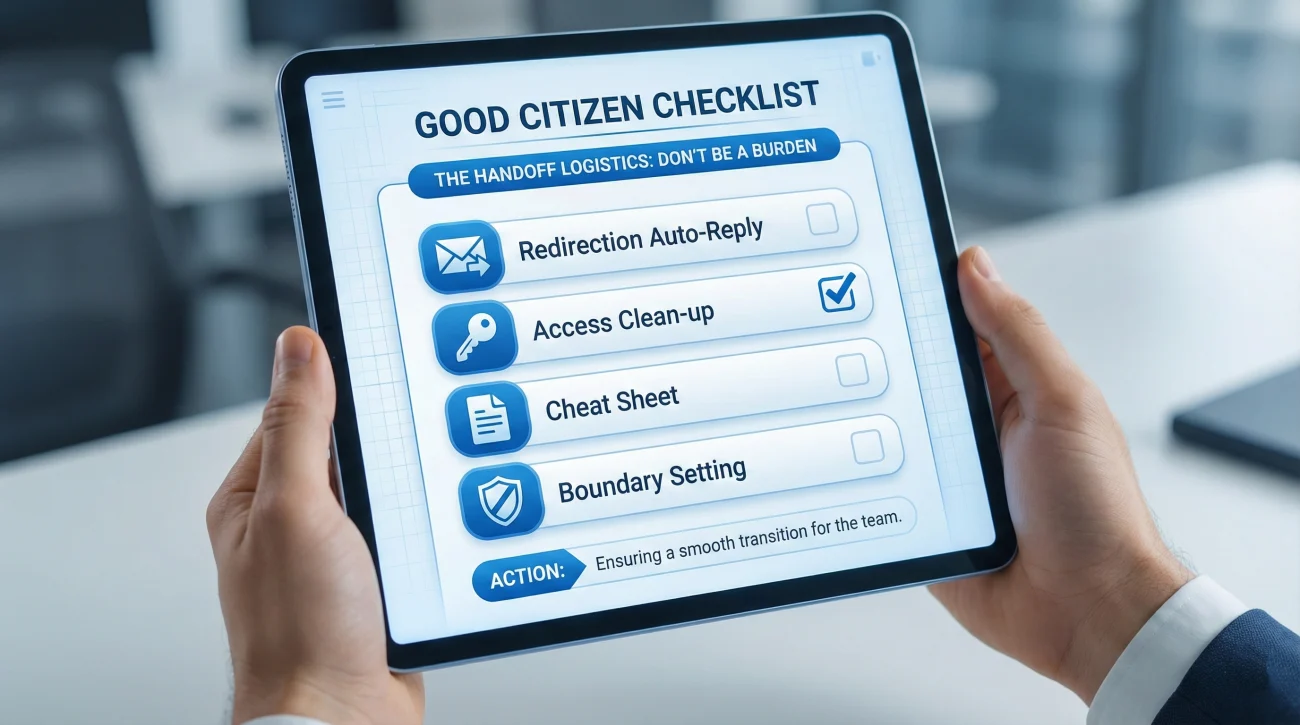
The “Good Citizen” Handoff Checklist
- The “Redirection” Auto-Reply: Set an internal out-of-office message for the first week: “I have moved to [Team]. For [Old Project], please contact [Colleague].” Do not just leave people guessing.
- The Access Clean-up: Proactively transfer ownership of Google Docs, Trello boards, or recurring calendar invites. Don’t make IT chase you.
- The “Cheat Sheet”: Leave a simple document for your successor covering the unwritten rules of your old role (e.g., “Bob in Accounting prefers emails over Slack”).
- The “Double Duty” Trap: Be very clear about when you stop doing your old work. If you don’t set a hard boundary, you will end up doing two jobs for months.
The Digital Etiquette: To Post or Not to Post?
For an internal transfer, updating LinkedIn requires nuance. You are not leaving the company, so a “I’m happy to announce…” post can sometimes feel self-congratulatory if the move is minor.
Guideline:
- Minor Move (Lateral): Just update your profile quietly. Turn off “notify network” if you don’t want a splash.
- Major Move (Promotion/Relocation): A post is appropriate. Focus on gratitude for the old team and excitement for the new one. Tag your old manager to show respect.
❓ Frequently Asked Questions
📧 Who sends the email first? Me or my manager?
Protocol dictates the manager speaks first. Usually, your manager should announce your move in a team meeting or via email first. This controls the narrative and prevents rumors. Once the official news is out, you follow up with your personal internal transfer farewell email to add your own sentiment and gratitude.
🤐 What if I am leaving because of a bad manager?
Silence is a strategy. Do not air dirty laundry in your farewell email. Stick to the “Scenario 4” template above. Keep it factual and brief. The company likely knows the dynamics; you don’t need to document them in a goodbye note. Save your feedback for the exit interview (if there is one) or keep it to yourself to protect your future growth.
🤝 Should I offer to help after I leave?
Be careful here. It is polite to say “Reach out if you have questions,” but set boundaries. You have a new job to do. A better phrase is: “I will be available for questions regarding the handoff for the next two weeks.” This puts a time limit on your availability so you don’t end up doing two jobs at once.
🎉 Do I send the email to the whole company?
Rarely. Unless you are a C-level executive, a company-wide blast is seen as ego-centric. Send your moving to new department email only to your direct team and close cross-functional partners. If you have friends in other departments, send them personal DMs or texts.
🔄 How do I handle the “awkward interim” period?
The 1-2 weeks where you are technically on the old team but mentally on the new one are tricky. Be present. Don’t check out early. Use this time to clean up files and document processes. Your team will remember how you finished, not just how you started.
Final Thoughts: The Long Game
Internal transfers are not just about changing desks; they are about expanding your influence within the organization. A well-crafted farewell message cements your reputation as a collaborative, grateful, and professional colleague.
Remember: You aren’t saying “goodbye” to the people; you are saying “thank you” to the shared experience. Keep it classy, keep it brief, and I’ll see you in the cafeteria.
If you are looking for more templates on handling complex exits, check out our guide on goodbye and handover emails. For those taking the leap to a new company entirely, our ultimate goodbye email guide has you covered.
⚠️ Legal Disclaimer: ResignSmartly provides general informational guidance about resignation, workplace communication, notice periods, handovers, and career transitions. Content does not constitute individualized legal advice. Employment laws, contracts, workplace policies, and individual circumstances vary, so review the requirements that apply to your situation and consult an appropriate qualified professional when needed.