- Core difference: A retirement farewell is not a standard resignation, it is a legacy message with heavier emotional weight.
- Why it feels hard: Retirement triggers an identity shift, so the email becomes your first step in reframing “end” as “graduation.”
- Best structure: Balance Past gratitude, Present transition, and Future confidence so you sound warm without sounding stuck or sad.
- Drafting method: Brain dump, Choose one theme, Draft around it, Then ego-check by shifting some “I” into “We.”
- Execution pieces: Pick the right template, reassure clients with a clear successor handoff, plan a LinkedIn post and short speech, and time messages close to the final days to avoid “lame duck” months.
The Art of the Final Bow: Writing a Retirement Farewell
I once attended a retirement party for a Director of Operations who had served the company for 35 years. Everyone expected a long, winding speech about the “good old days” of fax machines and three-martini lunches. Instead, he stood up, put on his reading glasses, and read a printed copy of his retirement farewell email. It was brief, but it wasn’t simple. He didn’t just say goodbye; he honored the shared history of the room. He acknowledged the interns who were now VPs and the technological shifts that made his first job description obsolete. That letter was framed and still hangs in the lobby today.
Retirement is not just another resignation. It is a fundamental life transition. When you write a standard resignation email, you are essentially saying, “I’m moving to a new location.” When you write a retiring from work email, you are saying, “I’m moving to a new state of being.”
The emotional weight is heavier. The institutional memory you carry is denser. Consequently, the pressure to get the words right can feel overwhelming. You aren’t just closing a laptop; you are closing a chapter of your identity. How do you summarize decades of work, relationships, triumphs, and failures into a few paragraphs? This guide digs deep into the strategy of closing your career with the dignity and grace it deserves.
The Psychology of the Exit: Why This Letter Is Hard to Write
In my years coaching executives through transitions, retirement is consistently the hardest message to draft. Why? Because it triggers a “Crisis of Relevance.” For decades, your value has been tied to your output, your title, and your team. Writing a retirement email message forces you to confront the question: “Who am I without this job?”
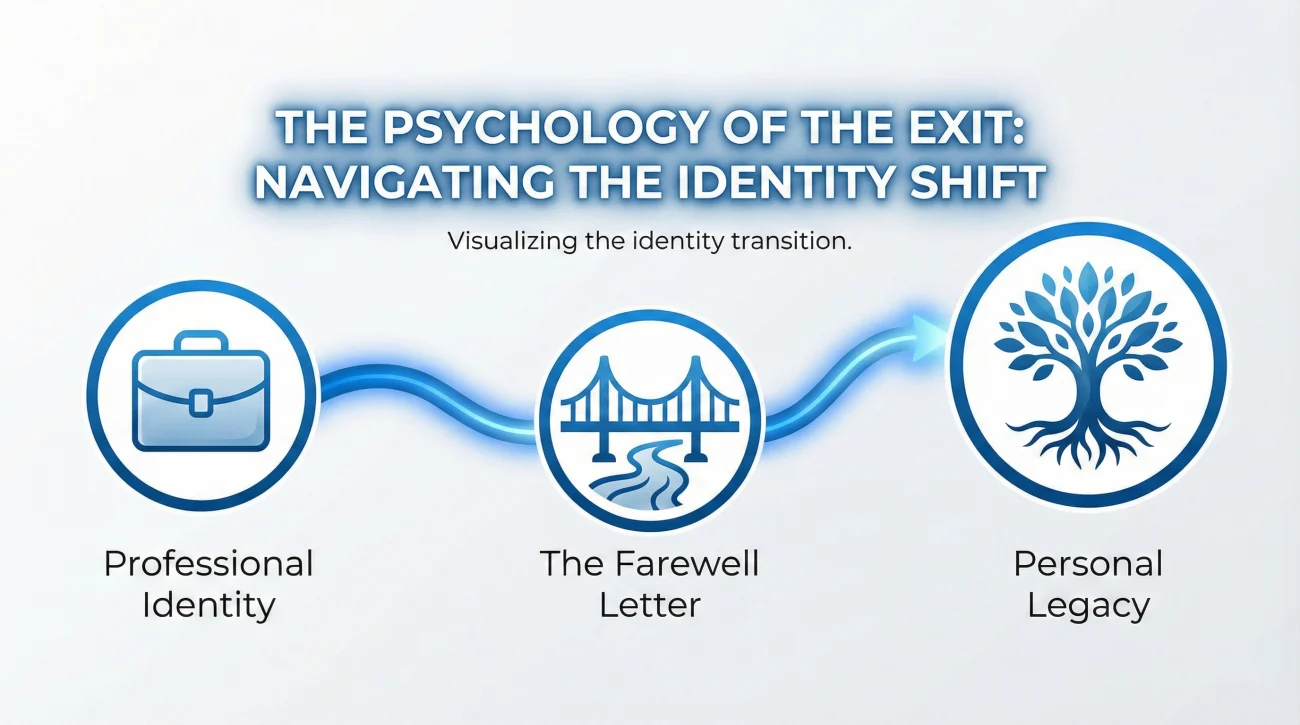
Navigating the Identity Shift
Your farewell letter is your first step in redefining that identity. It allows you to frame your departure not as an “end,” but as a “graduation.”
- Validation: You need to know your work mattered. Writing it down solidifies your legacy.
- Closure: It creates a psychological boundary. Once you hit “send,” you are mentally releasing your responsibilities.
- Permission: You are giving your team permission to move on without you, which alleviates the guilt of leaving them behind.
Why Retirement Farewells Are a Different Genre
If you try to use a standard “two-weeks notice” template for your retirement, it will feel hollow. The context has shifted entirely. You aren’t burning a bridge or crossing one; you are dismantling the bridge behind you so others can build new ones.
The Burden of Institutional Memory
After 20 or 30 years, you aren’t just an employee; you are a living archive. You remember why the policy manual is written that way. You remember the three mergers that failed and the one that succeeded. Your retirement goodbye letter to colleagues is an opportunity to pass the torch of that legacy without sounding like you are stuck in the past.
| Feature | Standard Resignation | Retirement Farewell |
|---|---|---|
| Primary Focus | Logistics & Handover | Legacy & Gratitude |
| Emotional Tone | Professional, Detached | Nostalgic, Warm, Personal |
| Future Outlook | “Excited for my new role” | “Excited for life’s next chapter” |
| Relationship Depth | Transactional connections | Generational relationships |
Structuring Your Retirement Goodbye Letter to Colleagues
A great retirement letter balances three distinct timelines: the Past (gratitude), the Present (transition), and the Future (confidence in the team). Striking this balance ensures you sound nostalgic but not melancholy.
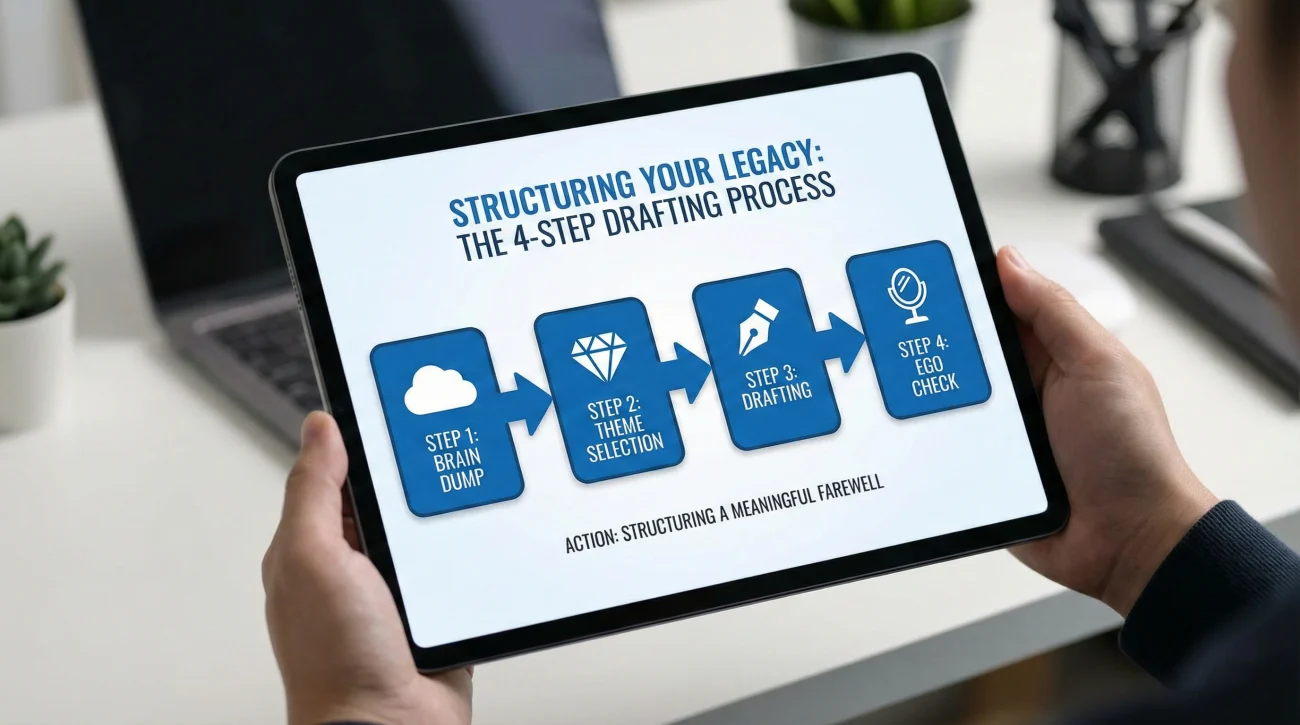
The 4-Step Drafting Process
Don’t try to write the final version immediately. Use this process:
- The Brain Dump: List everyone you want to thank and every major milestone you remember. Don’t edit; just list.
- The Theme Selection: Pick one core theme. Is it “Growth”? “Resilience”? “Community”? A letter with one strong theme is memorable; a letter with ten themes is a mess.
- The Drafting: Write the letter focusing on that theme. Connect your “brain dump” items to it.
- The “Ego Check”: Read it back. How many times did you say “I”? Change some of them to “We.”
The “Back in My Day” Trap
It is tempting to list every change you’ve seen (“I remember when we used typewriters!”). While a little contrast is charming, too much can make you sound disconnected from the current reality. Focus on growth rather than just change.
Calibration: Proud vs. Boastful
You have earned the right to be proud. However, frame your achievements as collective wins. Instead of “I built this department,” try “I am incredibly proud of how this department has grown.” This subtle shift makes your retirement farewell letter inclusive rather than ego-centric.
Templates for Internal Colleagues
These templates range from the deeply personal to the professionally concise. Choose the one that matches your tenure and company culture.
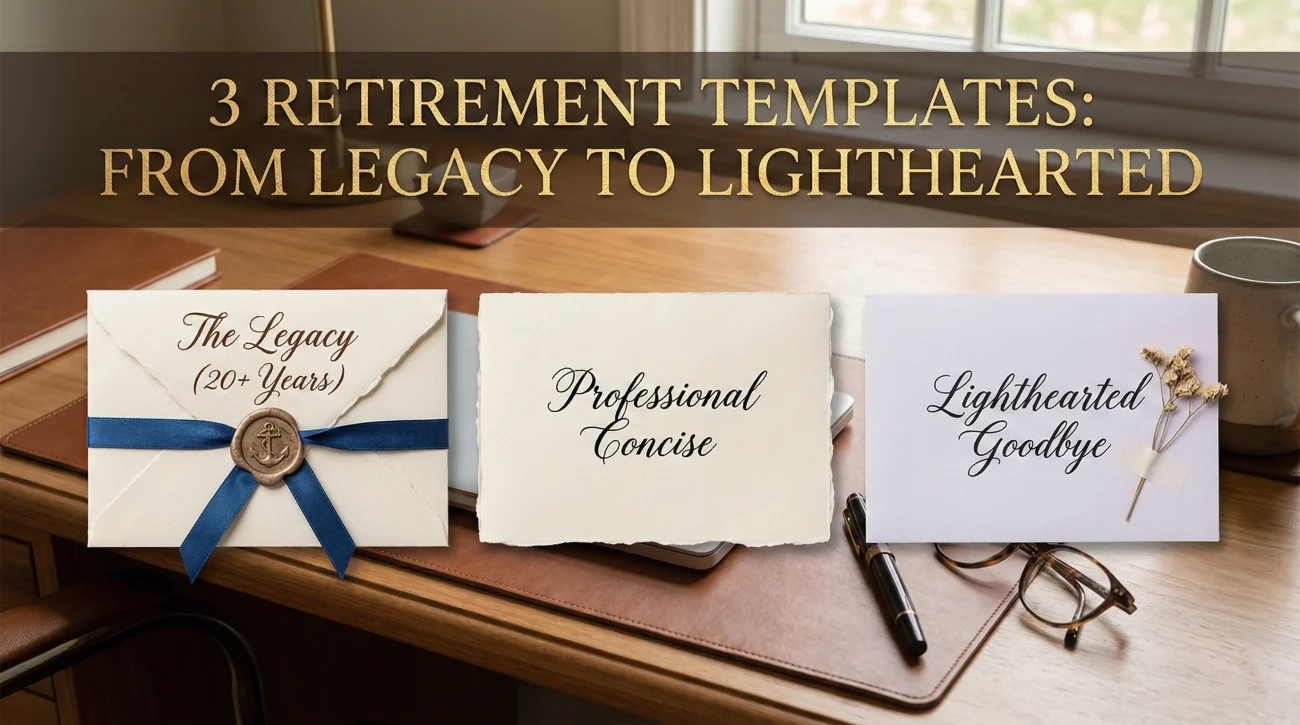
The “Legacy” Email (20+ Years)
Use this when you are a fixture of the organization and want to leave a heartfelt message. This is for the person who is leaving a piece of their heart in the building.
Subject: Signing off after [Number] incredible years
Dear Friends and Colleagues,
It feels surreal to be writing this, but the time has finally come. After [Number] years with [Company Name], I will be retiring on [Date].
When I first walked through these doors in [Start Year], [mention a brief, specific detail about the past, e.g., we were a team of 10 in a basement office]. Watching this organization transform into the industry leader it is today has been the privilege of my professional life.
I have had the honor of working alongside some of the sharpest minds and kindest hearts in the business. To those I’ve mentored: thank you for keeping me on my toes and teaching me more than I ever taught you. To those who mentored me: thank you for your patience and for setting the standard I tried to uphold.
I am leaving with a heart full of memories and a calendar full of plans to [mention 1-2 hobbies, e.g., travel to Italy/work on my garden]. I know the team is in excellent hands with [Successor Name], and I look forward to reading about your future successes from the comfort of my patio.
Let’s stay in touch. You can reach me at [Personal Email] or on LinkedIn.
With deepest gratitude,
[Your Name]
The Professional & Concise Note
If you prefer a lower profile or have a shorter tenure (5-10 years), this retiring from work email hits the right notes without overdoing the sentiment. It respects your colleagues’ time while still being polite.
Subject: Retirement Announcement – [Your Name]
Hi Team,
I am writing to share that I will be retiring effective [Date].
The past [Number] years at [Company] have been rewarding. I am proud of the work we accomplished on [Project A] and [Project B], and I’ve truly enjoyed being part of this group. Thank you for your collaboration and support.
[Colleague Name] will be taking over my responsibilities starting next week to ensure a smooth transition.
I am looking forward to my next chapter of slowing down and spending time with family. I wish you all the very best.
Sincerely,
[Your Name]
The “Lighthearted” Goodbye
If you are known for your humor, don’t get serious at the very end. Stay on brand.
Subject: Moving on to my new job (Professional Napper)
Hi everyone,
Rumors are true. I am trading in my spreadsheets for sunscreen. I will be retiring on [Date].
It has been a wild ride over the last [Number] years. We’ve survived [Mention a funny shared struggle, e.g., the great server crash of 2015] and celebrated [Mention a big win]. I will miss the people here (yes, even the Monday morning meetings).
Keep up the great work, and try not to break anything while I’m gone.
Cheers,
[Your Name]
Advanced Scenarios: When It’s Not a Standard Retirement
Life is complicated. Sometimes you retire early, sometimes for health reasons, or sometimes due to restructuring. Here is how to handle the edge cases.
Retiring for Health/Personal Reasons
You don’t need to disclose medical details. Focus on the “need to prioritize personal wellbeing.”
After [Number] years, I have decided to retire early to focus on my health and spend more time with family. While this decision came sooner than expected, I am grateful for the support this team has shown me…
The “Early Retirement” (FIRE)
If you are retiring at 45, be humble. Don’t brag about your financial freedom.
I have decided to step away from the corporate world to pursue personal passion projects. I’ve loved my time here, but I’m excited to explore this new phase of life…
Announcing Retirement to External Partners
Clients can panic when their trusted contact retires. Your retirement announcement to clients must prioritize continuity over celebration. Reassure them that they are not being abandoned.
Subject: Important update regarding your account / My retirement
Dear [Client Name],
I am writing to let you know that after [Number] years in the industry, I will be retiring on [Date].
Serving as your account manager has been a highlight of my time here. I have truly valued our partnership and the trust you placed in us to handle [Specific Service].
What comes next for you:
I am pleased to introduce you to [Successor Name], who will be taking over your account. [Successor Name] has been with us for [Number] years and is fully briefed on your current projects. I will be working closely with them over the next two weeks to ensure a seamless handoff.
Thank you for your business and friendship over the years.
Best regards,
[Your Name]
The Digital Farewell: Your LinkedIn Strategy
Your email goes to 50 people. Your LinkedIn post goes to 500 (or 5,000). This is your public legacy statement. It informs your wider network that you are “out of the game” but still available for coffee or mentorship.
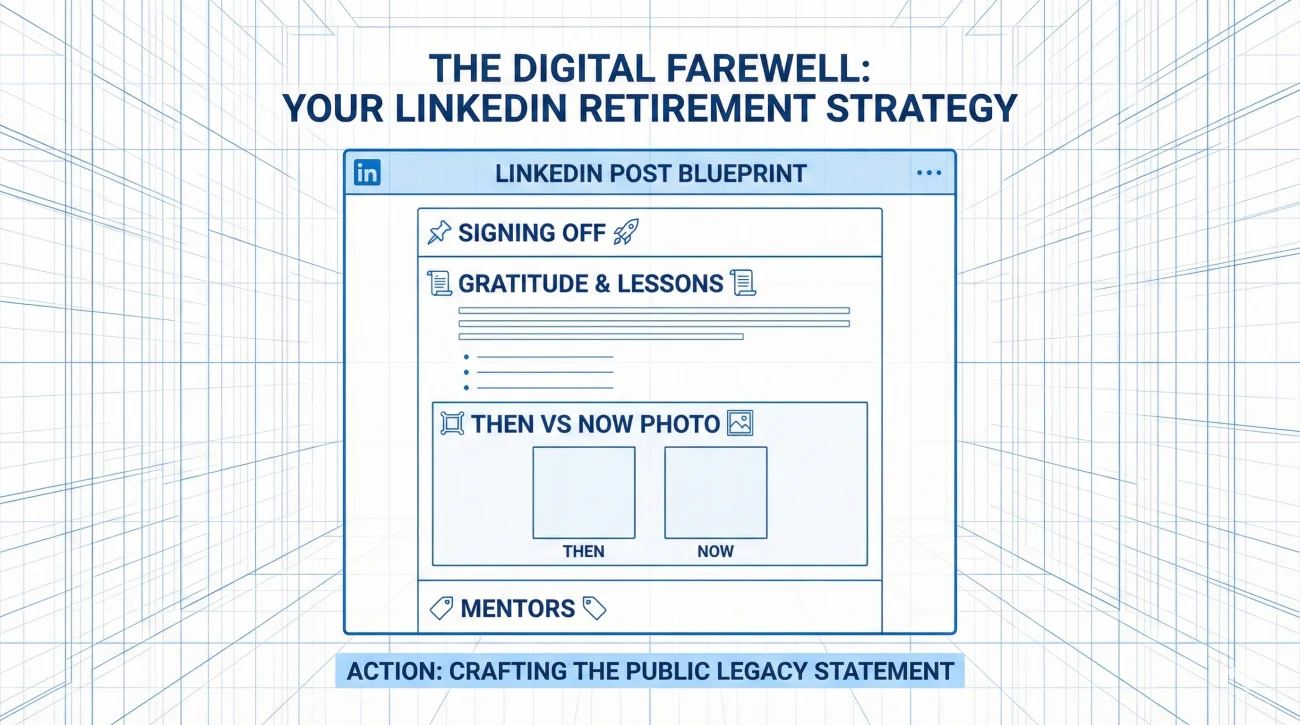
The Perfect LinkedIn Retirement Post
Headline: Signing off! 🚀
Body:
Today marks my final day at [Company] and the official start of my retirement.
Looking back at the last [Number] years, I am overwhelmed with gratitude. From my first day as a [First Job Title] to leading the [Current Department], it has been an incredible journey.
Three things I’ve learned along the way:
1. [Lesson 1]
2. [Lesson 2]
3. [Lesson 3]
A huge thank you to [Tag Key Mentors/Colleagues] for being part of my story.
Now, I’m trading Zoom calls for [Hobby]. I’ll still be active here to cheer you all on!
#Retirement #NewChapter #Gratitude #[CompanyName]
Pro Tip: Include a photo. A picture of your first day vs. your last day, or a photo of your team, performs exceptionally well.
The Retirement Speech: A Moment of Grace
You will likely be asked to say a few words at a happy hour or luncheon. The public speaking rule applies here: “Be brief, be brilliant, be gone.” A retirement speech should not be a résumé recital. It should be a toast to the people remaining.
Speech Outline (2-3 Minutes):
The Hook: “People keep asking me what I’m going to do with all my free time. Honestly, my first plan is to turn off my alarm clock.” (Humor breaks the tension).
The Reflection: “Looking around this room, I see people I’ve worked with for 20 years and people I’ve worked with for 20 days. The technology changes, the office layout changes, but the quality of people here hasn’t.”
The Gratitude: “Thank you for being my second family. You made the hard days bearable and the good days unforgettable.”
The Closing: “I’m not disappearing, but I am stepping aside to let you all shine. Cheers to the future!”
Practical Logistics: Timing & Transition
Emotion is important, but logistics prevent chaos. Here is the standard timeline for sending your communications:
- 📅 3 Months Out: Inform direct management and HR confidentially.
- 📅 1 Month Out: Inform your direct team/department.
- 📅 2-3 Weeks Out: Send the retirement announcement to clients.
- 📅 2-3 Days Out: Send the broad retirement farewell letter to the company.
Sending your email too early (months in advance) can make you a “lame duck,” where people stop including you in decisions. Sending it too late (last day) feels abrupt for such a major lifecycle event.
❓ Frequently Asked Questions
📨 Should I include my personal phone number?
It depends on your boundaries. Including a personal email and LinkedIn profile is standard and safe. Including a cell phone number in a company-wide email invites unwanted calls. Save the phone number for a select group of close colleagues in a separate, private note.
🤧 Is it okay to get emotional in the email?
Yes, but control the narrative. Phrases like “bittersweet” or “heavy heart” are appropriate. Avoid sounding distraught or overly dependent on the workplace. You want to project that you are moving toward something positive, not just away from something you love.
🏝️ Do I have to say what I am doing next?
No, but vague plans are better than no plans. If you don’t have a grand travel itinerary, just say you are looking forward to “spending time with family” or “pursuing personal interests.” This reassures colleagues that you are going to be okay, which relieves their anxiety about your departure.
👥 How do I handle “frenemies” or difficult colleagues?
Take the high road. Your retirement email message is your victory lap. Don’t spoil it with subtle digs. A blanket “Thank you to everyone who challenged me to grow” covers difficult relationships without being specific or petty.
🛑 What are the common mistakes to avoid?
Don’t burn bridges on the way out, even if you are never coming back. Avoid giving unsolicited advice (“Here is how you should run things after I’m gone”). Don’t promise to visit constantly – it makes it harder for the new team to establish authority. And finally, don’t forget to clean your physical and digital desk; don’t leave a mess for your successor.
Final Thoughts: Your Closing Argument
Your career is a story, and this email is the epilogue. A well-crafted retirement farewell email cements your reputation as a class act. It is the final professional artifact you leave behind, so make it count. Focus on gratitude, be gracious about the future of the company, and step into your new life with confidence.
For more details on the logistics of leaving, you can explore our guide on goodbye and handover emails. If you are still in the early stages of planning your exit, our comprehensive resignation resources can help you map out the process. And of course, for every other type of departure, check out the ultimate goodbye email guide.
⚠️ Legal Disclaimer: ResignSmartly provides general informational guidance about resignation, workplace communication, notice periods, handovers, and career transitions. Content does not constitute individualized legal advice. Employment laws, contracts, workplace policies, and individual circumstances vary, so review the requirements that apply to your situation and consult an appropriate qualified professional when needed.