- Career Insurance: A goodbye email to your manager protects your future reputation because managers influence references, back-channel checks, and boomerang returns.
- Psychology Lever: The Peak-End Rule means your exit can outweigh years of good work, so the final message must control the narrative.
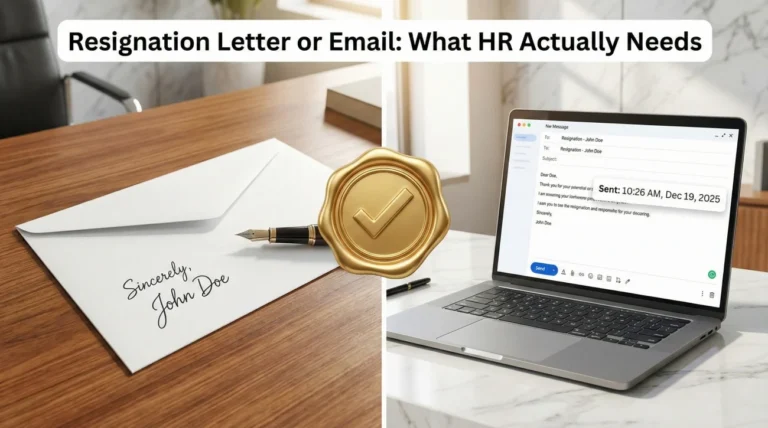
- Know The Difference: Resignation email is formal and logistic during notice, goodbye email is personal and sent on the final day to cement the relationship.
- High Value Structure: Use Specific gratitude, Growth acknowledgment, Open-door pivot, Zero-friction contact info so it feels real and easy to act on.
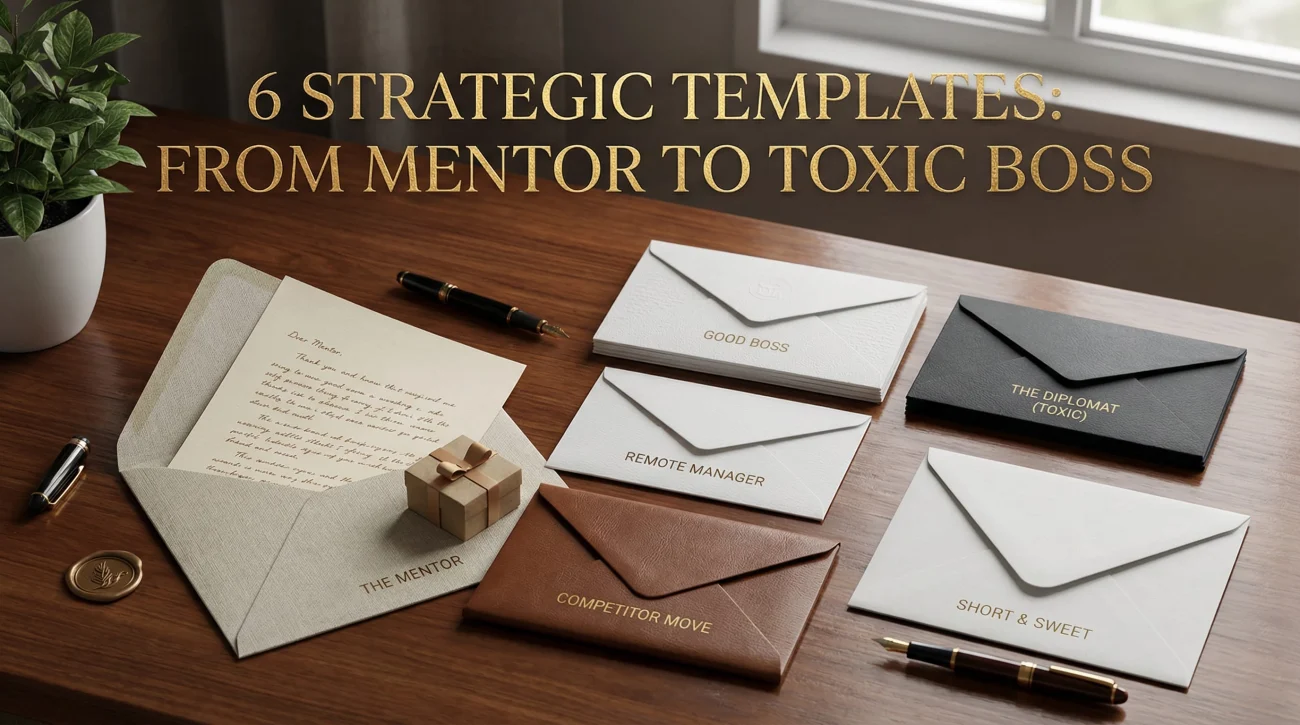
- Templates And Guardrails: Match the template to boss type, Avoid bridge-burners like feedback or comparisons, Then follow simple after-care like connecting on LinkedIn and a no-ask update.
The Strategic Art of the Manager Goodbye: Your Ultimate Career Insurance Policy
I once watched a Senior Analyst, let’s call him James, leave a major financial firm. He was burned out and frustrated with management. On his last day, he sent a generic, two-line email to his manager and walked out. Fast forward four years: James was a finalist for a Director role at a dream company. The hiring manager knew James’s old boss and made a casual reference call. The feedback was lukewarm: “Technically competent, but lacked professional maturity.” James lost the job.
Contrast that with Sarah. She left the same team under similar stress but crafted a thoughtful goodbye email to manager that highlighted specific lessons learned and expressed gratitude for the opportunity. Five years later, that same manager recruited her for a VP role at a new startup with a 40% pay raise.
Here is the brutal truth about the corporate world: **Your boss holds the keys to your future reputation.** They are the ones who give references, answer back-channel background checks, and influence whether you can ever return (the “Boomerang” employee). A strategic farewell email to boss isn’t just about politeness; it is a calculated move to cement your legacy and keep doors open. This guide will teach you how to master the delicate art of the “Manager Goodbye,” ensuring your exit serves your career long after you’ve handed in your badge.
The Psychology of the Exit: The “Peak-End Rule”
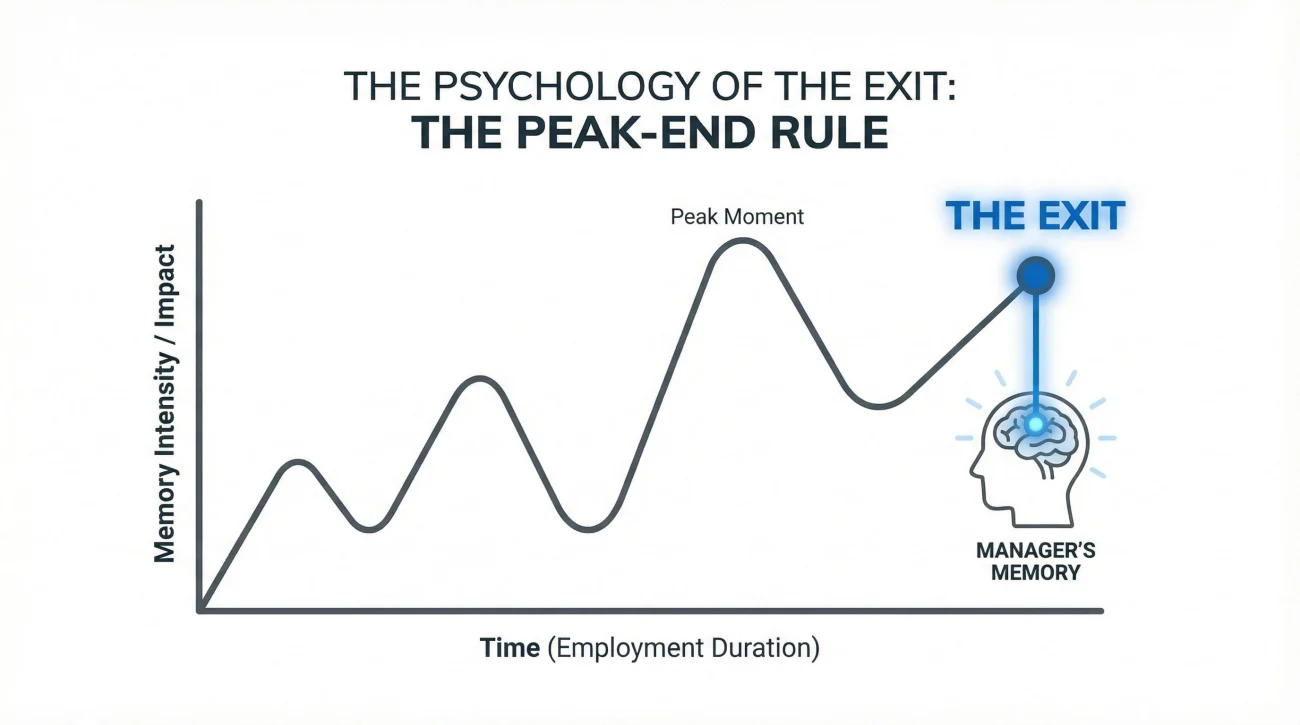
Why does this one email matter so much after years of work? Nobel Prize-winning psychologist Daniel Kahneman coined the term “Peak-End Rule.” It states that people judge an experience largely based on how they felt at its peak (the most intense point) and at its end.
You could have been a stellar employee for three years (the duration), but if your exit (the end) is sloppy, cold, or bitter, that is what your manager will remember. Your message to boss when leaving is your final opportunity to control the narrative. It allows you to frame your tenure as a success, regardless of the ups and downs that occurred in the middle.
Resignation vs. Goodbye: Knowing the Difference
A common mistake is conflating the resignation letter with the goodbye email. They serve two completely different functions in the departure timeline.
| Feature | Resignation Email | Goodbye Email to Manager |
|---|---|---|
| Timing | 2-4 weeks before leaving (The notice). | The afternoon of your final day. |
| Audience | Manager + HR (Formal record). | Manager only (Personal connection). |
| Tone | Formal, logistic, factual. | Warm, reflective, forward-looking. |
| Goal | To initiate the legal separation. | To cement the professional relationship. |
The Anatomy of a High-Value Manager Farewell
A goodbye letter to manager should not be a rambling manifesto. It requires a specific structure to be effective. Through analyzing thousands of exits, I have identified the four non-negotiable elements of a perfect farewell.
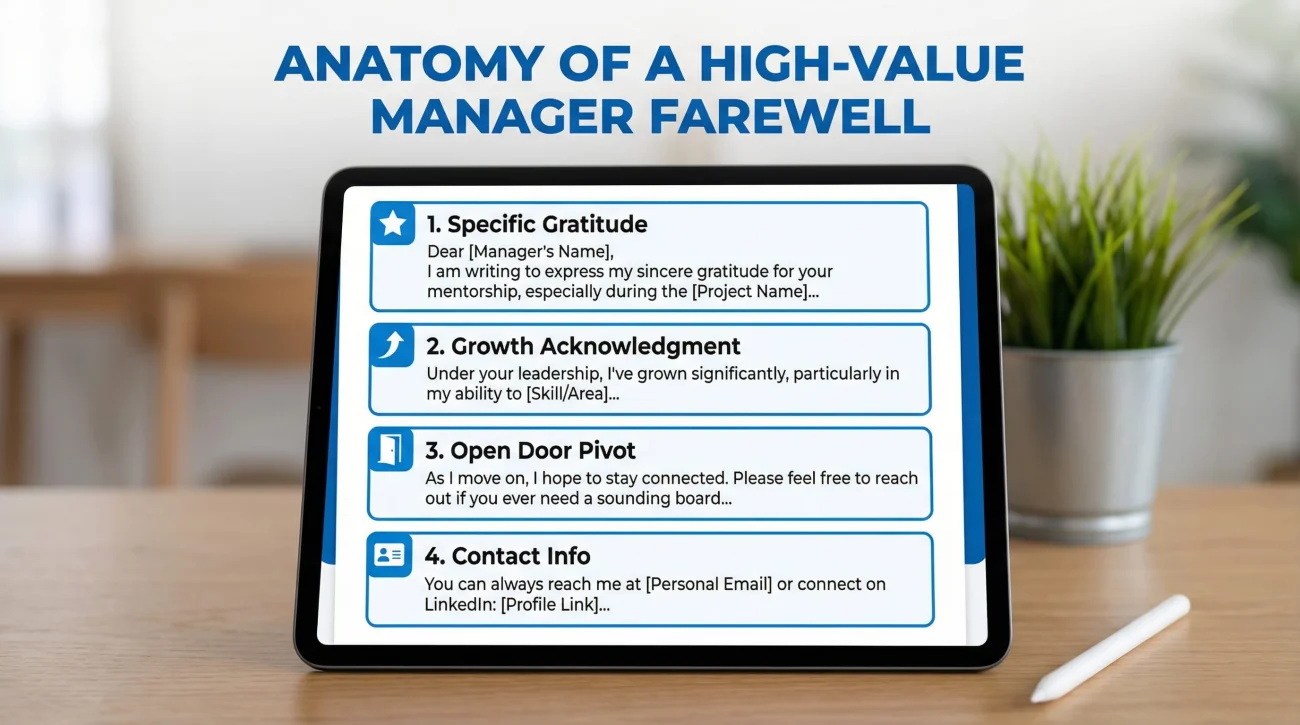
1. The “Specific Gratitude” Hook
Generic thanks (“Thanks for everything”) are forgettable. To make an impact, you must be specific. This proves you were paying attention. Mention a specific project where they backed you up, a specific skill they taught you, or a specific crisis they helped you navigate.
2. The “Growth Acknowledgment”
Every manager wants to believe they are a good mentor. Validate this self-image. Explicitly state how you are better today than when you started because of their leadership. Even if they were a mediocre boss, find one thing they taught you (even if it was just resilience).
3. The “Open Door” Pivot
Make it clear that this is a change in the relationship status, not an end to it. Pivot from “subordinate” to “peer in the industry.”
4. The “Zero-Friction” Contact Info
Do not make them hunt for your details. Provide your personal email and LinkedIn URL directly in the body of the email.
6 Strategic Goodbye Templates for Every Boss Type
No two managers are the same. A template that works for a mentor will sound sarcastic to a toxic boss. Choose the goodbye email to supervisor that matches your actual reality.
1. The “Mentor” (Deep Gratitude)
Best for: A boss who truly invested in your career and whom you admire.
Subject: Thank you for your mentorship – [Your Name]
Hi [Manager Name],
Before I log off for the final time, I wanted to send a personal note to express my genuine gratitude for your leadership over the past [Time Period].
Working on this team has been a highlight of my career, largely because of your mentorship. Specifically, I will never forget [mention specific moment, e.g., how you supported me during the Q3 launch]. You taught me that [mention a lesson, e.g., leadership is about empathy, not just metrics].
I am leaving with more confidence and skill than I arrived with, and that is a testament to your coaching. I hope to apply the standards you set as I move into my next chapter.
I would love to stay in touch and update you on my progress. I hope our paths cross again soon.
My personal contact info:
- Email: [Email]
- LinkedIn: [Link]
With deep appreciation,
[Your Name]
Why it works: It validates their impact as a leader, which is the highest compliment a manager can receive.
2. The “Good Boss” (Warm & Professional)
Best for: A solid, supportive manager with whom you had a good, standard relationship.
Subject: Thank you / Keeping in touch
Hi [Manager Name],
As today is my last day, I wanted to thank you for the opportunity to work with the [Team Name] team. I have truly enjoyed my time here.
Thank you for your guidance during [Project X] and for creating a supportive environment for the team. I have learned a great deal about [Industry/Skill] under your direction, and I am grateful for the trust you placed in me.
I am confident the team will continue to thrive under your leadership.
Please let’s stay connected on LinkedIn. I would love to see what the team accomplishes next.
Best regards,
[Your Name]
[LinkedIn Link]
3. The “Diplomat” (For a Difficult/Toxic Boss)
Best for: A boss you disliked or who was incompetent. Goal: Leave without burning the bridge.
Subject: Farewell and thank you – [Your Name]
Hi [Manager Name],
As I move on to my next chapter, I wanted to thank you for the opportunity to work at [Company Name].
I have gained valuable experience during my time on your team, particularly regarding [mention a neutral hard skill, e.g., managing complex timelines]. I appreciate the opportunities I had to contribute to [Project Name].
I wish you and the team the very best in the upcoming quarter.
Regards,
[Your Name]
[LinkedIn Link]
Why it works: It is polite but distant. It focuses on the “opportunity” and “experience” rather than the leadership itself. It satisfies professional etiquette without requiring you to lie about your feelings.
4. The “Remote Manager” (Distance Focused)
Best for: Managers you rarely saw in person.
Subject: Signing off from [Your Location]
Hi [Manager Name],
Since I can’t shake your hand in person on my last day, this email will have to do.
I wanted to thank you for your leadership. Managing a distributed team is not easy, but you always made me feel connected and supported, even from [Distance]. I particularly appreciated how you [mention remote-specific trait, e.g., respected work-life boundaries / kept our 1:1s focused].
I hope we can meet in person one day. Until then, see you on LinkedIn.
Best,
[Your Name]
5. The “Competitor Move” (Sensitive Departure)
Best for: When you are leaving for a direct rival. This requires extra tact.
Subject: Thank you for the opportunities
Hi [Manager Name],
I know my departure comes at a busy time, and I want to thank you for your professionalism during this transition.
I have incredible respect for you and this company. The decision to move was purely about exploring a new specific direction in my career, but it does not diminish my gratitude for the time I spent here. I learned the fundamentals of [Industry] from you, and I will carry those lessons with me.
I hope we can maintain a professional relationship across the industry.
Sincerely,
[Your Name]
6. The “Short & Sweet” (Busy Manager)
Best for: Senior executives who are extremely busy and value brevity.
Subject: Thank you and farewell
[Manager Name],
Today is my last day. I just wanted to send a quick note of thanks for your leadership over the last [Time Period].
I learned a lot working on your team and am grateful for the opportunity. I wish you continued success with the [Project Name].
Keep in touch:
[LinkedIn Link]
Best,
[Your Name]
The “Bridge Burners”: What to Exclude
Even if you are leaving on a high note, one wrong sentence can sour the relationship. When drafting your thank you goodbye to boss, ensure you avoid these common traps.
| What to Exclude | Why? | Better Alternative |
|---|---|---|
| ❌ Unsolicited Feedback “I think you should micromanage less.” | The time for feedback was the exit interview (or never). In a goodbye email, it reads as bitter. | Focus only on the positives. Silence speaks louder than criticism here. |
| ❌ Comparisons “My new job pays 20% more.” | This is bragging and makes you look graciousless. It alienates your former boss. | “I am moving to a new opportunity for professional growth.” |
| ❌ Apologies “Sorry for leaving you short-staffed.” | You are a professional making a career move, not a criminal. Do not apologize for growing. | “I have done my best to ensure a smooth handover.” |
The “After-Care”: Post-Departure Etiquette
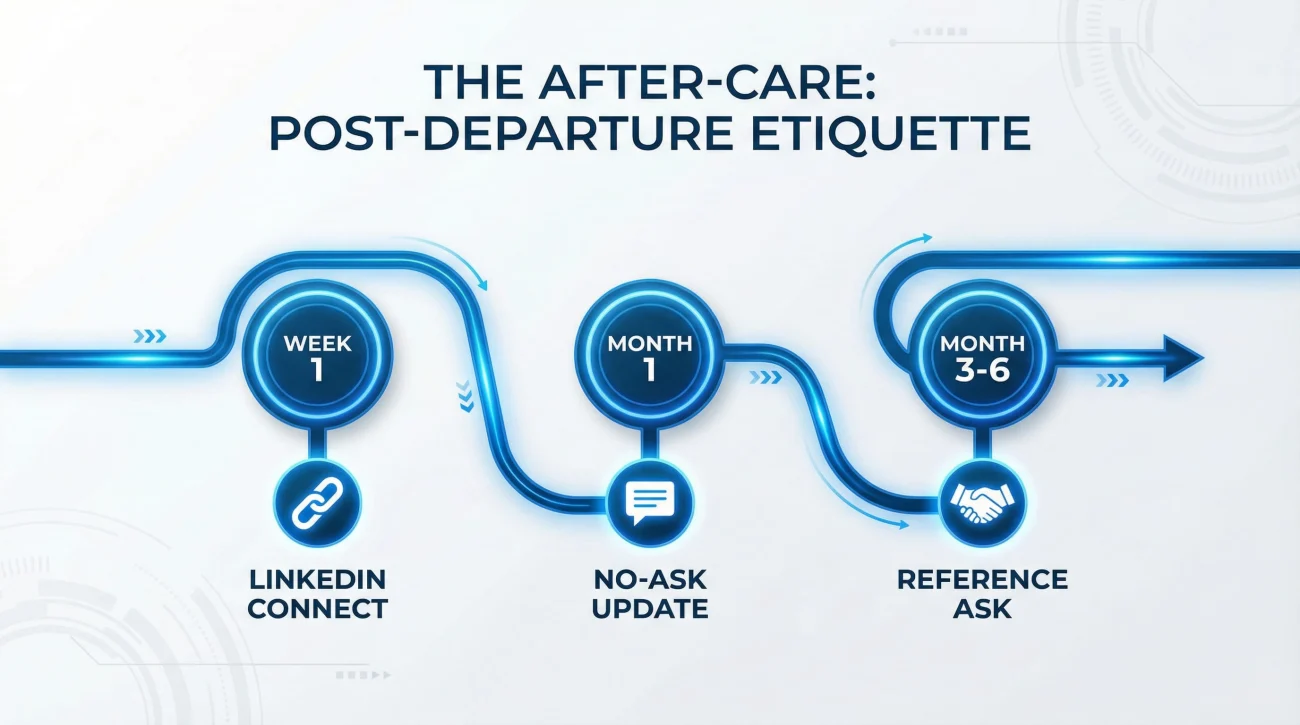
Sending the farewell email to boss is just the beginning. To truly secure the relationship (and the reference), follow this maintenance schedule:
- Week 1: The LinkedIn Connect. If you aren’t connected, do it now. Customize the invite: “Hi [Name], great working with you. Let’s stay connected.”
- Month 1: The “No Ask” Update. Send a quick note (or LinkedIn comment) sharing a relevant article or congratulating them on a team win you saw online. Do not ask for anything.
- Month 3-6: The Reference Ask. Now that you have maintained the bridge, you can reach out if you ever need a reference. Because you left well, the answer will likely be yes.
❓ Frequently Asked Questions (FAQ)
📧 Should I send this to my boss’s boss (Skip-level)?
Yes, if you had a relationship. If you interacted with them regularly, send a brief, modified version of the “Good Boss” template. It increases your visibility and expands your network at the executive level. If you never spoke to them, skip it.
🎁 Should I give my manager a gift?
Proceed with caution. Gifts flow down, not up. However, a handwritten card is always appropriate and often valued more than a physical object. If you must give a gift, keep it small, consumable (like coffee or chocolate), and inexpensive.
🤐 What if my boss is firing me?
Send the “Diplomat” email (Template 3). Even if you are angry, maintaining your dignity is the ultimate power move. A polite, brief email shows that you are a professional regardless of the circumstance. It disarms them and protects your reputation in the industry.
👥 Should I cc the team on my email to my manager?
No. Your relationship with your manager is distinct. Copying the team feels performative. Send the team a separate email, and send your manager a private one. Intimacy requires privacy.
Final Thoughts: Your Last Impression is Your Lasting Impression
In your career, you will likely have many managers. Some will be mentors, some will be obstacles, and most will be somewhere in between. But regardless of the quality of the manager, the quality of your goodbye email to manager should remain constant: Professional, Grateful, and Strategic.
By taking the time to craft a thoughtful farewell email to boss, you are doing more than saying goodbye. You are building a bridge to your future. You are ensuring that when your name comes up in a boardroom five years from now, the sentiment attached to it is one of respect.
If you are still navigating the logistics of your exit, ensure you consult our resignation guide or use our handover templates to leave your work as polished as your farewell. For a complete library of exit strategies, visit our ultimate goodbye email guide.
⚠️ Legal Disclaimer: ResignSmartly provides general informational guidance about resignation, workplace communication, notice periods, handovers, and career transitions. Content does not constitute individualized legal advice. Employment laws, contracts, workplace policies, and individual circumstances vary, so review the requirements that apply to your situation and consult an appropriate qualified professional when needed.