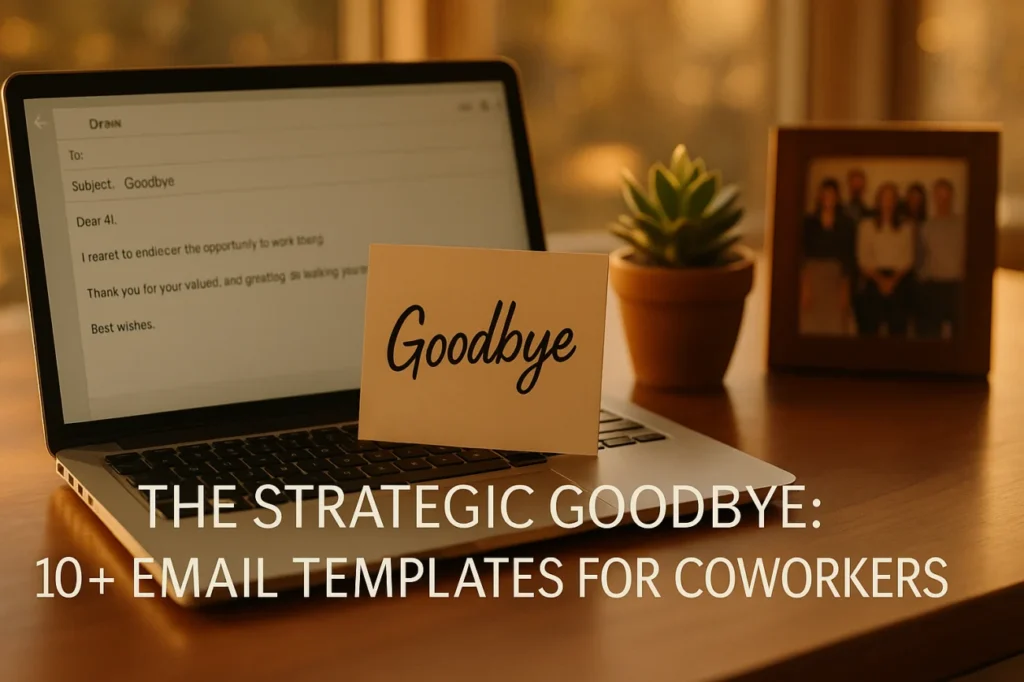
- Why it matters: A goodbye email is your last chance to protect reputation and turn coworkers into long-term network connections.
- When to send: Final afternoon (roughly 2:00 PM to 4:00 PM) to avoid awkward all-day limbo and still catch replies.
- Who to message: Segmented lists usually win for personalization, while one BCC blast is faster but feels impersonal.
- What to include: Clear subject line, specific gratitude, a frictionless LinkedIn link or personal email, and a forward-looking tone.
- What to avoid: Negativity, fake “let’s do lunch” promises, and any attachments or sensitive work info.
The Underrated Power of a Goodbye Email to Coworkers
I’ve watched hundreds of talented professionals leave their jobs over the last decade. Some vanish like ghosts, leaving behind nothing but an empty desk and a deactivated Slack account. Others – the ones who truly understand career strategy – treat their departure as a launchpad. They know that a well-crafted goodbye email to coworkers isn’t just an administrative checkbox; it is the final, defining brushstroke on their professional reputation at that company. The colleague sitting three desks away today could be the hiring manager reviewing your resume five years from now.
Last month, I witnessed a stark contrast in exit strategies that perfectly illustrates this point. Two senior employees, let’s call them Mark and Sarah, left the same organization in the same week.
Mark sent a dry, two-sentence notification at 9:00 AM on his last day. It read like a legal disclaimer. By lunch, half the office didn’t even know he was gone, and the other half felt he had “checked out” weeks ago. The silence was deafening.
Sarah, on the other hand, timed her approach differently. She sent her message at 3:00 PM – the “golden hour” for attention. Her email was warm, referenced specific shared victories, and provided clear paths for future connection. The result? She received 47 replies, three immediate LinkedIn recommendations, and a standing invitation to the company alumni network. She didn’t just leave; she extended her network.
The difference wasn’t their job performance; it was their narrative control. This deep-dive guide covers everything I’ve learned about writing a goodbye email to team members that people actually remember. We will move beyond generic templates and explore the psychology of a graceful exit, ensuring your farewell message to coworkers solidifies your legacy rather than erasing it.
The Strategic Psychology of Timing: When to Hit Send
One of the most frequent questions I field is simply: “When?” The timing of your leaving message to colleagues is just as critical as the content itself. Get it wrong, and you create awkwardness; get it right, and you maximize engagement.
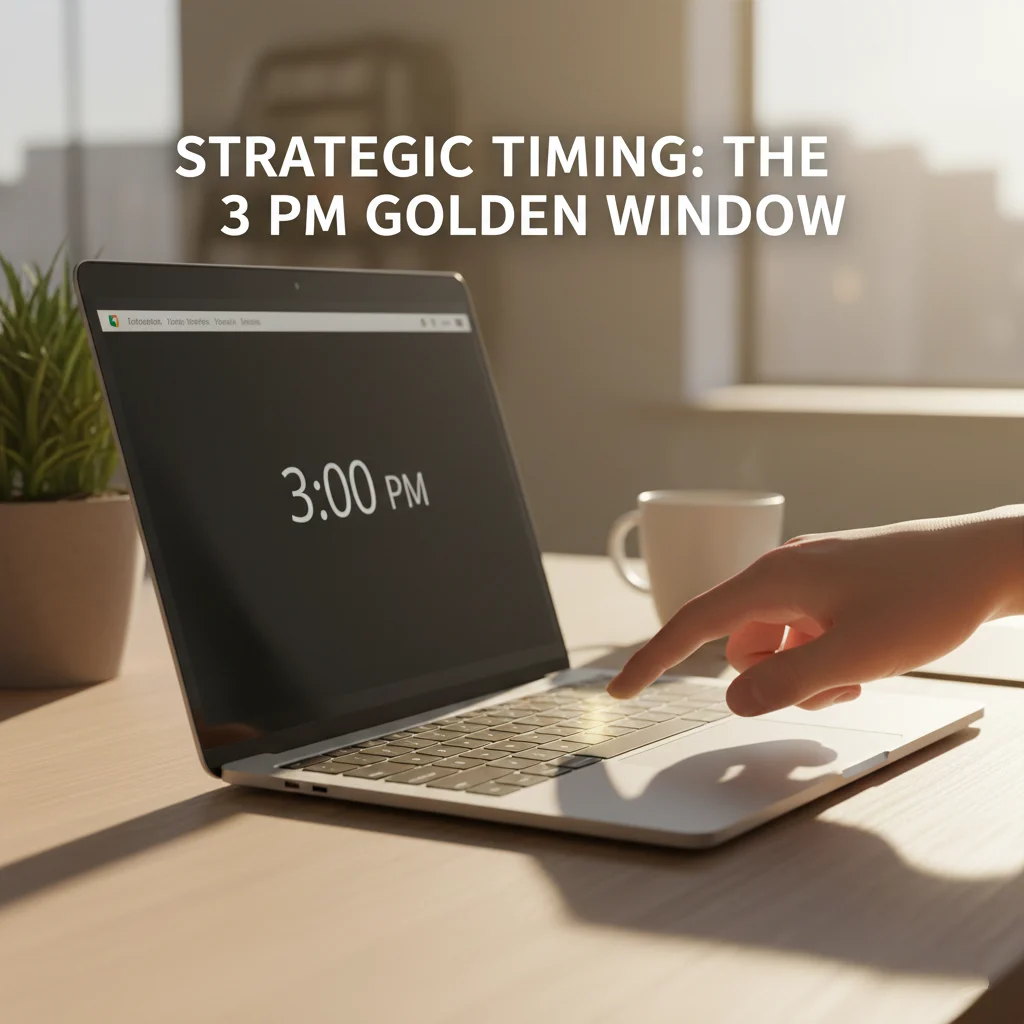
The 2:00 PM to 4:00 PM Window
Through years of observation, I have identified a specific window that yields the highest engagement rates: your final afternoon, between 2:00 PM and 4:00 PM.
Here is the strategic reasoning behind this window:
- Avoids the “Lame Duck” Morning: If you send your email at 9:00 AM, you face an entire day of awkward hallway encounters. Colleagues feel obligated to walk over and say something, but everyone knows you are technically still working. It disrupts productivity and creates a strange “limbo” atmosphere.
- Captures Attention: By mid-afternoon, the morning rush of meetings and urgent emails has subsided. People are naturally winding down and are more likely to read a non-urgent, personal email thoroughly rather than skimming it.
- Allows for Immediate Response: Sending it before the absolute end of the day gives colleagues a chance to hit “reply” while you still have access to your inbox. If you send it at 5:00 PM, you disappear before anyone can say goodbye back.
Strategy: Mass Email vs. Segmented Lists
Should you send one blast to everyone, or break it down? From a content strategy perspective, segmentation always wins, but it requires effort. Here is the trade-off:
| Strategy: Segmented Emails | Strategy: Single BCC Blast |
|---|---|
| ✅ Pro: Allows for high personalization (inside jokes, specific project wins). | ❌ Con: Feels impersonal and obligatory; readers know they are just one of many bcc’d. |
| ✅ Pro: Dramatically increases the likelihood of a meaningful reply and future connection. | ❌ Con: Risk of accidental “Reply All” disasters if you don’t use BCC correctly. |
| ❌ Con: Time-consuming to draft 3-4 different versions (Inner circle, Dept, Company). | ✅ Pro: Efficient and ensures nobody feels “left out” by accident. |
Anatomy of a High-Value Goodbye Letter to Colleagues
A high-value goodbye letter to colleagues is not a memoir. It is a strategic communication piece designed to transition a professional relationship from “coworker” (bound by employment) to “network connection” (bound by mutual respect).
To achieve this, every email must contain four non-negotiable elements. Missing any one of these reduces the effectiveness of your exit.
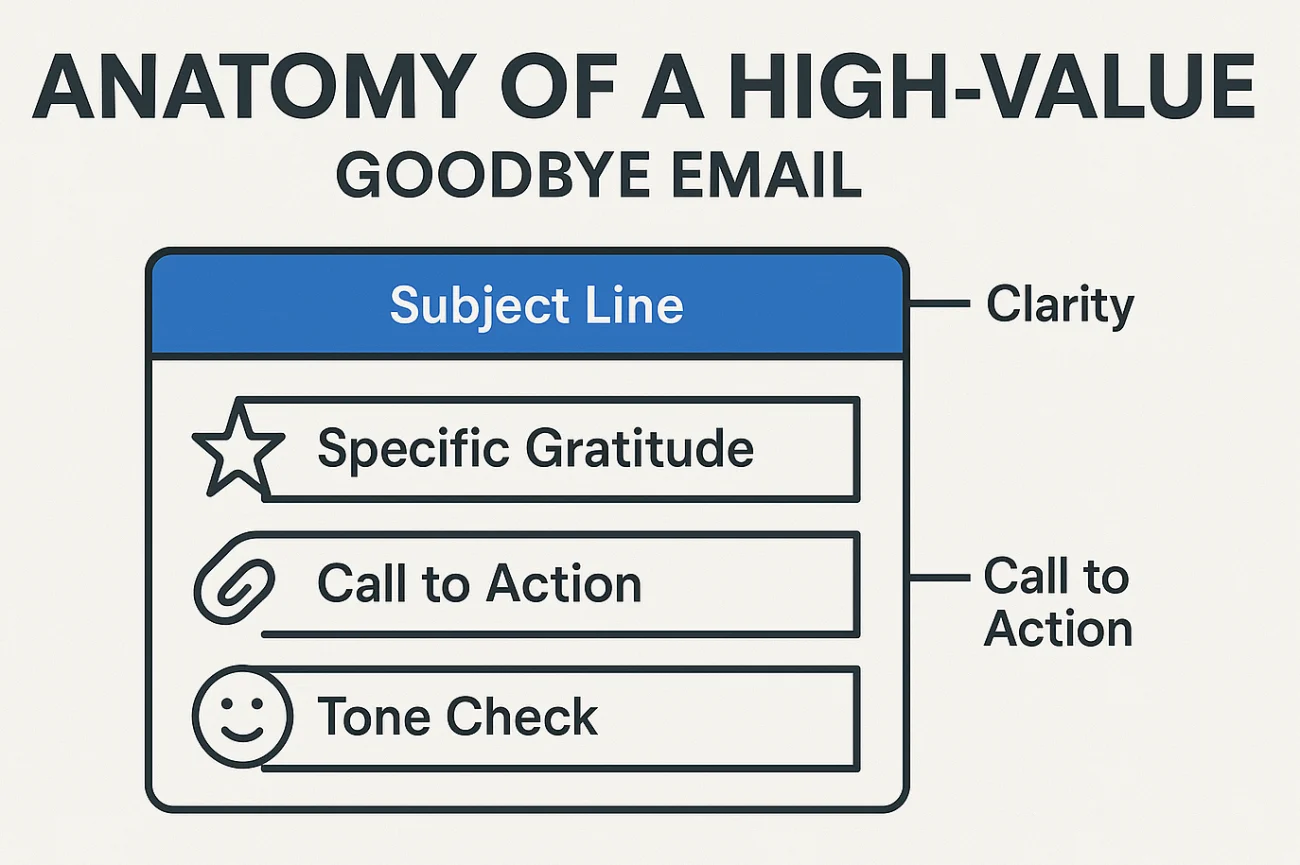
1. The Subject Line
Don’t overthink this, but don’t be vague. “Goodbye” is boring. “Update” is confusing. You want clarity mixed with warmth.
- Good: “Moving on – Thank you [Company Name] team”
- Better: “So long, and thanks for all the coffee (My last day)”
- Professional: “Farewell and Gratitude – [Your Name]”
2. Specificity in Gratitude
This is where most people fail. They write, “Thanks for everything.” This is “filler” content. As a Content Strategist, I advise you to anchor your gratitude in reality.
Instead of general thanks, mention:
- The specific “war stories” or tough projects you survived together.
- The culture quirk you will miss (e.g., the debate over the office thermostat).
- The professional growth you achieved thanks to the team’s support.
3. The “Conversion” Point (Contact Info)
In marketing, we call this the “Call to Action” (CTA). Your goal is to convert a colleague into a LinkedIn connection. Do not rely on them searching for you. You must provide the links.
💡 Expert Tip: Hyperlink your LinkedIn URL. Don’t just paste text. Reduce the friction for someone to click “Connect.”
4. Authority and Tone
Even if you are leaving because you hated the job, your tone must remain impeccable. This is not the place for subtle digs or passive-aggressive comments. Your tone should be:
- Forward-looking: Excited about the future, not bitter about the past.
- Gracious: Even if you have to fake it slightly, taking the high road pays dividends.
- Concise: Respect your colleagues’ time.
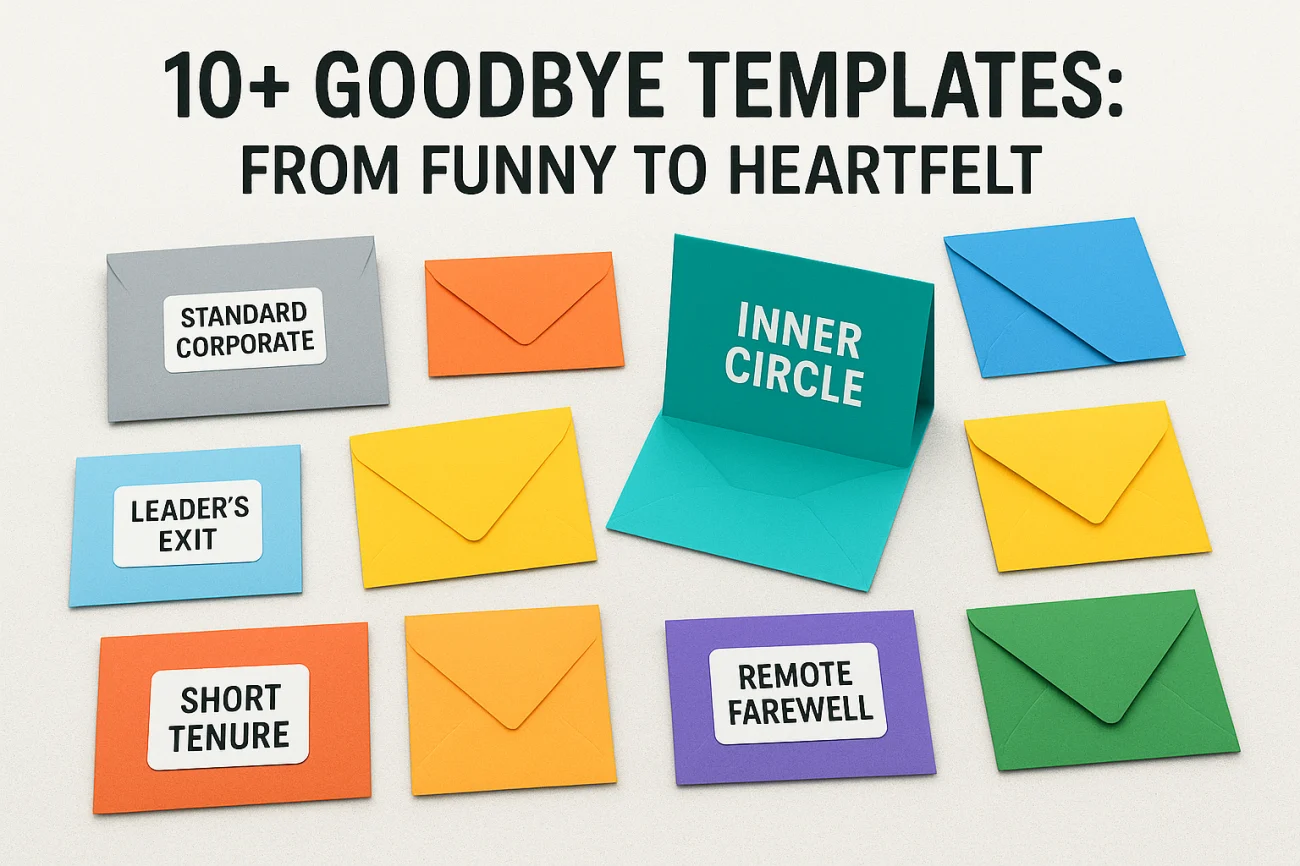
10+ Sample Goodbye Email to Team Templates
I have curated these templates based on different workplace dynamics. I strongly advise you to use these as a framework (a skeleton) and add your own “meat” (personal details) to them. A copy-paste job is easy to spot.
1. The Standard Professional (Safe for Corporate)
This is your “Swiss Army Knife” template. It works for Fortune 500s, law firms, and traditional corporate environments where you need to be polite but professional.
Subject: Farewell and thank you – [Your Name]
Hi Team,
As many of you know, today is my final day as [Your Job Title] at [Company Name]. I’m moving on to a new opportunity that aligns with my long-term career path, but I wanted to pause and express my gratitude before I sign off.
Working here for the past [Number] years has been a significant chapter in my career. I’ve learned a tremendous amount from this group – particularly during [mention a specific project or season, e.g., the Q4 relaunch]. The level of dedication I’ve seen in this department is something I will carry with me.
While I won’t be in the office (or on Slack) anymore, I would love to follow your future wins. The world is small, and our paths will likely cross again.
Please let’s stay connected:
- LinkedIn: [Link to your profile]
- Personal Email: [Your email address]
Wishing you all continued success in the next quarter.
Best regards,
[Your Name]
2. The “Startup Vibe” (Casual & Warm)
If you work in tech, creative agencies, or a place where GIFs are a primary form of communication, a stiff email will feel weird. This template allows for personality.
Subject: So long, and thanks for all the snacks 🍩
Hey everyone,
It’s hard to believe, but today is my last day at [Company].
We’ve been through a lot together – from [Project A] that nearly broke us to [Project B] that put us on the map. I’m genuinely going to miss the energy in this room (and yes, even the playlist disputes).
I’m heading off to [New Company/Adventure], but I’m not disappearing. I’m still your biggest cheerleader from the sidelines.
If you ever want to grab coffee or need someone to rubber-duck a code problem, hit me up.
Keep in touch:
[LinkedIn Link]
[Twitter/Personal Social Handle]
Cheers,
[Your Name]
3. The Inner Circle (Deeply Personal)
For the immediate team you worked with daily. This goodbye email to team members should be vulnerable and specific. This is not for the whole company; this is for your “trench mates.”
Subject: Not goodbye, just “see you later”
Team,
This is the hardest email I’ve had to write.
Leaving a job is easy; leaving a team like this is incredibly difficult. Over the last [Time Period], you haven’t just been colleagues; you’ve been mentors, friends, and my daily support system.
I want to specifically thank you for [mention specific quality, e.g., the patience during my onboarding / the laughter during stressful deadlines]. You made the tough days manageable and the good days unforgettable.
I am incredibly proud of what we built in [Department/Project]. You are hands down the best team I’ve ever been a part of.
This isn’t a real goodbye. You have my number, and I expect to see you at [local hangout/event].
With genuine gratitude,
[Your Name]
4. The “Leader’s Exit” (Manager to Direct Reports)
When you are a manager sending a goodbye email to staff, the dynamic changes. You need to reassure them, validate their work, and ensure a clean handover of authority.
Subject: Thank you for the privilege of leading this team
Hi Team,
Writing this note brings up a lot of emotion. Leading this department has been the highlight of my time at [Company].
I want you to know how proud I am of the growth I’ve seen in each of you. Together, we [mention 1 major achievement]. That success belongs to you and your hard work.
As I move on, I have full confidence in [New Manager’s Name/Interim Plan] and know that you will continue to thrive. You are a resilient, talented group, and I will be watching your future success with great pride.
Please feel free to reach out to me for career advice or references in the future. My door (virtual as it may be) remains open to you.
Warmly,
[Your Name]
5. The Short Tenure (Leaving under a year)
Leaving quickly can feel awkward. The key here is brevity. Do not over-explain why you are leaving. Focus on the positive interactions you did have.
Subject: Thank you and farewell
Hi everyone,
I’m writing to share that today is my last day with [Company].
Although my time here was shorter than expected, I’ve enjoyed getting to know you and learning more about [Industry/Topic]. I appreciate the welcome you gave me and the support during my time on the team.
I wish you all the best with the upcoming [Project Name].
Best,
[Your Name]
[LinkedIn Profile]
6. The Remote/Hybrid Goodbye
For distributed teams, you lack the physical handshake. Your words have to do the heavy lifting of connecting.
Subject: Signing off from [Your City]
Hi Team,
Since I can’t stop by your desks to shake hands, this email will have to do.
It has been a pleasure collaborating with you across time zones. Despite the distance, I’ve felt closer to this team than many I’ve shared an office with. Thank you for making our Zoom calls lively and our Slack channels helpful.
I’m logging off for the last time today, but I’m just a LinkedIn message away.
Keep in touch,
[Your Name]
7. The “Internal Move” (Staying in the Company)
When you are transferring to a different department, you aren’t really saying “goodbye,” just “see you around.” The tone should be excited but respectful of the team you are leaving.
Subject: Not goodbye, just moving downstairs (to [New Department])
Hi Team,
As some of you know, I will be transitioning to the [New Department Name] starting [Date]. While I am excited about this new internal challenge, I am going to miss working with this group every day.
I’ve loved being part of [Current Team]. Thank you for [mention 1 specific thing, e.g., the collaboration on the recent audit]. The good news is that I’m not going far – just a different Slack channel and floor.
Please don’t hesitate to reach out if you need anything during the transition or just want to grab lunch.
See you around the office,
[Your Name]
8. The “Gratitude-First” (For Supportive Teams)
Use this when your team has carried you through tough times or when the culture was exceptionally supportive. It centers appreciation over personal news.
Subject: With sincere gratitude – [Your Name]
Hi everyone,
Writing this email is bittersweet. Today is my last day at [Company], and my overwhelming emotion is gratitude.
This team has been more than just a place to work; it has been a place to grow. Thank you for the mentorship, the patience during my early days, and the constant support during crunch times. I am leaving as a better professional because of the standards you all set.
I will be cheering you on from the sidelines and hope our paths cross again.
Let’s stay connected:
[LinkedIn Profile]
Warmly,
[Your Name]
9. The “Boomerang” (Keeping the Door Wide Open)
For when you are leaving on excellent terms and want to explicitly signal that you might return or partner in the future. This is a high-level strategic exit.
Subject: Until we meet again – [Your Name]
Hi Team,
Today is my final day as I head off to pursue [New Opportunity].
I want to emphasize how much I respect the work being done here. The industry is small, and I am confident our paths will cross again – whether as partners, clients, or colleagues in the future.
I am not just leaving as a former employee, but as a lifelong fan of [Company Name]. Please keep me in the loop on your future successes.
I’d love to stay in your network:
[LinkedIn Profile]
Best,
[Your Name]
10. The “Lighthearted” (For Teams with Banter)
If your team communicates primarily in GIFs and sarcasm, a stiff formal email will feel fake. This template maintains the fun vibe while saying a proper goodbye.
Subject: I’m escaping! (Just kidding, I’ll miss you)
Hey everyone,
The rumors are true. I am turning in my badge and my laptop today.
I’m going to miss the coffee runs, the Slack banter, and yes, even our weekly Monday stand-ups. You have made this job genuinely fun, which is a rare thing.
I’m off to new adventures, but I expect to see you all on my LinkedIn feed (and at Happy Hour).
Stay awesome,
[Your Name]
[LinkedIn Profile]
Common Mistakes That Burn Bridges

I have seen careers “limited” by a bad exit. People remember how you leave often more than how you arrived. When crafting your farewell message to coworkers, avoid these traps:
1. The “Mic Drop” of Truth
You might be tempted to finally say what you really think about the management or the broken processes. Don’t. A “truth bomb” exit email might feel satisfying for 5 minutes, but it labels you as “toxic” or “difficult” forever. The industry talks. Screenshots happen. Keep it classy.
2. The Empty “Let’s Do Lunch”
Don’t promise to grab lunch with 50 people if you don’t mean it. It devalues your word. Instead of specific promises you can’t keep, use open-ended invitations like “I’d love to stay connected on LinkedIn.”
3. Security Violations
I once saw a sales director attach a “handover doc” to his goodbye email that contained sensitive client data. He was walked out by security immediately. Ensure your goodbye email contains only sentiments and contact info – no attachments, no work files.
❓ Frequently Asked Questions (FAQ)
Navigating the nuances of departure can be tricky. Here are the answers to the tough questions clients often ask me.
📧 Should I include my personal phone number?
Only for your inner circle. In a company-wide email, I strongly advise against it. Once your number is out there, you cannot “un-send” it. Stick to LinkedIn and personal email for the broad audience. Texting is an intimacy level reserved for friends, not just colleagues.
😰 What if I was fired or laid off?
You should still send a goodbye email, but keep it high-level. Do not discuss the reasons for departure. A simple “I am moving on to my next chapter and wanted to thank you for the collaboration…” is sufficient. It shows immense professionalism and grace under pressure, which people will respect.
📅 How long should the email be?
Keep it under 200 words. We live in a skimming economy. A wall of text will be ignored. Use short paragraphs (like the templates above) to make it readable on mobile devices.
🤝 Should I mention where I am going next?
It depends. If you are going to a direct competitor, your employment contract might restrict you from soliciting, so it’s safer to keep it vague (“a new opportunity”). If you are leaving on good terms for a non-competitor, sharing the new company name is fine and can help with networking.
Final Thoughts: Your Network is Your Net Worth

In the digital age, we don’t really “leave” jobs anymore; we just change the context of our relationships. The people you are saying goodbye to today are the same people who might refer you to a client, partner with you on a venture, or offer you a job ten years from now.
Your goodbye email to coworkers is the mechanism that seals these relationships in amber, preserving them for the future. By investing twenty minutes to craft a thoughtful, strategic message, you are not just being polite – you are investing in your own professional longevity.
If you are in the process of transitioning out, make sure you have covered all your bases. I recommend reviewing our guide on handover emails to ensure your work is passed on as smoothly as your farewell, or visit our homepage for comprehensive resignation strategies. Remember, finish strong.
⚠️ Legal Disclaimer: The resignation templates, email samples, and professional guidance provided in this guide are for informational purposes only and do not constitute legal advice. Employment laws and contract requirements vary by jurisdiction and individual circumstances. Please review your employment agreement and consult your HR department and/or a qualified attorney to ensure compliance with applicable laws and policies.