
- Client Reality: A farewell email is about business continuity, clients read it as risk until you prove “Business as usual”.
- Legal Pause: Check non-solicit, data privacy, and internal comms rules, get manager approval before you hit send.
- Timing Rule: Send 3–5 business days before leaving, key accounts get a call first and an email follow-up.
- Trust Anatomy: Name a qualified replacement, include hard contact details, CC them, and confirm project status and next steps.
- Reputation Killers: No humblebrag, no radio silence, no venting or oversharing, keep the focus on the client’s safety.
The High Stakes of the Client Farewell
I once watched a senior account manager send a farewell email to clients that was beautifully written, heartfelt, and completely disastrous. It thanked clients for years of partnership and expressed how much she’d miss working with them. It was emotional. It was poetic. But it didn’t include her replacement’s name, contact information, or any transition details. Within two hours, our support lines were flooded with five panicked client calls asking “Who is handling our account now?” and “Is my project stalled?”
This disaster highlights a fundamental truth: Client farewells serve a radically different purpose than internal goodbyes. Your coworkers care about your next career step; your clients care about their business continuity. When a client reads your notifying clients of resignation email, their brain doesn’t register sadness – it registers risk. “Will the service quality drop? Will I have to re-explain my history? Is this agency unstable?”
Writing a farewell letter to clients is not just about politeness; it is a strategic business operation. It is about the “Transfer of Trust.” You are taking the credibility you have built over years and carefully depositing it into the hands of your successor. Done right, it strengthens the client’s loyalty to the firm. Done wrong, it gives them an excuse to shop around for a competitor. This guide is your blueprint for a zero-friction handover.
The Psychology of Client Anxiety: What They Are Really Thinking
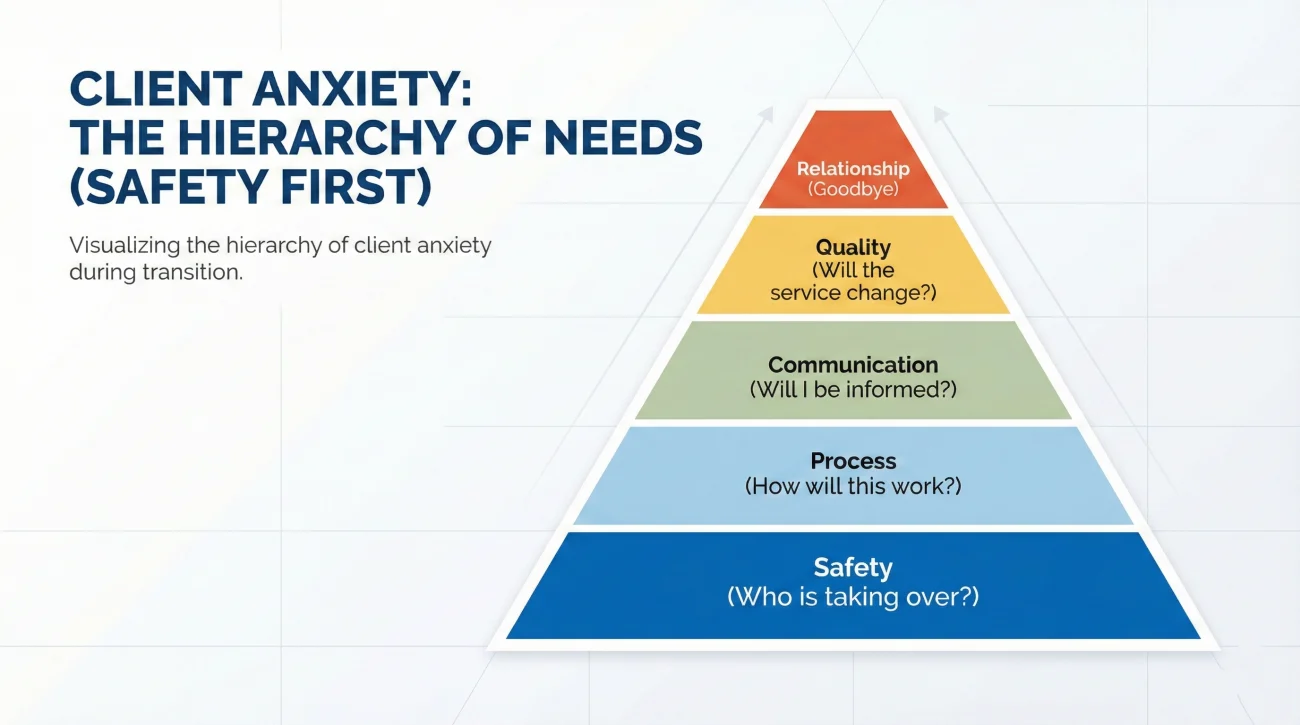
To write an effective business farewell message, you must first empathize with the panic your email generates. In the absence of information, clients assume the worst.
Here is the hierarchy of client needs during a transition:
- 🛡️ Safety (The “Who”): Who is taking over? Do they exist, or am I being thrown into a general support queue?
- 🧠 Competence (The “Can They?”): Does this new person know what they are doing? Do they know my business?
- ⚡ Continuity (The “What Now”): What happens to the project due on Friday?
- ❤️ Relationship (The “Goodbye”): (This is a distant fourth priority) Nice working with you.
Most bad emails flip this hierarchy, putting the relationship first and safety last. The goodbye email to customers that wins is the one that screams “Business as Usual” in the very first paragraph.
The Legal Minefield: Pause Before You Send

Before you draft a single word, you must consult your employment contract. Client relationships are often the most protected assets of a company.
| Critical Check | Why It Matters |
|---|---|
| Non-Solicitation Clauses | Most contracts explicitly forbid you from asking clients to follow you to a new firm. Even a hint of “I’d love to work with you in my next role” can be interpreted as an attempt to solicit the client and create serious legal risk. |
| Data Privacy | Downloading client lists to your personal device to “say goodbye later” is often treated as a serious misconduct and can breach GDPR or similar data/privacy rules. |
| Communication Protocol | Some firms require the VP or Director to send the initial announcement, not the departing employee. sending a rogue email can burn bridges instantly. |
Pro Tip: Always draft your goodbye email to clients and show it to your manager for approval. This protects you legally and ensures alignment on the transition plan.
The “3-5 Day” Golden Rule of Timing
Timing is part of the message. Sending an email at 4:55 PM on your last day is a hostile act against your clients. It signals chaos.
The Ideal Window: 3-5 Business Days Before Departure
This window provides enough buffer for:
- Clients to reply with panic questions (which you can answer while you still have access).
- A quick “handover call” with you, the client, and the replacement.
- The client to mentally adjust.
For Key Accounts: 2 Weeks + Phone Call
If you manage a “Whale” client (top revenue generator), an email is not enough. You must call them first. The email should only be a follow-up summary of that call. Breaking up via email is rude; resigning from a key account via email is negligent.
The Anatomy of a Trust-Building Farewell
Every successful introduction email to new account manager must contain these four non-negotiable elements. Miss one, and you create friction.
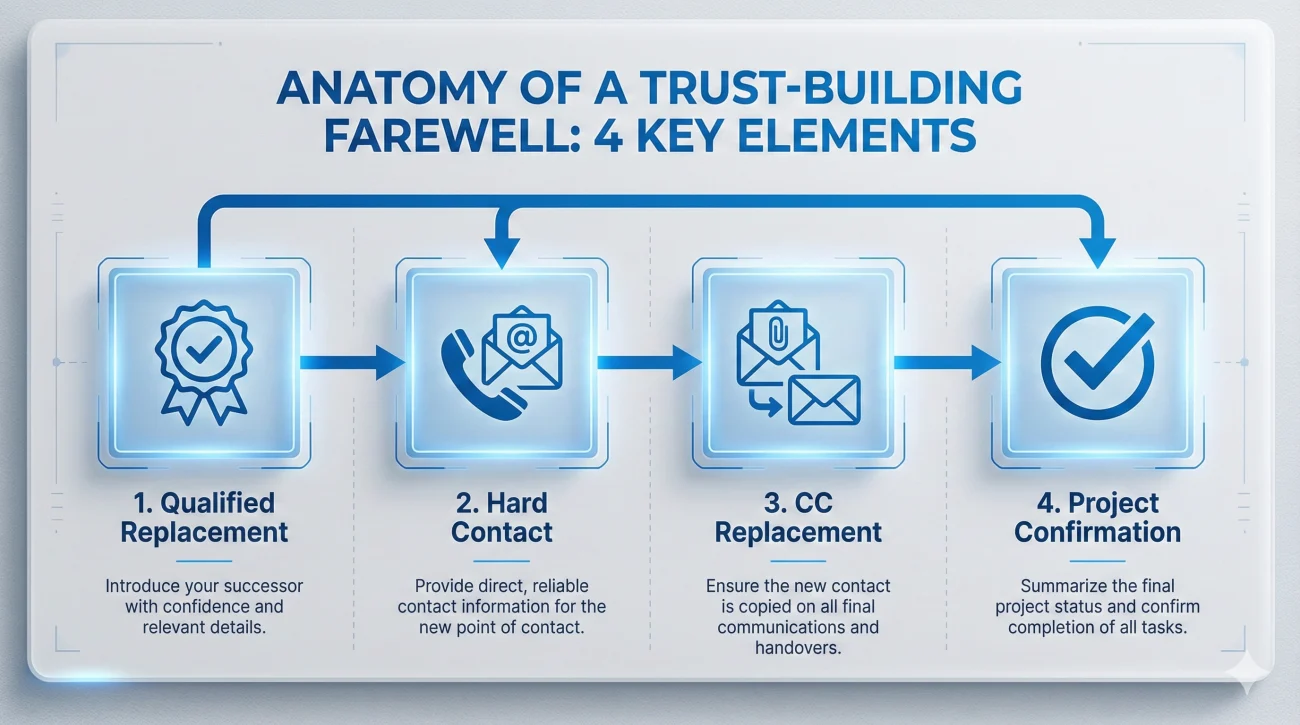
1. The “Qualified” Replacement
Don’t just give a name. Give a resume. You need to sell the new person.
Bad: “Steve will be taking over.”
Good: “Steve, who has 10 years of experience in your sector and has been fully briefed on your Q4 goals, will be taking over.”
2. The “Hard” Contact Details
Put their email and phone number in the body text. Do not make the client hunt for it.
3. The CC (Carbon Copy)
Always CC the replacement on this email. This allows the client to “Reply All” and instantly start the new relationship. It visually bridges the gap.
4. The Project Confirmation
Explicitly state that current work is safe. “The launch on Tuesday is still on track.”
Master Templates for Client Transitions
Choose the template that fits your specific situation. Remember to customize the bracketed information.

1. The Standard Professional Handoff
Best for: Regular ongoing relationships where a replacement is ready.
Subject: Important update regarding your account / Transition Plan
To: [Client Name]
Cc: [Replacement Name]
Dear [Client Name],
I am writing to let you know that I will be moving on from [Company] effectively [Date].
I want to ensure you that your account is in excellent hands. I have been working closely with [Replacement Name] (copied on this email) over the last week to transfer all knowledge regarding your [Current Project Name] and account history.
Your new point of contact:
Name: [Replacement Name]
Title: [Title]
Email: [Email]
Phone: [Phone]
[Replacement Name] is a fantastic account manager with [Number] years of experience, and they are fully up to speed on your upcoming deadlines. They will be reaching out shortly to introduce themselves properly.
It has been a privilege working with you. Thank you for the trust you’ve placed in us.
Best regards,
[Your Name]
2. The “VIP” White-Glove Handoff
Best for: High-value clients where you need to over-communicate safety.
Subject: Following up on our call – Account Transition Details
To: [Client Name]
Cc: [Replacement Name], [Your Manager/Director]
Hi [Client Name],
As we discussed on the phone, my last day with [Company] will be [Date].
Because your business is critical to us, we have appointed [Replacement Name], one of our most senior [Title], to manage your account moving forward. I have personally briefed [Replacement Name] on your specific preferences, including [mention a specific detail, e.g., weekly reporting format].
Continuity Plan:
– Current Projects: The Q3 strategy remains on schedule.
– Next Steps: [Replacement Name] has the files and will lead next Tuesday’s status call.
You can reach [Replacement Name] at [Email] or [Phone].
I have truly enjoyed our partnership and am confident you will see even greater results under [Replacement Name]’s guidance.
Warmly,
[Your Name]
3. The “Interim” Solution (No Replacement Yet)
Best for: When the company hasn’t hired your successor yet. This is tricky – you must direct them to a manager.
Subject: Account Management Update
Dear [Client Name],
I am writing to share that I will be transitioning out of my role at [Company] on [Date].
While the team finalizes your permanent new Account Manager, your account will be personally overseen by my Director, [Manager Name] (copied here). [Manager Name] has full visibility into your account status and will ensure all deliverables remain on track during this brief interim period.
Please direct any immediate inquiries to [Manager Email] starting [Date].
Thank you for the opportunity to work together.
Best,
[Your Name]
4. The Mass Email (BCC)
Best for: Low-touch clients or vendor relationships where a personal note isn’t feasible.
Subject: Update regarding your account contact
To: [Yourself]
Bcc: [Client List]
Hi everyone,
I’m writing to let you know that [Date] will be my last day with [Company].
It has been a pleasure working with you. Moving forward, please direct all inquiries and orders to the general support team at [Team Email] or our Head of Service, [Name], at [Email].
The team has all your account details on file to ensure seamless service.
Wishing you all the best,
[Your Name]
3 Ways to Ruin a Client Relationship on Your Way Out
Even seasoned professionals make mistakes when they are mentally “checked out.” Avoid these reputation-killers.
❌ Mistake 1: The “Humble Brag” Exit
“I’m leaving to join Google as a Senior VP!”
Your client doesn’t care. In fact, if they are stuck with a vendor they dislike, your success might annoy them. Keep the focus on them, not your shiny new job title.
❌ Mistake 2: The “Radio Silence”
Leaving without saying goodbye is not “low drama” – it’s unprofessional ghosting. When a client emails you a week later and gets a bounce-back message, they feel disrespected. Always send the goodbye email to clients.
❌ Mistake 3: Oversharing
“I’m leaving because the management here is chaotic.”
Never, ever vent to a client. Even if you are friends. It puts them in an incredibly awkward position and makes you look like a liability. Keep it classy: “I’m pursuing a new opportunity.”
❓ Frequently Asked Questions
📧 Can I give clients my personal email address?
⏰ What if I am leaving immediately (Short Notice)?
🤝 Should I mention where I am going?
Generally, no. Unless you are moving to a non-competing industry and your employer has explicitly approved it, keep your destination private. Simply say “a new opportunity” or “my next chapter” and leave it at that.
Announcing that you are joining a competitor in a client email can easily violate non-solicitation or non-compete clauses in many contracts and create unnecessary legal and political risk. Keep the focus on continuity for the client, not on your new employer.
📝 Should I call or email?
The Final Handshake
Your farewell email to clients is the final deliverable you will ship for your company. Make it a high-quality one. By focusing on reassurance, clarity, and the competent introduction email to new account manager, you preserve your professional reputation.
The industry is small. The client you leave gracefully today might be the Hiring Manager you interview with in five years. Leave them with the impression of a professional who cared about their business until the very last minute.
Before you hit send, ensure your internal house is in order. Check our professional resignation processes guide, and review our comprehensive farewell resources. For a broader look at exit strategies, our complete goodbye email guide covers every stakeholder.
⚠️ Legal Disclaimer: ResignSmartly provides general informational guidance about resignation, workplace communication, notice periods, handovers, and career transitions. Content does not constitute individualized legal advice. Employment laws, contracts, workplace policies, and individual circumstances vary, so review the requirements that apply to your situation and consult an appropriate qualified professional when needed.