
- Why It Matters: A live farewell speech becomes your last impression because there is no edit button, and people remember how you made them feel.
- Read The Room: Match your tone to the setting and audience, they are usually rooting for you, so aim for gratitude not awkward apologies.
- Simple Structure: Use Hook (15s), Tribute (60–90s), Toast (15s), thank groups and shared moments, and do not run a risky name roll call.
- Pick A Script: Choose a style that fits your vibe (Short, Funny, Heartfelt, Executive, Awkward exits), then customize with one real story and one specific detail.
- Deliver Calmly: Do a quick pre-speech routine (Water, Breath, Posture), memorize the opening and closing only, and handle hecklers by smiling and pivoting back.
The Final Performance: Why Your Speech Matters More Than Your Email
I once attended a going-away happy hour for a Senior Developer who was a genius at coding but terrified of public speaking. When the room went quiet and eyes turned to him, he froze. He mumbled, “Uh, thanks for the cake,” and stared at his shoes until someone awkwardly started clapping. It was painful. The team felt shortchanged, and he felt humiliated. Contrast that with a Project Manager I knew who left a month later. She stood up, cracked a joke about her coffee addiction, shared a genuine story about a late-night launch, and raised a toast. People were laughing, crying, and talking about that speech for weeks.
Here is the brutal truth: Your goodbye email is read in silence; your farewell speech to colleagues is experienced live. There is no backspace key. There is no edit button. It is a moment of high social pressure that cements your final impression. In the corporate world, memories are short. People will forget your deadlines and your spreadsheets. But they will remember how you made them feel in your final moments.
But fear not. You do not need to be Winston Churchill to deliver a memorable goodbye speech for office party. You just need a structure. In this comprehensive guide, we will break down the psychology of the room, the mechanics of a toast, and provide you with farewell speech samples that range from the hilarious to the tear-jerking. We will cover everything from handling nerves to managing the “heckler” in the back of the room.
Reading the Room: The Psychology of the Farewell
Before you write a single word, you must understand the context. A speech delivered in a break room with fluorescent lighting requires a different energy than one delivered at a dim bar after two rounds of drinks. Understanding the psychological undercurrents of the room gives you control.
The “Spotlight Effect” Paradox
Most anxiety comes from the “Spotlight Effect” – the belief that everyone is judging your every micro-movement. The reality? They are rooting for you. In a farewell scenario, the audience has a “Warmth Bias.” They want to feel acknowledged, they want to celebrate you, and frankly, they want to get back to their conversations. They are on your side. Use that energy. You are not defending a thesis; you are saying thank you.
The Law of Diminishing Returns
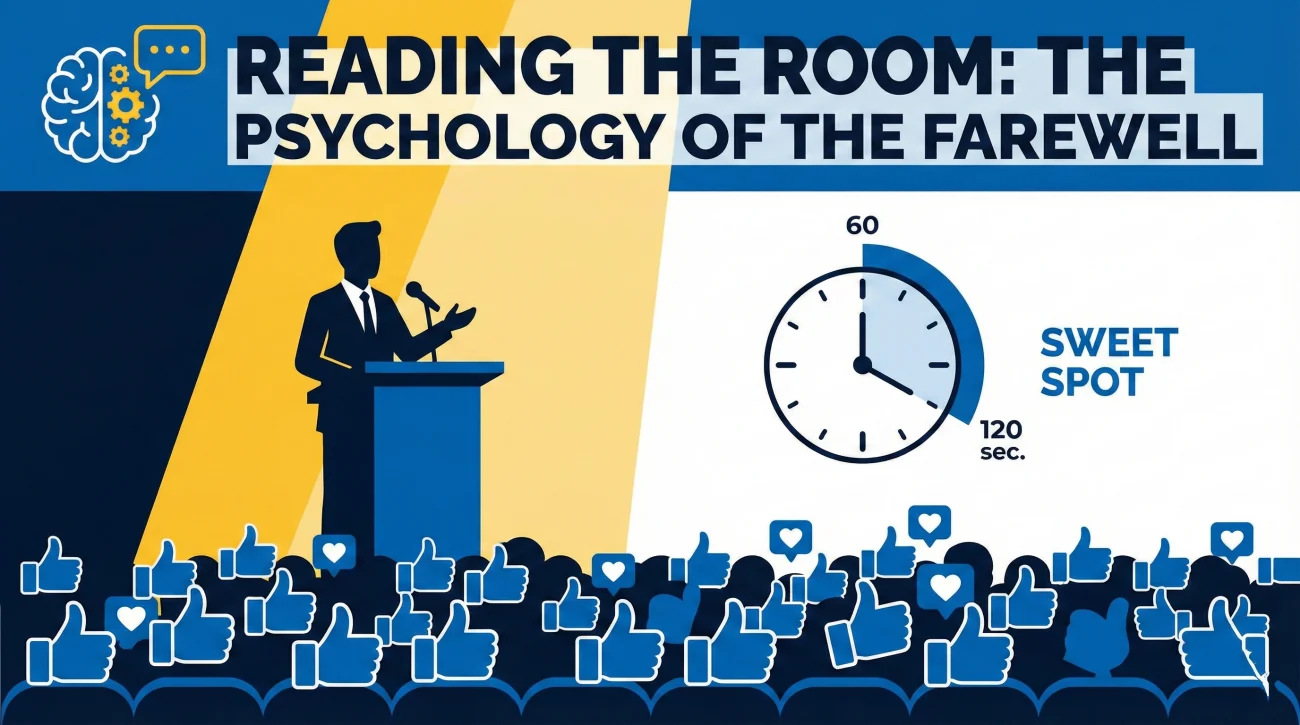
I have timed hundreds of speeches. Here is the golden rule: A short farewell speech is always better than a long one. The audience’s attention span follows a bell curve.
- 0-60 Seconds: Peak engagement. Everyone is listening.
- 60-120 Seconds: The Sweet Spot. You have established connection and delivered value.
- 120-180 Seconds: The Danger Zone. People start shifting their weight.
- 3+ Minutes: The Resentment Phase. People check phones and wonder if the bar is still open.
Calibrating Emotion: The “Vulnerability” Balance
How much emotion is too much? It depends on your tenure and the culture.
- Startup / Close Team: High emotion is acceptable. Tears show passion.
- Corporate / Law / Finance: Controlled emotion is power. A “crack” in the voice is better than a breakdown.
- Short Tenure (< 2 years): Keep it light. Deep emotion feels unearned and confusing.
The Anatomy of a Perfect Speech: A 3-Part Framework
Do not wing it. “Speaking from the heart” usually leads to rambling, repeating yourself, or forgetting key people. Use this architectural framework to build your remarks.
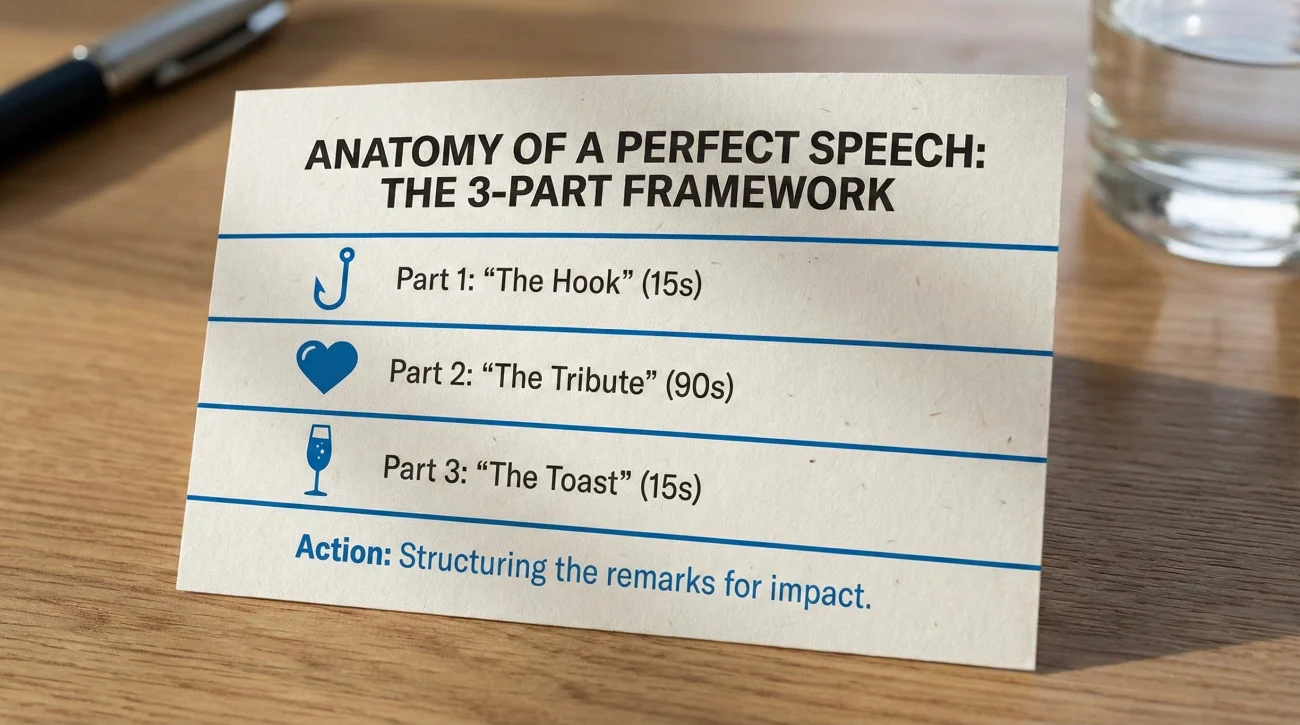
Part 1: The Hook (The Icebreaker) – 15 Seconds
Do not start with “Um, okay, can I have everyone’s attention?” or “I’m not good at speeches.” Start with confidence. Grab them immediately.
- The Joke: “I promised myself I wouldn’t cry… mostly because I want to save my tears for my new commute.”
- The Fact: “Statistics show that 90% of you are only here for the free pizza, and I respect that hustle.”
- The Gratitude: “Standing here today, looking at this group, I’m realizing how incredibly lucky I am.”
- The Call-Back: “When I started 5 years ago, [Boss Name] told me I wouldn’t last a week. Well, I guess we both lost that bet.”
Part 2: The Tribute (The Meat) – 60-90 Seconds
This is where you deliver the value. Mention specific groups or traits of the team.
Crucial Rule: Do not list names like a roll call (you will forget someone and create a lifelong enemy). Instead, thank groups or specific dynamics.
- The “In the Trenches” Mention: “To the Q4 Launch Team – we survived on caffeine and panic, and I wouldn’t trade those late nights for anything.”
- The Mentor Mention: “To [Boss Name], thank you for teaching me that ‘perfect’ is the enemy of ‘done’.”
- The Culture Mention: “I will miss the way this team supports each other. It’s rare to find people who are this talented and this kind.”
Part 3: The Call to Action (The Toast) – 15 Seconds
End on a high note. Do not trail off with “…so yeah, thanks.” Raise your glass. Signal clearly that the speech is over so people know when to clap.
The Formula: “Please raise your glass. To [Company Name], to friendship, and to the future. Cheers!”
Master Scripts: Farewell Speech Samples
Below are templates tailored for different personalities, tenures, and vibes. Adapt them to your voice. Do not memorize them robotically; use them as a skeleton.

1. The “Short & Sweet” (Casual / Happy Hour)
Best for: A short farewell speech at a bar or casual lunch. Low pressure, high energy. Ideal for tenures of 1-3 years.
Opening: “Alright everyone, I promise to keep this shorter than [Colleague’s Name]’s coffee order.”
Body: “Seriously though, working with this team for the last [Number] years has been a highlight of my career. We’ve survived [Project Name], infinite Zoom calls, and [Inside Joke]. You made the hard days manageable and the good days unforgettable. I learned something from every single person here.”
Closing: “I’m excited for my next chapter, but I’m going to miss the hell out of this crew. Let’s stay in touch. To you guys!”
(Raise glass -> Drink -> Applause)
2. The “Roast” (Funny & Charismatic)
Best for: A funny farewell speech when you have a close bond with the team and the culture allows for humor. Warning: Only use if you are naturally funny.
Opening: “They say you should leave them wanting more. I think after 5 years, you’re all probably just wanting me to leave.”
Body: “I learned a lot here. I learned that ‘Urgent’ in a subject line usually isn’t. I learned that the printer smells fear. But mostly, I learned what it means to work with people who actually give a damn. To [Manager Name], thank you for not firing me that time I [Funny Mistake]. To the [Department] team, thank you for carrying me in every group project – my back is grateful for the rest.”
Closing: “I’m off to [New Company], but don’t worry, I’ll still be stalking you on LinkedIn. Cheers to the best team I’ve ever scammed a paycheck from!”
3. The “Heartfelt” (Deep Connection / Long Tenure)
Best for: An emotional farewell speech after a long tenure (5+ years). It is okay to get choked up here. Vulnerability is a strength in this context.
Opening: “I wrote down some notes because I knew if I tried to wing this, I’d turn into a mess. So bear with me.”
Body: “When I walked in here [Number] years ago, I was just looking for a job. I didn’t expect to find a family. We have grown up together. We’ve seen weddings, babies, promotions, and losses. You have supported me through [Personal/Professional Challenge], and for that, I will be forever grateful. This isn’t just a workplace to me; it’s a home. Leaving this building is easy; leaving this community is the hardest thing I’ve ever done.”
Closing: “This isn’t goodbye. It’s just ‘see you later.’ Thank you for shaping who I am. To all of you.”
4. The “Executive” (Formal & Legacy Focused)
Best for: Managers or Directors addressing a large department. Focuses on the institution, not the individual.
Opening: “Thank you all for being here. It means a great deal to me to see everyone together.”
Body: “Leading this department has been the greatest privilege of my professional life. When we look back at what we achieved with [Project/Goal], I hope you feel the same pride that I do. This team is resilient, talented, and ready for the future. I am leaving, but I am leaving you in the most capable hands. The culture of excellence we built is not about one person; it’s about the DNA of this group.”
Closing: “I look forward to watching your continued success from the sidelines. Please raise a glass to the future of [Company Name].”
5. The “Gracious Exit” (Layoff / Redundancy)
Best for: Leaving under difficult circumstances. This requires immense class. It shows you are bigger than the situation.
Opening: “I didn’t want to leave without saying a proper thank you to the people who made my time here special.”
Body: “Change is part of the business, but relationships are personal. Regardless of the circumstances, I am walking away with valuable experience and incredible friends. I want to thank the team for the late nights and the laughs. You made the hard work worth it.”
Closing: “I’m excited to see where we all land. The industry is small, so I know our paths will cross again. Cheers to new beginnings.”
Delivery Masterclass: How to Own the Room
Your content is ready. Now, let’s talk about the performance. 90% of communication is non-verbal. Even a great script fails if you look terrified.
What to Do With Your Hands (The Anchor)
The most common question I get: “What do I do with these awkward appendages?”
- The Drink Anchor: If you are holding a drink, hold it in one hand (waist level) and gesture with the other. This naturally relaxes your posture.
- The Note Card Anchor: If you don’t have a drink, hold a small note card (index card size). Do not hold a flimsy piece of A4 paper – it will shake if your hands shake, broadcasting your nervousness.
- The Forbidden Moves: Never put your hands in your pockets (looks bored/unprofessional) or cross your arms (looks defensive/closed off).
The “Lighthouse” Technique
Don’t stare at the floor. Don’t stare at your boss. Don’t stare at the back wall.
The Technique: Scan the room slowly like a lighthouse. Pick three friendly faces in different parts of the room (Left, Center, Right) and rotate your gaze between them. This makes everyone feel included without you having to lock eyes with 50 people. Avoid the “Eye Dart” – looking rapidly around the room makes you look shifty.
The “Water Break” Trick (Panic Button)
If you feel tears coming during your emotional farewell speech, or your voice starts to crack, do not panic. Do not apologize.
The Fix: Stop speaking. Take a slow, deliberate sip of water. This buys you 5-7 seconds to reset your vocal cords and breathing. The audience will just think you are thirsty. It is a socially acceptable pause button.
Handling the “Heckler”
Sometimes, a drunk or overly enthusiastic colleague will shout something out. Do not ignore it (it looks weak), and do not get angry.
The Fix: Acknowledge it with a smile and pivot.
Heckler: “We’re glad you’re leaving!”
You: “I’m glad someone finally said it! But seriously…” (Pivot back to script).
The 10-Minute Pre-Speech Ritual
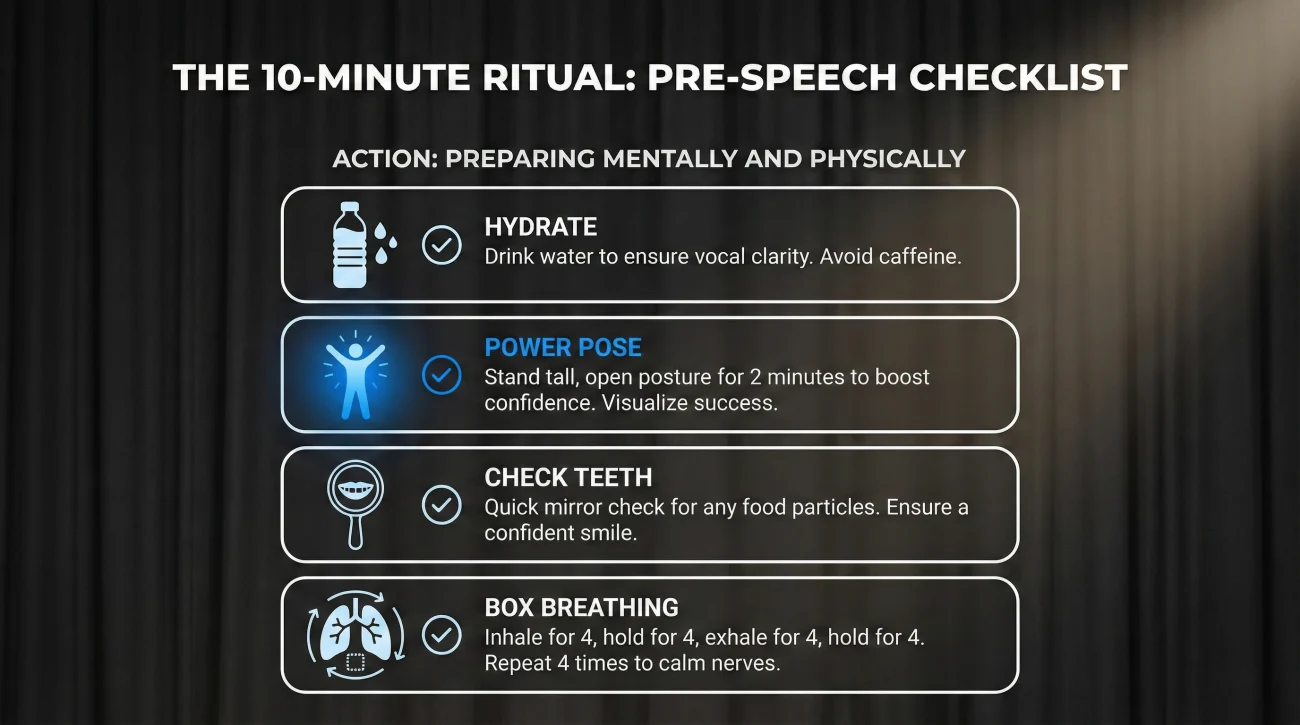
What you do in the 10 minutes before you speak determines your success.
- Hydrate: Drink water. Nervousness causes dry mouth (cottonmouth), which makes speaking difficult.
- The Power Pose: Find a bathroom stall or private space. Stand with feet wide, hands on hips (Wonder Woman pose) for 2 minutes. This reduces cortisol (stress hormone) and boosts testosterone (confidence hormone).
- Check Your Teeth: Nothing ruins a speech like spinach in your teeth. Check a mirror.
- Breathe: Use the “Box Breathing” technique: Inhale 4s, Hold 4s, Exhale 4s, Hold 4s. This physically forces your heart rate down.
❓ Frequently Asked Questions
📝 Should I memorize my speech?
🍷 Should I drink before the speech?
😂 Is it okay to roast my boss?
🏃 What if I hate the job and just want to leave?
The Last Word: Your Legacy Moment
Your farewell speech is the ribbon on the package of your tenure. It doesn’t need to be perfect; it just needs to be present. People won’t remember your exact words, but they will remember how you made them feel. Were you gracious? Were you warm? Did you end on a high note?
This is your opportunity to reframe your narrative. Even if you had a tough time, a gracious speech leaves people thinking, “Wow, they were a class act.”
Take a breath. Find your light. Raise your glass. You earned this moment.
For more advice on navigating the logistics of leaving, check out our professional resignation processes. If you need written templates to accompany your speech, explore our comprehensive farewell resources. For the complete exit playbook, visit our ultimate goodbye email guide.
⚠️ Legal Disclaimer: ResignSmartly provides general informational guidance about resignation, workplace communication, notice periods, handovers, and career transitions. Content does not constitute individualized legal advice. Employment laws, contracts, workplace policies, and individual circumstances vary, so review the requirements that apply to your situation and consult an appropriate qualified professional when needed.