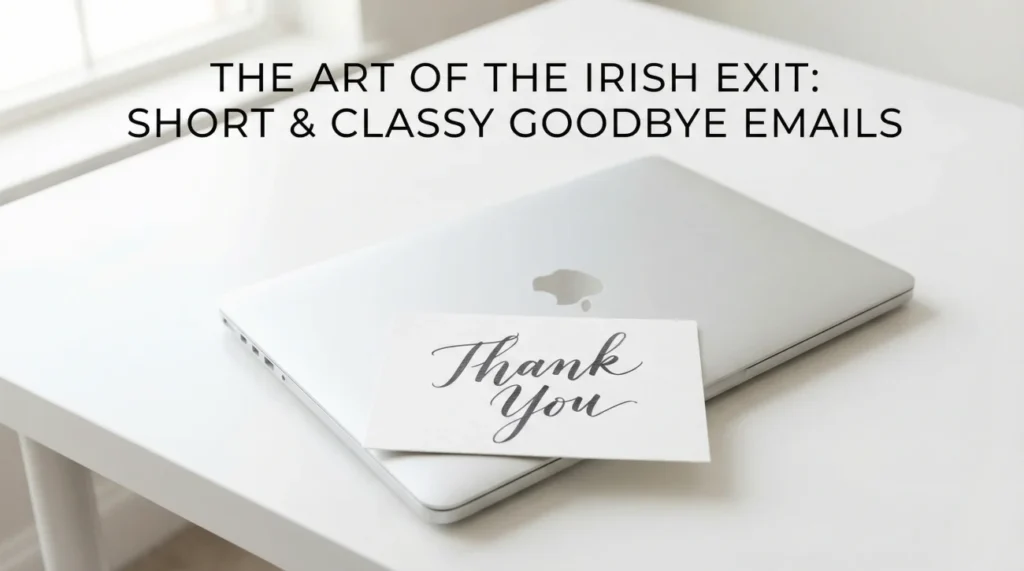
- Main idea: A short goodbye email can feel more confident and warmer than a long farewell if it respects people’s time.
- Why it works: Brevity reduces cognitive load, signals security, fits introverts, and lowers the risk of saying something awkward.
- 3-line structure: News of departure, One blanket gratitude line, One bridge with contact info (usually LinkedIn or email).
- Make it easy to read: Use a clear subject line, pick the right template vibe, and keep the message complete without extra stories.
- Best strategy: Send one safe short note to the wide list, then personal notes to the 3 to 5 people who matter most.
The Power of the “Irish Exit”: Mastering the Art of the Short Goodbye Email
The most impactful short goodbye email I ever witnessed was sent by a VP of Operations at a Fortune 500 company. It arrived at 4:55 PM on a Friday, just as laptops were snapping shut across the office. It read, in its entirety:
“Team, today is my last day. It has been a privilege to build this with you. I am rooting for your continued success. Please stay in touch at [email].”
There was no drama. No lengthy manifesto about “lessons learned.” No forced sentimentality. Just clean, professional respect for everyone’s time. And do you know what happened? That email generated more genuine, warm replies than the five-paragraph essay another director had sent the week prior. Why? Because it didn’t ask for emotional labor from the reader.
In a corporate world drowning in information, brevity is not just a preference; it is a currency. A brief goodbye message signals confidence. It says, “I don’t need 500 words to validate my time here; my work speaks for itself.” However, there is a fine line between “concise” and “cold.” How do you write a minimalist goodbye email that feels warm and classy without wasting a single second of your reader’s time? This deep-dive guide will teach you the strategic art of the professional “Irish Exit.”
The Psychology of Brevity: Why “Less” Is Actually “More”
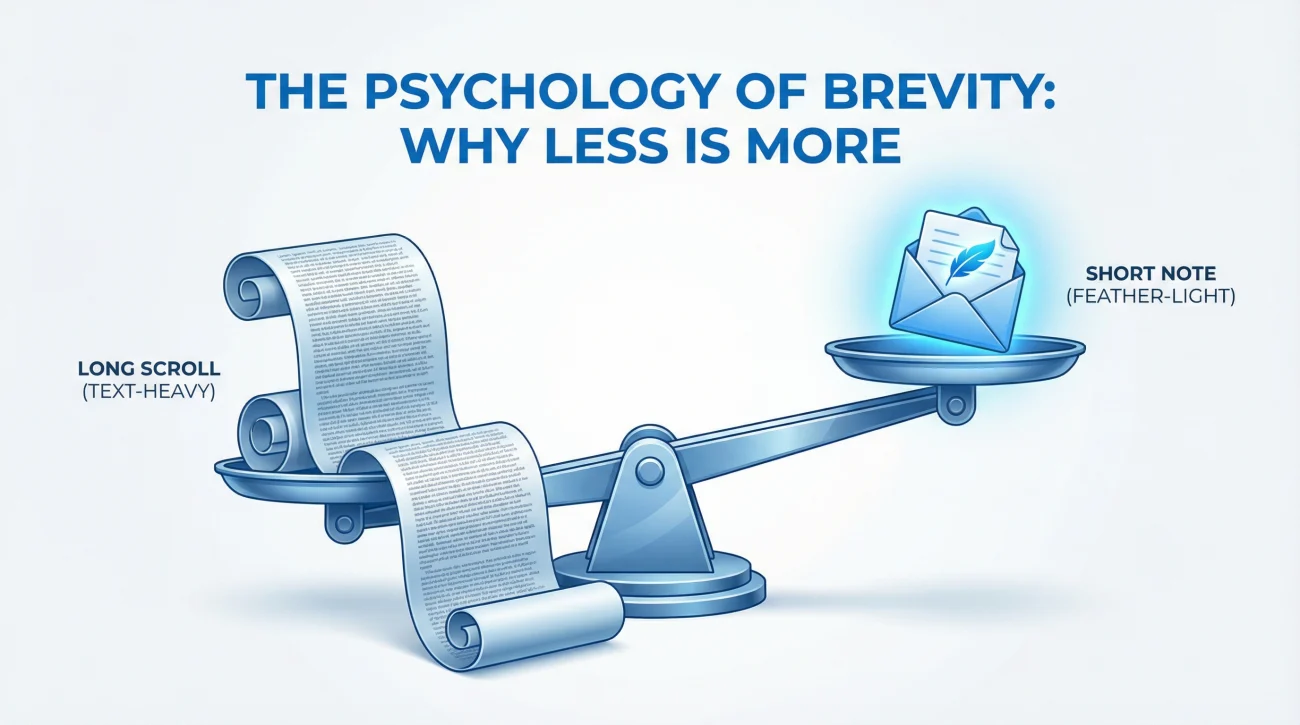
There is an unspoken pressure to perform emotion when we leave a job. We feel obligated to write a novel to prove we cared. But from a Content Strategy and psychological perspective, short emails often outperform long ones. Here is why savvy professionals are switching to the short farewell email to colleagues:
1. Reducing Cognitive Load
Your colleagues are busy. Their inboxes are battlegrounds. When they see a wall of text, their brain sighs. When they see three crisp sentences, they feel relief. Sending a quick farewell email is an act of empathy. It respects their cognitive load.
2. The Confidence Signal
Over-explaining is often a trauma response or a sign of insecurity. We ramble when we want to be understood. Brevity signals that you are secure in your relationships and your reputation. You don’t need to remind people what you did; they already know.
3. The Introvert’s Authentic Exit
Not everyone enjoys the spotlight. If you are naturally reserved, writing an emotional ballad feels inauthentic – like wearing a costume on your last day. A simple goodbye note allows you to exit on your own terms, maintaining your authentic voice without forcing a “personality transplant.”
4. Risk Mitigation
The longer the email, the higher the risk of saying something awkward, leaving someone out, or striking the wrong tone. A short goodbye letter to coworkers minimizes the surface area for errors. It is the safest professional bet.
The Anatomy of a Perfect 3-Line Goodbye
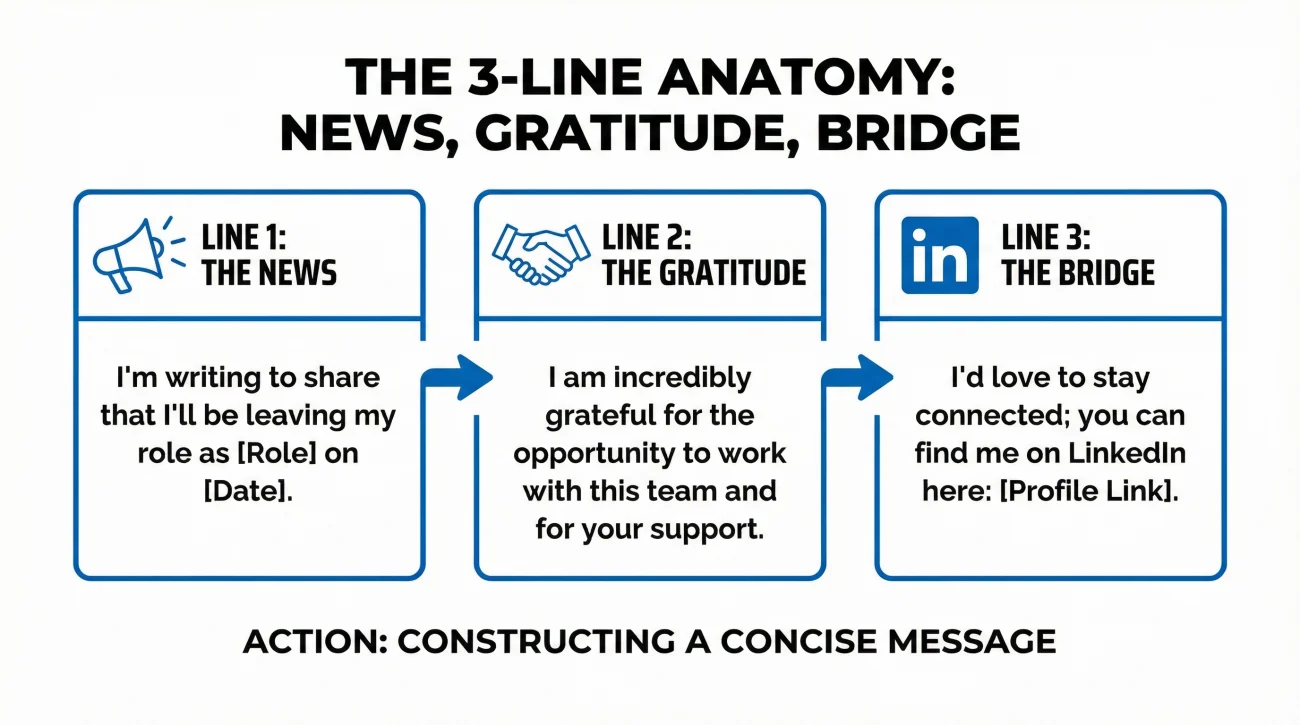
A successful short email is not just a fragment of a longer one; it is a complete thought distilled to its essence. It is like a haiku – every word must pull its weight. It must contain three non-negotiable elements:
- The News (The “What”): State clearly that you are leaving (and when). Don’t bury the lede.
- The Gratitude (The “Why”): A blanket “thank you” that covers everyone. This provides the warmth.
- The Bridge (The “How”): Your contact info to maintain the network. This is the CTA (Call to Action).
Anything else – jokes, quotes, long stories – is optional fluff that dilutes the message.
Subject Line Science: Getting Open Rates Up
With a short email, the subject line does 80% of the work. Avoid vague subject lines like “Update” or “Hi.” Be explicit.
- Good: “Goodbye and thank you”
- Better: “Moving on – My last day is today”
- Best (for close teams): “So long, and thanks! (My last day)”
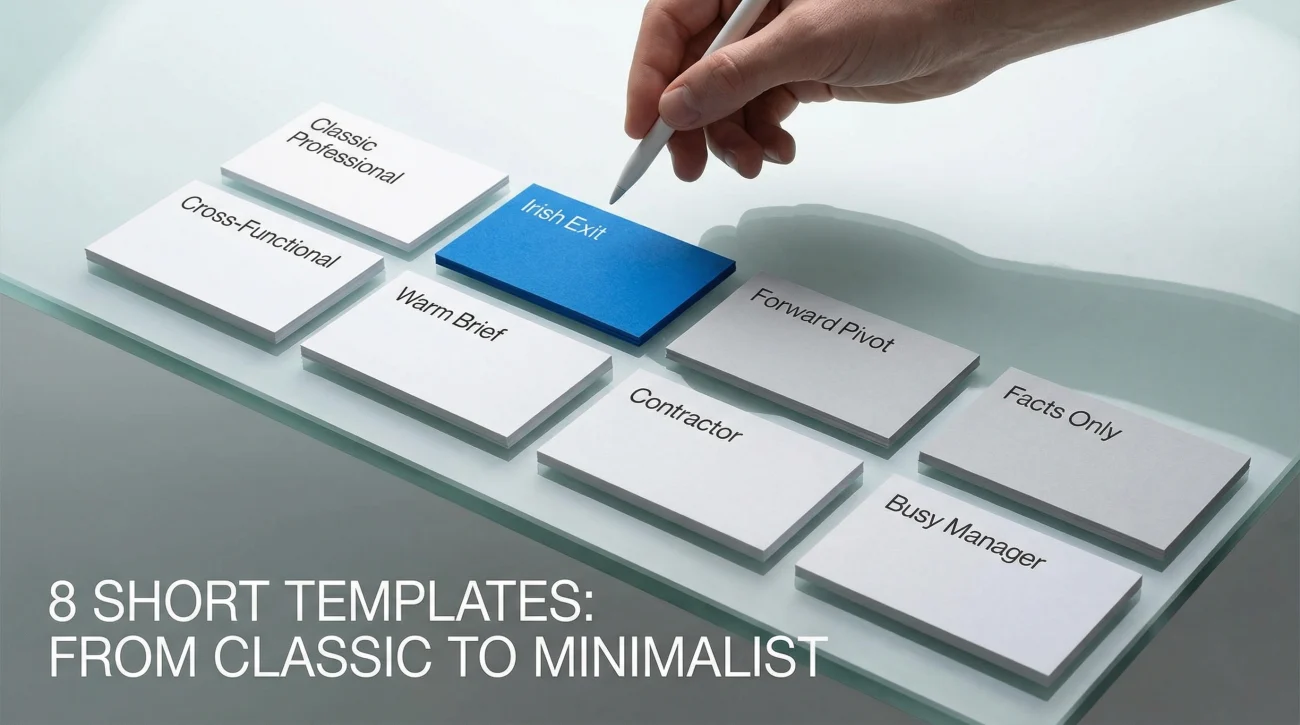
8 Short Goodbye Email Templates (Categorized & Analyzed)
These templates are designed to be copied, pasted, and sent in under 60 seconds. I have categorized them so you can choose the right “vibe.”
1. The Classic Professional (The “Swiss Army Knife”)
Best for: Corporate environments, large teams, or when you want to be universally safe.
Subject: Thank you and farewell – [Your Name]
Hi Team,
I’m writing to let you know that today is my last day with [Company].
I have truly enjoyed my time here and am grateful for the support and collaboration I’ve received from this group. I wish you all continued success in the future.
Please stay in touch:
LinkedIn: [Link]
Email: [Email]
Best regards,
[Your Name]
Why it works: It hits all three structural notes perfectly. It is polite but efficient.
2. The “Digital Irish Exit” (Ultra-Minimalist)
Best for: Distant colleagues, very large distribution lists, or people you barely know.
Subject: Moving On
Hi Everyone,
Today is my final day. I wanted to say a quick thank you for the opportunity to work with you all.
You can find me on LinkedIn here: [Link]
Wishing you all the best,
[Your Name]
Why it works: It demands nothing from the reader. It is a notification, not a conversation starter.
3. The Cross-Functional Blast
Best for: People in other departments (Marketing, Sales, IT) whom you worked with occasionally but aren’t close to.
Subject: Signing off – [Your Name]
Hi Team,
As I transition to a new opportunity, I wanted to thank you for the cross-functional collaboration over the last [Time Period]. It was a pleasure working with your department.
Let’s keep connected:
LinkedIn: [Link]
Cheers,
[Your Name]
4. The “Warm but Brief” (For Friends/Peers)
Best for: A team you like and respect, but you still want to keep it short to avoid getting emotional.
Subject: So long! 👋
Hi Team,
Short and sweet: Today is my last day.
Working with this crew has been a highlight of my career. Thank you for making the workdays fun and the projects successful. I’m going to miss you guys.
Don’t be strangers:
[LinkedIn Link]
Warmly,
[Your Name]
Why it works: The phrase “Short and sweet” sets expectations immediately. It allows for warmth (“I’m going to miss you guys”) without rambling.
5. The “Forward-Looking” Pivot
Best for: Leaving for an exciting new role (without sounding like you’re bragging).
Subject: Off to new adventures
Hi everyone,
Today is my last day as I head off to my next adventure. I’m taking with me great memories and valuable lessons from my time here.
Thanks for being a great team to work alongside.
Keep in touch:
LinkedIn: [Link]
Best,
[Your Name]
6. The Contractor/Intern Exit
Best for: End of a fixed-term contract or internship.
Subject: Thank you from [Your Name]
Hi Team,
As my contract wraps up today, I wanted to say thank you for the guidance and opportunities over the past few months. I’ve learned a ton.
I hope our paths cross again!
LinkedIn: [Link]
Thanks,
[Your Name]
7. The “Just the Facts” (Strictly Business)
Best for: Highly formal industries (Law, Finance) or if you want zero emotion.
Subject: Departure Notification – [Your Name]
Colleagues,
Please be advised that today, [Date], is my final day with [Company].
Thank you for your professional collaboration. You may reach me in the future at [Email] or via LinkedIn [Link].
Sincerely,
[Your Name]
8. The “Busy Manager” (Executive Style)
Best for: Leaders who want to model efficiency.
Subject: Signing off
Team,
It has been a privilege leading this group. You are in good hands.
I am moving on to my next chapter, but I will be rooting for your success from the sidelines.
Stay in touch: [LinkedIn Link]
[Your Name]
The Fine Line: How NOT to Be Rude
Brevity is dangerous if mishandled. Here is how to ensure your short farewell email to colleagues reads as “busy and professional” rather than “angry and dismissive.”
| Mistake | Why it Fails | The Fix |
|---|---|---|
| ❌ The 2-Word Exit “Bye everyone.” | It feels aggressive, like you are storming out of the room. | Add one sentence of thanks. Gratitude softens brevity. |
| ❌ The “Sorry” Trap “Sorry this is short…” | Never apologize for respecting time. It makes you look insecure. | Just send it. Confidence needs no apology. |
| ❌ The Missing Link (No contact info) | It’s a dead end. It signals “I don’t want to know you anymore.” | Always include LinkedIn. It’s the professional handshake. |
| ❌ The Vague Promise “Let’s get coffee sometime.” | In a short email, this feels like a lie. | Cut the promise. Stick to “Stay in touch on LinkedIn.” |
The “Tiered” Strategy: Have Your Cake and Eat It Too
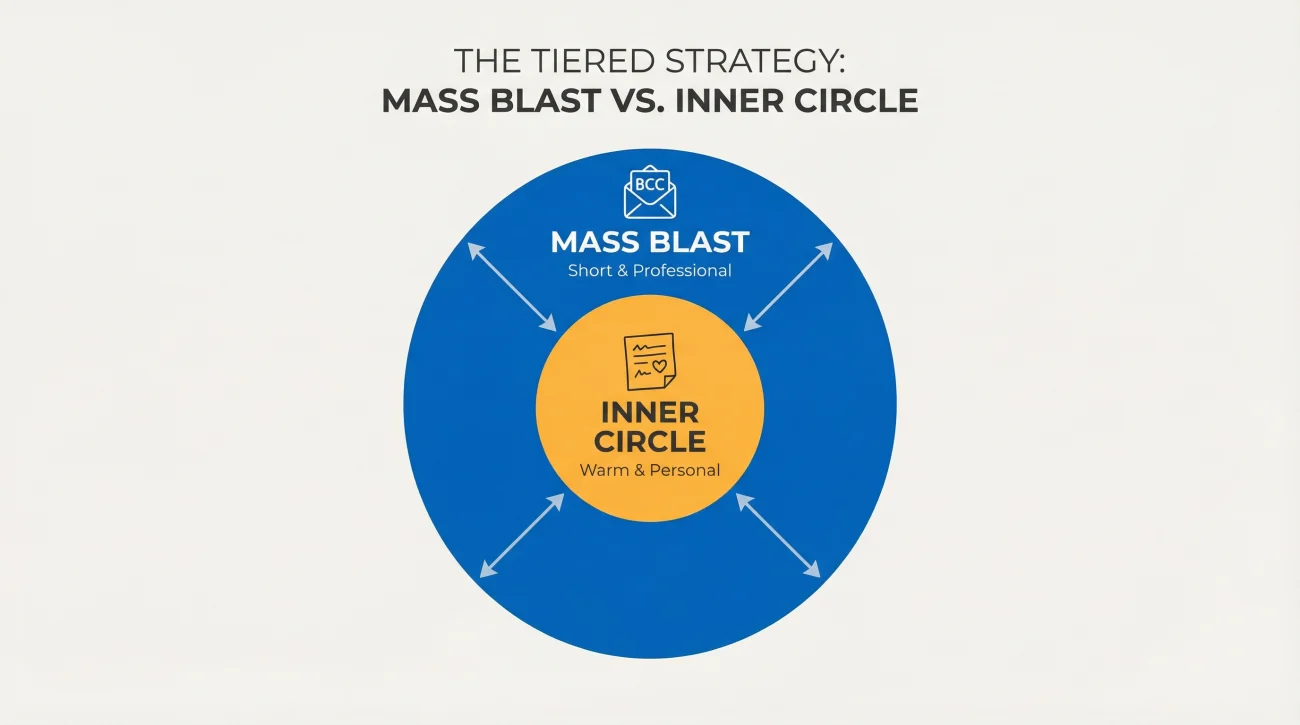
Who says you only get one email? The smartest exit strategy is often a hybrid one, leveraging the “Tiered Communication” model.
- Tier 1 (The Mass Blast): Use Template #1 or #2 for the entire company/department (BCC is your friend here). Keep it short, safe, and professional. This checks the administrative box.
- Tier 2 (The Inner Circle): Send personal, longer notes (or texts) to the 3-5 people who actually matter. This preserves the relationships without performing for an audience.
This way, you satisfy the social contract of saying goodbye to everyone without performing fake intimacy with strangers.
❓ Frequently Asked Questions (FAQ)
📏 How short is “too short”?
Anything under 30 words risks feeling curt. You need enough length to cover the three anatomical parts: News, Thanks, and Contact. A 50-75 word email is usually the “Goldilocks” zone – just right.
🥶 Will people think I’m cold?
Not if you include the word “grateful” or “thank you.” Those words carry a lot of emotional weight. A short message with warmth beats a long message with fluff. It shows you value the relationship enough to not waste their time.
🏢 Does this work for senior leadership?
Actually, yes. Senior leaders often send shorter emails because they are expected to be busy. A concise, gracious note from a Director reads as “Executive Presence.” It signals that you are focused on the business until the very end.
🔗 Is it okay to just put a LinkedIn link?
Yes, absolutely. In 2024, LinkedIn is the primary Rolodex. It is often better than a personal email because it updates automatically if you change jobs again. It is the lowest-friction way to stay connected.
📨 Should I reply to people who respond?
If they take the time to reply to your short note, a quick “Thank you!” reply is polite. But don’t feel obligated to start a long thread. The whole point was brevity.
Final Thoughts: Leave Without the Fuss
The short goodbye email is an act of confidence. It asserts that you came, you contributed, and now you are moving on. You don’t need a parade. You just need a clean break.
By keeping it brief, you ensure your message is actually read, your contact info is actually saved, and your professional reputation remains polished to the very last second. You leave them wanting more, not wishing you had said less.
If you need to ensure your departure is as smooth as your email, review our resignation checklist or grab our handover document templates. For every other type of farewell, our comprehensive goodbye guide has you covered.
⚠️ Legal Disclaimer: ResignSmartly provides general informational guidance about resignation, workplace communication, notice periods, handovers, and career transitions. Content does not constitute individualized legal advice. Employment laws, contracts, workplace policies, and individual circumstances vary, so review the requirements that apply to your situation and consult an appropriate qualified professional when needed.