
- Core Idea: In conservative sectors, your farewell email is a permanent artifact, so formal beats funny every time.
- Why Formal Wins: It reduces misread humor risk, signals institutional respect, and protects your long-term network value.
- Executive Language: Swap casual words for authority vocabulary to sound like you understood the culture to the last second.
- Protocol Rules: Never pre-empt official announcements, avoid reply-all storms, and choose the right distribution scope.
- Clean Presentation: Use standard formatting, no emojis or color tricks, and pick a template that matches seniority and tenure.
The Art of the Dignified Exit
I once coached a brilliant associate at a “Magic Circle” law firm who was leaving for a tech startup. Excited about his new casual culture, he sent a professional farewell email that included a GIF of a mic drop and the phrase “Peace out, it’s been real.” The silence that followed was deafening. Senior partners didn’t find it funny; they found it disrespectful. That one email undid five years of reputation building. He was no longer remembered as “the brilliant associate”; he was remembered as “the guy who didn’t understand our culture.”
In the world of Law, Finance, Government, and Traditional Corporate, communication is currency. How you say goodbye is just as important as the work you delivered. Your final email is not just a notification; it is a permanent digital artifact that remains in the system long after your access is revoked. A formal farewell email to colleagues isn’t about being stiff or cold; it’s about demonstrating that you possess the executive presence to understand institutional norms until the very last second.
This guide is your protocol for leaving conservative environments with your dignity and network intact. We will strip away the fluff and focus on the precise architecture of a corporate farewell message that commands respect.
Why “Stiff” is Safe: The Strategy of Formality
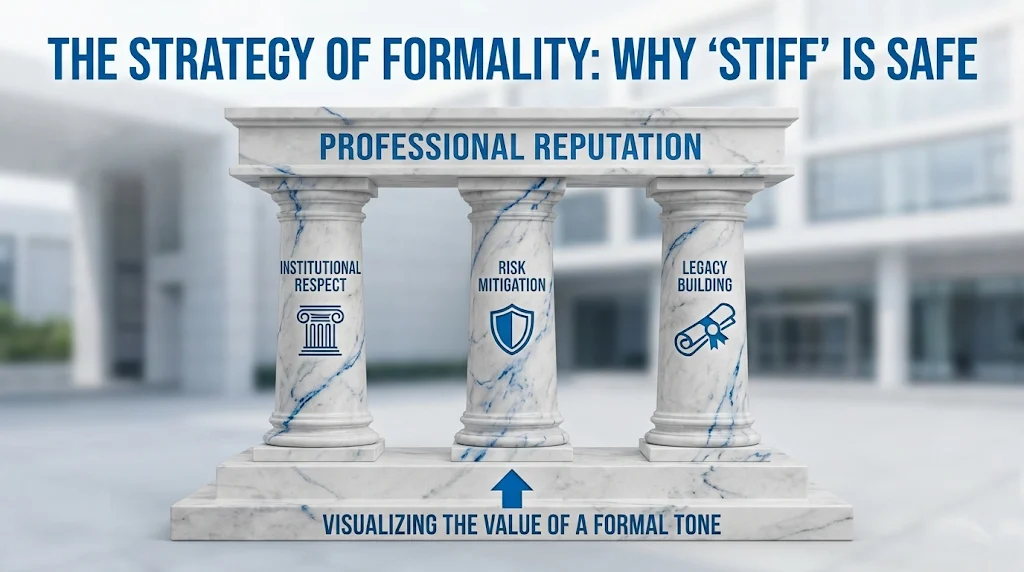
In modern business, we are often told to “bring our whole selves to work.” However, when drafting a business exit email in a conservative sector, this advice can be dangerous. Formality serves a specific strategic purpose:
- 🏛️ Institutional Respect: It signals that you respect the hierarchy and the history of the organization, regardless of your personal feelings. It positions you as a steward of the brand, not just an employee.
- 🛡️ Risk Mitigation: Humor is subjective. A joke that lands with your peer might offend a Managing Director. A formal tone eliminates the risk of misinterpretation. In high-stakes environments, “boring” is synonymous with “reliable.”
- 🎓 Legacy Building: A dignified professional goodbye letter frames you as a serious professional who has outgrown the role, rather than a disgruntled employee fleeing the scene. It preserves your status in the Alumni Network – a critical asset in industries like Law and Consulting.
Deconstructing the Formal Farewell
Writing a formal farewell email to colleagues requires a shift in structure. We are moving from “Conversational” to “Correspondent.”
| Element | Casual Approach (Avoid) | Formal Approach (Adopt) |
|---|---|---|
| Salutation | “Hey team,” / “Hi guys,” | “Dear Colleagues,” / “To the [Department] Team,” |
| The News | “I’m heading out…” | “I am writing to inform you of my departure…” |
| Gratitude | “Thanks for everything!” | “I express my sincere gratitude for the opportunity…” |
| Next Step | “I’m off to Google!” | “I have accepted a new opportunity that aligns with my long-term goals.” |
| Sign-off | “Cheers,” / “Best,” | “Sincerely,” / “Respectfully,” / “With best regards,” |
The “Unspoken Rules” of High-Protocol Exits
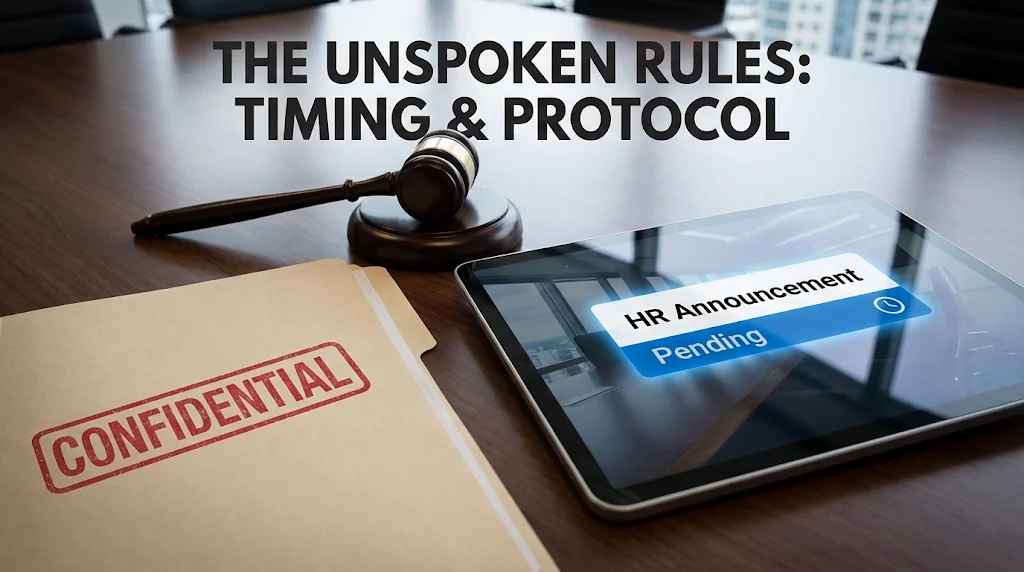
Beyond the text, the context matters. In conservative firms, breaking these unwritten rules can be just as damaging as a typo.
- Timing is Everything: Never send your email before HR or your Manager has sent the official announcement. Pre-empting official comms is seen as insubordination. The ideal time is 2-3 days before your last day, typically mid-morning.
- The “Reply All” Trap: If you are BCC’d on a farewell, reply only to the sender. If you send a farewell, use BCC for large lists to prevent a “Reply All” storm that annoys senior leadership.
- Distribution Lists: Be careful with “All Staff” lists. Unless you are a Senior Executive or have been there 10+ years, sending an email to the entire global firm is often seen as arrogant. Stick to your Division, Department, or Office.
Protocols & Templates: Copy-Paste Dignity
Select the template that matches your seniority and the culture of your firm. When in doubt, choose the more formal option.

1. The “Corporate Standard” (Safe for All Levels)
Best for: Mid-level managers in Banks, Insurance, or Traditional Retail.
Subject: Departure Notification – [Your Name]
Dear Colleagues,
I am writing to inform you that I will be leaving [Company Name], effective [Date].
I would like to express my sincere gratitude for the opportunities I have been given during my tenure here. Working alongside such a dedicated team of professionals has been a privilege, and I am proud of what we have accomplished together, particularly regarding [mention one general achievement, e.g., the Q3 Audit results].
I am fully committed to ensuring a smooth handover of my responsibilities. Moving forward, please direct all inquiries regarding [Your Function] to [Replacement Name] at [Email Address].
I wish the organization and each of you continued success in all future endeavors.
Sincerely,
[Your Full Name]
[Your Title]
[LinkedIn Profile Link]
2. The “Senior Executive” Departure
Best for: Directors, VPs, or Partners. This tone is authoritative, gracious, and focused on the institution’s legacy.
Subject: Transition Announcement
To the Team,
After [Number] years of service, I write to announce my departure from [Company Name], with my final day being [Date].
It has been the distinct honor of my career to serve as your [Title]. Together, we have navigated significant challenges and achieved remarkable growth. I leave with a profound respect for the integrity and talent that defines this institution.
I have every confidence that under the leadership of [Successor/Management Team], the department will continue to thrive and exceed its strategic objectives.
Thank you for your trust, your hard work, and your partnership. I look forward to watching [Company Name]’s continued success from afar.
With deep appreciation and respect,
[Your Full Name]
[Your Title]
3. The “Legal / Government” Strict Formal
Best for: Law Firms, Government Agencies, Academia. This is the most conservative tier of professional farewell email.
Subject: Notice of Departure
Dear Colleagues,
Please accept this correspondence as formal notification of my resignation from [Agency/Firm Name], effective [Date].
I wish to record my appreciation for the professional opportunities afforded to me during my service. The experience of contributing to [Mission/Case Work] has been invaluable to my professional development.
All active files and responsibilities have been transferred to [Replacement Name] to ensure continuity. Please direct future correspondence to [him/her/them] accordingly.
I extend my best wishes to the firm and its staff.
Respectfully,
[Your Full Name]
[Your Title]
4. The “Short Tenure” (Graceful Exit)
Best for: Leaving after less than 2 years. Keep it brief to avoid drawing attention to the short timeline.
Subject: Moving On – [Your Name]
Dear Colleagues,
I am writing to let you know that [Date] will be my last day with [Company Name].
I have accepted a new opportunity that represents the next step in my career path. I want to thank you for the support and collaboration during my time here. I have learned a great deal from working with this team.
My responsibilities have been handed over to [Manager/Replacement Name].
Wishing you all the best.
Sincerely,
[Your Name]
5. The “Retirement” Farewell (Legacy Focus)
Best for: Long-serving employees retiring after 15+ years. This allows for a slightly warmer, reflective tone while maintaining dignity.
Subject: Retirement Announcement – [Your Name]
Dear Friends and Colleagues,
It is with mixed emotions that I announce my retirement from [Company Name], effective [Date], concluding my [Number] years of service with the firm.
Looking back at my tenure, I am filled with gratitude for the relationships built and the milestones we have achieved together. It has been a privilege to witness the growth of this organization and to work alongside such talented individuals.
While I look forward to this next chapter of life, I will always carry with me the fond memories of our shared work. I leave with the utmost confidence in the future of the department.
Thank you for your partnership and friendship over the years.
With warmest regards,
[Your Full Name]
6. The “Internal Transfer” (Promotion/Relocation)
Best for: Moving to a different department or office within the same parent company.
Subject: Transition to [New Department/Office]
Dear Team,
I am writing to share that I will be transitioning from my role in [Current Dept] to join the [New Dept] team as [New Title], effective [Date].
I want to thank you for your collaboration during my time in this division. It has been a pleasure working with this group, and I am grateful for the support you have shown me.
While my role is changing, I look forward to continuing our work together under the broader [Company Name] umbrella. Please feel free to reach out to me at my existing email address.
Best regards,
[Your Full Name]
The Visuals of Authority: Formatting Rules
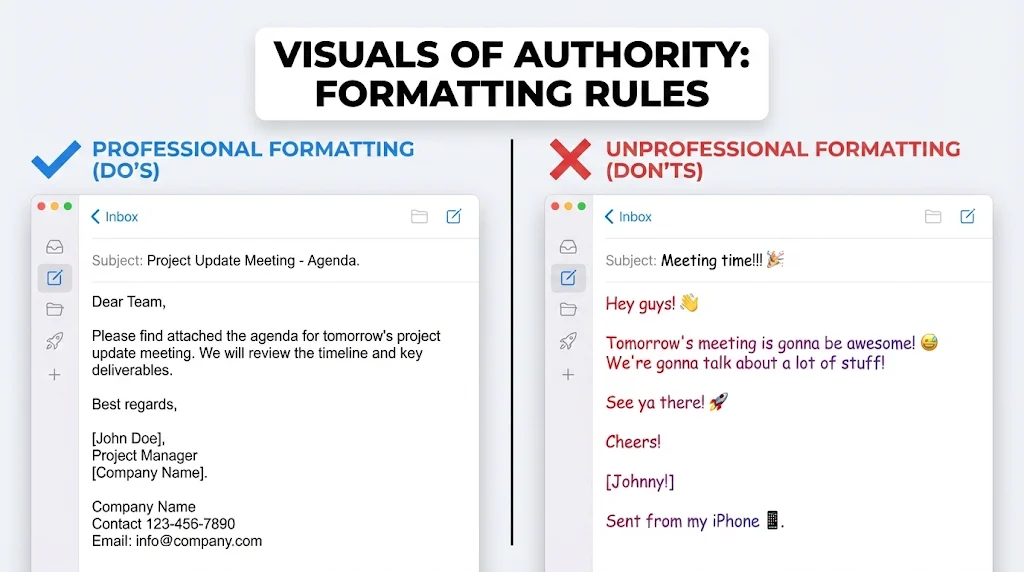
In a formal goodbye email sample, how it looks is as important as what it says. Visual clutter screams “amateur.”
- 🚫 No Emojis: A smiley face 🙂 undermines your authority in a formal letter.
- 🚫 No Colored Text: Stick to black or dark grey. Do not highlight text in yellow.
- 🚫 Standard Fonts Only: Use Arial, Calibri, or Times New Roman. This is not the time for Comic Sans or creative typography.
- ✅ Signature Block: Ensure your email signature is clean, with your current title and LinkedIn URL. Do not include your personal cell phone number unless you have a specific reason to do so.
❓ Frequently Asked Questions
📧 Is it okay to BCC everyone in a formal email?
🤝 Should I mention where I am going?
📝 How long should it be?
😢 Can I express emotion?
Your Final Act of Executive Presence
In many ways, your professional farewell email is your first application for your next job. The colleagues reading it today are the people who will refer you, hire you, or partner with you in ten years. They will not remember the late nights or the stressful deadlines. They will remember how you left: with grace, with dignity, and with class.
Do not rush this. Proofread it three times. Check the recipient list twice. Then hit send and walk out the door with your head high.
For more insights on navigating complex exit scenarios, review our professional resignation processes. If you need templates for other contexts, our comprehensive farewell resources are available. For the definitive playbook on all things exit-related, visit our complete goodbye email guide.
⚠️ Legal Disclaimer: ResignSmartly provides general informational guidance about resignation, workplace communication, notice periods, handovers, and career transitions. Content does not constitute individualized legal advice. Employment laws, contracts, workplace policies, and individual circumstances vary, so review the requirements that apply to your situation and consult an appropriate qualified professional when needed.