- Why it matters: Vendors keep operations running, and a missed handoff can trigger lockouts, stalled work, and unpaid invoices.
- What can go wrong: Dead-inbox billing, SaaS admin and 2FA tied to you, contract auto-renew traps, and reputation damage with future decision-makers.
- Find the hidden vendors: Audit calendar, expense reports, inbox keywords, and bookmarks to build a complete contact list before you write.
- What the email must include: New owner and payer, effective date, status of pending orders, and clear portal actions like transfer, archive, or deactivate.
- Timing and execution: Send 3 to 5 days before you leave, CC the replacement when possible, and confirm admin access and billing routing before your account is cut.
The Invisible Backbone of Your Exit Strategy
I once witnessed a logistical nightmare that started with a simple omission. A marketing director left her role and notified everyone – her team, her boss, and her clients. But she forgot one group: her software vendors. Three weeks later, a critical SaaS subscription failed to renew because the invoice was sent to her deactivated email. The service was suspended on a Monday morning, bringing the entire marketing department to a standstill. It took days of escalations to fix a problem that a single farewell email to vendors could have prevented.
Vendors, suppliers, and service providers are often the forgotten casualties of a resignation. We tend to focus on the people we see in the office or the clients who pay the bills. But the partners who keep the lights on – from the logistics company handling shipping to the freelancer managing the blog – need clarity just as much.
Writing a professional farewell email to suppliers is an act of operational integrity. It protects your company from service disruptions, ensures invoices get paid, and preserves your reputation as a competent professional. This guide will walk you through the nuances of handing over these critical external relationships without dropping the ball.
The “Butterfly Effect” of Vendor Ghosting
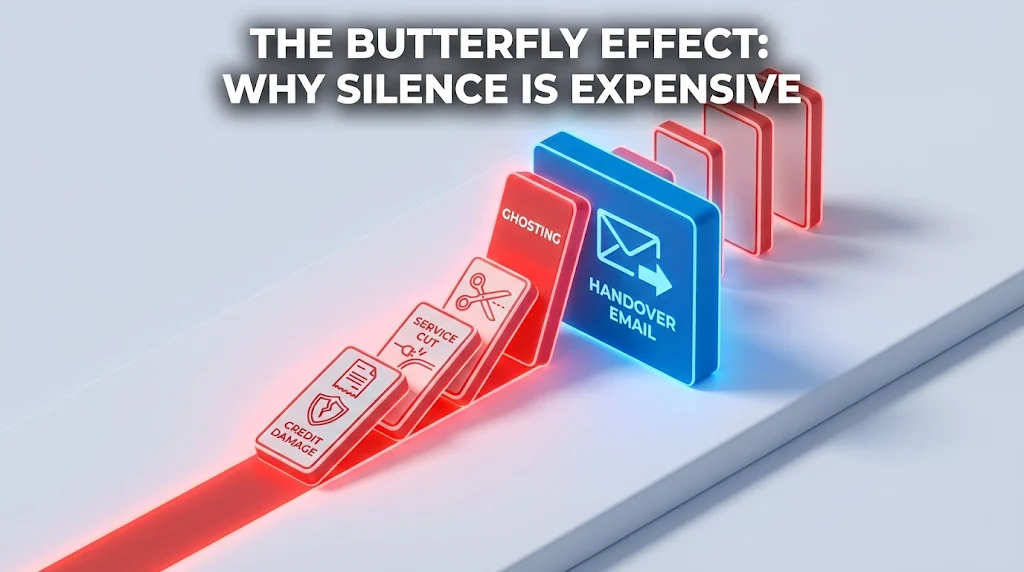
You might think, “I’m just the customer; they won’t care if I leave.” This is a dangerous misconception. In B2B relationships, stability is currency. When a key contact disappears, it triggers alarm bells that can ripple through your company’s operations.
Failing to send a vendor notification email creates specific, high-stakes risks:
- 💸 Financial Paralysis: Invoices sent to a dead email address go unpaid. This leads to late fees, credit holds, and damaged credit ratings. I’ve seen credit lines cut for entire companies because one accounts payable contact left without a handover.
- 🔒 The “SaaS Lockout”: This is the modern crisis. If you leave with admin access to vendor portals (like AWS, Salesforce, or HubSpot) and your phone number is tied to the 2FA (Two-Factor Authentication), your team is effectively locked out. IT cannot “hack” into these external systems easily.
- 🤝 Reputation Capital: The account manager at your vendor today might be the procurement director at your dream company tomorrow. Industries are small. Ghosting them marks you as unprofessional and disorganized.
- ⚖️ Legal Vulnerability: For contract renewals or termination notices, missing a deadline because the notification went to a ghost inbox can auto-renew expensive contracts you intended to cancel.
The Pre-Departure Audit: Finding the “Hidden” Vendors
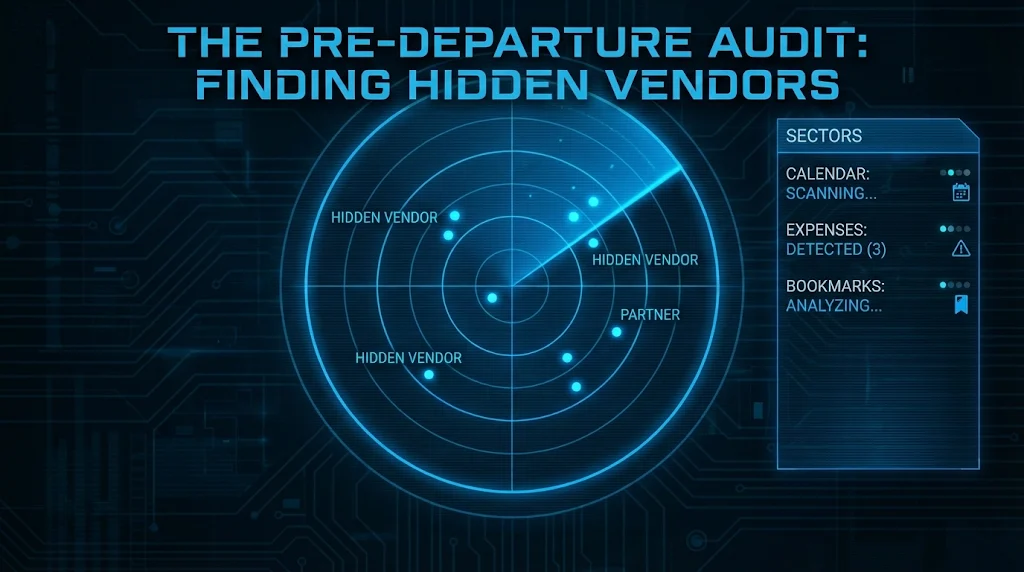
The biggest problem isn’t knowing how to write the email; it’s remembering who to send it to. We often forget the software we subscribed to six months ago or the freelancer we use once a quarter.
Before you draft your emails, execute this Vendor Discovery Audit:
| Audit Source | What to Look For |
|---|---|
| Calendar Review | Scan your calendar for the last 12 months. Look for recurring meetings with external domains. |
| Expense Reports | Check your credit card statements and expense reports. Who are you paying monthly? (e.g., Zoom, Canva, Hosting). |
| Email Search | Search your inbox for keywords like “Invoice,” “Renewal,” “Subscription,” “Agreement,” and “Statement.” |
| Browser Bookmarks | Check your “Work” bookmarks folder. Are there login portals for tools only you use? |
The Power Dynamic: Vendors vs. Clients
It is crucial to understand that a goodbye email to partners differs fundamentally from one sent to clients. The power dynamic flips. With clients, you are reassuring them about service quality. With vendors, you are reassuring them about administrative continuity.
| Feature | Client Farewell | Vendor Farewell |
|---|---|---|
| Primary Goal | Retain Revenue | Maintain Service & Payment |
| Key Anxiety | “Will the work suffer?” | “Who pays the invoice? Who approves the scope?” |
| Tone | Warm, Service-Oriented | Direct, Process-Oriented, Authoritative |
Anatomy of a Farewell Letter to Service Providers
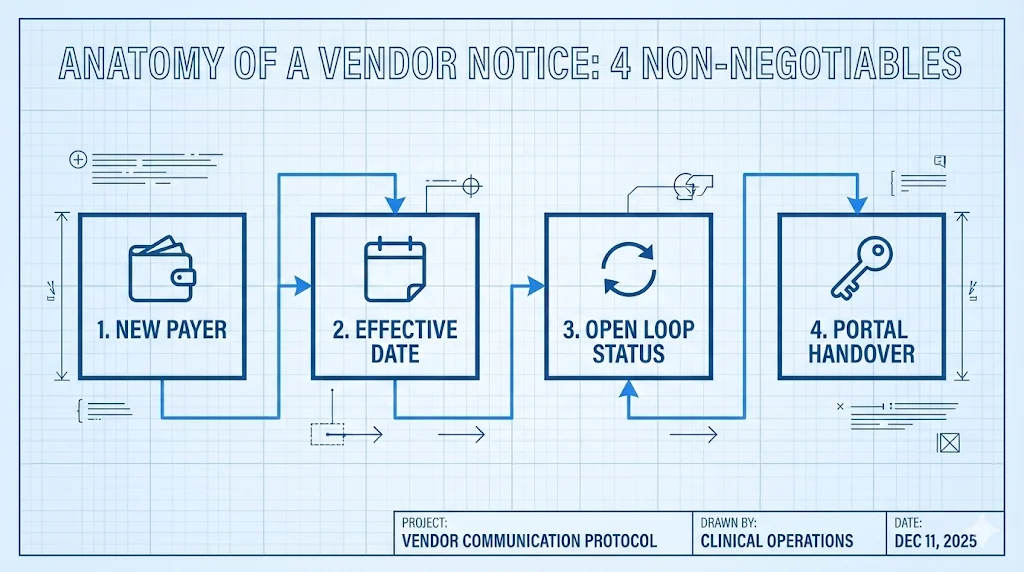
Unlike internal emails where emotion is acceptable, vendor emails should be clinically precise. Your goal is to route information to a new destination effectively.
Every effective notification must include:
- ✅ The New Admin/Payer: Who approves the budget now? Who receives the PDF invoice? Be specific.
- ✅ The “Effective Date”: When should they stop emailing you? This draws a hard line in the sand.
- ✅ Open Loop Confirmation: Explicitly state the status of pending orders. “PO #12345 is still valid.” This prevents them from pausing work out of fear.
- ✅ Portal Handover Instructions: If they manage a login for you, tell them exactly what to do with your user account (Archive, Delete, or Transfer).
Scripts for Every Supply Chain Scenario
Choose the template that fits the nature of your partnership. A strategic partner gets a different level of care than an office supply vendor.
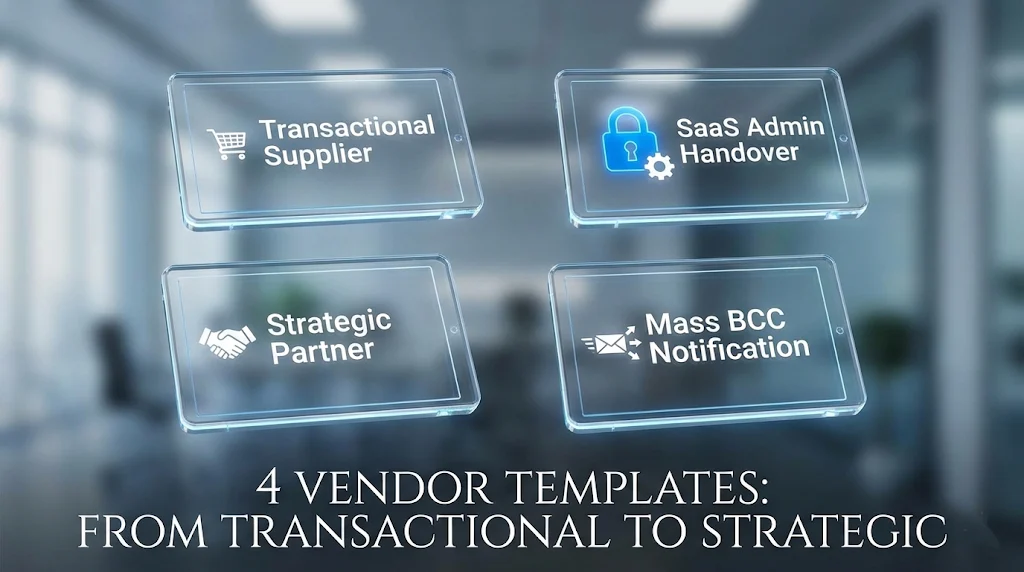
1. The Transactional Supplier (The “Keep the Lights On” Email)
Best for: Vendors you order from regularly but don’t have a deep relationship with (e.g., Office Supplies, Catering, Logistics). The goal here is pure efficiency.
Subject: Point of Contact Update – [Your Company Name]
To: [Vendor Contact]
Cc: [Replacement Name]
Hi [Vendor Name],
I am writing to let you know that I will be leaving [Company] on [Date].
To ensure there are no delays in orders or payments, please update your records. Effective immediately, [Replacement Name] will be your primary contact for all new orders and invoicing.
New Contact Information:
Name: [Replacement Name]
Email: [Email]
Phone: [Phone]
Please ensure all future invoices for [Account Number] are routed to [Replacement Name] or our Accounts Payable department directly.
Thank you for your reliable service over the years.
Best regards,
[Your Name]
2. The Service Provider / SaaS Admin (The “Security Handover”)
Best for: Software subscriptions, agencies, or consultants where you hold admin rights. This farewell letter to service providers is critical for security and access continuity.
Subject: URGENT: Admin Access Transfer & Contact Update – [Account ID]
To: [Support/Account Manager]
Cc: [Replacement Name], [IT/Security Contact]
Hello Team,
I am transitioning out of my role at [Company] effective [Date].
As I am currently the Primary Admin (and 2FA holder) on our account, we need to transfer these rights to [Replacement Name] (copied here) before my departure to ensure we don’t lose access to our dashboard.
Action Required Immediately:
1. Please downgrade my user permissions to “Inactive” on [Date].
2. Assign “Super Admin” privileges to [Replacement Email].
3. Update the billing contact to [Replacement Email] for the upcoming renewal.
[Replacement Name] will follow up today to confirm these changes are made and reset the 2FA settings.
Thanks for your help in keeping this secure,
[Your Name]
3. The Strategic Business Partner (The “Relationship Builder”)
Best for: Agencies, Consultants, or long-term partners where the relationship drives revenue or strategy. This needs warmth and “future pacing.”
Subject: Partnership Transition – [Your Name]
To: [Partner Name]
Cc: [Replacement Name]
Dear [Partner Name],
I wanted to reach out personally to share that I will be moving on from [Company] next week.
Our partnership has been a highlight of my time here. I am particularly proud of the work we’ve done on [Project Name] – it truly set a new standard for our department. To ensure we maintain this momentum, I am handing the reins to [Replacement Name], who is fully briefed on our joint goals for Q4.
Your New Lead: [Replacement Name] ([Email])
[Replacement Name] has a deep background in [Skill] and is excited to pick up where we left off. I’m confident the partnership will continue to thrive under their guidance.
I’d love to stay connected as I move to my next chapter. Feel free to find me on LinkedIn here: [Link].
All the best,
[Your Name]
4. The “Mass” Vendor Notification (BCC)
Best for: Cleaning up a long list of minor contacts via BCC (e.g., freelancers you use occasionally, sporadic suppliers).
Subject: Update regarding your account contact at [Company]
To: [Yourself]
Bcc: [Vendor List]
Hi everyone,
I am writing to update you that effective [Date], I will no longer be with [Company].
Please update your address books. For all future inquiries, orders, and invoices, please contact:
[Replacement Name]
[Email Address]
[Phone Number]
For any invoices currently pending, please ensure they are submitted by [Date] to ensure prompt processing before my departure.
Thank you for your support over the years.
Best regards,
[Your Name]
Timing & Logistics: The 3-Day Rule
Unlike clients, who might need weeks of hand-holding, vendors need efficiency. However, telling them too late causes “invoice limbo.”
The Ideal Window: 3-5 Days Before Departure.
Why this specific window?
- It gives them time to update their CRM and billing systems (which often takes 24-48 hours in large organizations).
- It allows you to approve one final round of invoices so your successor starts with a clean slate.
- It ensures you are still around to answer “Wait, who do I send the contract to?” questions without panicking.
💡 Pro Tip: If you are the signatory on legal contracts, consult your Legal department. You may need to formally sign a “Change of Control” or “Authorized Signatory” transfer document before you leave. Do not assume your successor automatically inherits your signature authority.
❓ Frequently Asked Questions
📧 Should I introduce my replacement in the same email?
🤔 Do I need to tell vendors where I am going?
🛑 What if I don’t have a replacement yet?
🔒 What about 2-Factor Authentication (2FA)?
💸 Can I send this after I leave?
Leave a Clean Desk (and Inbox)
The hallmark of a true professional is how they leave the room. By sending a clear, timely farewell email to vendors, you are ensuring that the machinery of business keeps humming long after you’ve turned in your badge.
Your successor will thank you for not leaving them with a mess of unpaid bills and locked accounts. Your vendors will respect you for the smooth transition. And you will walk away knowing you tied up every loose end.
Before you draft your final notes, ensure you have reviewed our guides on professional resignation processes and explored our comprehensive farewell resources. For a complete strategy on exiting gracefully, check out the ultimate goodbye email guide.
⚠️ Legal Disclaimer: The resignation templates, email samples, and professional guidance provided in this guide are for informational purposes only and do not constitute legal advice. Employment laws and contract requirements vary by jurisdiction and individual circumstances. Please review your employment agreement and consult your HR department and/or a qualified attorney to ensure compliance with applicable laws and policies.