
- Triad of obligation: Contract, law, and company policy decide your real notice requirement, so “standard two weeks” can be wrong.
- Last-day math matters: Business days vs calendar days, bank holidays, and office closures can shift your exit date and put you in breach if you guess.
- Money traps hide in timing: Bonus “good standing” rules, vesting cliffs, and health insurance cutoffs can cost you more than the final paycheck.
- Write a boring, legally clean letter: State resignation, state the exact final date tied to the notice period, offer a transition plan, avoid vague language and written grievances.
- Plan for what happens after send: Garden leave can block your start date, counter-offers usually backfire, and your reputation is set by how you hand over and communicate.

You have hit “send” on your resignation letter with notice period. You feel a wave of relief wash over you. But three days later, HR calls you into a meeting. They are not smiling. It turns out, your calculation of the “last working day” was off by three days because you counted weekends, but your contract specifies “business days.” Now, you are technically in breach of contract, your final bonus payout is at risk because you won’t be “employed in good standing” on the payout date, and that vacation you booked? It’s gone.
This isn’t a scare tactic; it is a common reality for professionals who treat their notice period as a mere formality rather than a binding legal and financial commitment. The period between saying “I quit” and actually walking out the door is the most dangerous phase of your employment lifecycle. It is a minefield of potential errors – from vague date language that allows employers to extend your tenure against your will, to misaligned timelines that leave you with a gap in health insurance coverage.
Most guides will just give you a template and wish you luck. This guide is different. We are going to dissect the strategic architecture of the notice period. We will explore the complex interplay between your employment contract, labor laws, and company politics. You will learn how to protect your reputation, secure every dollar you are owed, and craft a resignation letter that closes one door professionally while ensuring the next one opens smoothly.
The Triad of Obligation: Contract, Law, and Policy
Before you even open a blank document to write your letter, you need to understand the source of your resignation notice requirements. Many employees operate on assumptions – “Two weeks is standard, right?” – without realizing that their specific obligation is governed by a hierarchy of authority. Misunderstanding this hierarchy is the root cause of most resignation disputes.
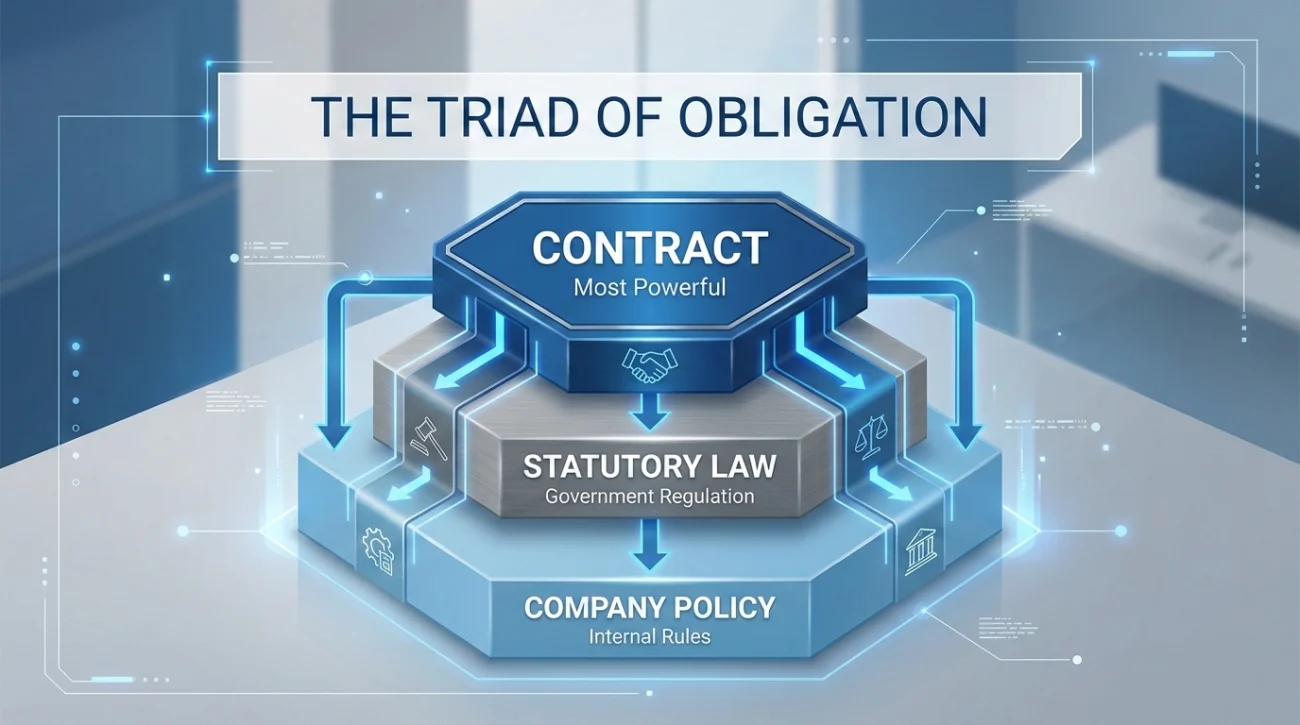
1. The Contractual Layer (The “Source of Truth”)
Your employment contract is the most powerful document in this equation. If you signed an agreement stating you must provide “one month’s written notice,” that clause overrides any “at-will” employment norms or general courtesies. For senior roles, it is not uncommon to see notice periods of three to six months.
The “Clawback” Trap: Read the fine print. Does your contract have a “clawback” provision for training costs or sign-on bonuses if you leave within a certain timeframe? Does it specify that failing to work the full notice period results in a forfeiture of accrued vacation pay? I have seen executives lose five-figure sums because they resigned two days before their retention period officially expired. Your contract isn’t just a list of rules; it’s a financial map.
2. The Statutory Baseline (The Safety Net)
Beneath the contract lies the law. In the United States, “at-will” employment means that, absent a contract, no notice is legally required (though highly recommended), a standard clarified by the US Department of Labor. However, in the UK, Canada, Australia, and much of Europe, there is a statutory standard resignation notice based on your length of service.
For example, an employee with five years of tenure might be legally obligated to give four weeks’ notice under local labor laws, even if their old offer letter only mentioned two weeks. In this conflict, the law typically supersedes the contract if the contract offers less protection or notice than the statute requires. Always check your local jurisdiction’s employment act.
3. Company Policy (The Operational Rules)
Finally, there are the resignation letter notice rules buried in the employee handbook. These dictate the mechanics of your departure. They answer specific questions:
- Does the notice period pause during company holidays (like the Christmas break)?
- Must the resignation be physical, or is email acceptable?
- Who must receive the notice? (Often, notifying just your manager isn’t enough; HR must be copied to stop the payroll clock).
Ignoring these operational rules gives a hostile employer ammunition to delay your departure or mark you as “ineligible for rehire.”
The Mathematics of Departure: Calculating Your Last Day
The single most common error in resignation letters is a specific date mismatch. You write “My last day will be Friday the 14th,” but HR calculates it as “Tuesday the 18th.” Why? Because you counted calendar days, and they counted business days. Or perhaps you forgot a bank holiday.
Calendar Days vs. Business Days
This distinction is critical.
Scenario A: “Four weeks notice.” This almost always means 28 calendar days.
Scenario B: “20 days notice.” This is ambiguous. Does it mean 20 working days (effectively a month) or 20 calendar days?
If your contract is vague, the interpretation often defaults to the standard practice of the industry, but “standard” is a shaky defense in a dispute. Always clarify this before you submit the letter. If you are trying to start a new job on a specific date, a miscalculation here can leave you technically employed at two places simultaneously – a breach of contract for many organizations.
The Holiday Paradox
Imagine resigning on December 15th with a two-week notice. The office is closed from December 24th to January 2nd. Do those closure days count towards your notice?
In many companies, the answer is NO. Notice periods are intended for knowledge transfer. If the office is closed, you cannot transfer knowledge. Therefore, your “two-week” notice might effectively stretch to four weeks on the calendar to account for the closure. Failing to account for this can destroy your timeline for starting a new role.
| Calculation Method | Pros | Cons |
|---|---|---|
| ✅ Business Days | Clearer for handover planning (only counts days you actually work). | ❌ Results in a longer actual wait time before you can leave. |
| ✅ Calendar Days | Faster exit; includes weekends in the count. | ❌ Ambiguous if holidays fall within the period; often disputed by HR. |
The Financial Stakes: It’s Not Just About Salary
Strategic resignation is about protecting your wallet. Your resignation letter is a financial trigger event. Once submitted, it alters your status from “active employee” to “terminating employee,” which changes how you are treated by payroll systems.

The “Employed in Good Standing” Trap
Most annual bonuses, commissions, and profit-sharing schemes have a strict eligibility clause: “Employee must be employed and in good standing on the date of payout.”
If the bonus pays out on March 15th, and you submit a two-week notice on March 1st, your last day is March 15th. You made it, right?
Wrong. Many policies state you must not have submitted notice prior to the payout date. By resigning on March 1st, you effectively disqualified yourself from a bonus you spent all year earning. The strategic move here is to wait until the money hits your bank account before handing in the letter.
RSU and 401k Vesting Cliffs
Stock options and retirement matches often vest on specific anniversaries. Leaving one week before your 3-year anniversary could cost you 20% of your unvested stock or the company match on your 401k. Your resignation letter sets the “Termination Date.” If that date falls 24 hours before a vesting cliff, you lose the equity. Always check your equity plan documents and calculate your notice period so your last day falls after the cliff.
The Health Insurance Gap
In the US, employer-sponsored health insurance usually runs through the end of the month in which you terminate.
Exit Date: October 31st. Insurance ends October 31st. You are uncovered on November 1st.
Exit Date: November 1st. Insurance typically covers you for the entire month of November.
By extending your resignation notice by just one day – pushing your last day into the first of the next month – you can secure 30 days of free health coverage. This is a massive financial win for the cost of one working day.
Drafting Your Letter: The Anatomy of a Perfect Resignation
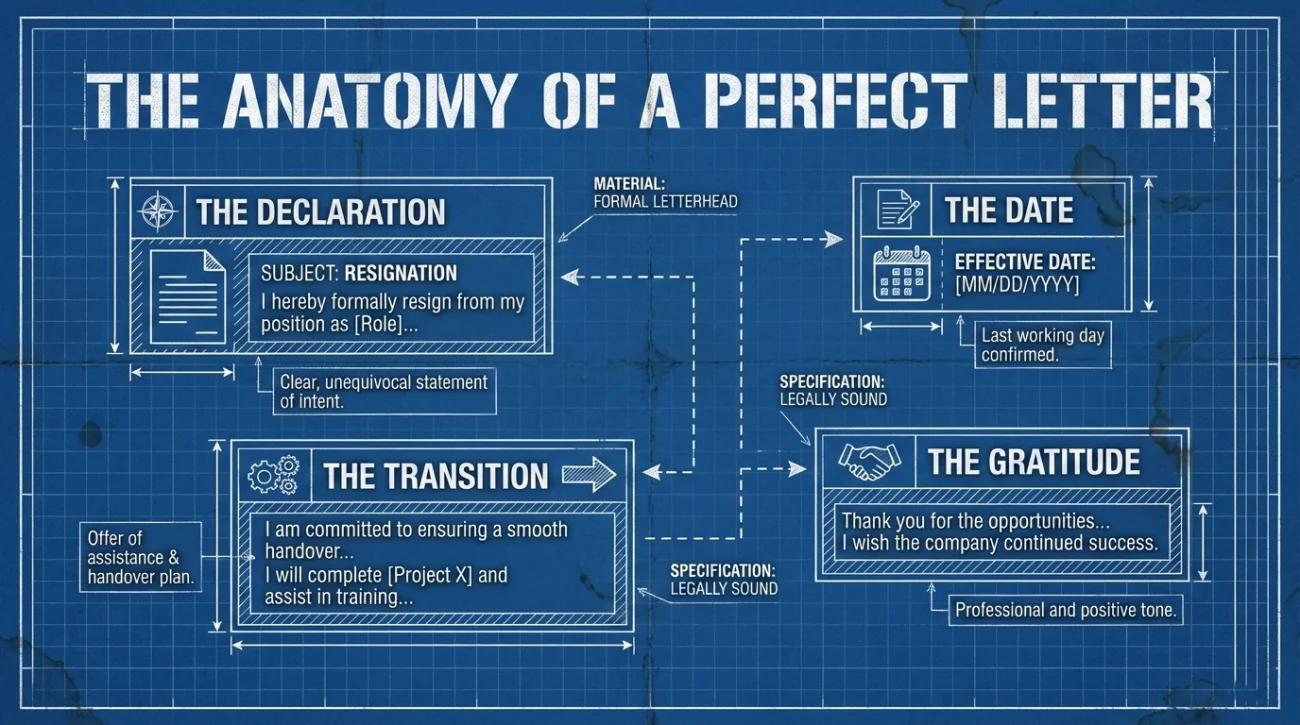
Your letter needs to be boring. This is not the place for manifestos, emotional outpourings, or detailed feedback. It is a legal record. It needs to accomplish three things: state you are leaving, state the date, and offer a transition plan.
Sentence-by-Sentence Breakdown
- The Declaration: “I hereby resign…” (Unambiguous).
- The Date: “My final day of work will be [Date], in accordance with my notice period of [X weeks].” (Tying the date to the contract).
- The Transition: “I intend to complete [Project X] and hand over my duties to [Person Y].” (Shows professionalism).
- The Gratitude: “Thank you for the opportunity…” (Keeps the bridge intact, even if you are lighting a match behind you).
Phrases to Avoid
Avoid saying “I hope to leave on…” or “I was thinking my last day could be…” This vague language opens the door for negotiation you might not want. Be declarative. Also, never include grievances in writing. “I am leaving because of the toxic culture” will just go into your permanent file and could be read by a future reference checker. Save the feedback for the exit interview, or better yet, keep it to yourself if you want a clean break.
Resignation Letter Templates (Copy & Paste)
These templates are designed to be legally robust and professionally courteous. Choose the one that fits your specific situation.
1. The “By The Book” Standard Notice
Use this for a standard departure where you are fulfilling your contractual obligations perfectly.
Subject: Resignation – [Your Name]
[Date]
Dear [Manager’s Name],
Please accept this letter as formal notification that I am resigning from my position as [Your Job Title] at [Company Name].
In accordance with my employment contract which requires a [Number]-week notice period, my final day of employment will be [Day of Week, Month Day, Year].
I am committed to ensuring a smooth transition during my remaining time here. I have already begun updating all status documents for the [Project Name] and will work with the team to hand over my responsibilities before my departure.
I want to thank you for the opportunities I have had at [Company Name]. I wish you and the team nothing but success in the future.
Sincerely,
[Your Signature]
[Your Name]
2. The “Short Notice” Request (Negotiation)
Use this if you need to leave earlier than your contract states. Note the change in tone – you are asking, not just telling.
Subject: Resignation – [Your Name]
[Date]
Dear [Manager’s Name],
Please accept this letter as my formal resignation from the position of [Your Job Title].
Although my contract stipulates a notice period ending on [Contractual End Date], I would like to request your approval to shorten this period, making my final working day [Proposed Earlier Date].
I believe I can fully transition my current responsibilities by this earlier date. I am willing to work extra hours over the coming days to ensure all my tasks are completed and documented to your satisfaction. I hope we can agree to this timeline to allow for my transition to a new opportunity.
Thank you for your understanding and for your support during my time at [Company Name].
Sincerely,
[Your Name]
3. The Senior Executive / Extended Handover
For senior roles where the relationship is paramount and the transition is complex.
Dear [Manager’s Name],
It is with a mix of gratitude and sadness that I write to formally resign from my role as [Senior Title].
Per my employment agreement, I am providing [Number] months’ notice. My final official day will be [Date]. However, I want to ensure that my departure causes zero disruption to the strategic goals we have set for Q4.
I have prepared a detailed succession plan and am available to assist in recruiting and onboarding my replacement. My goal is to leave the department in a stronger position than I found it.
Thank you for your mentorship and partnership over the years.
Sincerely,
[Your Name]
For even more specific scenarios, such as leaving due to illness or family emergencies, browse our complete resignation letter template library.
Common Notice Period Scenarios (Reference List)
Your situation might not fit the standard “two-week” mold. We have developed specialized guides for every variation of the resignation timeline. Use the list below to find the specific advice that matches your contract and circumstances:
- ⏱️ Resignation letter with two weeks notice: The gold standard for most US corporate jobs. Learn exactly what to say to keep it professional.
- 🗓️ Resignation letter with one month notice: Essential for senior management or roles in Europe/Australia where longer transitions are legally required.
- 🚀 Immediate resignation letter: Sometimes you can’t stay another day. This guide covers how to quit “effective immediately” while minimizing legal fallout.
- 📉 Resignation letter with short notice: When you can give some time, but not the full amount required by your contract. Strategies for negotiation.
- 🚪 Resignation letter with no notice: The “nuclear option.” Understand the consequences of walking out without warning.
- ⚡ Resignation letter with 24 hours notice: A slightly more courteous version of immediate resignation, giving the company one day to collect your badge.
- 🤝 Request to waive notice period: How to ask your employer to let you go early (and why they might actually say yes to save money).
Global Variations: Notice Periods Around the World
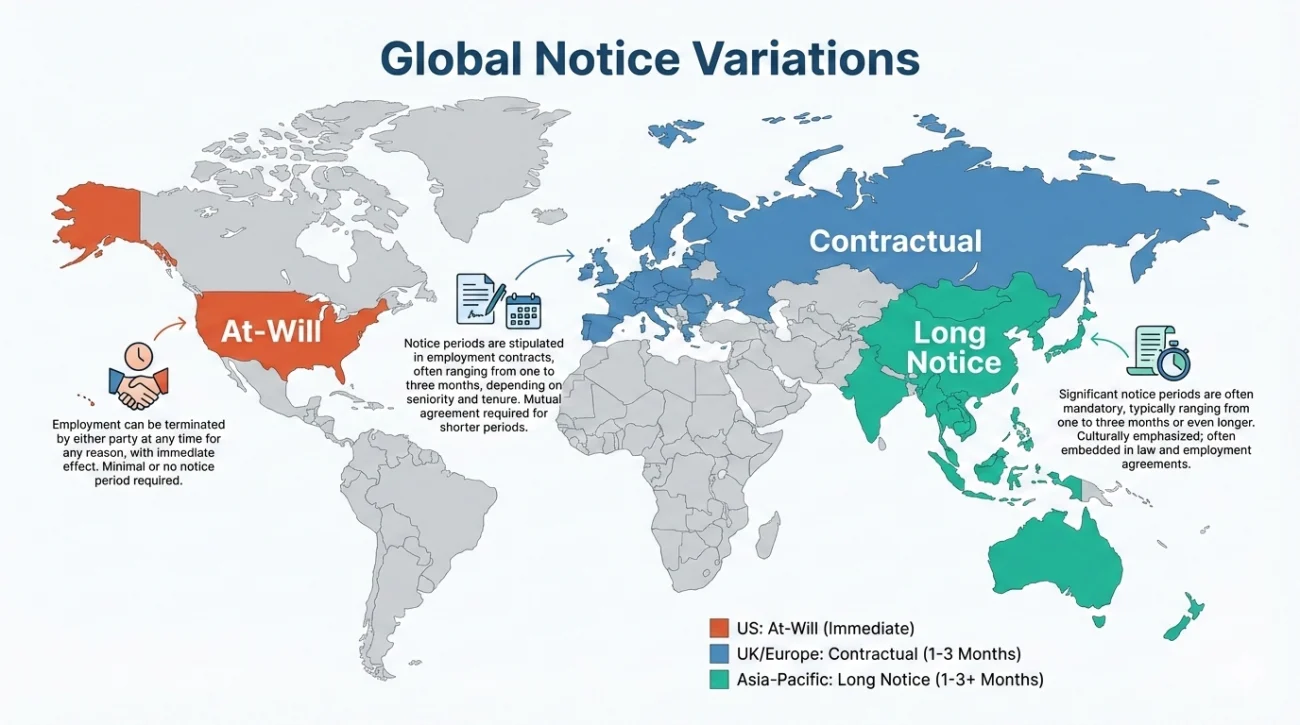
In the digital age, many of us work for international companies. It is vital to understand that “Standard Notice” changes depending on where your contract is domiciled.
The UK and Europe
Unlike the US “at-will” system, European employment is heavily contractual.
UK: As detailed by ACAS (The Advisory, Conciliation and Arbitration Service), statutory notice rises with service (1 week per year worked, up to 12 weeks). However, contracts for professionals often demand 3 months of notice.
Germany/France: Notice periods are strictly regulated and can be very long – often 3 to 6 months for senior staff. Resigning “effective immediately” is virtually impossible without “good cause” (gross misconduct by the employer).
Asia-Pacific
Australia: The Fair Work Ombudsman mandates specific notice periods based on tenure and age, which can surprise expats used to simpler systems.
India: Notice periods are notoriously long, often ranging from 60 to 90 days. Companies are strict about “buyout” options (paying salary in lieu of notice) and may refuse to release your “Relieving Letter” (a mandatory document for your next job) if you don’t serve the full term.
Japan: While the Civil Code theoretically allows resignation with 2 weeks’ notice, cultural expectations and corporate rules often demand 1-3 months to preserve “Wa” (harmony).
Common Risks: Garden Leave and Counter-Offers
Even if you calculate your dates perfectly, two things can derail your plan: Garden Leave and the Counter-Offer.
Understanding “Garden Leave”
This is a clause where the company accepts your resignation, pays you for your notice period, but forbids you from coming to work or accessing company systems. They effectively pay you to “tend your garden.”
The Risk: You are still legally employed. You cannot start your new job yet. If you start your new job while on Garden Leave, you are working for two companies at once, which is usually a breach of contract. Enjoy the paid time off, but do not double-dip.
The Counter-Offer Trap
When you hand in your letter, your boss might panic and offer you a raise to stay. Statistics show that 80% of employees who accept counter-offers leave within 6 months anyway. Why? Because the trust is broken. You have revealed you are looking to leave. By submitting your resignation letter, you should be mentally 100% committed to the exit. Do not use the letter as a bargaining chip unless you are prepared for it to backfire.
What Happens After You Hit Send?
Sending the letter is just step one. The “Lame Duck” period follows. This is where your reputation is cemented. To ensure you handle this phase correctly, you need a plan for your internal communications.
First, coordinate with your manager on how to tell the team. Do not leak the news before an official announcement. Once the news is public, send a tailored resignation email to your wider colleagues.
Next, focus on the handover. A vague handover frustrates your former team and ensures they will speak poorly of you after you leave. Use a structured handover email to document passwords, project states, and key contacts.
Finally, on your very last day, send a gracious goodbye email. This is your networking tool. Include your personal LinkedIn or email so valuable contacts can find you later.
❓ FAQ
📧 Is email considered “written notice”?
In 99% of modern businesses, yes. However, check your employee handbook. Some legacy contracts strictly define “written notice” as a physical letter delivered by registered mail. While rare, ignoring this technicality could allow a litigious employer to claim you never officially resigned. Always cc your personal email address so you have a timestamped copy of the submission.
🗓️ What if I resign while I’m already on vacation?
You can resign while on vacation, but be careful about the notice period count. If your contract requires you to facilitate a handover, resigning from a beach in Bali might be seen as bad faith. Your employer might require you to return to work to complete the notice period, or they might simply terminate you immediately. It is generally more professional to resign when you return.
💰 Can I just pay the company to let me leave early?
This is known as a “buyout” of your notice period. In some countries (like India) or senior executive contracts, this is explicitly allowed. In the US/UK, it’s a negotiation. You can offer to forfeit your salary for the notice period in exchange for an early release, but the company is not obligated to accept. They might value your presence for the handover more than the money saved.
⚖️ Is a resignation letter legally binding?
Yes. Once you submit a formal resignation with a specific date, you cannot simply “take it back” if your new job offer falls through. The employer must agree to rescind the resignation. If they have already started looking for your replacement, they are fully within their rights to enforce your departure on the date you stated.
🤒 What happens if I get sick during my notice period?
You are entitled to sick leave as per your company policy and local laws. However, taking suspicious sick leave immediately after resigning (often called “pulling a sickie”) is a fast way to burn bridges and potentially face a disciplinary hearing during your final days. If you are genuinely ill, get a doctor’s note to protect yourself from accusations of contract avoidance.
Final Thoughts
There is an old saying in HR: “People remember the first day and the last day.” You might have been a stellar employee for five years, but if your exit is messy, calculating, or unprofessional, that is the memory that will stick.
The resignation letter with notice period is not just a piece of paper; it is the final act of your professional performance at that company. By taking the time to understand the legal nuances, calculating your dates with precision, and navigating the financial implications carefully, you ensure that you leave not just with your final paycheck intact, but with your reputation glowing. Treat this process with the strategic seriousness it deserves, and your future self will thank you.
⚠️ Legal Disclaimer: ResignSmartly provides general informational guidance about resignation, workplace communication, notice periods, handovers, and career transitions. Content does not constitute individualized legal advice. Employment laws, contracts, workplace policies, and individual circumstances vary, so review the requirements that apply to your situation and consult an appropriate qualified professional when needed.