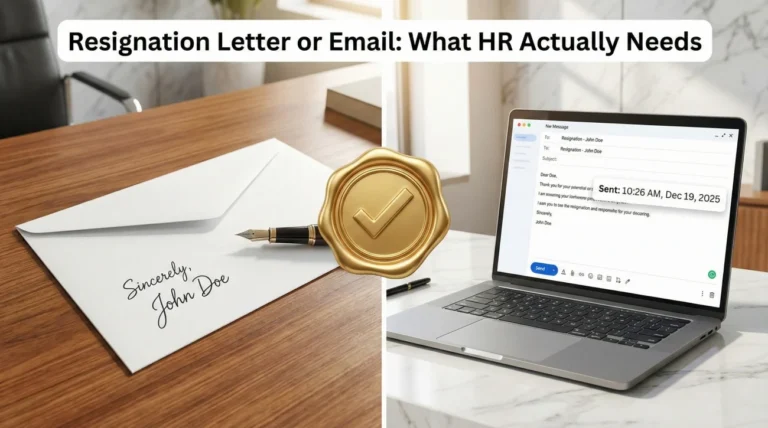

- Core thesis: A short resignation letter is safer because every extra sentence becomes permanent, reviewable, and usable against you.
- Risk logic: Skip reasons, future plans, competitor names, and big promises, because those create liability, scrutiny, and broken expectations.
- 3-sentence formula: Declare resignation, state your exact last day, then close with one polite line of courtesy.
- Use cases: Brevity is best for toxic exits, short-tenure “false starts,” and situations where you expect counter-offers.
- Final polish: Double-check date math, exact job title, and clean formatting, because one typo stands out in a 50-word document.
The Strategic Advantage of Saying Less: Why Brevity Is Your Best Defense
In a world that equates word count with effort, it feels counterintuitive to hand in a resignation letter that is shorter than a grocery list. You might worry that brevity looks cold, ungrateful, or unprofessional. But ask any employment lawyer or seasoned HR director, and they will tell you the exact opposite: when it comes to resignation documentation, less is not just more – it is safer.
Every word you write in a resignation letter becomes a permanent part of your personnel file. It is a legal document, not a diary entry. Detailed explanations invite scrutiny (“Wait, why did they say they were leaving for ‘growth’? Did we not offer training?”); elaborate gratitude can ring hollow or be used to contradict future claims of constructive dismissal; and long-winded transition promises create expectations you might not be able to meet during a busy notice period.
A short resignation letter minimizes these risks by reducing your written statement to the absolute essentials – your position, your end date, and basic courtesy. It gives future readers nothing to question, criticize, or weaponize. This guide is your masterclass in the art of the “under 100 words” exit. We will show you how to strip away the noise and submit documentation that is surgically precise, protecting your reputation while satisfying every bureaucratic requirement.
The Psychology and Strategy of Brevity
Brief doesn’t mean lazy. Writing a short, effective letter requires more discipline than rambling on for two pages. Strategic brevity serves specific professional purposes that longer letters simply cannot match.
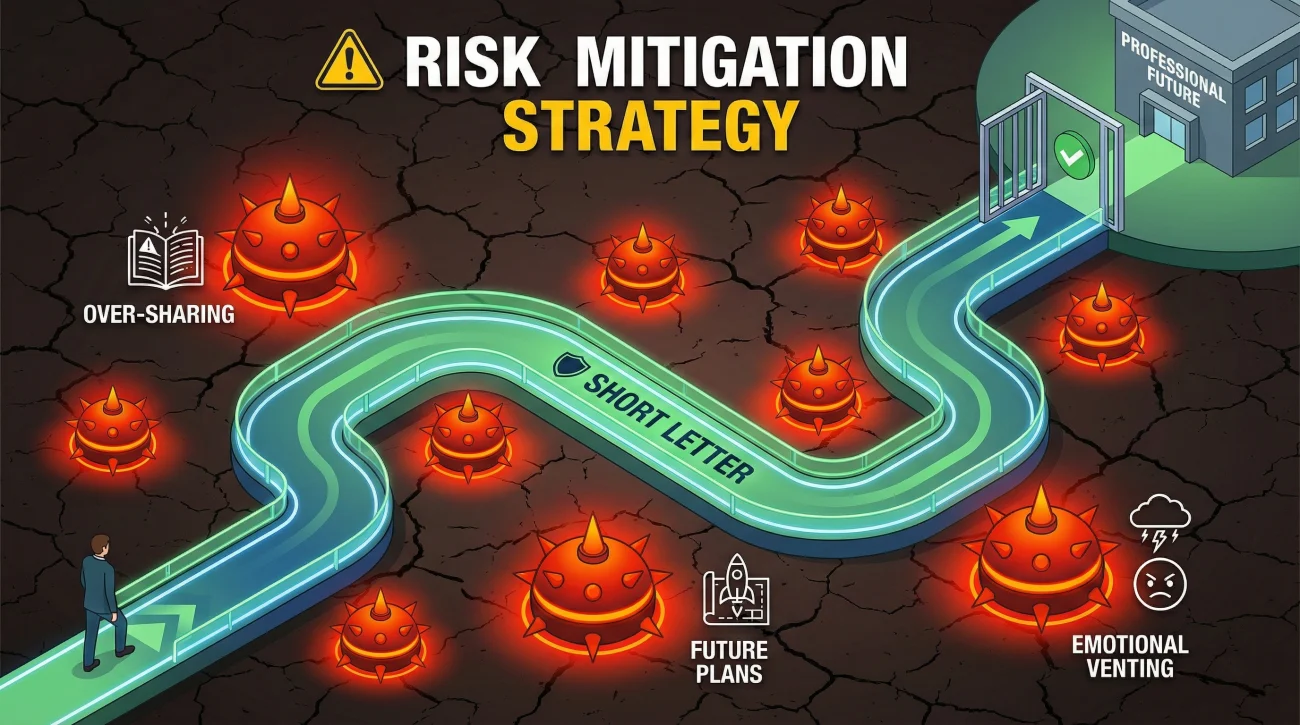
Risk Mitigation: Silence Is Golden
The primary function of a resignation letter is to end a legal contract. Anything beyond that function adds liability. Consider the risks hidden in “extra” sentences:
- ❌ Mentioning the new job: “I’m excited to join [Competitor Name].”
Risk: Immediate termination due to conflict of interest or non-compete triggers. - ❌ Explaining the “Why”: “I need a role with better work-life balance.”
Risk: This is permanently recorded as a complaint, which might mark you as “unwilling to work hard” in future reference checks (however unfair that may be). - ❌ Over-promising: “I will finish the entire Q4 roadmap before I leave.”
Risk: When you inevitably run out of time, you leave on a broken promise rather than a success.
A brief resignation letter containing only facts eliminates these landmines. It gives critics nothing to attack and gives you nothing to regret reading ten years later.
Administrative Efficiency
HR departments are processing machines. When they receive a resignation, they need three data points to input into the Human Capital Management (HCM) system: Who is resigning? From what role? When is the last payroll date? Everything else is noise.
Long letters require HR staff to hunt for these dates amidst paragraphs of text. Short letters get processed instantly. By submitting a clean, concise document, you are subtly signaling that you understand how business works and that you respect their time. Efficiency is a hallmark of professionalism.
The “Cooling Off” Mechanism
Resignation decisions often trigger a storm of emotions – relief, anger, anxiety, or guilt. Writing extensively while emotionally activated is dangerous. You might inadvertently include a passive-aggressive “thank you” or an overly apologetic tone that signals weakness.
Short formats protect you from your own feelings. A three-sentence template is an emotional firewall. It forces you to stick to the script, ensuring that your official record remains neutral and polished, regardless of how you actually feel inside.
The Three-Sentence Formula: A Masterclass in Precision
You do not need to be a writer to craft the perfect resignation. You just need to follow this proven formula. It works universally across industries, company sizes, and departure circumstances.
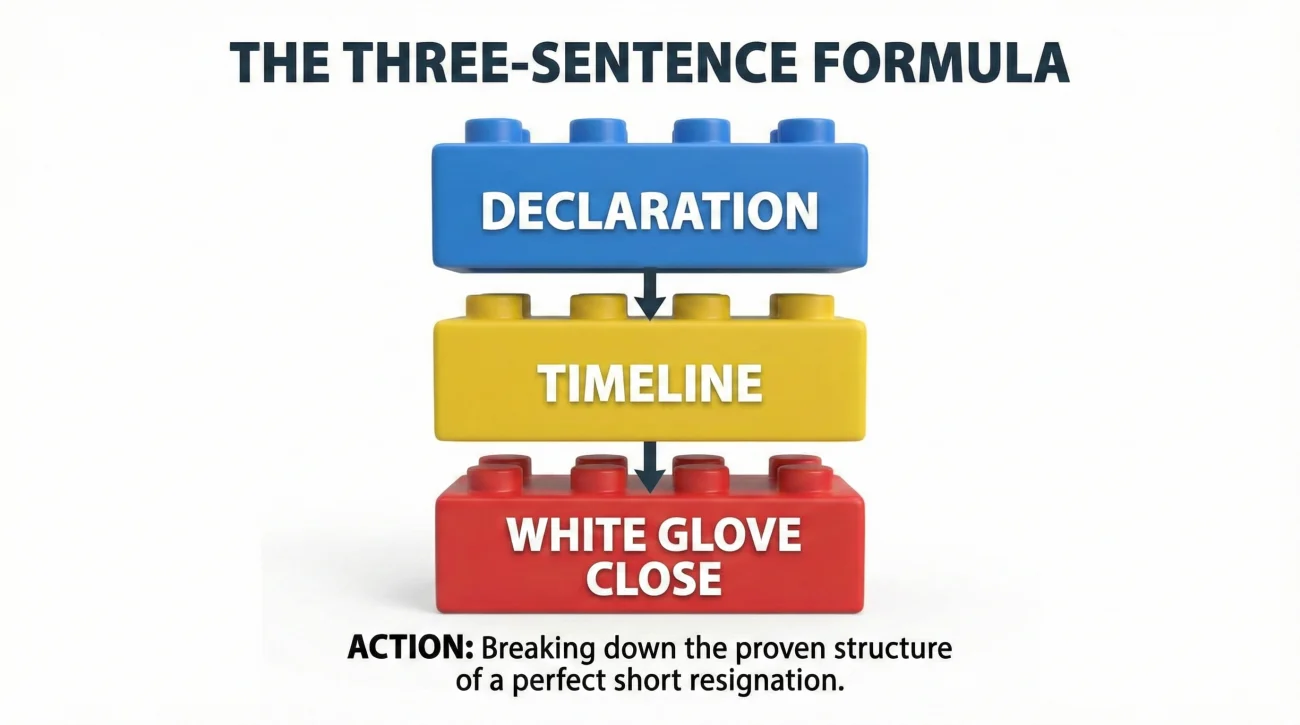
Sentence 1: The Declaration
This is the “performative act.” You must clearly state that you are ending your employment. Avoid wishy-washy language like “I am thinking about resigning.”
The Gold Standard: “I am resigning from my position as [Job Title] at [Company Name].”
Sentence 2: The Timeline
This is the most financially critical part of the letter. It determines your final paycheck, your benefits termination date, and your compliance with notice period contracts. Be specific.
The Gold Standard: “My last day of work will be [Day of Week, Month Date, Year].”
Sentence 3: The “White Glove” Close
This is where you add a drop of oil to the machinery. You need just enough courtesy to be professional, but not enough to be insincere.
The Gold Standard: “Thank you for the opportunity to work with this team.”
| What You Want to Say (Emotional) | What You Should Write (Strategic) |
|---|---|
| “I’m finally leaving this toxic dump!” | “I am resigning effective immediately.” |
| “I feel so guilty for leaving you guys.” | “Thank you for the opportunity.” |
| “I’m going to make double my salary.” | [Silence – Do not mention it] |
Ready-to-Use Short Templates
These templates demonstrate the three-sentence formula applied to common resignation scenarios. We have categorized them by format – formal letters for physical submission/PDFs and emails for digital-first environments.
The Standard Short Letter (Formal)
Use this version when you need to submit a signed document to HR or hand a physical folder to your boss. This is the “little black dress” of resignations – appropriate for everything from banking to retail.
[Your Full Name]
[Your Employee ID – Optional]
[Your Phone] | [Your Email]
[Date]
[Manager’s Name]
[Title]
[Company Name]
Dear [Manager’s Name],
Please accept this letter as formal notification that I am resigning from my position as [Your Job Title] at [Company Name].
Per my employment contract, I am providing the required notice. My final day of employment will be [Specific Date].
Thank you for the opportunity to have worked here.
Sincerely,
[Your Signature]
[Your Printed Name]
The “Quick & Clean” Email
In modern tech or startup environments, a PDF might feel overkill. This quick resignation letter works perfectly in the body of an email. It gets straight to the point.
Subject: Resignation – [Your Name] – [Job Title]
Dear [Manager’s Name],
I am writing to formally resign from my position as [Job Title]. My last day will be [Date].
Thank you for the opportunities I have had during my time here. I will ensure my current tasks are handed off before my departure.
Best regards,
[Your Name]
The Strict “Two-Week Notice” (Formal)
If you are worried about burning bridges or want to be explicitly clear that you are following the rules, use this version. It emphasizes compliance.
[Your Full Name]
[Your Address]
[Date]
[Manager’s Name]
[Company Name]
Dear [Manager’s Name],
I am providing two weeks’ notice of my resignation from [Company Name]. My final working day will be [Specific Date].
I appreciate the professional experience I have gained here and wish the company success in the future.
Regards,
[Your Signature]
[Your Printed Name]
The “Grey Rock” Resignation (For Hostile Environments)
When leaving a toxic boss or a hostile workplace, your goal is to be as boring and uninteresting as a grey rock. Do not give them any emotional hooks. This concise resignation letter is your shield.
Subject: Resignation Notice – [Your Name]
Dear [Manager’s Name],
I am resigning from my position as [Job Title], effective [Date].
I will work to ensure my responsibilities are transitioned by my final date.
Sincerely,
[Your Name]
Why this works: It removes the “Thank you.” In legal terms, gratitude is not required. If you were mistreated, you do not need to thank them for it. Just state the facts and leave.
The “Under 100 Words” Urgent Exit
Sometimes you cannot give full notice. Maybe you have a family emergency, or your new job starts Monday. This template acknowledges the breach of standard protocol without over-apologizing.
Subject: Resignation – Effective Immediately
Dear [Manager’s Name],
Please accept my resignation from [Job Title], effective immediately [or insert date].
I regret that I am unable to provide the standard notice period due to unforeseen personal circumstances. I will do my best to wrap up outstanding items today.
Respectfully,
[Your Name]
Strategic Context: When Short Resignation Letters Are the Best Choice
While we advocate for brevity generally, there are specific scenarios where an ultra-short letter is not just a preference, but a tactical necessity.
The “False Start” (Leaving After a Few Months)
Leaving a job after only 3 months? Writing a long letter makes it weirder. You don’t have enough shared history to justify a page of text. A resignation letter under 100 words acknowledges the reality: “This didn’t work out, let’s move on.” It minimizes the awkwardness by not drawing attention to the short tenure.
When You Anticipate a Counter-Offer
If you suspect your company might try to keep you, a short letter is a power move. A long, emotional letter can signal “I’m conflicted.” A short, factual letter signals “I have decided.” It frames the negotiation from a place of firmness. If you are unsure about how to handle the counter-offer conversation itself, you can find detailed scripts in our comprehensive guide.
The “No-Nonsense” Professional Brand
Some professionals build their brand on efficiency. If you are known for short emails and direct meetings, a flowery resignation letter will feel out of character. Aligning your resignation style with your working style maintains your personal brand consistency to the very end.
The “Cut List”: What to Delete Immediately
Strategic brevity isn’t just about writing short sentences; it is about ruthlessly deleting content that doesn’t serve you. Here is your checklist for what to cut.

Delete the “Because”
Your resignation letter documents that you are leaving, not why. “I am resigning because…” is a sentence starter that rarely ends well in a permanent file. Save the “because” for the exit interview or the verbal conversation with your boss, where tone and nuance can be conveyed. On paper, reasons can look like complaints.
Delete the “Roll Call”
Do not list every colleague you enjoyed working with. “I want to thank Sarah for the coffee runs and Mike for the Excel tips.” This is unprofessional in a formal document. If you want to thank Sarah and Mike, send them personal notes on LinkedIn or a handwritten card. That is far more meaningful and keeps your official file clean.
Delete the “Next Steps”
We cannot stress this enough: Do not mention your future plans. Do not say “I’m going back to school,” “I’m moving to London,” or “I’m taking a sabbatical.” Information is power. Once you disclose your plans, the company can calculate how much leverage they have over you. Keep them guessing.
Overcoming the Fear of Being “Too Short”
It is natural to feel a pang of anxiety when hitting “send” on a three-sentence email. Let’s dismantle those fears.
Myth: “Short = Rude”
Reality: Rude is submitting a resignation on a post-it note. Rude is ghosting. Rude is leaving the office in a mess. A typed, properly formatted, concise letter is the height of professionalism. It respects the recipient’s time.
Myth: “I Need to Show I Cared”
Reality: You show you cared by how you handle the transition. Working hard during your notice period, training your replacement, and organizing your files – that shows you care. A long letter full of adjectives does not make up for a messy exit. Actions speak louder than adjectives.
Final Polish: Don’t Let Typos Ruin Your Exit

When a document is only 50 words long, a single typo stands out like a neon sign. Before you print or send, check these three things:
- ✅ The Date Math: Did you actually count 14 days? Does the end date land on a weekend? Ensure your “Last Day” is a business day unless you work shifts.
- ✅ The Title Match: Are you a “Senior Analyst” or a “Lead Analyst”? Check your HR portal. Use the exact official title, not what you call yourself on LinkedIn.
- ✅ The Formatting: If sending a PDF/Letter, make sure it has a header. If sending an email, make sure the Subject Line is clear. “Resignation – [Your Name]” is perfect.
❓ FAQ
📏 Is there a legal minimum length for resignation letters?
No legal minimum exists. Your resignation is valid as long as it clearly communicates your intent to resign (‘I resign’) and specifies your timeline. A short resignation letter consisting of one sentence is legally sufficient. While we recommend three sentences for politeness, the law only cares about the clarity of intent.
⏰ Should I apologize for keeping it short?
Never. Apologizing for brevity signals insecurity. It suggests you think you are doing something wrong. Submit your letter with confidence. If asked, simply say, “I wanted to keep the official documentation clear and concise.”
💼 Will a short letter hurt my chance of being rehired?
No. Companies rehire based on your historical performance and skills, not your resignation letter word count. In fact, a clean, professional exit often makes you a more attractive “boomerang” candidate than someone who wrote a long, emotional letter that revealed too much.
📧 Can I copy-paste these templates exactly?
Yes, absolutely. These templates are designed to be “plug-and-play.” Just ensure you replace the bracketed text [Like This] with your actual details. Do not accidentally leave “[Your Name]” at the bottom!
Final Thoughts: Making the Clean Break
Strategic brevity is a power tool in your career management kit. A well-executed short resignation letter provides everything HR needs for processing while minimizing your exposure to future scrutiny, regret, or relationship damage.
The three-sentence formula – declaration, date, courtesy – accomplishes all legal and professional requirements in under 100 words. Use it confidently knowing that shorter often means smarter when documenting career transitions. Your resignation letter is administrative paperwork, not a memoir. Treat it accordingly, and save your energy for the exciting chapter ahead.
⚠️ Legal Disclaimer: ResignSmartly provides general informational guidance about resignation, workplace communication, notice periods, handovers, and career transitions. Content does not constitute individualized legal advice. Employment laws, contracts, workplace policies, and individual circumstances vary, so review the requirements that apply to your situation and consult an appropriate qualified professional when needed.