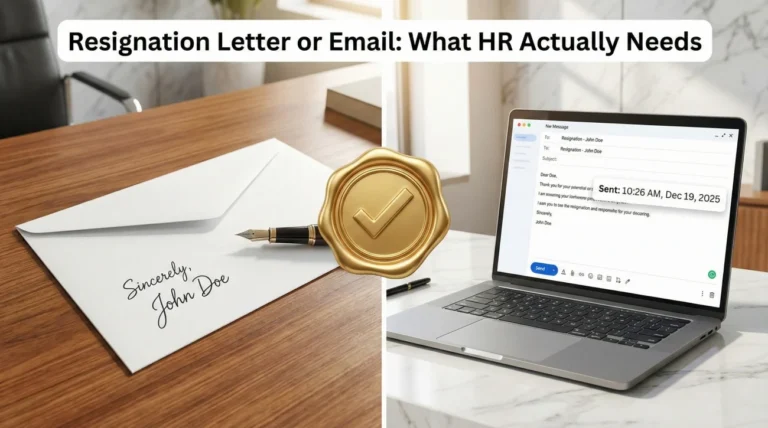
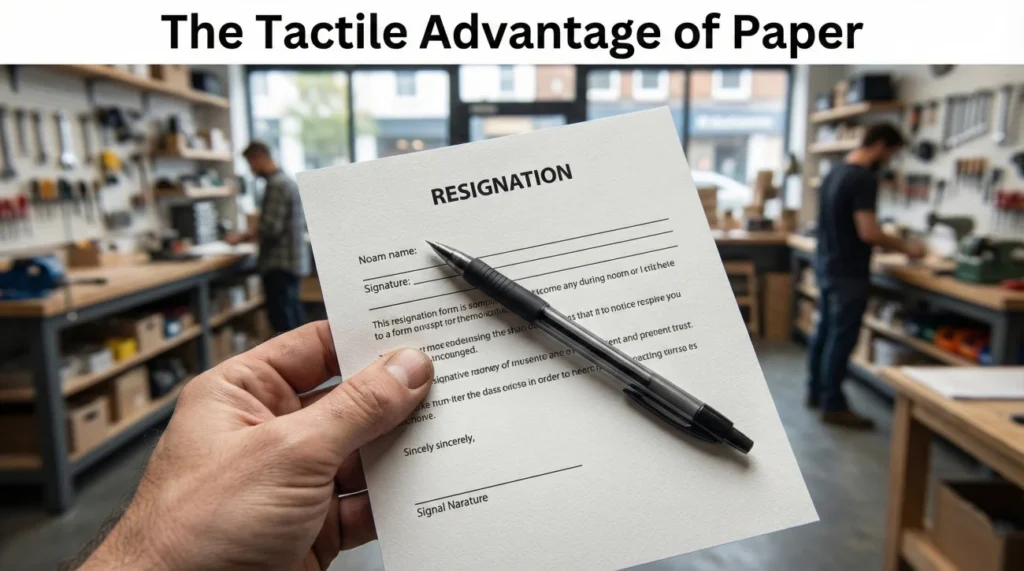
- Why Paper Still Works: A printed, signed letter adds gravity, reduces awkward back and forth, and plays well with traditional “old guard” workplaces.
- When To Use A Printable Form: Deskless jobs, no easy email access, urgent exits, or when you want a clean ritual of closure.
- What You Get: Fill in the blank templates for universal resignations, strict two week notice, corporate formal letters, and effective immediately exits.
- Professional Details That Matter: Use blue or black ink, write full dates, keep handwriting legible, and reprint if you make errors instead of crossing out.
- Submission And Proof: Hand it over in a brief private meeting, take a clear photo first for a timestamp record, and know a handwritten form is valid if intent, identity, and timing are clear.
The Tactile Advantage: Why Paper Still Rules in a Digital World
In an era dominated by DocuSign, Slack notifications, and instant emails, the act of handing over a physical, crisp piece of paper feels almost revolutionary. It carries a gravitas that a digital file simply cannot replicate. For the deskless workforce – the nurse ending a 12-hour shift, the retail manager on the floor, the line cook in a bustling kitchen – resignation doesn’t happen behind the safety of a laptop screen. It happens in real-time, face-to-face, amidst the noise and heat of the job. In these visceral moments, a printable resignation letter is not just a document; it is a physical anchor.
There is a unique psychology to the physical resignation letter. It serves as a prop in the difficult theater of quitting. When your heart is racing and you are walking into your manager’s office, holding that folder gives you something to do with your hands. It signals preparation, intent, and finality. You aren’t just “thinking” about leaving; you have printed, signed, and delivered the decision. It transforms a negotiation into a notification.
Furthermore, we must respect the “Old Guard.” In traditional industries – law firms, manufacturing plants, academia, or family-owned businesses – a digital notification can be perceived as disrespectful or cowardly. A printed document, signed in wet ink, bridges the gap between modern efficiency and traditional professional courtesy. It says, “I respect you enough to do this formally.”
This guide is designed for the professional who needs to resign now, without the friction of formatting margins or troubleshooting printer drivers. We provide field-tested, fill in the blank resignation letter templates that you can print, sign, and submit within minutes. Whether you are in a rush, lack computer access, or simply prefer the undeniable authority of a hard copy, these forms are your immediate solution.
The Strategy of Physical Documentation
Digital may be the default for the laptop class, but for millions of others, paper remains the failsafe. Understanding when to deploy a physical document is part of being a strategic professional. It is about reading the room and knowing your environment.
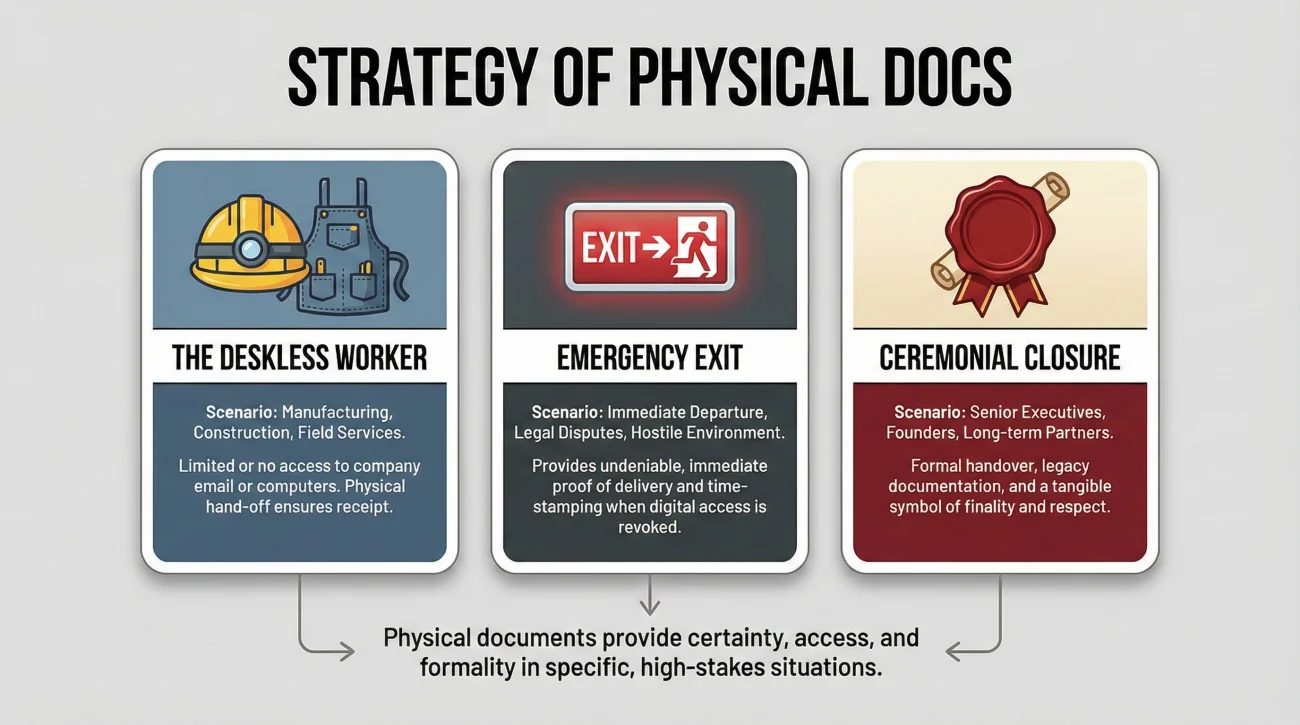
The “Deskless” Workforce Reality
Not everyone works at a desk. If you are in construction, hospitality, healthcare, or logistics, your “office” might be a job site, a hospital wing, or a warehouse floor. You might not have a corporate email address, or accessing it might trigger IT alarms you want to avoid until you are ready. A resignation letter form pdf stored on your phone allows you to print at a library, FedEx office, or home, bypassing the need for company infrastructure entirely. This gives you control over the timeline.
The Emergency Exit Protocol
Sometimes, life happens fast. A family emergency, a sudden relocation, or a toxic incident requires you to leave immediately. In these high-stress moments, the cognitive load of drafting a letter from scratch is overwhelming. You don’t have the mental bandwidth to worry about font sizes or salutations. A printable form removes the writer’s block. You fill in the blanks, sign it, and the deed is done. It turns a complex emotional task into a simple administrative one, allowing you to focus on the exit itself.
The Ritual of Closure
There is a ceremonial aspect to signing a document in ink that clicking “Send” cannot match. For long-term employees, a physical letter provides a sense of closure. It is a tangible artifact that marks the end of an era. Handing it over is a definitive act that helps both you and your manager process the reality of the departure. It minimizes the “Are you sure?” or “Can we talk about this?” responses because the document is already sitting there, signed and sealed.
The Universal “Fill-in-the-Blank” Template
This is the workhorse of resignation forms. It is designed to be universally applicable, legally sound, and impossible to misinterpret. It strips away all fluff, leaving only the essential data points HR needs to process your final paycheck.
RESIGNATION LETTER FORM
Date: [Date]
To: [Manager’s Name]
Title: [Manager’s Title]
Company: [Company Name]
Dear [Manager’s Name],
I am writing to formally inform you of my resignation from my position as: [Your Job Title] at [Company Name].
My last day of work will be: [Last Working Day – Full Date].
Thank you for the opportunity to work at [Company Name].
Sincerely,
[Your Signature]
[Your Printed Name]
Expert Tips for Completion
Filling out a form seems simple, but small details impact professionalism. Here is how to ensure your handwritten form looks executive-level:
- ✅ Ink Choice: Use blue or black ink only. Blue is often preferred in legal contexts because it helps distinguish the original document from photocopies. Avoid pencils [which can be erased/altered] and felt-tip markers [which bleed through paper].
- ✅ Date Format: When filling in the dates, use the full format [e.g., “January 15, 2024”] rather than slashes [1/15/24]. This avoids any ambiguity about notice periods, especially in international companies where date formats vary.
- ✅ Legibility: If your handwriting is messy, print in block letters. The only thing that should be cursive is your signature. HR needs to be able to read your name to process your offboarding.
Specialized Printable Forms for Specific Scenarios
One size does not fit all. Different departure terms require different documentation structures. Choose the printable resignation form that matches your specific exit strategy.
The Strict “Two-Week Notice” Calculator
This form is designed to eliminate arguments about dates. By explicitly stating the two-week timeframe, you create a clear record of compliance with standard notice protocols. This is crucial if you want to ensure you are paid out for accrued vacation time, as many policies require “full notice” for eligibility.
NOTICE OF RESIGNATION [TWO WEEKS]
Today’s Date: [Today’s Date]
To: [Manager Name]
From: [Your Name]
RE: Formal Two Weeks’ Notice
I am hereby providing formal two weeks’ notice of my resignation from: [Company Name].
Calculating 14 days from today, my final working day will be: [Final Working Day – Date]
I will ensure all company property is returned and my tasks are handed over by this date.
[Signature]
The Corporate Formal Letter
For office environments where you want to maintain a high degree of formality [e.g., finance, law, government], this template mimics the structure of a typed business letter but allows for handwritten completion. It looks appropriate on a mahogany desk.
[Your Full Name]
[Your Employee ID – Optional]
Date: [Date]
To: [Manager’s Name]
RE: Resignation from [Company Name]
Dear [Manager’s Name],
Please accept this letter as formal notification of my resignation from the position of: [Your Job Title].
My last day of employment will be: [Last Day of Employment – Date].
I appreciate the professional opportunities provided during my employment and wish the company continued success.
Respectfully,
[Signature]
[Printed Name]
The “Effective Immediately” Form
For urgent departures where notice is not possible. This form is brief, direct, and unapologetic, designed to end the relationship instantly. Use this when safety is a concern or when personal circumstances leave you no choice.
IMMEDIATE RESIGNATION NOTICE
Date: [Date]
To: [Manager]
I am resigning from my position as [Job Title] effective IMMEDIATELY.
My final day of work is today: [Today’s Date].
I regret that I am unable to provide the standard notice period due to personal circumstances.
[Signature]
The Aesthetics of Authority: Printing & Paper
A printable resignation letter is a physical object. Its quality reflects on you. When you hand someone a piece of paper, the tactile experience communicates subconscious messages about your professionalism.
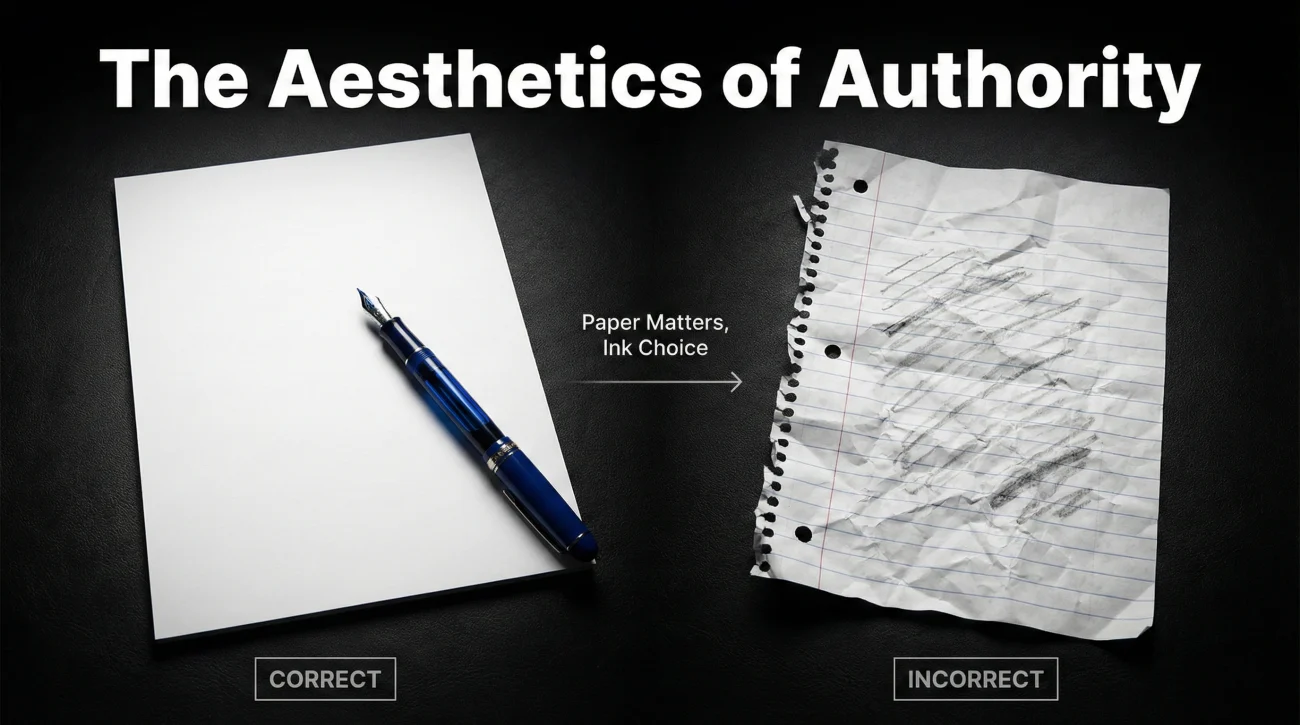
The Paper Matters
If possible, print on standard 20lb or 24lb bright white office paper. Avoid using paper that has been folded, wrinkled, or has printing on the other side. Do not use lined notebook paper ripped from a spiral bound book; the ragged edges [the “confetti”] look unprofessional and juvenile. If you are in a bind and notebook paper is your only option, trim the edges cleanly with scissors.
The “One Strike” Rule
Handwriting creates vulnerability: mistakes happen. If you misspell your manager’s name or botch the date, do not cross it out. Do not use Wite-Out. A resignation letter with cross-outs looks indecisive and sloppy. It suggests you didn’t care enough to get it right. Throw it away and print a new one. This document goes into your permanent file; make sure it looks pristine.
The Handoff: A Choreographed Submission
Having the form is only half the battle. How you deliver it matters. The “handoff” is a pivotal moment in your career, and doing it right can save a relationship.
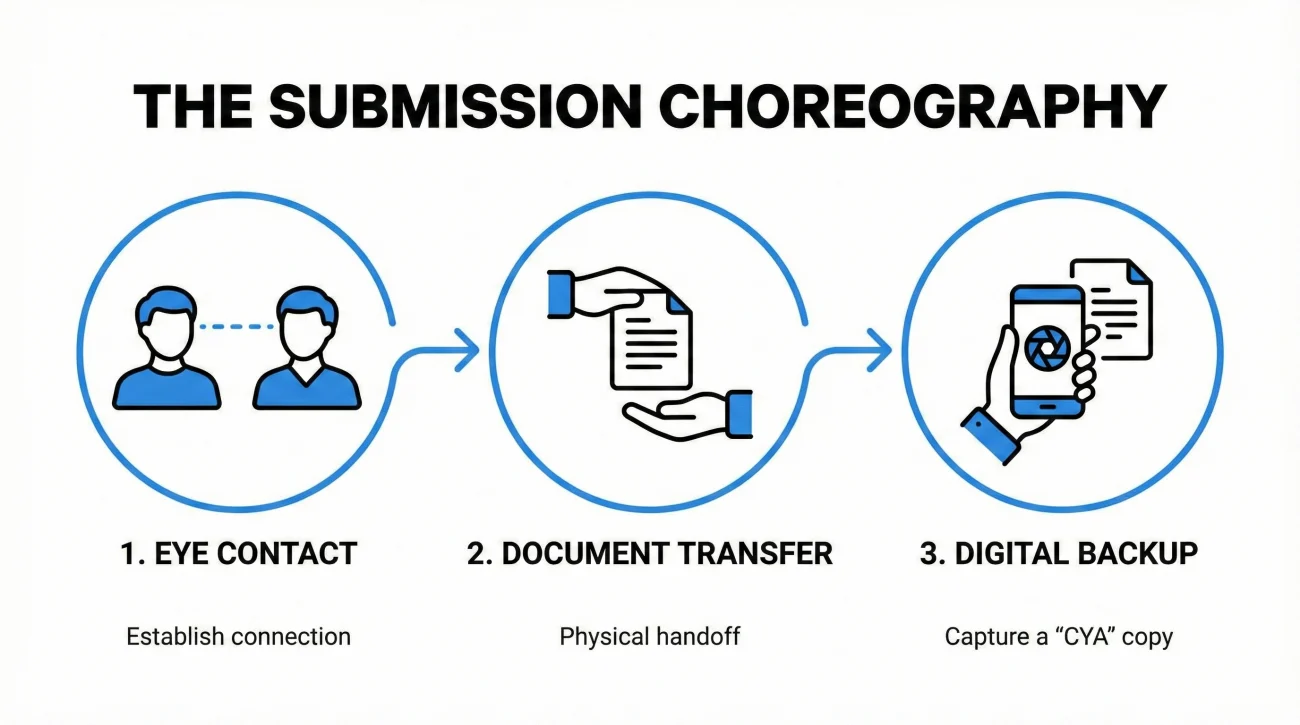
The Private Meeting
Never leave a resignation letter on an empty desk or slide it under a door unless absolutely necessary. It is passive-aggressive. Request a brief “five-minute chat” with your manager. Look them in the eye, state that you are resigning, and then hand them the paper. The document validates the conversation; it does not replace it. If you are nervous, holding the paper gives you a prop to focus on.
The “CYA” [Cover Your Assets] Copy
Before you hand over the original, take a picture of it with your phone. Ensure the text is legible in the photo. This creates a timestamped digital record of exactly what you submitted and when. If HR later claims you didn’t give enough notice [to deny you a payout or mark you as ineligible for rehire], you have the photo metadata to prove otherwise. For more tips on protecting yourself during the exit process, check our guide on resignation documentation.
Is a Handwritten Form Legally Binding?
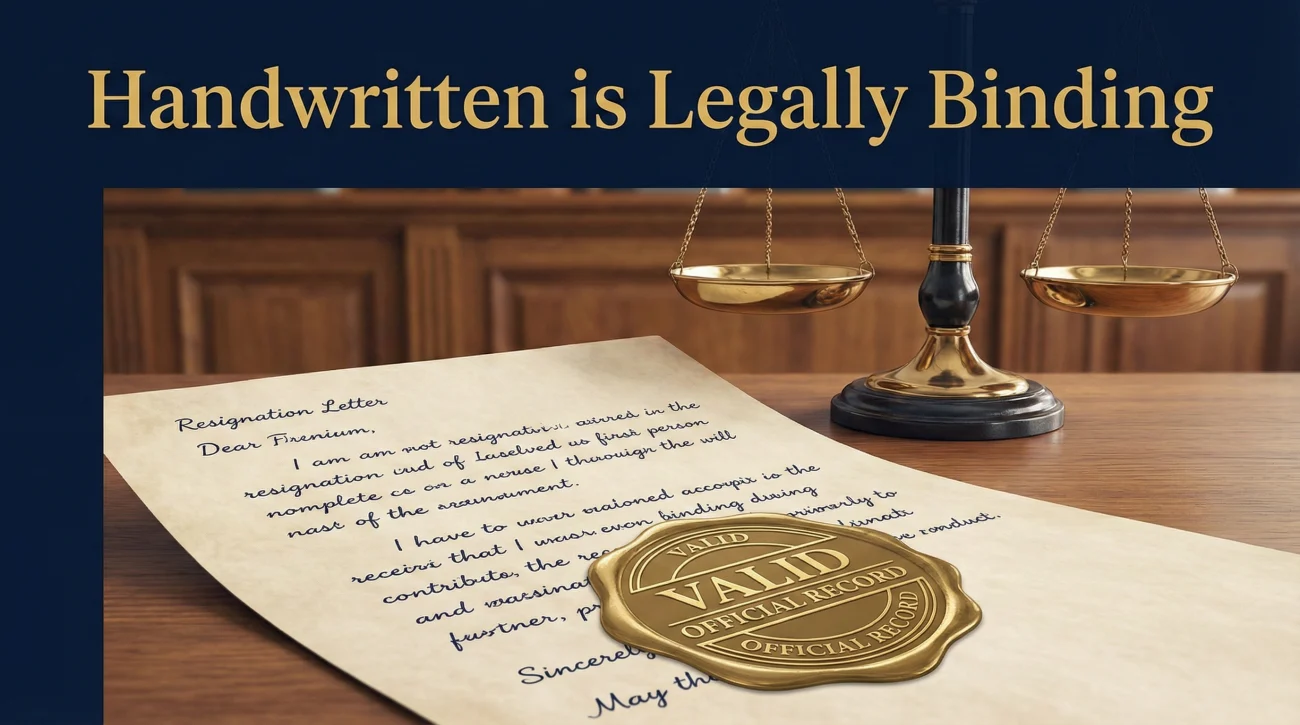
There is a common misconception that typed letters are “more legal” than handwritten ones. This is false. In the eyes of the law, a resignation is valid if it meets three criteria: Clarity of Intent [you said you are quitting], Identity [it is clearly from you], and Timing [a clear end date].
In fact, a handwritten signature is often considered stronger proof of identity than a typed name in an email, which could theoretically be spoofed. As long as your writing is legible, a fill in the blank resignation letter carries the full weight of the law. It stands up in court, in unemployment hearings, and in boardrooms.
❓ FAQ
🖨️ Can I print this at work?
Risky. Network printers often log activity, and “Resignation_Letter.pdf” is a red flag for IT administrators. If you print at work, do it swiftly and retrieve the document immediately. Ideally, use a library, a print shop, or a home printer to maintain confidentiality until you are ready to submit.
✍️ What if my handwriting is terrible?
Print in block letters [all caps or separated letters]. Do not use cursive. The goal is legibility, not calligraphy. If your handwriting is truly illegible, find a way to type the document, or ask a trusted friend to fill in the non-signature parts for you.
📋 Should I envelope the letter?
It adds a nice touch of professionalism, especially in corporate settings. A plain white envelope with your manager’s name written on the front signals that the contents are private and confidential. In casual settings [retail, food service], presenting the clean, unfolded paper is sufficient.
🔒 Can I scan this and email it after signing?
Absolutely. This is the “Hybrid Method.” Handing over the physical copy provides the ceremonial closure, while emailing a scan [or photo] to HR ensures a digital paper trail. It is the safest way to resign.
📄 Do I need to notarize a printable resignation?
No. Resignation letters do not require notarization. A signature is sufficient. Notarization is typically reserved for legal affidavits or property transfers, not employment notices.
Final Thoughts: The Power of Paper
In a fleeting digital world, a printable resignation letter stands as a tangible marker of a major life transition. It doesn’t require expensive software or perfect typing skills – just a pen, paper, and the courage to make a change. It puts the control back in your hands, quite literally.
Download the template that fits your situation, print it on clean white paper, and fill it out with care. Whether you are moving on to better opportunities or simply closing a chapter, this simple piece of paper is your ticket to a fresh start. Sign it, submit it, and walk out the door with your head held high.
⚠️ Legal Disclaimer: ResignSmartly provides general informational guidance about resignation, workplace communication, notice periods, handovers, and career transitions. Content does not constitute individualized legal advice. Employment laws, contracts, workplace policies, and individual circumstances vary, so review the requirements that apply to your situation and consult an appropriate qualified professional when needed.