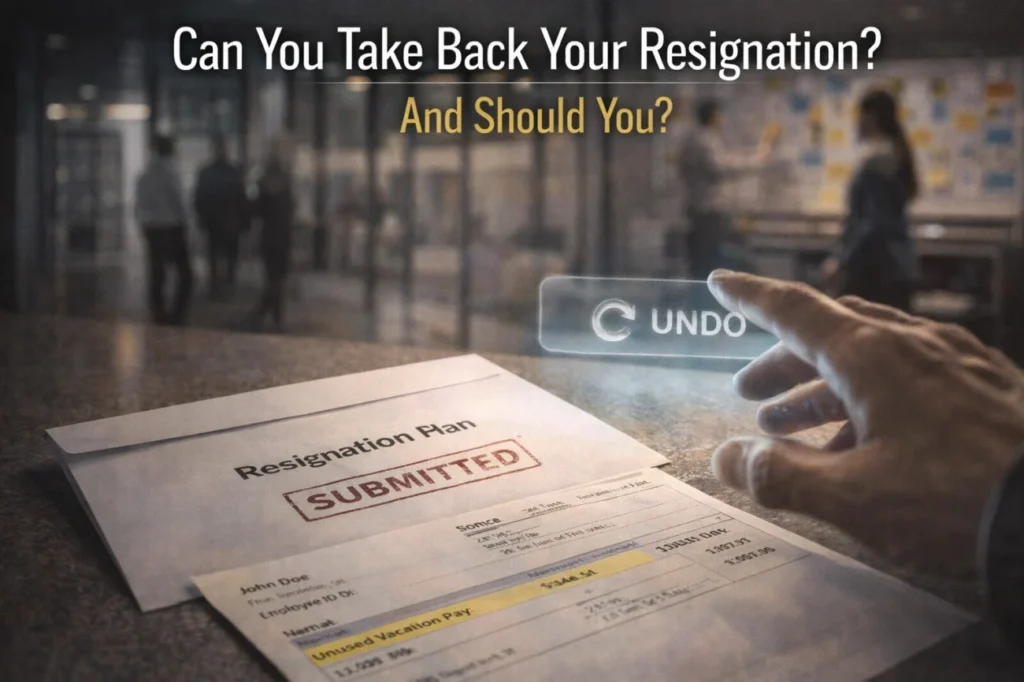
- Reality: You can sometimes withdraw a resignation if your last day has not arrived and the company has not locked in a replacement.
- Not a right: Approval depends on convenience, risk, and manager support, so how you ask matters as much as what you ask.
- Best odds: Act fast, have a stable reason, show strong performance, and confirm the role has not been filled or reassigned.
- Hidden cost: Even if they say yes, trust can shift and you may be treated as “already gone,” so decide if staying is a bridge or a loop.
- Clean approach: Acknowledge the resignation, request withdrawal briefly, avoid blame, then document the decision by email and exit calmly if they refuse.
You Can Sometimes Take It Back, But You Can’t Undo the Moment
The desire to retract resignation usually shows up after the adrenaline wears off. You quit in a burst of frustration, or you resigned because you thought you had a new job locked – and then something changed. Now you’re staring at the calendar thinking: “If I could just rewind two weeks…”
The tricky part is this: even if your employer agrees to let you stay, your resignation still happened. People heard it. Plans were made. Trust shifted. So the question is not only “Can you withdraw it?” It’s also “Should you?”
This guide is a practical, low-drama way to decide – and if you choose to do it, to do it cleanly.
Can You Withdraw a Resignation?
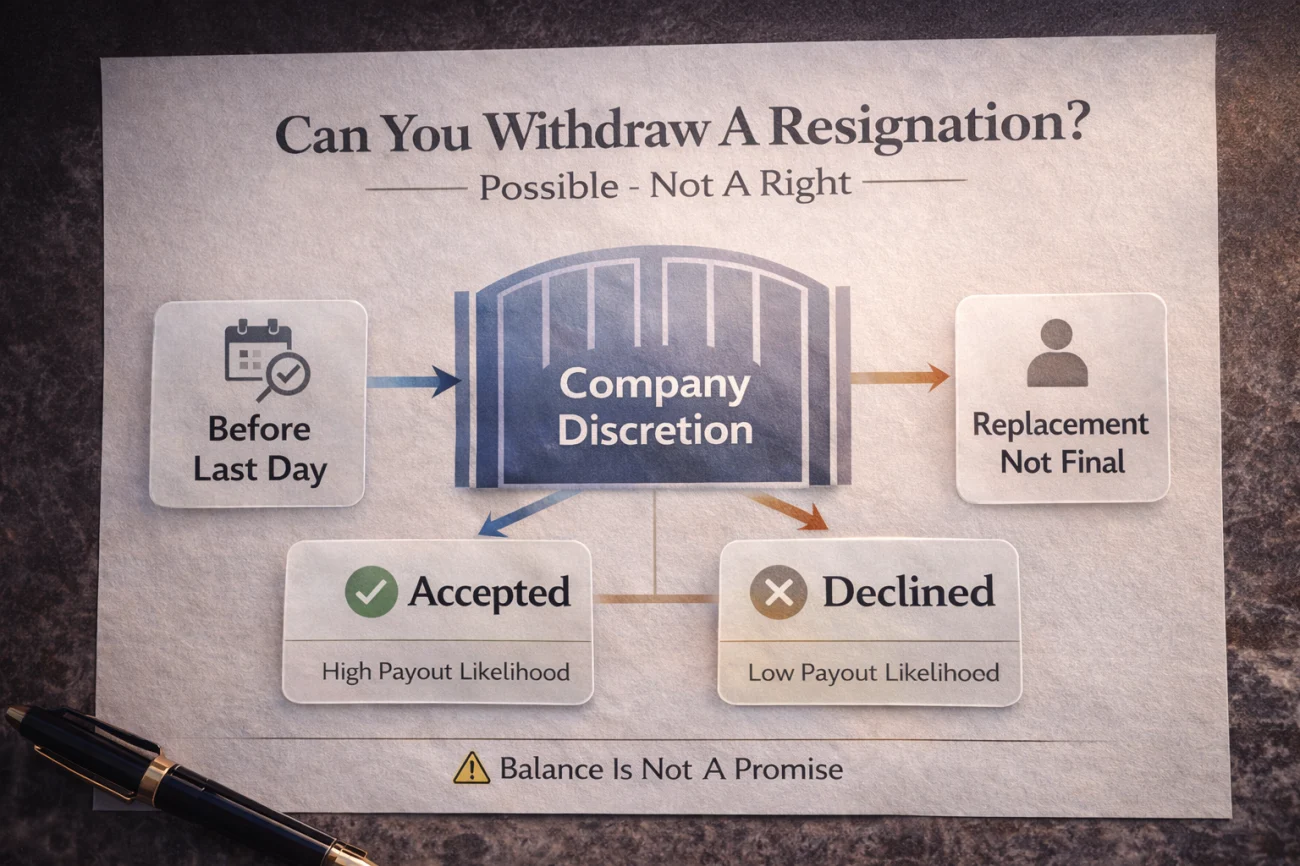
Sometimes, yes. In many workplaces, a resignation is not “magically irreversible.” If your last day hasn’t arrived and the company hasn’t finalized your replacement plan, your manager or HR may agree to a withdrawal – especially if you’re a strong performer or the team is understaffed.
But it’s not a right. It’s a decision the company makes based on what’s convenient, what’s politically safe, and what precedent they want to set. That’s why asking matters – but how you ask matters even more.
When Retracting a Resignation Has the Best Chance of Working
If you’re trying to withdraw resignation and you want a realistic shot, look for these conditions. They don’t guarantee success, but they make success more likely.
| Condition | Why It Helps | What It Looks Like |
|---|---|---|
| Short time since you resigned | Less operational disruption | You’re within days (not weeks) of giving notice |
| No replacement committed | No one to “un-hire” or displace | They haven’t posted, hired, or reassigned your role |
| Your performance is strong | Keeping you is an easy business decision | You’re dependable, high-output, low-drama |
| Your reason is stable and credible | Reduces fear you’ll quit again next month | You can explain the change without chaos |
| Your manager wants you | Manager advocacy is often the gate | They’re willing to back the decision to HR |
The Most Common Reasons People Try to Take It Back
Your reason affects how the company interprets risk. Some reasons sound like a one-time disruption. Others sound like ongoing instability.
Reasons that are easier to sell
- A new offer fell through unexpectedly.
- A personal situation changed and you can now stay.
- You made a decision too quickly and want to correct it professionally.
Reasons that raise red flags
- You resigned during conflict and now want to “un-resign” without resolving anything.
- You resigned for money and now want to stay without clear terms.
- You resigned because of your manager and now want that same manager to approve your return.
You don’t need to overshare. You need a reason that sounds calm and final, not emotional and reversible.

A Quick Framework: Should You Actually Do This?
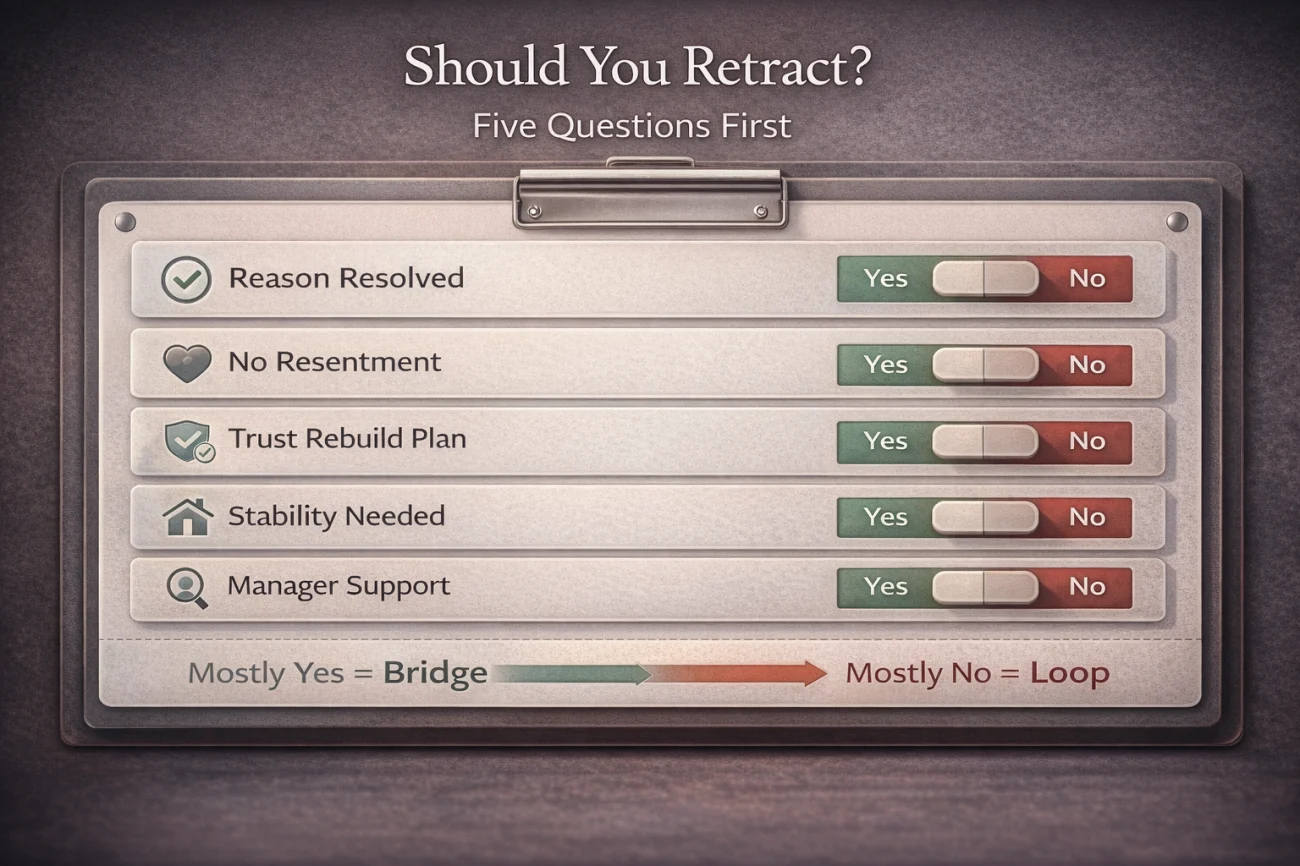
Use these questions. If you answer “no” to most of them, retracting may keep you employed but still leave you stuck in the same problem.
- Was the original reason for resigning resolved? If not, you’re likely delaying pain.
- Can you stay without resentment? If you’ll be angry every day, it will show.
- Do you have a clear plan to rebuild trust? If not, you may get quietly sidelined.
- Do you need this job for stability right now? If yes, retracting may be rational as a bridge.
- Is your manager likely to support you long-term? If no, you might be buying time only.
How to Withdraw Your Resignation Without Making It Worse
The goal is to sound steady and professional. You’re not asking them to pretend nothing happened. You’re asking if they’re willing to consider a change, and you’re offering a clean path forward.
Keep it short: acknowledge the resignation, state you’d like to withdraw it, give a simple reason, and ask for a meeting. Do not blame people. Do not argue history. Do not overshare.
Copy-Paste Scripts: Manager First, Then HR
Script 1: Message to your manager (request a meeting)
Hi [Manager Name], I wanted to ask for a quick conversation today if possible. I’d like to discuss the possibility of withdrawing my resignation. I realize this is an unusual request, but circumstances have changed and I want to approach it professionally. When would you have 15 minutes?
Script 2: What to say in the meeting (simple and stable)
“I’d like to formally withdraw my resignation, if the company is open to it. I made the decision quickly, and circumstances have changed since then. If you’re willing, I want to stay and commit to the role. I understand if plans have already moved forward, but I wanted to ask directly and handle it respectfully.”
Script 3: Follow-up email (document it cleanly)
Subject: Request to withdraw resignation
Hi [Manager Name],
As discussed, I would like to formally withdraw my resignation submitted on [date]. If the company approves, I confirm my intention to continue in my role and support the team’s priorities going forward.
Please let me know the next steps and whether HR needs any documentation from me.
Thank you,
[Your Name]
Script 4: If HR needs a direct email
Subject: Withdrawal of resignation notice
Hi [HR Name],
I’m writing to request withdrawal of my resignation notice submitted on [date]. My manager is aware of the request. Please advise on any required steps or documentation to update my employment status accordingly.
Thank you,
[Your Name]
If They Say No: How to Exit With Dignity
If the company refuses, don’t argue. A refusal usually means one of three things: they already replaced you, they don’t trust the reversal, or they don’t want the precedent. None of those are fixed by debate.
Your move is to stay calm, confirm the last day, and execute a clean handover. You can still leave with a good reputation even if the answer is no. In some cases, the cleanest outcome is accepting the no and moving forward with clarity.
Checklist: Before You Try to Retract Your Resignation
If you run this checklist first, you’ll avoid the most common mistake: asking to stay without a plan, then looking unreliable when people push for details.
| Checklist Item | What You Confirm | Why It Matters |
|---|---|---|
| Timing | How long it’s been since notice | Shorter = better odds |
| Replacement status | Whether the role is already filled | Prevents impossible asks |
| Stable reason | A simple explanation that doesn’t invite arguments | Reduces leadership anxiety |
| Your commitment statement | What you’re committing to if you stay | Signals reliability |
| Plan if they say no | Clean exit + handover | Protects reputation either way |
Retracting Can Save You – But Only If It’s a Bridge, Not a Loop

Yes, you can sometimes retract resignation. But the smarter question is whether staying moves you forward or pulls you back into the same cycle. If you’re retracting because you need stability, do it intentionally and set a plan. If you’re retracting because you’re scared, pause and make a decision you can live with.
The best outcome is the one where you keep your options, keep your dignity, and keep control of your next step – whether that step is staying or leaving.
❓ FAQ
✅ Can you withdraw a resignation after submitting it?
Sometimes, yes. If your last day hasn’t arrived and the company hasn’t finalized replacement plans, your manager/HR may accept a withdrawal. But it’s discretionary, not guaranteed.
📅 How soon should I try to retract my resignation?
The sooner the better. Waiting increases the chance the company has already restructured work or hired a replacement, which makes a reversal harder or impossible.
💬 What should I say when withdrawing my resignation?
Keep it short: request to withdraw, a simple reason that circumstances changed, and a commitment to stay. Avoid blaming people or re-litigating conflicts.
🧾 Will retracting my resignation hurt my reputation?
It can. Some leaders may treat you as a higher flight risk afterward. That’s why it helps to pair the request with a calm commitment statement and a plan to rebuild trust.
🔒 What if they refuse to let me withdraw it?
Don’t argue. Confirm your last day, complete a clean handover, and exit professionally. A refusal usually reflects operational decisions or risk concerns that debate won’t change.
⚠️ Legal Disclaimer: ResignSmartly provides general informational guidance about resignation, workplace communication, notice periods, handovers, and career transitions. Content does not constitute individualized legal advice. Employment laws, contracts, workplace policies, and individual circumstances vary, so review the requirements that apply to your situation and consult an appropriate qualified professional when needed.