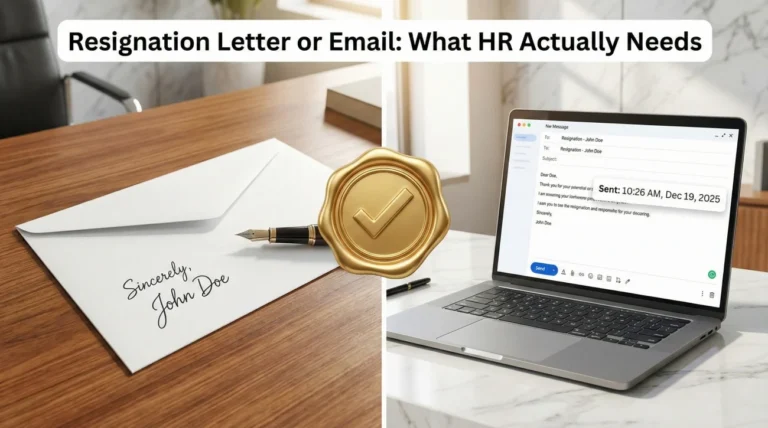

- Golden rule: Tell Your manager first, never let them hear it through coworkers.
- Correct order: Manager, HR if required, direct teammates, work bestie, then wider stakeholders.
- Best timing: After Your last day and the communication plan are aligned, then tell people in one tight window.
- What to say: Leaving, last day, appreciation, smooth transition, nothing more.
- How to stay safe: Use short repeatable lines for “Why” and “Where,” avoid oversharing, and keep emotional notes to private messages.
Tell the Right People First, or You’ll Spend Your Last Two Weeks Doing Damage Control
There’s a moment in every resignation where the job stops being the hard part and the people become the hard part. Not because they’re bad. Because you’re managing emotion, information, and timing at the same time. You’re trying to leave with grace, keep relationships intact, and not accidentally turn your exit into office entertainment.
If you’ve ever watched someone quit “the messy way,” you already know the pattern: one coworker finds out early, the story mutates, your manager feels blindsided, and suddenly your last days are spent answering the same questions on loop. That’s why telling coworkers isn’t just a social moment. It’s an exit tactic.
This guide gives you a simple order, clean timing, and copy-paste scripts. You’ll tell your work bestie without burning trust. You’ll tell the team without oversharing. And you’ll keep control of the story – without acting secretive or weird.
The One Rule That Solves 80% of the Awkwardness

Don’t tell coworkers until your manager has heard it from you first. That’s it. That’s the rule.
Even if your manager is difficult. Even if you’re leaving because of them. Even if you “only told one person.” In most workplaces, the manager finding out through the grapevine is the fastest way to turn a calm resignation into a tense situation. It creates a narrative that you’re organizing people against them, that you’re recruiting others to leave, or that you’re being disrespectful on the way out.
If you want a clean exit, your manager should never learn your resignation from someone else. When you follow this order, you reduce drama and protect your references – even if you don’t plan to use them.
Who You Tell First (The Correct Order)
The right order isn’t about politics. It’s about preventing the two most common problems: a blindsided manager and uncontrolled gossip. Use this sequence and you’ll avoid both.
| Order | Who | Why This Order Matters | When |
|---|---|---|---|
| 1 | Your manager | They must not hear it secondhand | First conversation, before any coworkers |
| 2 | HR (if required) | Paperwork, notice period, offboarding rules | Same day or right after manager discussion |
| 3 | Direct teammates you impact daily | They need operational clarity, not rumors | After manager acknowledges and timing is agreed |
| 4 | Your work bestie | They get the “human moment” without risk | After direct team is informed (or same wave) |
| 5 | Wider group / stakeholders | Prevents “I heard…” narratives | After internal message is ready |
If your company has a strict policy, follow it. If it doesn’t, this order still works because it aligns with how trust flows in workplaces: manager first, then the people who depend on you, then everyone else.
Timing: The Best Window to Tell Coworkers
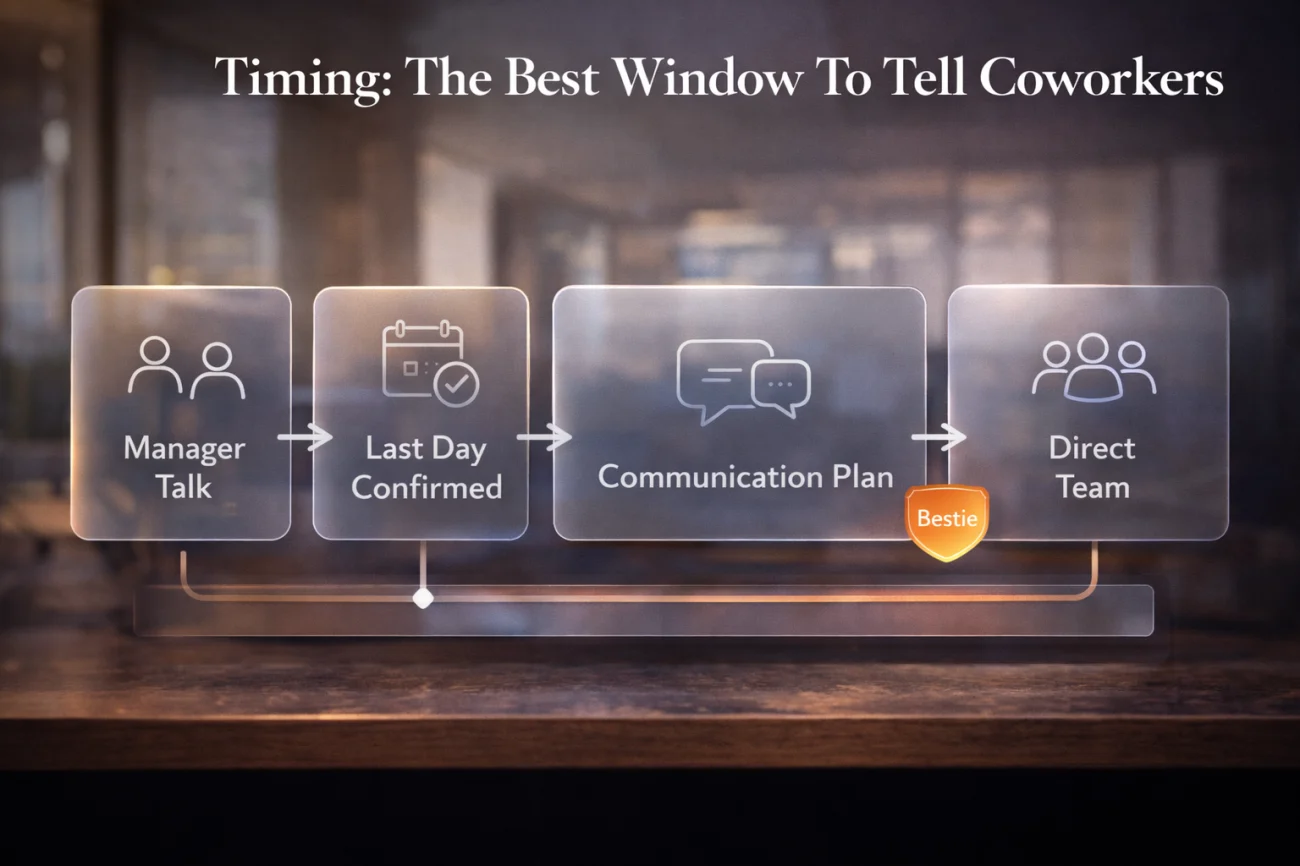
The best time to tell coworkers is right after you and your manager have agreed on two things: your last day and the communication plan. That doesn’t mean you need a perfect plan. It means you need enough alignment so you won’t contradict leadership in public.
In a healthy workplace, the timeline can be fast: you tell your manager in the morning, HR the same day, and your direct team that afternoon. In a tense workplace, you might wait until HR confirms the details, or until the company is ready for an internal message. Either way, your goal is simple: don’t create a situation where people are asking questions you can’t answer yet.
If you want the “cleanest” feel, tell your direct team before the wider group, and do it in one tight window. The longer the gap, the more space you leave for rumors to grow legs.
What to Say (Without Oversharing or Sounding Cold)
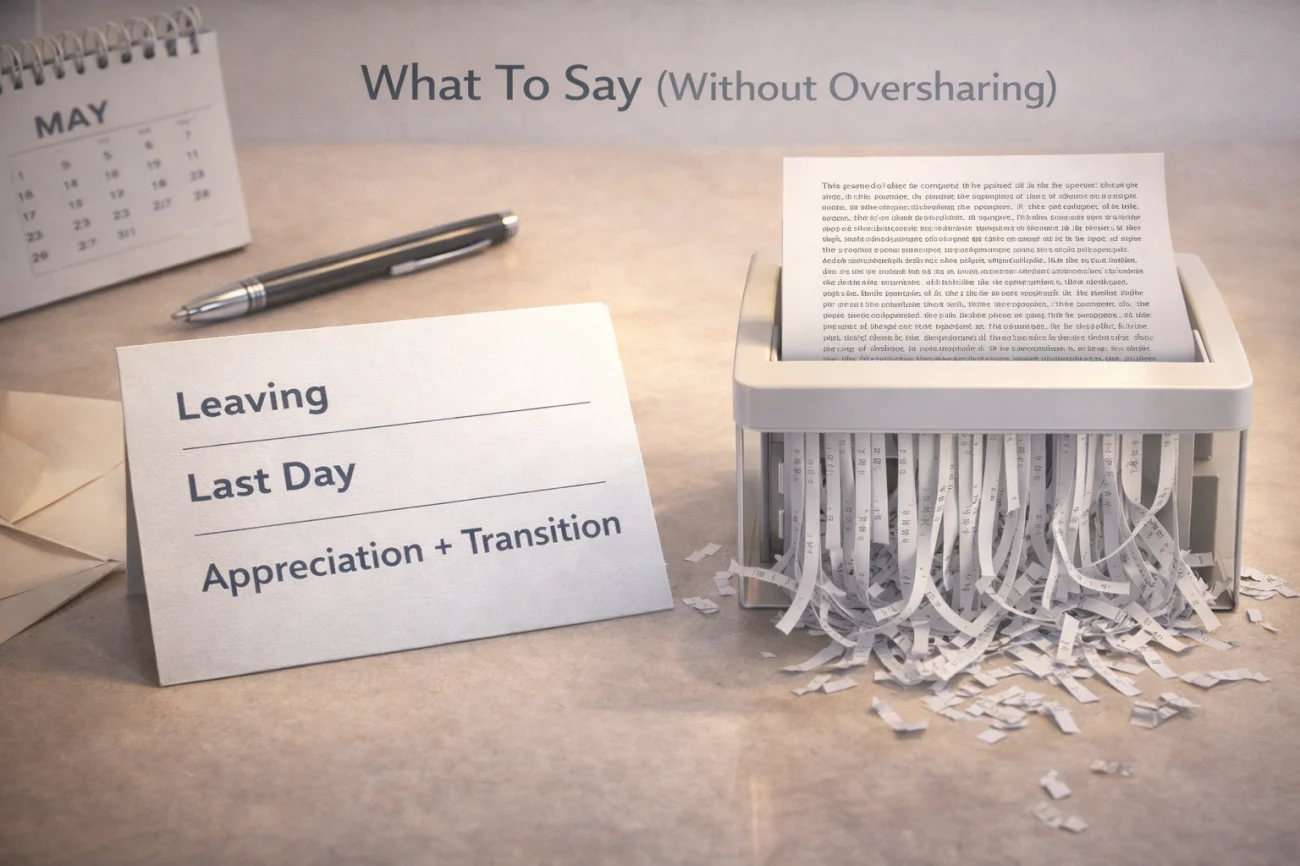
Most people think the hard part is the words. It’s not. The hard part is deciding how much truth to share in a workplace that will repeat your words without your consent. Your resignation doesn’t need to be a confession. It needs to be a clean announcement.
A safe structure is three lines: (1) you’re leaving, (2) your last day, (3) appreciation and transition intent. If you stick to that, you’ll sound professional even if you’re leaving because you’re miserable.
Good reasons to keep it short
You don’t know who will screenshot your message. You don’t know who will interpret your reason as “tea.” You don’t know who will forward it to someone you didn’t intend. Keeping it short isn’t being robotic. It’s being careful.
One sentence that works almost everywhere
“I’ve decided to move on, and my last day will be [date]. I’m grateful for working with you, and I’ll do everything I can to make the transition smooth.”
Copy-Paste Scripts for Slack, Teams, and In-Person
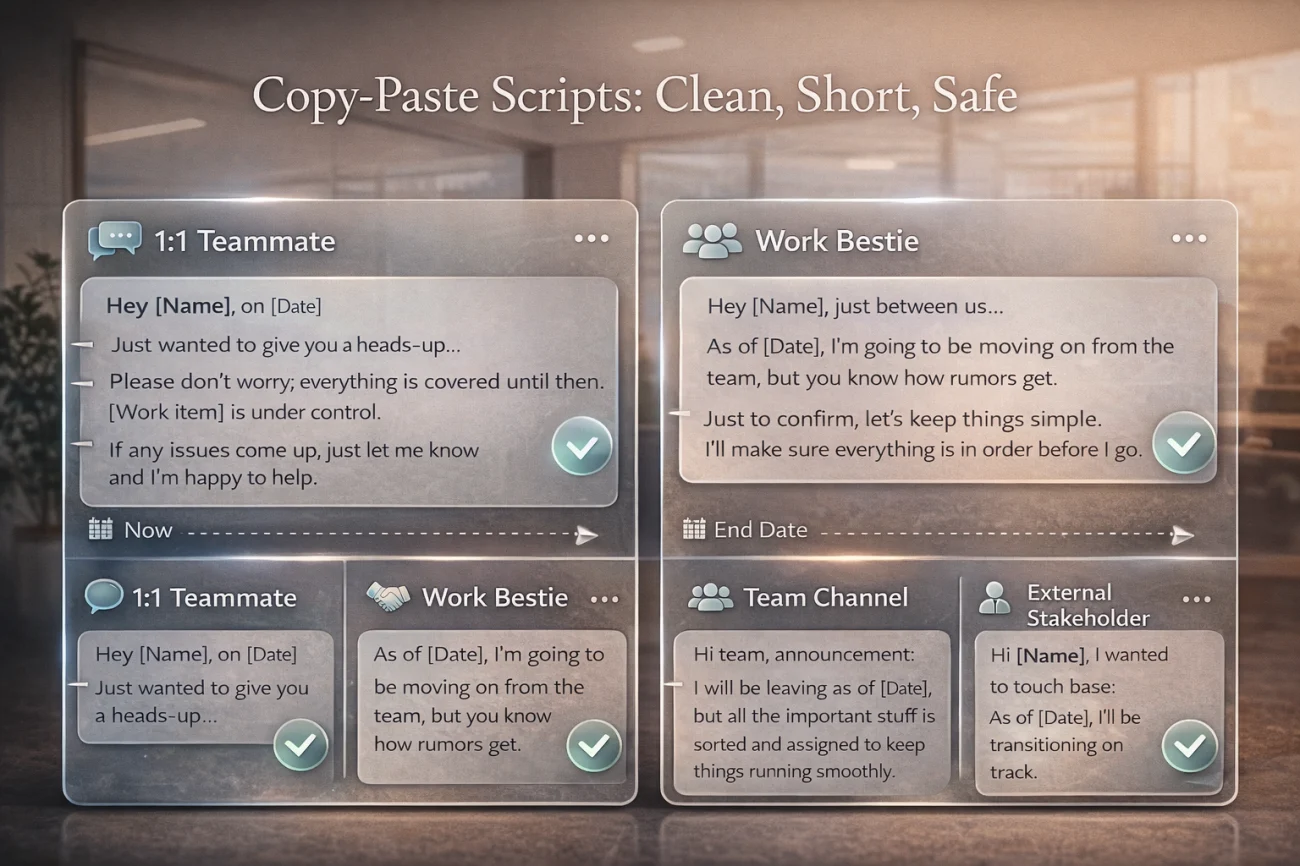
These scripts are intentionally boring. Boring is good. Boring doesn’t start rumors. Use these as your base, then adjust tone slightly to match your workplace.
Script 1: Direct Teammate (1:1 message)
Hey [Name] – I wanted you to hear it directly from me. I’m resigning, and my last day will be [date]. I really appreciate working with you, and I’m going to make the transition as smooth as possible. If you want, I can walk you through what I’m currently owning so nothing gets dropped.
Script 2: Work Bestie (Human, but still professional)
Okay, telling you because you’re my person at work: I’m leaving. My last day is [date]. I’m excited (and a little emotional), but I wanted you to hear it from me first – and thank you for making this place survivable on the hard days.
Script 3: Team Announcement (Slack/Teams channel)
Hi team – I wanted to share that I’ll be leaving [Company], with my last day on [date]. I’m grateful for the chance to work with all of you, and I’ll be focused on a smooth transition over the next [time period]. Thank you for everything.
Script 4: Stakeholders Outside Your Team
Hi [Name] – quick note that I’ll be leaving [Company], with my last day on [date]. I’m coordinating a handover plan and will make sure you’re connected to the right owner for anything we’ve been working on. I appreciate working with you.
How to Answer the Two Questions Everyone Asks
You can almost guarantee you’ll hear these: “Why are you leaving?” and “Where are you going?” You’re allowed to answer politely without giving away your private life or your strategy.
If they ask “Why?”
Use a reason that closes the topic instead of opening it. “I’m moving on to something new,” “I’m looking for a different direction,” or “It felt like the right time for a change.” If you give a detailed reason, people will debate it like a group project. If you keep it simple, the conversation ends naturally.
If they ask “Where are you going?”
If you want to share, share. If you don’t, don’t. A safe line is: “I’m not ready to share details yet, but I’ll definitely stay in touch.” This sounds normal, not paranoid. If you’re worried about gossip management, it’s okay to delay disclosure until your next role is official.
Keeping Resignation Secret Without Being Weird
Sometimes you need to keep things quiet. Maybe you’re negotiating. Maybe you’re leaving a toxic situation. Maybe you’re worried your manager will retaliate. That’s where keeping resignation secret becomes practical, not dramatic.
The key is choosing a short “holding line” and repeating it. Not explaining. Not defending. Just repeating. The more you talk, the more you create material for office gossip.
Holding Line (Works in almost any conversation)
I’m still sorting out the timing, but I’ll share updates once everything is confirmed. I appreciate you understanding.
If someone pushes, you can stay calm: “I don’t want to share details until it’s final.” Then change the subject. People take their cue from your energy. If you act like it’s normal, it becomes normal.
Remote and Hybrid Teams: Don’t Let Your Exit Turn Into a Thread
In remote workplaces, resignation news travels through screenshots and side chats. That’s not evil. It’s just how people cope with change. The best way to keep your story intact is to avoid long, emotional paragraphs in public channels.
Share the announcement once, keep it short, and move important relationship moments into private messages. If someone replies with a big emotional note, you can match the warmth in a direct reply without turning the channel into a farewell stage.
What Not to Do (Even If It’s Tempting)
The most common mistakes happen when someone is hurt and wants validation. That’s human. But your resignation is not the moment to recruit allies, vent publicly, or narrate workplace injustice. Even if you’re right, it doesn’t help you.
- Don’t announce before your manager knows.
- Don’t share complaints in public channels.
- Don’t overshare your next move before it’s locked.
- Don’t promise things you can’t deliver (“I’ll make everything perfect before I go”).
- Don’t let one person turn your exit into gossip content.
You can still be honest. Just choose honesty that protects you: “I’m leaving,” “my last day is,” “I’m grateful,” “I’m focused on transition,” and “I’ll stay in touch.”
The Quick Checklist for a Clean Coworker Announcement
If you want a simple way to keep control, run this checklist before you tell anyone beyond your manager. It reduces confusion and prevents “mixed messages” that turn into awkward follow-ups.
| Checklist Item | What You Confirm | Why It Matters |
|---|---|---|
| Manager told first | They heard it directly from you | Prevents blindsiding and retaliation energy |
| Last day is confirmed | Exact date and notice period alignment | Stops “wait, I heard…” confusion |
| Message is short | Leaving + date + appreciation + transition | Reduces gossip fuel |
| Direct team informed first | People you impact daily know early | Protects workflow and relationships |
| Answer lines prepared | Simple replies for “why” and “where” | Prevents oversharing under pressure |
Tell Your Work Bestie Like a Pro, Not Like a Rumor
Leaving a job is a story people will retell. You can’t control every version, but you can control the first version. When you handle telling coworkers with the right order, short messaging, and calm boundaries, you protect the relationships that matter and avoid the chaos that doesn’t.
Tell your manager first. Tell your direct team next. Tell your work bestie with warmth. Tell the wider group with professionalism. Then spend your last days doing the only thing that actually improves your reputation: a clean handover and a calm exit.
❓ FAQ
✅ When is the safest time to tell coworkers I’m leaving?
After your manager has heard it from you and your last day is confirmed. If you tell coworkers first, you risk blindsiding leadership and triggering gossip before you can control the details.
📅 Should I tell my work bestie before the rest of the team?
Usually, no. Tell your manager first, then the people who depend on you operationally. You can tell your work bestie in the same wave, but avoid creating a situation where they know before your direct team does.
💬 What if coworkers keep asking why I’m leaving?
Use a short, repeatable line and don’t elaborate: “I’m ready for a new direction,” or “It felt like the right time.” The more detail you give, the more you create material for gossip and debate.
🧾 How do I keep my resignation quiet until it’s final?
Use a neutral holding line: “I’m still sorting out timing, but I’ll share updates once it’s confirmed.” Repeat it calmly, avoid explaining, and don’t put emotional paragraphs in public channels.
🔒 What’s the biggest mistake people make when announcing to coworkers?
Announcing too early and oversharing. Tell your manager first, keep the message short, and save the emotional conversations for private messages. That’s how you leave with relationships intact.
⚠️ Legal Disclaimer: ResignSmartly provides general informational guidance about resignation, workplace communication, notice periods, handovers, and career transitions. Content does not constitute individualized legal advice. Employment laws, contracts, workplace policies, and individual circumstances vary, so review the requirements that apply to your situation and consult an appropriate qualified professional when needed.