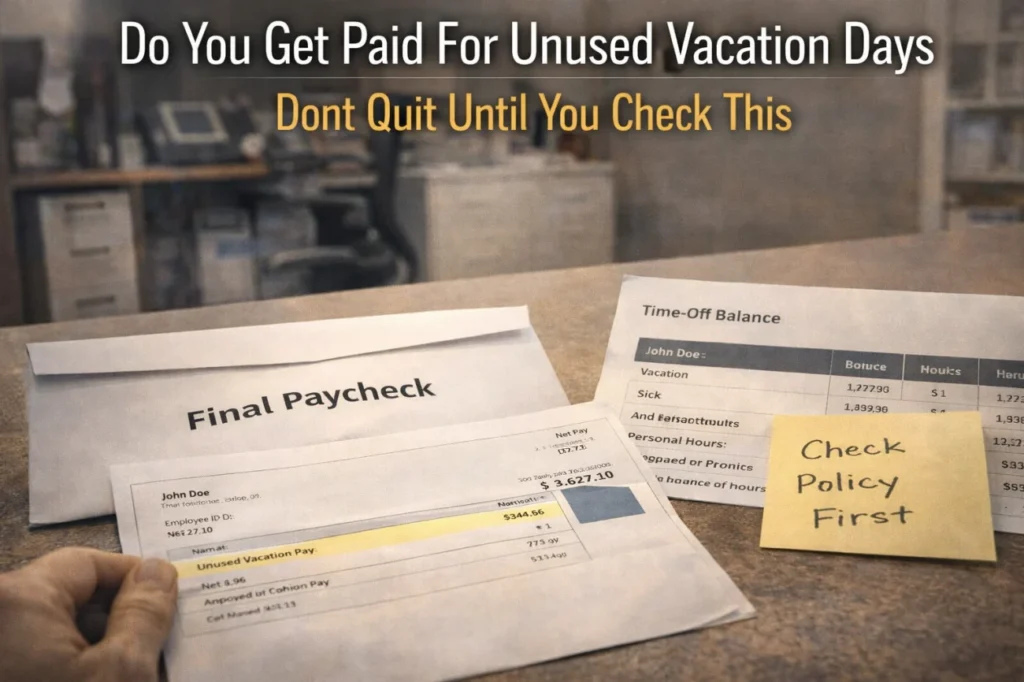
- Why this matters: Unused vacation pay is often money you already earned, but people lose it by resigning without checking rules.
- What decides payout: Policy language and local rules, plus whether time is accrued vs granted, and vacation vs PTO vs sick.
- Common traps: Unlimited PTO pays out nothing, notice-required clauses can zero out payout, negative balances can trigger deductions.
- What to do before resigning: Confirm the exact policy section, verify your balance, estimate the value, and time your exit to protect accrual and eligibility.
- How to get clarity: Email HR for written confirmation on payout eligibility, notice requirements, calculation method, and payout timing.
This Is the Money People Leave Behind Without Realizing It
There’s a specific kind of pain that hits after you resign: you realize you walked away from money that was basically already yours. Not a bonus. Not a negotiation. Just a payout you could’ve planned for if you knew how your company handles unused vacation pay.
The confusing part is that PTO payout rules can change based on where you live, how your company labels time off (vacation vs PTO vs “unlimited”), and what your policy says about resignation timing. Some people get a clean payout automatically. Others get surprised by restrictions that feel petty, but are still enforceable if written clearly.
This guide is a practical exit checklist: what to check before you quit, how to estimate your payout, and exactly what to email HR so you don’t rely on rumors.
What “Unused Vacation Pay” Usually Means
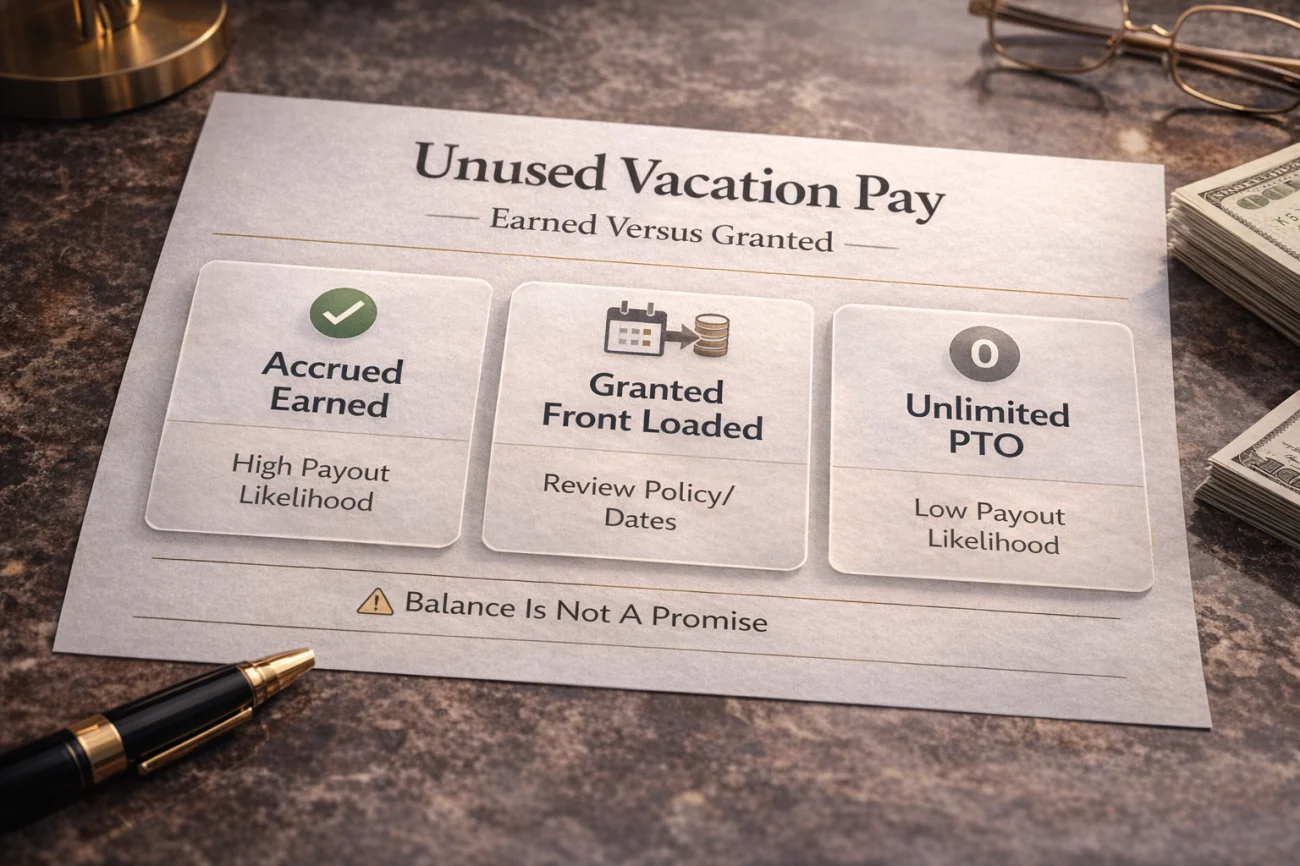
Unused vacation pay is the cash value of earned time off you didn’t use before your employment ends. The key word is earned. Many systems track “accrued” time (earned over time) and “granted” time (given upfront at the start of a year). Those are treated differently in some policies.
If your time-off balance is listed in your HR portal, that number is not automatically a promise of a check. It’s a balance. Whether it becomes money depends on your PTO payout policy and, in some places, local rules.
Do Companies Pay Unused Vacation When You Quit?
The honest answer to “do companies pay unused vacation?” is: sometimes, and it depends on policy and jurisdiction. Many employers do pay out accrued vacation/PTO at separation. Others pay only under certain conditions, like giving proper notice or being in good standing.
The most important thing is to stop guessing. Your friend’s payout is not your payout. Even inside the same company, different employee types (hourly vs salaried, union vs non-union, different countries/regions) can have different terms.
What to Check Before You Resign
Your goal is to find the exact language that controls your final paycheck vacation payout. Look in your employee handbook, HR knowledge base, offer letter addendums, and any local policy documents for your region. If you can’t find it, ask HR directly in writing.
| Item to Check | Why It Matters | What You’re Looking For |
|---|---|---|
| Vacation vs PTO definitions | Some policies pay one but not the other | Clear payout language by category |
| Accrual method | Earned vs granted time can be treated differently | “Accrued,” “earned,” “front-loaded” wording |
| Notice requirement | Some policies restrict payout if you don’t give notice | “Payout requires X weeks’ notice” clause |
| Good standing / termination clauses | Some employers pay differently if you’re fired vs resign | Separation type rules |
| Cap / forfeiture rules | Balances can be capped or forfeited under certain setups | Carryover limits, max accrual, forfeiture triggers |
| Final paycheck timing | Affects cash flow planning | When PTO payout is issued |
The Common PTO Payout Traps That Surprise People
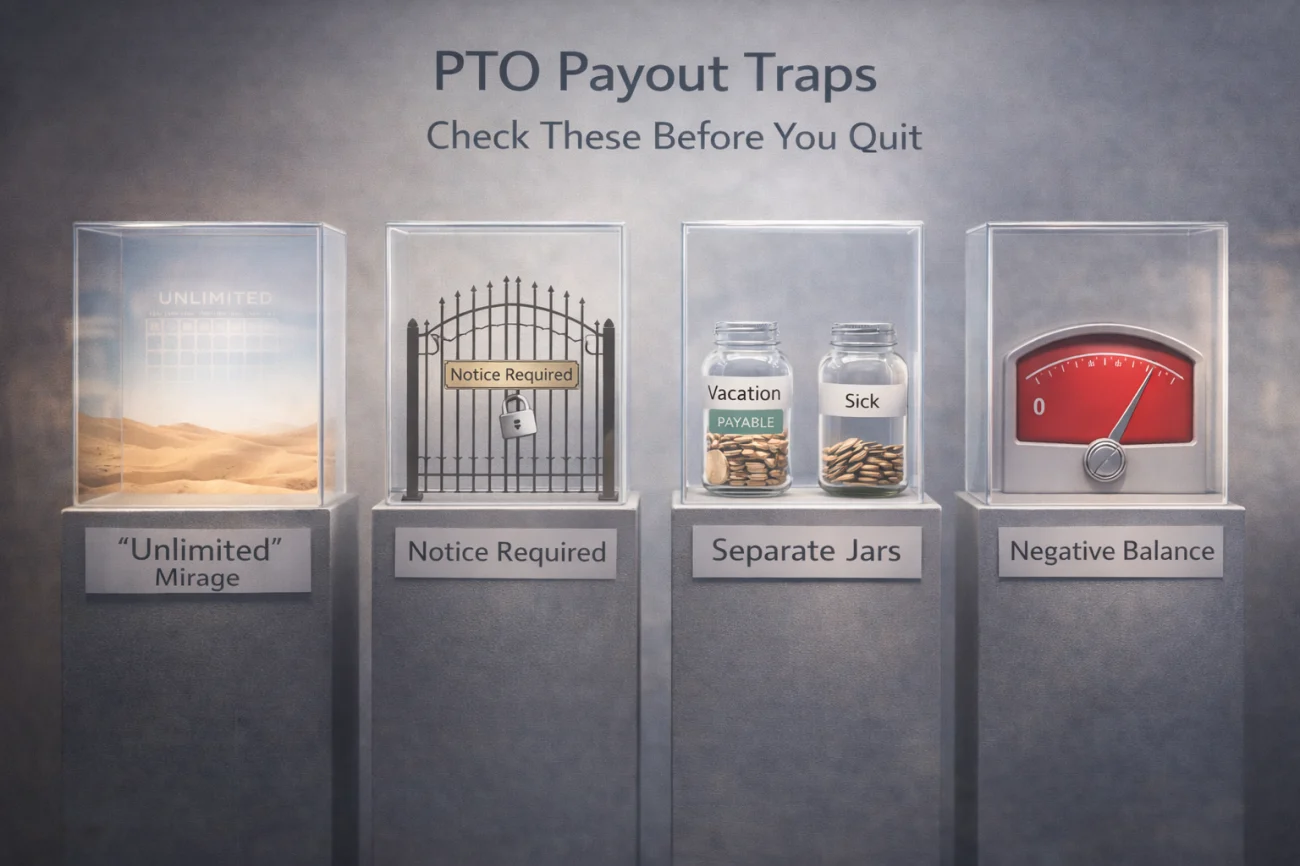
These are the “I wish I knew” rules that tend to catch people right when they’re trying to leave fast. They aren’t always fair, but they are common enough that you should check them early.
Trap 1: “Unlimited PTO” that pays out nothing. If your policy is truly unlimited (no accrual), there may be no banked time to cash out. Some companies still track usage for planning, but tracking is not the same as earning.
Trap 2: Payout only for vacation, not for sick time. Many companies separate time-off types. Vacation may be paid; sick time may not be. Don’t assume everything converts to cash.
Trap 3: “You must give notice” clauses. Some policies say you only get payout if you provide a minimum notice period and work through it. If you’re planning to resign immediately, this is where you can accidentally burn money.
Trap 4: Negative PTO balances. If your company allows borrowing time, leaving with a negative balance can mean deductions or repayment expectations, depending on the policy and local rules.
How to Estimate Your Payout Before You Quit
You don’t need a perfect calculation to make a smart decision. You need a reasonable estimate so you can plan your exit date and budget. Start with three numbers: your current balance, your pay rate, and whether payout is at base rate or includes differentials.
A simple estimate is: PTO hours × hourly equivalent rate. For salaried employees, your hourly equivalent is typically your salary divided by standard work hours. But don’t rely on home math for the official number – use it to understand whether you’re talking about “a nice bonus” or “a rent-sized amount.”
Timing Your Resignation So You Don’t Accidentally Lose the Payout
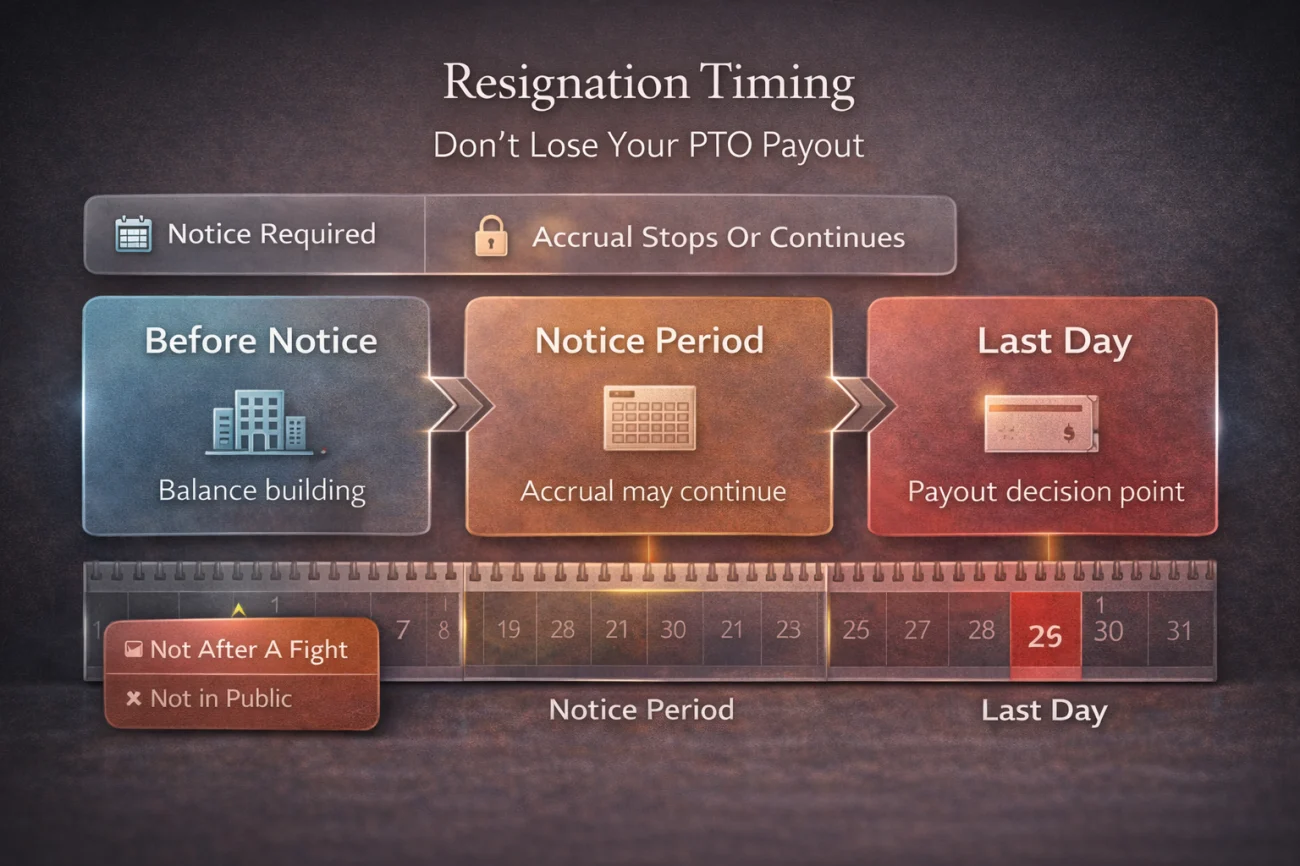
This is where strategy matters. If your policy requires two weeks’ notice to receive payout, resigning without notice can turn PTO into zero. If your accrual continues through your notice period, working those weeks might increase your final balance. If accrual stops when notice is given, the benefit is different.
The point isn’t to “game” the system. The point is to make your resignation date a decision, not an impulse – especially if vacation payout after resignation could materially impact your cash runway.
The Email to HR That Gets You a Clear Answer

If you want to avoid misunderstandings, ask for a written confirmation. Keep it short, factual, and focused on process. You’re not arguing. You’re clarifying.
Email 1: Confirm PTO Payout Policy
Subject: PTO/vacation payout policy clarification
Hi [Name],
I’m reviewing the company’s policy on PTO/vacation payout at separation. Could you please confirm in writing:
(1) whether accrued vacation/PTO is paid out upon resignation,
(2) whether any notice period is required to receive the payout,
and (3) how the payout is calculated and when it is issued?
Thank you,
[Your Name]
Email 2: Request an Estimated Balance/Payout (If They Provide It)
Subject: Request for current accrued PTO/vacation balance
Hi [Name],
Could you please confirm my current accrued PTO/vacation balance as of today, and whether any additional accrual would apply through a standard notice period? I want to make sure my records match the payroll/HR system.
Thank you,
[Your Name]
What to Do If They Say “No Payout”
If HR says there is no payout, don’t immediately assume someone is lying. First, identify why: is your policy truly “no payout,” is your time categorized as non-payable (like sick), or are you under an “unlimited PTO” structure?
Then do one calm check: ask them to point you to the exact policy section. You’re not escalating; you’re ensuring accuracy. If the amount is meaningful and the situation is complicated, consider getting professional guidance in your jurisdiction. This article is informational, not legal advice.
Checklist: Don’t Quit Until You’ve Checked These 10 Things
This is the “no surprises” checklist. If you do this, you’ll know where you stand before you hit send on the resignation email.
| Checklist Item | What You Confirm | Why It Matters |
|---|---|---|
| Policy source | Handbook / HR policy / local policy | Stops rumor-based decisions |
| Vacation vs PTO vs sick | Which buckets are payable | Prevents false expectations |
| Accrued vs granted | What is truly earned | Changes payout eligibility |
| Notice requirement | Minimum notice to receive payout | Resignation timing impact |
| Balance accuracy | HR portal vs payroll records | Avoids disputes later |
| Accrual during notice | Whether balance grows during notice | Impacts final number |
| Final paycheck timing | When payout is issued | Cash flow planning |
| Deductions risk | Negative balance / repayments | Avoids shock deductions |
| Separation type rules | Resign vs termination differences | Eligibility changes |
| Written confirmation | Email from HR/payroll | Reduces misunderstandings |
Your Exit Is a Financial Event, Not Just a Career Event
A resignation isn’t only emotional. It’s administrative and financial. If you treat it like a clean process, you can avoid the most common “I wish I knew” mistake: quitting without understanding what happens to your time-off balance.
If you take one takeaway from this, make it this: confirm the policy, confirm your balance, and confirm timing in writing. Unused vacation pay is often the easiest money you’ll ever protect – because it’s already sitting there, waiting for you to handle your exit smartly.
❓ FAQ
✅ Do I get paid for unused vacation days when I resign?
Sometimes. It depends on your company’s PTO payout policy and, in some places, local rules. The safest move is to ask HR for written confirmation of payout eligibility, notice requirements, and calculation method.
📅 Can I lose my PTO payout if I don’t give notice?
In some policies, yes. Some employers require a minimum notice period to receive payout. That’s why it’s worth checking the policy before you resign, especially if you’re considering an immediate exit.
💬 What’s the difference between vacation payout and PTO payout?
Some companies treat “vacation” as payable and other time buckets (like sick time) as non-payable. “PTO” can be a combined bucket or a separate category. The label matters because payout rules can differ by category.
🧾 How can I estimate my final PTO payout?
A simple estimate is your payable hours multiplied by your hourly equivalent pay rate. Use that to plan, but request HR/payroll confirmation for the official payout amount and timing.
🔒 What should I do if HR says there is no payout?
Ask them to point you to the exact policy section explaining the rule, and confirm whether your time is categorized as payable (accrued vacation/PTO) or non-payable (such as unlimited PTO tracking or sick time). Keep communication calm and written.
⚠️ Legal Disclaimer: ResignSmartly provides general informational guidance about resignation, workplace communication, notice periods, handovers, and career transitions. Content does not constitute individualized legal advice. Employment laws, contracts, workplace policies, and individual circumstances vary, so review the requirements that apply to your situation and consult an appropriate qualified professional when needed.