- Strategic advantage: Relocation is a neutral reason that lowers defensiveness and protects relationships better than most exits.
- Pre-resignation audit: Confirm the point of no return, lock housing and finances, and check tax nexus so you know if remote is even viable.
- Conversation first: Tell your manager live before any email, then use the script that fits, Supportive, Remote pitch, or Vague and firm for toxic situations.
- Template choice: Use a relocation email that matches your goal, Clean exit, Private reasons, Remote proposal, or cost-of-living move, with clear dates and a transition plan.
- Renegotiation and logistics: Build a business-continuity case, keep a contractor fallback ready, and manage admin traps like insurance timing and equipment return receipts.
The Strategic Advantage of a Geographic Exit
Writing a resignation email due to relocation is arguably the most tactically advantageous way to leave a job. In the delicate psychology of professional departures, most reasons for leaving – such as better pay, a higher title, or a shift in career path – inherently imply a critique of the current employer. They suggest that the company failed to retain you. This can bruise egos, trigger defensive counter-offers, and leave a lingering sense of betrayal.
Relocation is fundamentally different. It is an objective, external circumstance that completely removes the “personal” element from the resignation. You aren’t leaving because you dislike the boss, the culture, or the salary; you are leaving because you simply won’t be physically present anymore. This neutrality creates a “psychological safety zone,” allowing you to preserve relationships more effectively than almost any other exit strategy. It shifts the narrative from “I am rejecting you” to “Life is taking me elsewhere.”
However, treating this purely as a logistical notification is a massive wasted opportunity. In today’s distributed workforce, a relocation resignation can be the opening move in a high-stakes negotiation for remote work, or a strategic pivot to a lucrative consulting arrangement. This guide moves far beyond basic templates to provide a masterclass in managing your geographic exit. We will ensure that when you write your resignation letter for personal reasons relocation, you are positioning yourself for future success, securing your professional network, and potentially even keeping your job on your own terms.
The Psychology of the “Geographic Exit”
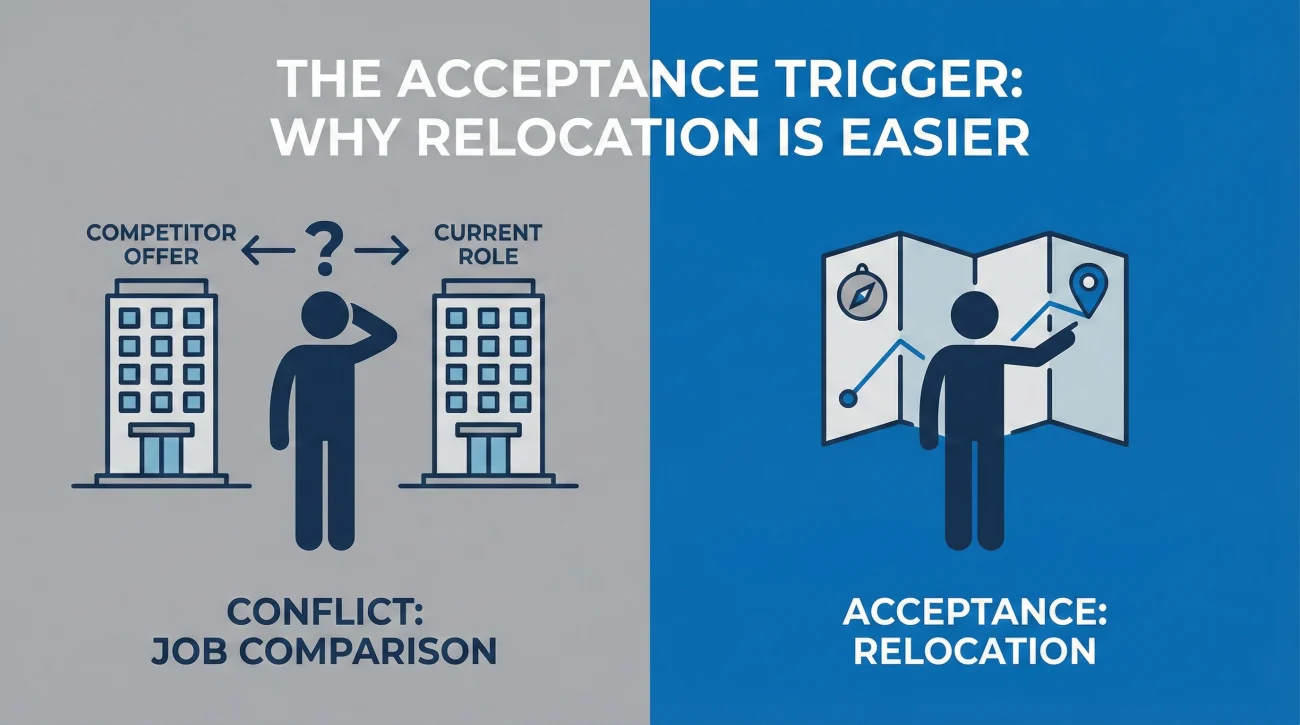
To master the resignation, you must first understand what happens in your manager’s brain when they hear the news. Understanding these psychological triggers allows you to control the conversation.
1. The “Acceptance” Trigger
Unlike a resignation for a competitor, which invites comparison (“What do they have that we don’t?”), relocation triggers immediate acceptance. It is viewed as a “force majeure” – an event beyond the company’s control. This lowers the manager’s defenses instantly, making the subsequent transition period much smoother and more cooperative.
2. The Remote Negotiation Window
Because the manager is not feeling defensive, they are more open to problem-solving. Their immediate thought shifts from “How do I convince them to stay?” to “How do I replace their productivity?” This is your window. If you are a high performer, the pain of losing you often outweighs the logistical headache of setting up a remote arrangement. You can leverage this to convert a resignation into a “work-from-anywhere” contract.
The Pre-Resignation Audit: Don’t Send That Email Yet
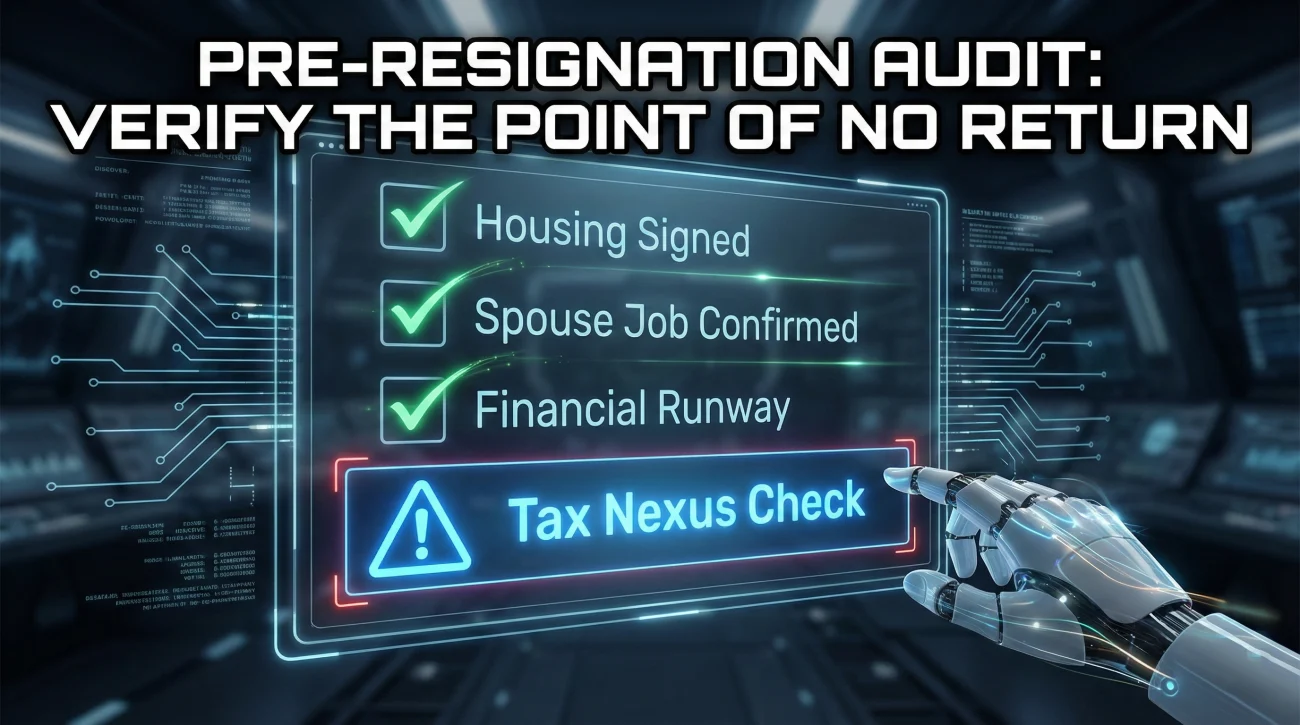
Before you schedule the meeting or draft your email, you must conduct a rigorous logistical audit. Relocation adds a layer of extreme complexity to the standard two-week notice period. If your moving truck is delayed, your closing date pushed back, or your partner’s job offer rescinded, you do not want to be left without a job and without a home. Proceed with extreme caution.
1. Verify Your “Point of No Return”
Do not submit your resignation until your relocation is absolutely irreversible. This protects you from the nightmare scenario of resigning, having the move canceled, and then having to sheepishly ask for your job back (which severely diminishes your future negotiating power). Ensure you have specifically checked these boxes:
- ✅ Housing is Locked: Do not rely on a verbal agreement. Have a signed lease or a closing document in the new city.
- ✅ Spousal Employment Confirmation: If you are moving because of a partner, wait until their background check clears and the formal offer letter is countersigned.
- ✅ Financial Runway: If you don’t have a job lined up in the new city, ensure you have 3-6 months of liquid savings. Relocation costs often exceed estimates by 30% due to hidden expenses like double rent, storage fees, and travel costs.
2. Assess Remote Work Viability (The “Tax Nexus” Trap)
If you plan to use this resignation to pivot to remote work, you need to think like an HR Director, not an employee. The biggest barrier to your proposal isn’t your performance; it’s the Tax Nexus.
Does your company already have a business entity in the state you are moving to?
If YES: Keeping you is administratively easy. They just change your tax code in the payroll system.
If NO: Keeping you requires them to register as a business in that new state, pay local franchise taxes, and comply with a whole new set of local labor laws. This costs time and money. Knowing this answer before you negotiate changes your strategy. If they don’t have a nexus, you might need to propose working as a 1099 contractor instead of a W-2 employee.
The Verbal Conversation: Scripts for Every Reaction
Your resignation email due to relocation is merely the written confirmation of a conversation that has already happened. Never blindside your manager with an email. The verbal conversation is where you frame the narrative and gauge their reaction. Here are scripts for the three most common scenarios.
Scenario A: The Supportive Manager
Use this when you have a good relationship and simply want a clean break.
You: “Manager, I requested this time because I have some big personal news. My family has made the difficult decision to relocate to [City/State] to [Reason: be closer to aging parents/support my spouse’s career]. Because of this move, I will unfortunately need to resign from my position. My target move date is [Date], so I plan for my last day here to be [Date].”
Scenario B: The Remote Work Pitch
Use this when you want to stay, but are willing to leave if they say no.
You: “I have some personal news. My family is relocating to [City] next month. I’ve genuinely loved working here, and honestly, if the role allowed for full remote work, I would love to stay. I know that might be complicated given the company’s policy, but I wanted to see if you were open to exploring a remote arrangement? If not, I completely understand, and I’ll focus on ensuring a flawless handover.”
Scenario C: The Toxic/Hostile Environment
Use this when you need a bulletproof excuse to escape a bad boss.
You: “I’m writing to let you know that due to personal family circumstances, I will be relocating out of the area. As a result, I need to submit my resignation. My last day will be [Date]. I want to make sure my files are organized for the next person before I go.”
Note: In Scenario C, keep it vague. Do not offer details they can argue with.
Strategic Resignation Email Templates (The “Why It Works” Edition)
Once the verbal conversation is complete, you need to formalize it for HR. Below are templates tailored to specific strategic situations, helping you say exactly what needs to be said – no more, no less.

1. The “Spouse Transfer” (The Unquestionable Exit)
This is the most robust reason for leaving. It signals that the decision is driven by family unity, which is universally respected. When drafting a spouse or partner transfer resignation email (for example, a husband transfer resignation email), clarity is your ally.
Subject: Resignation – [Your Name] – Relocation
Dear [Manager’s Name],
Please accept this letter as formal notification of my resignation from my position as [Job Title], effective [Date].
My spouse has recently accepted a job transfer to [City, State], and our family will be relocating there next month. While I am saddened to leave a team and role I have enjoyed so much, this move is necessary for our family’s next chapter.
I want to thank you for the mentorship and opportunities I have received at [Company Name]. I am committed to making my departure as seamless as possible and will ensure all my current projects are handed over to [Colleague’s Name] before my final day.
I hope to stay in touch and wish the company continued success.
Sincerely,
[Your Name]
[Phone Number]
[LinkedIn Profile]
Why It Works: It positions you as a supportive partner, a trait that is respected. It also shuts down any conversation about “Can we offer you more money to stay?” because money doesn’t solve the geographic issue.
2. The “Private” Relocation (Low Transparency)
Sometimes, you don’t want to share details. Perhaps the move is due to a divorce, a sick relative, or simply escaping a bad environment. In these cases, a resignation letter for personal reasons relocation is the professional standard.
Subject: Resignation Notice – [Your Name]
Dear [Manager’s Name],
I am writing to inform you of my resignation from [Job Title], effective [Date].
Due to personal reasons requiring my relocation to [State/Region], I will no longer be able to continue my employment with [Company Name]. This was a difficult decision, as I have truly valued my time here.
I want to express my gratitude for the professional growth I’ve experienced on this team. I will be working diligently over the next two weeks to document my processes and complete outstanding tasks.
Thank you for your understanding.
Best regards,
[Your Name]
Why It Works: It uses the phrase “personal reasons requiring my relocation,” which is formal code for “I am not discussing this further.” It sets a professional boundary while satisfying HR’s need for a reason.
3. The Remote Work Proposal (The Pivot)
Use this template when you genuinely want to stay. Note that this is structured as a proposal first, resignation second.
Subject: Update on my location and future at [Company Name]
Dear [Manager’s Name],
I am writing to share some personal news. Due to family commitments, I will be relocating to [City, State] in [Month].
I have loved working with this team and feel that I am currently in a strong rhythm. Since my role consists primarily of [Key Tasks], I would love to propose a plan where I continue my position remotely from my new location. I am confident I can maintain the same level of productivity and availability.
However, I understand if the company policy does not support this. If remote work is not an option, please consider this my formal resignation effective [Date], and I will focus on handing over my duties.
I would appreciate the chance to discuss this with you briefly this week.
Best regards,
[Your Name]
Why It Works: It is non-threatening. It says “I want to stay” (compliment) but “I am ready to go” (boundary). It forces the manager to make a choice: lose a good employee or bend the rules.
4. The Cost of Living Adjustment
In the current economic climate, moving for financial health is a valid and respected reason.
Subject: Resignation – [Your Name]
Dear [Manager’s Name],
Please accept this email as my formal resignation from the position of [Job Title]. My final day of employment will be [Date].
My family has decided to relocate to [Region] to pursue a lifestyle and cost of living that better aligns with our long-term financial goals. Consequently, I will no longer be able to continue my duties here at [Company Name].
I appreciate the opportunities I’ve been given and will ensure a smooth transition of my responsibilities before I depart.
Sincerely,
[Your Name]
Strategy: Turning Resignation into Renegotiation
If you are a high performer, your resignation is a “pain point” for your manager. Replacing you costs 1.5x – 2x your annual salary in recruitment fees, training time, and lost productivity. You can leverage this pain to negotiate, but you must focus on business continuity, not your personal convenience.
The Business Case for Keeping You (Remotely)
| Employer Fear | Your Solution |
|---|---|
| “We can’t monitor you.” | Propose a switch to output-based metrics. “I will deliver X reports by Friday noon, regardless of hours worked.” |
| “Collaboration will suffer.” | Commit to specific “overlap hours.” “I will be online from 10 AM to 2 PM EST daily for all team syncs.” |
| “It’s a legal headache.” | Do the research for them. If they use a PEO (Professional Employer Organization) like Justworks or Deel, remind them that multi-state hiring is already supported. |
The “Contractor” Fallback
If they refuse to keep you as an employee because of HR policies, offer to stay on as a 1099 Contractor.
“I understand you can’t have a W-2 employee in Texas. Would you be open to retaining me as a contractor for 3 months to finish the Alpha Project? This avoids the tax nexus issue for the company and ensures the project gets done.”
This is often a win-win. They get their project finished, and you get 3 months of income while you settle into your new city.
Managing the Exit: The Art of Leaving Well
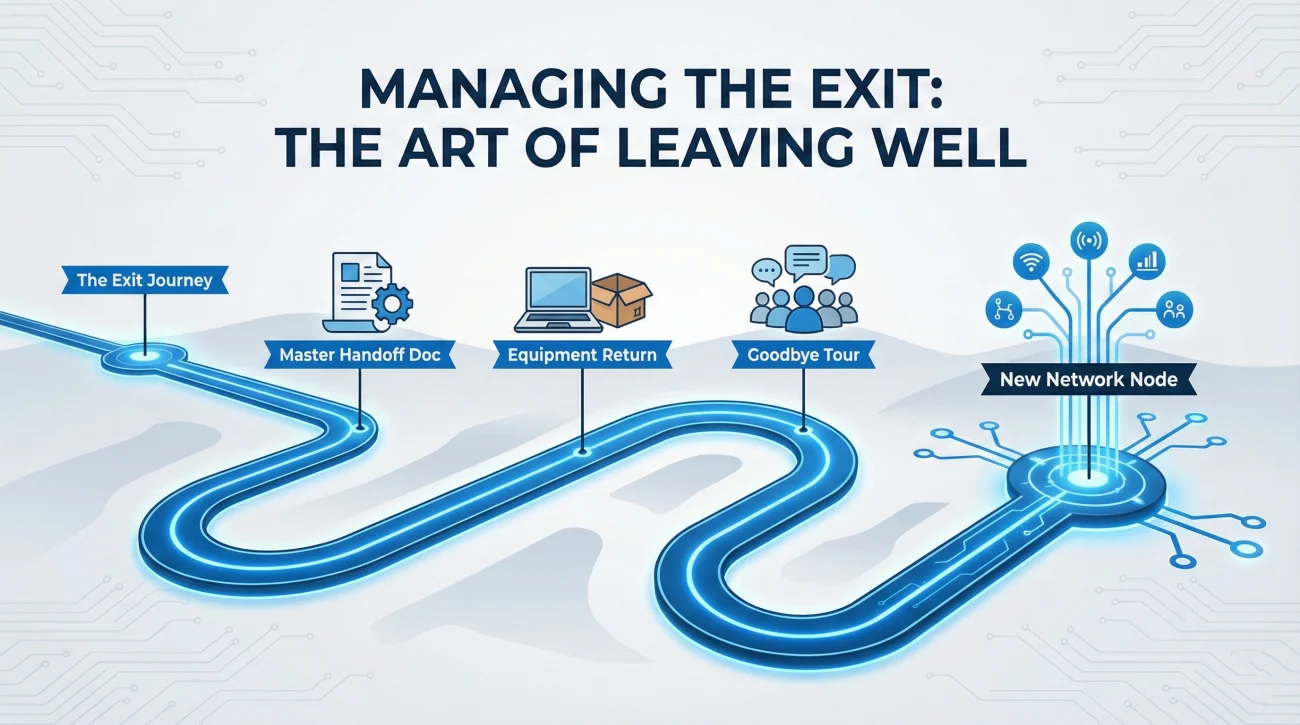
The last two weeks define your legacy. When you are relocating, you are often distracted by packing boxes and utilities, but do not check out mentally at work.
The Transition Document
Create a “Master Handoff” Google Doc. Include:
- ✅ Login Credentials: For any shared accounts (use a password manager if possible).
- ✅ Project Status: Where exactly does every project stand? What is the immediate next step?
- ✅ Key Contacts: Who is the point of contact at Client X? (Include their email and quirks).
- ✅ Unfinished Business: Be honest about what is falling through the cracks.
The “Goodbye Tour”
Since you are leaving the area, you won’t bump into these people at the grocery store. Schedule 15-minute coffee chats with the people who matter. Connect with them on LinkedIn. Ask for personal email addresses. Your network is your net worth, and you are about to stretch that network to a new city.
❓ FAQ
📝 How much detail should I include in a resignation email due to relocation?
⏰ Can I give less than two weeks’ notice if I have to move urgently?
🔄 What if I want to come back later?
💰 Should I ask for a severance package?
📧 Is it better to say “personal reasons” or “relocation”?
Final Thoughts
Submitting a resignation email due to relocation marks the end of a chapter, but if handled with strategic foresight, it does not have to mean the end of the relationship. By focusing on professional transparency, securing your logistics, and perhaps even negotiating a remote future, you can turn a geographic exit into a career bridge.
Remember, the world is small. The manager you leave on good terms with today could be the reference that lands you your dream job in your new city tomorrow. Handle this exit with the same care you would handle a promotion.
For more specific templates based on different job roles, you can explore our resignation email examples category. If you need a broader overview of resignation etiquette, check out our pillar guide on how to write a resignation email.
⚠️ Legal Disclaimer: ResignSmartly provides general informational guidance about resignation, workplace communication, notice periods, handovers, and career transitions. Content does not constitute individualized legal advice. Employment laws, contracts, workplace policies, and individual circumstances vary, so review the requirements that apply to your situation and consult an appropriate qualified professional when needed.