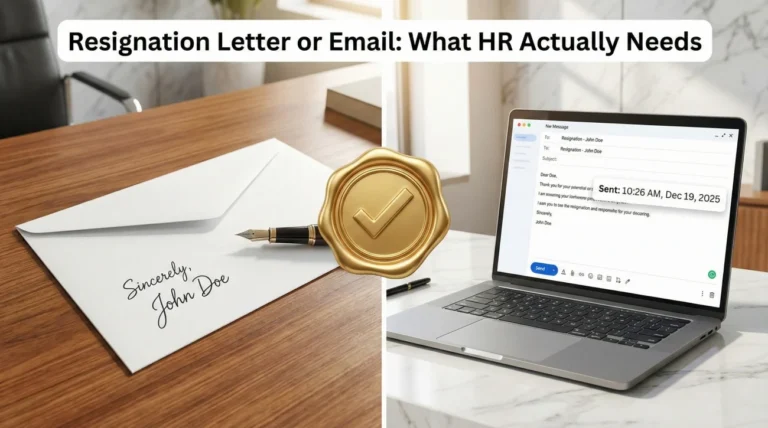
- Core idea: Your resignation email to a manager is a reputation moment, because the ending shapes how you are remembered.
- Sequence: Tell your manager first, then send the formal email after the talk, then loop in HR so your manager is not blindsided.
- Velvet protocol: Speak first, write second, and use the email as confirmation and a clean timestamp for your notice period.
- Email essentials: Clear subject line, first sentence states resignation plus last day, brief gratitude, and a concrete handover commitment.
- Avoid landmines: No complaints, no critiques, no emotional apologies, no salary flex, and be ready for counteroffers or guilt trips with a calm transition focus.
The Strategic Weight of Notifying Your Manager
Sending a resignation email to a manager is far more than a simple administrative checkpoint or a box to tick on your way out the door. It is a defining moment of professional etiquette that can cement your reputation for years to come. In the corporate world, the “peak-end rule” suggests that people judge an experience largely based on how it felt at its peak and, crucially, how it ended. Your resignation is that ending.
Because your direct supervisor controls your references, influences your immediate exit experience, and often remains a fixture in your industry network, this communication requires a sophisticated blend of empathy, strategy, and icy professionalism. The email itself is merely the artifact; the real work lies in the orchestration of the announcement.
The relationship you share with your direct manager is arguably the most significant, and complex, connection in your professional life. They are the person who has overseen your growth, advocated for your raises, approved your leave, and perhaps even mentored you through difficult projects. Therefore, how you dismantle this relationship determines whether you leave behind a burned bridge that haunts you, or a lasting ally who champions you from afar.
While the ultimate goal is to leave, the strategic imperative is to preserve the relationship. This comprehensive deep-dive guide will walk you through the psychology of the notification, the exact timing protocols to avoid blindsiding leadership, and provide high-level, battle-tested templates to ensure your departure is handled with the utmost class.
The Hierarchy of Notification: Manager vs. HR
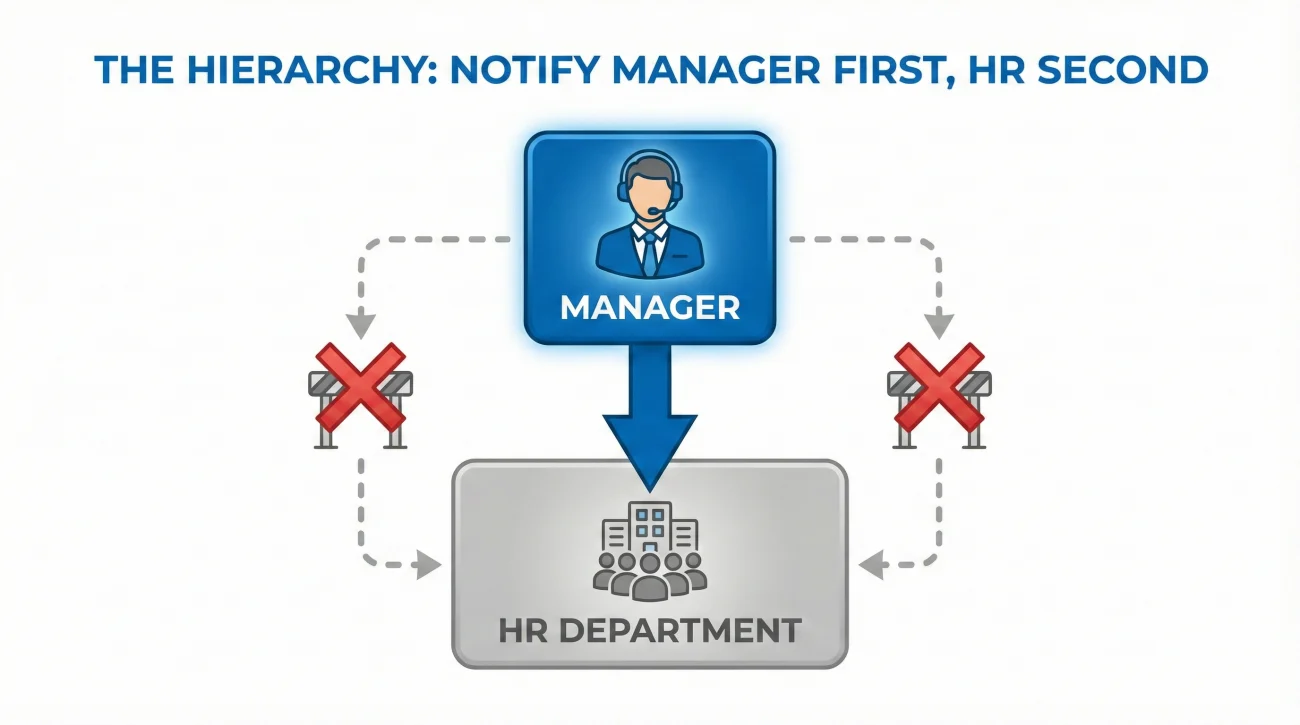
In the adrenaline-fueled anxiety of quitting, many employees commit a tactical error that damages their standing immediately: they submit their resignation letter to their direct manager and Human Resources simultaneously. Or worse, they notify HR first to “get the paperwork started” or to ask about benefits, assuming HR will keep it confidential.
From a strategic standpoint, this is a critical misstep. Understanding the hierarchy of notification is essential for maintaining professional leverage.
The Psychology of “Manager First”
Resigning is not just a legal transaction; it is a deeply emotional one for the person you report to. By bypassing your manager, you inadvertently signal a lack of trust or respect. Here is why the order of operations matters immensely:
- 🛑 Control of Narrative: If HR knows first, the news rarely stays contained. It may leak to your manager through corporate backchannels or automated system notifications. Hearing “Did you know Sarah is leaving?” from an HR representative is humiliating for a leader. It makes them look out of touch with their own team.
- 🛑 Operational Shock Absorption: Your manager carries the burden of your workload. They need a moment of privacy to process the gap your departure will create, panic privately about the deadline next week, and formulate a plan before they are bombarded with HR’s official offboarding checklists.
- 🛑 Relationship Preservation: Offering your manager the courtesy of a private “heads-up” allows them to prepare their reaction before it becomes official company record. It frames the resignation as a partnership in transition rather than an act of betrayal.
The Strategic Sequence for Notifying HR
The ideal workflow respects the chain of command. You should only send your formal email resignation to your supervisor after a verbal conversation. HR comes last – typically only after your manager has given the green light or acknowledged the news.
| Step | Action | Strategic Purpose |
|---|---|---|
| 1. The Meeting | Book a private 1:1 meeting (Video or In-person). | Creates a contained environment for the news. |
| 2. The Verbal Notice | Break the news verbally. | Allows for emotional processing and Q&A without a paper trail. |
| 3. The Manager Email | Send the formal resignation email to manager. | Creates the legal timestamp for your notice period (1 hour post-meeting). |
| 4. The HR Notification | CC HR or forward the chain (with manager approval). | Triggers the official offboarding machinery (Day 0 afternoon or Day 1). |
The “Velvet Resignation” Protocol
Unless you are working in a hostile environment or have zero access to your boss (e.g., they are on long-term leave), you should never let an email break the news. A blind quitting email to a manager is often perceived as cold, cowardly, or unprofessional. It denies them the closure of a conversation.
The “Velvet Resignation” technique involves softening the blow with a face-to-face (or camera-to-camera) conversation, ensuring the email is merely a confirmation of what has already been discussed. This conversation is where you save the relationship.

Scripting the Meeting Request
The anxiety often starts with “How do I ask for the meeting?” If you book a meeting titled “Resignation,” you will induce panic before you even speak. You want to be vague enough to avoid panic but serious enough to secure their undivided attention.
Use these subject lines for the invite:
- “Quick sync / Important update”
- “Check-in regarding my career path”
- “15-minute chat: Personal update”
Verbal Scripts for Different Manager Archetypes
Not all managers react the same way. A “one-size-fits-all” script can backfire. You must tailor your verbal opening based on the psychological profile of your manager and your existing relationship.
The Supportive Mentor
This manager has invested in you. They will likely feel a mix of pride and personal loss.
“This is really hard for me to say because I’ve loved working with you, but I’ve received an offer that aligns perfectly with the long-term goals we’ve discussed. I’m going to be accepting it, but I wanted you to hear it from me first. I want to make sure I do right by you during this transition.”
The Strictly Business Boss
This manager cares primarily about output and disruption. Focus on the transition plan immediately.
“I’m requesting this meeting to notify you that I’ll be moving on to a new position. My last day will be [Date]. I know this comes at a busy time, so I’ve already drafted a plan to ensure my current projects don’t lose momentum. I want to use this meeting to discuss how to make the handover seamless.”
The Difficult or Volatile Manager
Keep it brief, factual, and devoid of emotion to prevent them from finding an opening to argue.
“I’ve decided to move in a different direction with my career, so I’m putting in my formal notice today. My last day will be [Date]. I’ve prepared a transition document to ensure my tasks are covered. I’ll follow this up with an email for your records.”
Anatomy of a Professional Resignation Email
Once the conversation is over, the clock starts ticking on the follow-up email. This document is essential for HR compliance, payroll calculation, and protecting yourself legally. However, it is also the final document in your personnel file. A standard email resignation to a supervisor should contain four non-negotiable elements.
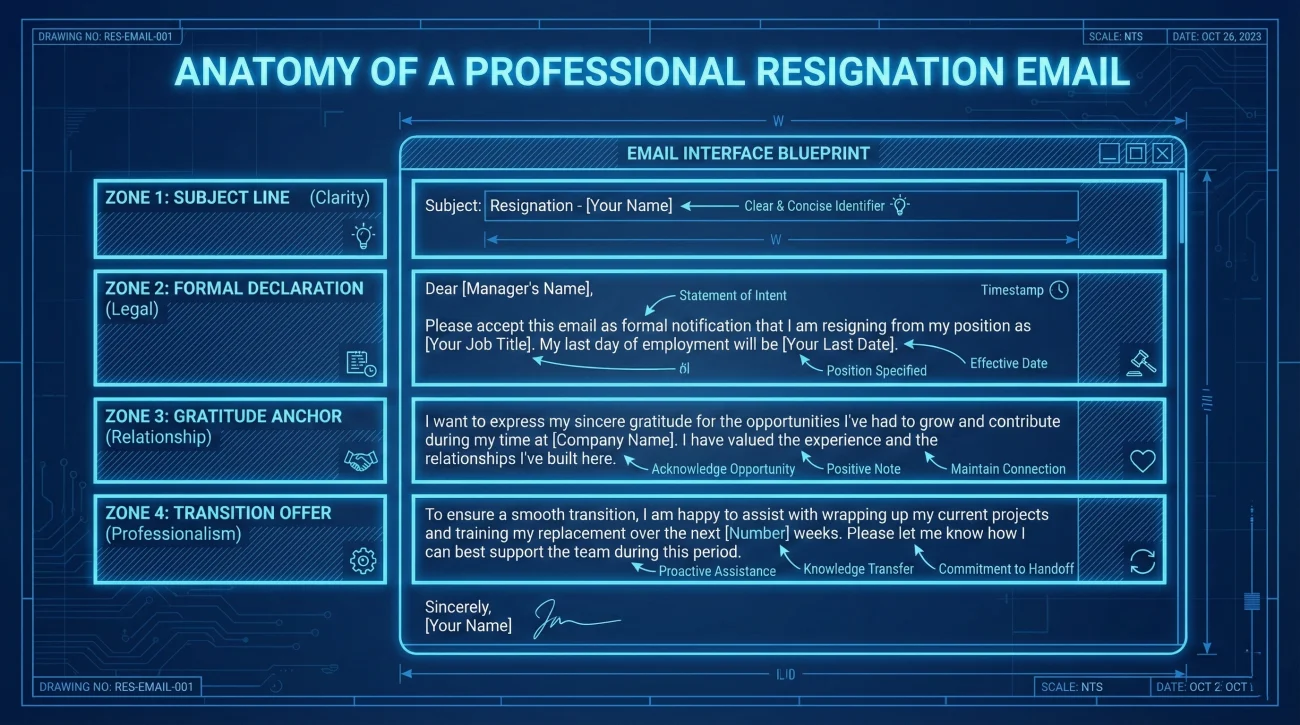
1. The Unambiguous Subject Line
Do not be cryptic. HR departments process hundreds of emails. Your subject line must be searchable and clear. Avoid emotional subject lines like “Goodbye” or “Moving on.”
- Resignation – [Your Name]
- Resignation Notice – [Your Name] – [Last Day]
- Formal Resignation – [Your Name] – [Employee ID if applicable]
2. The Formal Declaration
The first sentence must state that you are resigning and, crucially, when your last day will be. This is the legal “notice” part of the document. If you do not state the date clearly, companies can argue you didn’t provide sufficient notice, which might affect payout of accrued vacation time.
3. The Bridge-Building (Gratitude)
Even if you are leaving on neutral terms, find one thing to thank them for. Gratitude disarms defensiveness. If you are leaving on bad terms, you can skip this or keep it very high-level (“Thank you for the opportunity”). If you loved the job, this is where you cement the relationship.
4. The Transition Commitment
End by reassuring them that you aren’t leaving them in the lurch. Offer to document processes, close out tickets, or train a replacement. This signals that you remain a professional until the very last hour.
What to Explicitly Exclude
Your resignation email is not the place for:
- ❌ Grievances: Do not list why you are leaving if the reasons are negative.
- ❌ Constructive Criticism: Save this for the exit interview (or keep it to yourself).
- ❌ Emotional Apologies: You have the right to leave. You do not need to beg for forgiveness.
- ❌ Salary Details: Do not mention your new salary or use the email as a bargaining chip unless you are specifically negotiating (which is risky).
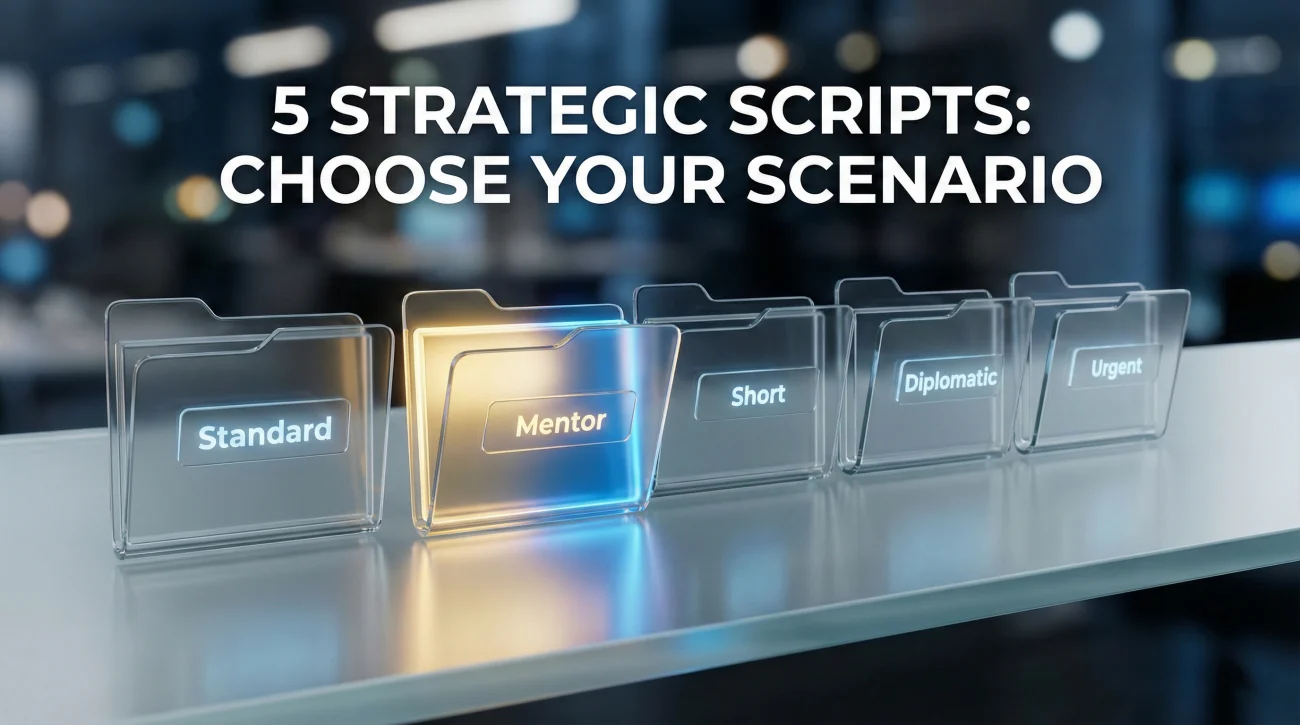
5 Strategic Resignation Email Templates
Below are calibrated templates for various scenarios. Choose the one that best fits the temperature of your relationship when notifying a manager of resignation. Remember to fill in the bracketed information with precision.
Template 1: The “Standard Professional” (Safe & Effective)
Use this for a standard corporate exit where the relationship is positive but professional. It covers all bases without being overly emotional.
Subject: Resignation – [Your Full Name]
Dear [Manager’s Name],
Following our conversation earlier today, please accept this email as formal notification that I am resigning from my position as [Job Title]. My final day with [Company Name] will be [Date].
I want to express my gratitude for the opportunities I’ve had during my time here. I have genuinely enjoyed working with you and the team, and I appreciate the support you have provided during my tenure. The projects we worked on regarding [mention a project] were particularly valuable for my professional growth.
Over the next [Notice Period], I am fully committed to ensuring a smooth handover. I will finalize the [Project Name] and ensure all my files are updated for my successor. I am also happy to assist in training a replacement should one be hired before my departure.
Thank you again for your guidance. I hope we can stay in touch.
Sincerely,
[Your Name]
[Your Phone Number]
[Your Personal Email]
Template 2: The “Grateful Mentee” (Warm & Personal)
Use this when your manager has been a significant figure in your career growth. This text is designed to turn a boss into a lifelong mentor and reference.
Subject: Resignation – [Your Full Name]
Dear [Manager’s Name],
As we discussed, I am writing to formally resign from my position as [Job Title], effective [Date].
This was not an easy decision to make. I want to sincerely thank you for your mentorship over the past [Number] years. Your guidance on [Specific Project/Skill] has been instrumental in my professional development, and I am incredibly grateful for the advocacy and support you have shown me. I would not be ready for this next step without the foundation I built under your leadership.
I am moving on to a new opportunity that aligns with the career goals we have often discussed, but I will truly miss working with this team. I am committed to making this transition as easy as possible for you. I have already begun organizing my handover notes and am happy to assist in training my replacement.
I hope we can maintain our professional connection in the future.
Best regards,
[Your Name]
[Your Phone Number]
[Your Personal Email]
Template 3: The “Short & Neutral” (Strictly Business)
Use this if the relationship is distant, strictly transactional, or if you simply prefer to keep the departure low-profile. It offers zero ammunition for gossip.
Subject: Resignation Notice – [Your Name]
Dear [Manager’s Name],
Please accept this email as formal notification that I am resigning from my position as [Job Title]. My last day of employment will be [Date].
I appreciate the opportunity to have worked with [Company Name] and wish the team the best in the future.
I will focus on completing my current duties and handing over my responsibilities during my remaining time here. Please let me know how I can best assist during this transition.
Regards,
[Your Name]
[Your Phone Number]
Template 4: The “Diplomatic Exit” (Difficult Manager)
Use this when leaving a toxic situation or a difficult boss. It remains polite but removes emotional warmth to protect you professionally. It is legally sound but emotionally detached.
Subject: Resignation – [Your Name]
Dear [Manager’s Name],
I am writing to formally resign from my position as [Job Title] at [Company Name]. My final day will be [Date].
I have decided to move forward with a new opportunity that aligns with my long-term career path. I will ensure that all my projects are up to date and handed over properly before my departure.
Please advise on the next steps for the offboarding process and where you would like me to return company property.
Respectfully,
[Your Name]
[Your Phone Number]
Template 5: The “Immediate Departure” (Emergency Only)
Only use this if you cannot work the notice period due to personal emergencies, severe health reasons, or an unsafe work environment. Be prepared to burn a bridge with this one, but sometimes it is necessary.
Subject: URGENT: Resignation Effective Immediately – [Your Name]
Dear [Manager’s Name],
I am writing to inform you that I must resign from my position as [Job Title], effective immediately. Today, [Date], will be my last day.
Due to unforeseen personal circumstances, I am unable to fulfill the standard notice period. I sincerely apologize for the inconvenience this sudden departure may cause the team.
I have left all relevant files and status updates on the shared drive to assist with the handover. I am available via email for critical questions over the next 48 hours.
Thank you for your understanding.
Sincerely,
[Your Name]
[Your Phone Number]
❓ FAQ
📞 Should I resign over Zoom or Email if I work remotely?
⏰ What is the best time of day and day of week to resign?
Time: Late afternoon (around 3:00 PM – 4:00 PM) is often best. It allows you to have the conversation and then leave shortly after, giving your manager the evening to process the news without having to immediately face a full day of meetings with a poker face.
📧 Can I just send the email if I hate my boss or fear conflict?
📝 Do I need to include my specific reason for leaving?
🤝 What if my manager refuses to accept my resignation?
Final Thoughts
The moment you hit send on your resignation email to a manager, you are technically no longer just their employee – you are a future alumnus of the company. How you execute these final weeks will define your legacy there far more than your average workdays. People remember the last impression vividly.
Prioritize the human element. Speak first, write second. Be firm in your decision but gracious in your tone. Even if you are thrilled to leave, maintain the discipline of gratitude. By following this protocol, you ensure that your exit is remembered for its professionalism, keeping your network intact for wherever your career takes you next. The world is small; you never know when you might need that bridge again.
For more specific scenarios, explore our resignation email examples, or return to the homepage for guidance on your next career move. If you are still drafting your notification, our guide on how to write a resignation email offers further structural advice.
⚠️ Legal Disclaimer: ResignSmartly provides general informational guidance about resignation, workplace communication, notice periods, handovers, and career transitions. Content does not constitute individualized legal advice. Employment laws, contracts, workplace policies, and individual circumstances vary, so review the requirements that apply to your situation and consult an appropriate qualified professional when needed.