- Privacy Split: Keep the email legally vague, save human context for a verbal conversation so you get empathy without gossip risk.
- Remote Pivot: Ask for downshifting options like async hours, reduced load, or contractor mode before you resign to protect income and insurance.
- Crisis Handover: If you must leave fast, create a single “bus factor” doc with access, status, contacts, and file links, then send a short triage note to the team.
- Templates By Scenario: Match tone to the situation, use zero-notice, caregiver, childcare, private, or burnout versions without medical details or oversharing.
- Money And Protection: Check leave options first, document accommodation requests for benefits nuance, and time your last day to avoid insurance gaps.
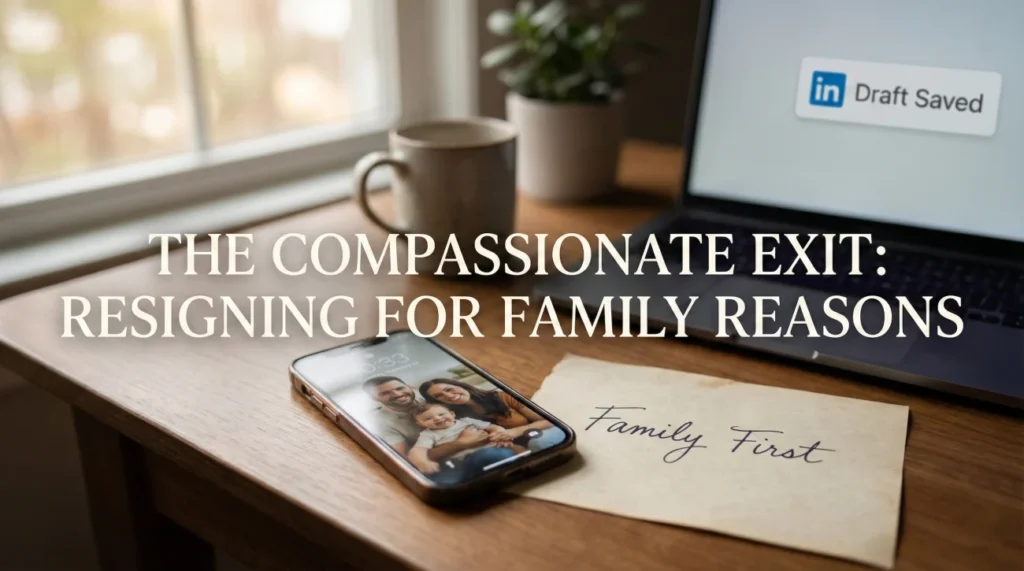
Writing a Resignation Email Due to Family Reasons: The Ultimate Guide to Compassionate Exits
In the high-stakes world of career management, resigning is usually a calculated move – a pawn sacrificed for a queen. But when you draft a resignation email due to family reasons, the chessboard is overturned. You aren’t leaving for a better title, a corner office, or a 20% salary bump. You are leaving because life – messy, unpredictable, and urgent – has intervened.
Whether it’s a sudden medical crisis, the slow, heartbreaking decline of an aging parent, or a childcare arrangement that has collapsed under its own weight, family resignations are unique beasts. They are the only type of exit where “burning bridges” is rarely a concern, yet the internal guilt of “abandoning the team” is often at its highest.
This guide is not just a collection of copy-paste templates. It is a strategic playbook for professionals standing at the crossroads of career duty and personal crisis. We will dissect how to protect your privacy without alienating your boss, how to leverage legal protections like FMLA to save your job before you quit, and how to execute a “Crisis Handover” that ensures your professional reputation survives your personal emergency.
The Privacy Strategy: Controlling the Narrative Without Oversharing
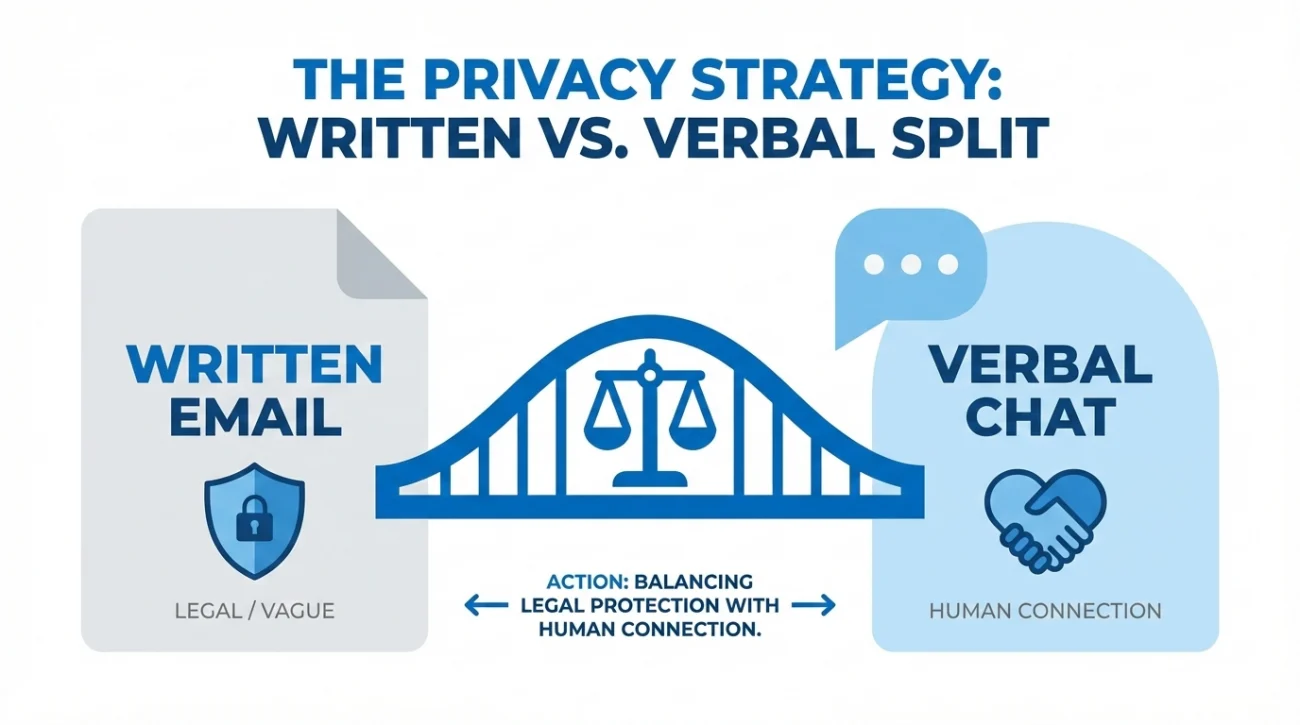
When you resign for “better opportunities,” you shout it from the rooftops. When you resign for family trauma, silence is often your instinct. However, total silence in a professional setting can breed toxic rumors. The strategic goal is to share enough to garner empathy and support, but not so much that you become the subject of office gossip or pity.
The Verbal vs. Written Split
To master this exit, you must treat your resignation letter and your resignation conversation as two distinct entities with different goals.
1. In the Letter (The Legal Record):
Your email is a permanent legal document saved in HR files forever. It is not the place for emotional outpourings or medical details. Keep it legally vague. The phrase “Personal family circumstances” is a legally sufficient shield that protects your medical privacy while satisfying HR requirements.
2. In the Conversation (The Human Connection):
This is where you build bridges. Use the “Category Rule.” You do not need to share the gruesome details of a diagnosis (e.g., “My husband has Stage 4 pancreatic cancer”), but sharing the category creates a human bond.
The Script: “We are facing a severe medical crisis with my immediate family. It’s a long road ahead, and I need to be fully present for them right now. I hope you understand why I can’t share more details at this moment.”
By showing this vulnerability, you turn your boss from a “manager” into an “ally.” This often unlocks hidden company benefits like discretionary bonuses, extended leave, or a “soft landing” promise for when you are ready to return.
The “Remote Pivot”: Don’t Quit… Yet
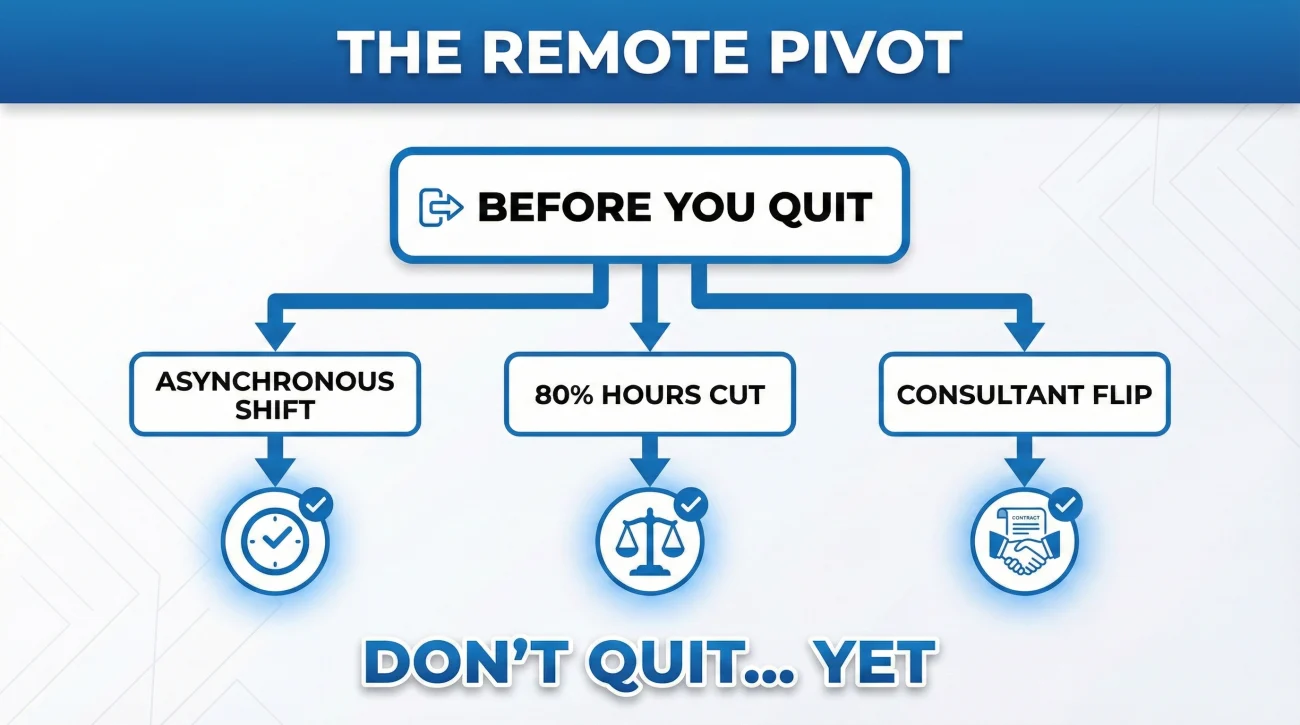
Before you hit send on that resignation letter, have you attempted the “Remote Pivot”? In the modern workforce, talent is scarce. Many professionals resign prematurely because they assume their current role cannot accommodate their new reality. This is often a false assumption.
If you are a valued high-performer, your company would almost always rather keep 50% of you than lose 100% of you. Before resigning, propose a “Downshifting Plan”:
- 📉 The Asynchronous Shift: “I can’t work the standard 9-5 due to hospital visits and treatments, but I can guarantee delivery of all coding projects between 8 PM and midnight.”
- 📉 The 80% Cut: “Can I reduce my salary by 20% in exchange for taking every Friday off to manage my parent’s care?”
- 📉 The Consultant Flip: “I must resign my full-time operational role, but can I stay on as a 10-hour/week contractor to answer questions and train the new hire?”
Why do this? If they say no, you have lost nothing – you were going to quit anyway. If they say yes, you keep an income stream and health insurance during a crisis, which is invaluable.
The “48-Hour Crisis Handover” Protocol
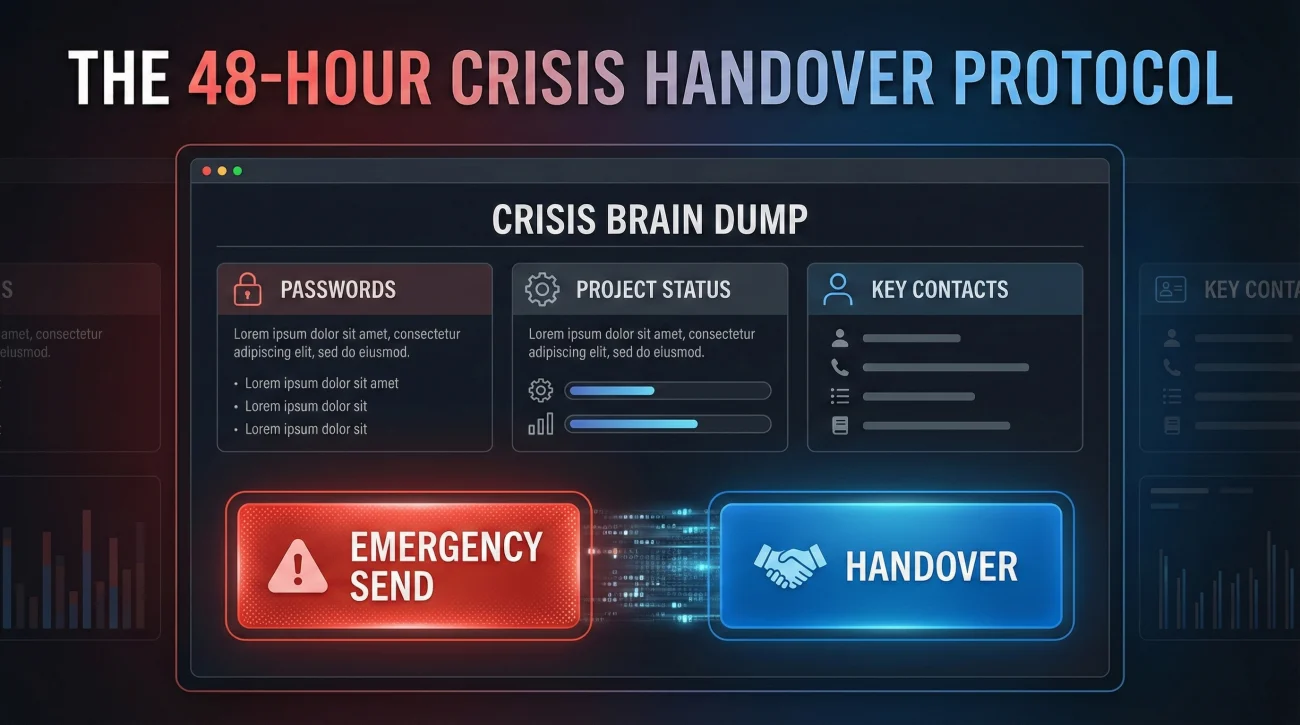
Standard corporate etiquette demands two weeks’ notice. But a family emergency resignation email often implies you are leaving now. If a stroke, car accident, or severe mental health crisis strikes, you cannot sit at a desk for 10 days “wrapping things up.”
Here is how to leave immediately (Zero Notice) without wrecking the reputation you spent years building.
Step 1: The “Bus Factor” Document
Before you send your resignation email, spend 2 hours creating a single “Crisis Brain Dump” Google Doc. This document is your insurance policy against burning bridges. It must contain:
- Access: Passwords for all shared accounts (or where to find them in LastPass).
- Status: A simple Red/Yellow/Green status of every active project.
- Contacts: Direct phone numbers for key clients and what they are currently waiting for.
- Files: Links to the folder locations of critical assets on the server.
Step 2: The “Triage” Email Strategy
Send this email to your immediate team simultaneously with your resignation to HR:
“Team, I have to leave immediately for a family emergency. I know this is abrupt, and I am sorry for the shock. To help you survive the next week, I have created a Handover Doc [Link] that contains everything I know. I will check email once a day at 8 PM for true emergencies only.”
This protocol turns a chaotic, damaging exit into a managed transition. Even in your absence, you are demonstrating leadership and care for the team.
Resignation Templates for Specific Crises
One generic template does not fit all family crises. A resignation for a happy reason (staying home with a baby) requires a different tone than a tragic one (hospice care). Customize these templates, ensuring you blend the bolded keyword phrases naturally.

1. The “Zero-Notice” Crisis (Medical/Accident)
Use this when a family emergency resignation email is the only option because physically coming to the office is impossible. It apologizes for the timing but remains firm on the departure.
Subject: Immediate Resignation – [Your Name] – Family Emergency
Dear [Manager’s Name],
Please accept this letter as my formal resignation from my position as [Job Title], effective immediately, [Today’s Date].
A severe and unexpected family emergency has occurred that requires my full and immediate presence. Due to the urgent nature of this crisis, I am unable to provide the standard two-week notice period. I sincerely apologize for the abruptness of this departure and the disruption it will cause the team.
I have drafted a “Crisis Handover” document attached to this email, outlining the status of [Project A] and [Project B], along with pending deadlines for the week. I have also cc’d [Colleague’s Name] who has access to my files.
Thank you for your understanding and compassion during this difficult time.
Sincerely,
[Your Name]
2. The Long-Term Caregiver (Aging Parents)
Caregiving is exhausting and often progressive. This taking care of parents resignation email acknowledges the conflict between your professional desire to work and your personal duty to family.
Subject: Resignation – [Your Name]
Dear [Manager’s Name],
I am writing to formally resign from my role as [Job Title], effective [Date].
Over the past few months, my family circumstances have changed significantly. My parent’s health has declined to a point where they require full-time support, and I have made the decision to step away from my career to be their primary caregiver. This was a difficult choice, as I love my work here, but it is the necessary one for my family.
I am grateful for the flexibility [Company Name] has shown me thus far. I want to ensure my departure is as smooth as possible and will spend my final two weeks training [Colleague Name] on the [Specific System].
I hope to stay in touch and perhaps rejoin the workforce when my family situation stabilizes.
Best regards,
[Your Name]
3. The Childcare Cliff
When childcare costs exceed income or availability vanishes, leaving is a logical choice. This resignation due to child care email is direct and unapologetic about priorities.
Subject: Resignation Notice – [Your Name]
Dear [Manager’s Name],
Please accept this email as my resignation from [Company Name]. My final day of work will be [Date].
Due to unforeseen changes in my family’s childcare arrangements, I am no longer able to sustain the schedule required for this position. After reviewing our options, we have decided that it is necessary for me to transition to being a full-time parent at this stage to ensure stability for my children.
I have truly enjoyed my time here, particularly working on [Project Name]. I am committed to a thorough handover process before my departure.
Thank you for the opportunity to be part of this team.
Sincerely,
[Your Name]
4. The “Private” Exit (Mental Health/Divorce/Legal)
For sensitive issues where you want zero follow-up questions. This family issues resignation email draws a firm professional boundary.
Subject: Resignation – [Your Name]
Dear [Manager’s Name],
I am writing to provide formal notice of my resignation from [Job Title], effective [Date].
Due to pressing personal family circumstances that require my undivided attention, I must step down from my role. This decision allows me to focus fully on resolving these matters without compromising the quality of work the team deserves.
I want to thank you for your mentorship during my tenure. I am fully committed to ensuring my projects are handed over efficiently during my notice period.
Best regards,
[Your Name]
5. The “Burnout” Factor
When the stress at home makes working effectively impossible. This personal family reasons resignation email is honest about your capacity limitations.
Subject: Resignation Notice – [Your Name]
Dear [Manager’s Name],
I am writing to resign from my position at [Company Name], with my last day being [Date].
Recent personal challenges within my family have made it difficult for me to maintain the high standard of work I hold myself to. I believe it is in the best interest of both the team and myself that I step away to focus entirely on resolving these matters.
I appreciate your understanding and the privacy you have afforded me. I will do everything I can to support the transition before I leave.
Sincerely,
[Your Name]
Legal & Financial Intelligence: The “Before You Quit” Checklist
Resigning affects more than just your daily routine; it triggers a cascade of legal and insurance changes that can ruin you financially if ignored. Do not resign until you have physically checked these three boxes.
1. The FMLA Shield (United States)
Before you quit, ask yourself: “Do I qualify for FMLA?” The Family and Medical Leave Act provides up to 12 weeks of job-protected, unpaid leave with continued health insurance.
- ✅ Eligibility Checklist: Have you worked there for 12 months? Have you worked 1,250 hours? Does the company have 50+ employees?
- ✅ The Strategy: Even if you don’t plan to return, taking FMLA extends your health insurance for 3 months at employee rates (cheap) vs. COBRA rates (expensive). It buys you time to see if the crisis resolves. Always apply for FMLA before resigning.
2. The “Good Cause” Exception for Unemployment
The general rule is: You can’t get unemployment benefits if you quit voluntarily. However, there is a major exception. Many states recognize “Good Cause” quitting for compelling family reasons.
- Domestic Violence: If you quit to escape abuse or protect your safety, you are often eligible.
- Caregiving Refusal: If you quit because your employer refused a shift change to accommodate necessary caregiving, you may be eligible.
- The Documentation Trick: Document your request for accommodation in writing (email) before you quit. If they reply “No,” you now have evidence that you tried to keep your job but were forced out by inflexibility. This paper trail is key to winning benefits.
3. The COBRA Trap
Health insurance usually ends on the last day of the month you resign. This creates a timing strategy:
| Scenario | Result |
|---|---|
| Resign on March 31st | Insurance often ends that same day at midnight. You have zero coverage for April. |
| Resign on April 2nd | Insurance often covers you for the entire month of April. |
Strategy: If possible, push your resignation date just a few days into the new month to gain 30 days of “free” coverage while you figure out your next steps.
The Psychology of “Caregiver Guilt”
Resigning for family reasons triggers a specific, toxic psychological burden known as “Caregiver Guilt.” You feel you are failing your team by leaving them short-handed, and simultaneously failing your family by having worked so long while they suffered.
The Reframing Technique:
You must ruthlessly remind yourself of the “Replacement Reality.” Your company can hire a new Project Manager within 4 weeks. Your parents cannot hire a new child. Your children cannot hire a new parent. You are not “quitting”; you are simply reallocating your limited resources to the only place where you are truly irreplaceable.
When you talk to your boss, stand tall. You are not asking for forgiveness; you are informing them of a life priority. This confidence often commands more respect than an apology ever could.
Final Thoughts: The “Open Door” Exit
Resigning for family reasons is rarely the end of a career. It is a pause button, not a stop button. Because you are leaving for a “noble” reason, you become a prime candidate for “Boomerang Employment” (being rehired later).
In your final days, plant the seed with your manager: “I love this company. When my home situation stabilizes, I would love to knock on your door again.” By framing your exit as a temporary necessity rather than a permanent dissatisfaction, you keep your professional network alive, ready for you when you are ready to return.
For more specific scenarios, you can review our library of resignation email examples or read our pillar guide on how to write a resignation email to ensure you cover all technical bases.
⚠️ Legal Disclaimer: ResignSmartly provides general informational guidance about resignation, workplace communication, notice periods, handovers, and career transitions. Content does not constitute individualized legal advice. Employment laws, contracts, workplace policies, and individual circumstances vary, so review the requirements that apply to your situation and consult an appropriate qualified professional when needed.