- Core Frame: Schedule conflict resignations are about health and life stability, not “laziness”, especially with night shifts, rotations, and overtime creep.
- Try Before You Quit: Run a short “schedule audit” and present a data-backed pilot request so you learn fast if the chaos is fixable or permanent.
- Protect Your Money: Learn constructive discharge logic and build a paper trail so benefits and documentation are easier if the schedule was changed drastically.
- Use The Right Template: Pick a scenario-specific email for bait-and-switch shifts, overtime burnout, childcare, health impact, school conflict, or on-call unpredictability.
- Exit Cleanly: If you work opposite hours from leadership, use an asynchronous handover with clear docs, risk logs, and secure key returns to protect your reputation.
Writing a Resignation Email Due to Schedule Conflict: The Ultimate Strategic Guide
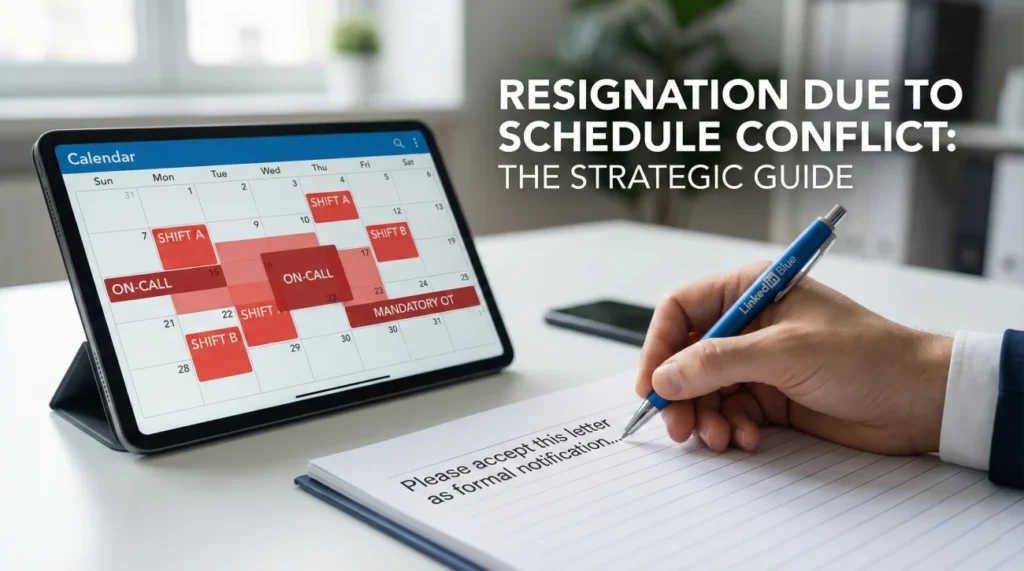
In the standard contract of employment, the deal is simple: you trade your skills for money. But there is a third, invisible currency that often goes uncounted until it runs out: Time. When you draft a resignation email due to schedule conflict, you are not just leaving a job; you are declaring that the exchange rate for your time has become biologically and emotionally unsustainable.
Schedule conflicts are arguably the most physically draining reason to resign. Unlike a difficult project or a boring task, a toxic schedule – whether it is the infamous “clopen” (closing late then opening early), the permanent night shift, or the creeping “mandatory” overtime – attacks your fundamental biology. It disrupts your circadian rhythms, erodes your relationships, and slowly dismantles the infrastructure of your personal life (childcare, education, health).
This guide is a strategic playbook for professionals who have reached their breaking point. We will move far beyond simple “I quit” templates. We will explore the “Biology of Scheduling,” how to legally document “Constructive Discharge” to protect your unemployment benefits, and how to negotiate a better roster before you pull the trigger on resignation.
The “Biology of Time”: Validating Your Decision

Many employees hesitate to send a work schedule quitting notice because they fear being seen as “lazy,” “uncommitted,” or “inflexible.” This is a dangerous corporate misconception. Human beings are not software; we cannot simply be “patched” to work indefinitely without specific cycles of rest.
1. The Circadian Tax
For those on night shifts or rotating rosters, the cost is cellular. The World Health Organization (WHO) has classified night shift work as a “probable carcinogen” due to the disruption of melatonin production. Resigning because your body cannot adjust to a 3 AM shift is not a preference; it is a preventative health decision. Framing your shift conflict resignation around “long-term health sustainability” is unarguable and professional.
2. The “Availability Creep”
In the age of Slack, Teams, and Zoom, the boundary between “on” and “off” has vanished. “Occasional overtime” often mutates into “mandatory 60-hour weeks.” When you resign due to this, you are fighting against “Scope Creep” of your life. You negotiated a 40-hour contract; demanding 60 hours is a breach of that agreement, implicitly if not explicitly.
The “Schedule Audit”: The Data-Driven Approach

Before you hand in your notice, you need to audit the situation. Is this a permanent feature of the industry (e.g., investment banking), or a management failure that can be fixed? You have leverage here: hiring a new employee to cover these shifts is expensive and difficult.
The “Pattern Interrupt” Negotiation Strategy
Most managers schedule on autopilot. Before quitting, try to interrupt the pattern with a data-driven proposal. Do not just complain; propose a pilot program.
The Script: “I want to stay with the team, but the current roster is unsustainable for my family commitments. I have analyzed the last 3 months, and I am closing 4 nights a week. Can we pilot a fixed schedule where I work 7 AM – 3 PM for the next 30 days? This would allow me to stabilize my childcare and actually increase my productivity during peak hours.”
If they say yes, you solve the problem without losing the paycheck. If they say no, you have your answer: the chaos is a feature, not a bug.
Legal & Financial Intelligence: Constructive Discharge
⚠️ Disclaimer: This guide is for general educational purposes only and does not constitute legal, tax, or financial advice. Laws and company policies vary by country, state, and employer. Always review your own documents and consult a qualified professional before making final decisions.
Resigning due to schedule isn’t always just “quitting.” In employment law, there is a concept called Constructive Discharge. This occurs when an employer makes working conditions so intolerable (e.g., forcing a single mother to work nights without notice) that a reasonable person would feel compelled to resign.
1. Unemployment Benefits: The “Good Cause” Exception
Generally, you cannot collect unemployment if you quit voluntarily. However, changing an employee’s schedule drastically (e.g., moving you from Day Shift to Night Shift without consent) can be considered “Good Cause” in many states.
- ✅ Document the Change: Keep copies of your original offer letter (showing 9-5) and the new roster (showing nights).
- ✅ Document the Objection: Send an email stating, “I cannot work this new schedule due to X.” If they fire you or force you out, you have a paper trail to fight for benefits.
2. FMLA for Schedule-Induced Illness
If the schedule is causing severe anxiety, sleep disorders, or exacerbating a condition, you may qualify for FMLA (Family and Medical Leave Act) before you quit. This provides unpaid, job-protected leave. It buys you time to find a new job while keeping your health insurance.
Resignation Templates for Every Schedule Conflict
One template does not fit all. A resignation due to burnout differs significantly from one due to a childcare hard stop. Use these expanded templates to frame your specific scheduling conflict scenario professionally. Remember to customize the bracketed information.
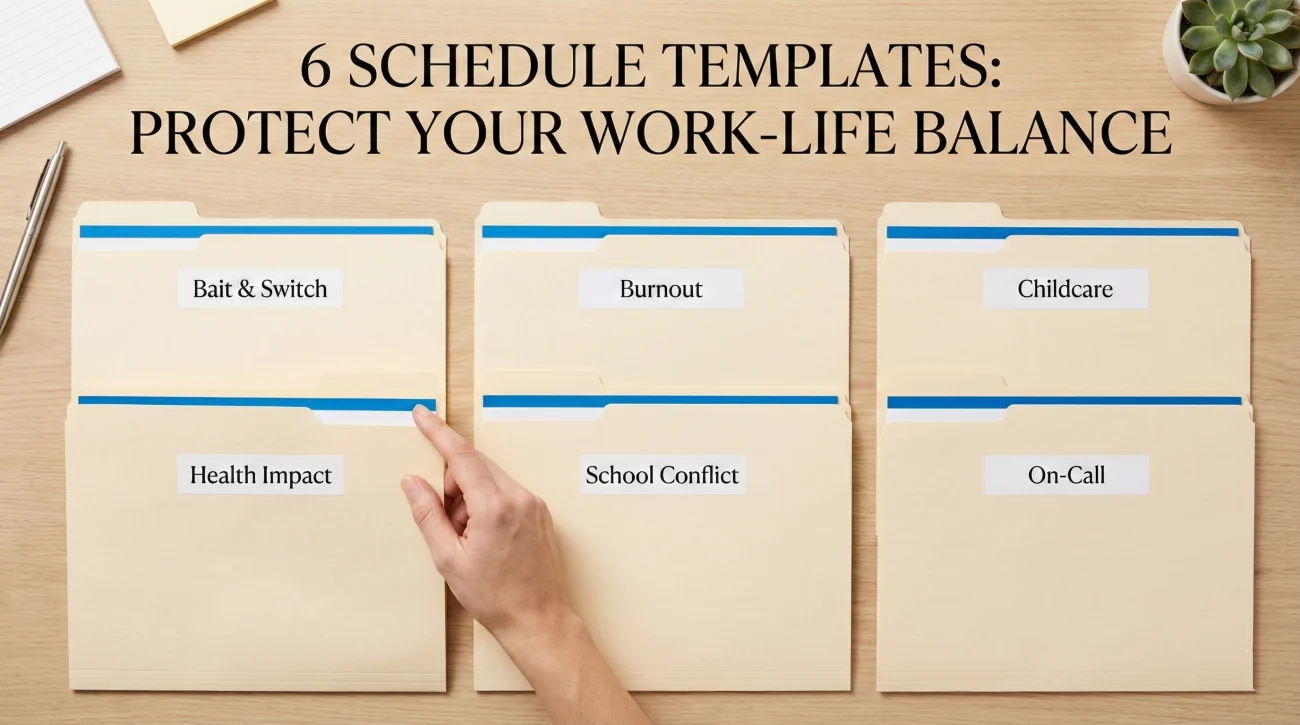
1. The “Bait and Switch” (Changed Expectations)
Use this when you were hired for one shift (e.g., Days) and forced into another (e.g., Nights/Weekends). This shift conflict resignation highlights the breach of the original verbal or written agreement.
Subject: Resignation – [Your Name] – Schedule Changes
Dear [Manager’s Name],
Please accept this letter as my formal resignation from my position as [Job Title], effective [Date].
When I accepted this role, my understanding based on our employment agreement was that my hours would be [Original Schedule, e.g., 9-5 M-F]. Over the past few months, the requirements have shifted significantly to include [New Schedule, e.g., permanent weekends/night shifts].
While I have tried to accommodate these changes, the new schedule is unfortunately incompatible with my existing personal commitments. I need to return to a position with the hours I was originally hired for, which necessitates this transition.
I appreciate the opportunity to work with the team and will ensure a smooth handover of my duties before I depart.
Sincerely,
[Your Name]
2. The “Burnout” (Excessive Overtime)
For when “crunch time” never ends. This overtime resignation email frames the exit as a necessity for sustainability rather than a complaint about hard work.
Subject: Resignation – [Your Name]
Dear [Manager’s Name],
I am writing to resign from my position at [Company Name], with my last day being [Date].
This was a difficult decision, as I value the work we do. However, the consistent requirement for mandatory overtime – averaging [Number] hours per week over the last [Timeframe] – has become unsustainable for my work-life balance.
I have realized that I need to step back into a role with a more predictable schedule to maintain my health and performance standards. I am proud of what we achieved on [Project Name] and want to leave the team in a strong position.
I will work diligently during my notice period to finalize pending tasks.
Best regards,
[Your Name]
3. The “Childcare Cliff” (Family Logistics)
Parents often have hard deadlines (daycare pickup). This work-life balance leaving email is objective and logistical, removing emotion from the decision.
Subject: Resignation Notice – [Your Name]
Dear [Manager’s Name],
Please accept this email as my resignation from [Company Name], effective [Date].
Due to recent changes in my family’s childcare arrangements, I am no longer able to support the [Current Shift/Hours] required for this position. The logistics of my family’s schedule now require me to work standard business hours, which conflicts with the current needs of this role.
I have explored alternative options, but unfortunately, none are viable at this time. I have truly enjoyed my time here and regret that logistics have made this necessary.
I am committed to a thorough transition process over the next two weeks.
Sincerely,
[Your Name]
4. The Health Impact (Night Shifts/Rotation)
When the schedule is making you physically ill. This is a strong work schedule quitting template that prioritizes health and creates a record of the reason for leaving.
Subject: Resignation – [Your Name]
Dear [Manager’s Name],
I am writing to formally resign from my position, effective [Date].
After consulting with my doctor regarding recent health challenges, I have been advised that I can no longer sustain the rotating shift patterns required by this role. To prioritize my long-term health and recovery, I must transition to a role with a fixed daytime schedule.
I appreciate the opportunities for growth I have had at [Company Name]. I hope you understand that this is a health-related decision.
I will ensure all my responsibilities are documented for my successor.
Sincerely,
[Your Name]
5. The “School Conflict”
For students whose class schedules clash with work. This creates a clear schedule conflict resignation rationale that is widely respected.
Subject: Resignation – [Your Name]
Dear [Manager’s Name],
I am writing to provide formal notice of my resignation, effective [Date].
As you know, I am currently pursuing my degree in [Field]. My upcoming semester schedule conflicts directly with my required shift hours at [Company Name]. As my education is my primary priority at this stage, I must step away from this role to focus on my studies.
Thank you for supporting me thus far. I have learned a great deal here that I will carry into my future career.
Best regards,
[Your Name]
6. The “On-Call” Nightmare (Unpredictable Hours)
Use this when you are tired of living by the phone. Unpredictability is a major stressor that justifies resignation.
Subject: Resignation Notice – [Your Name]
Dear [Manager’s Name],
I am writing to resign from my role as [Job Title], effective [Date].
While I enjoy the work itself, the unpredictable nature of the on-call schedule has made it difficult for me to maintain necessary commitments in my personal life. I need a position with more structured hours to ensure I can meet my obligations outside of work.
I value the training I have received here and want to ensure a smooth hand-off of my current clients.
Sincerely,
[Your Name]
The “Ghost Handover”: Leaving When You’re Not There
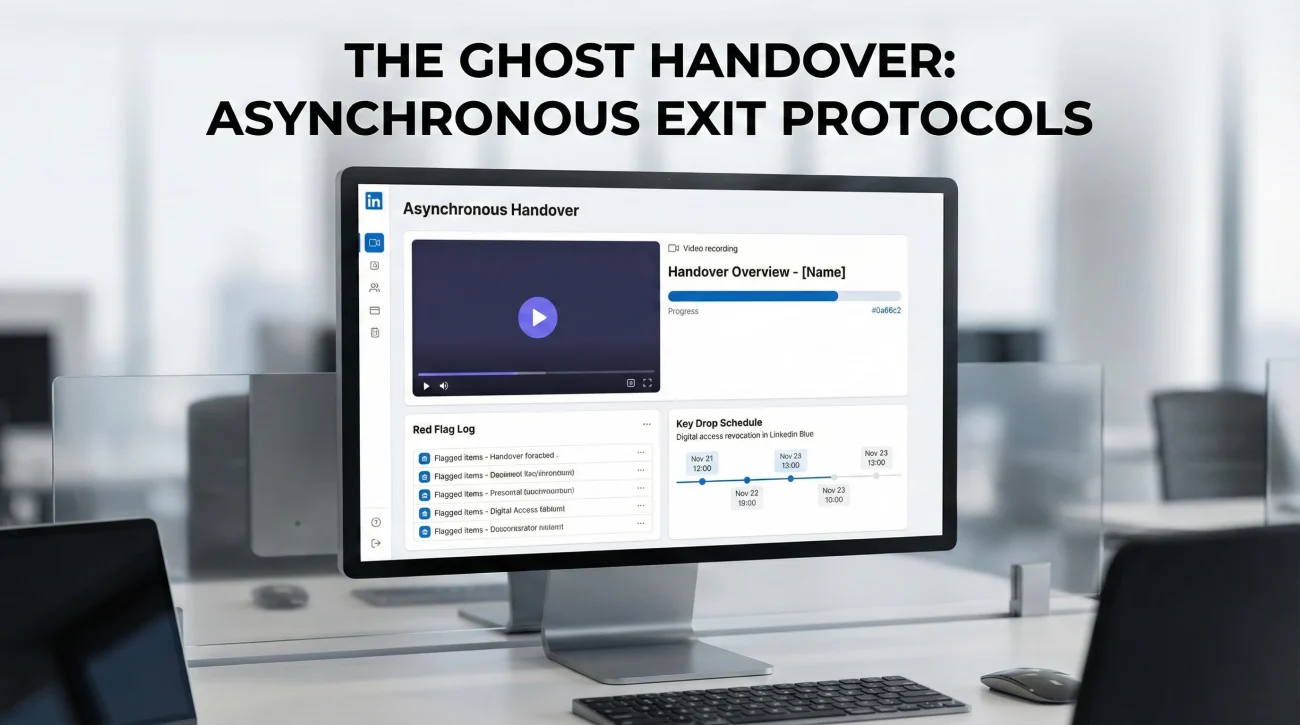
Schedule conflicts often mean you and your boss work different hours (e.g., you are on the night shift, they are on days). This makes the traditional face-to-face handover impossible. You need an “Asynchronous Exit Strategy.”
The Asynchronous Protocol
- 📹 Video Documentation: Do not just write long emails that no one reads. Use tools like Loom to record your screen and narrate complex tasks. “Here is exactly how I close the register at 3 AM when the system freezes.”
- 🚩 The “Red Flag” Log: Create a specific document listing the “time bombs” – problems that usually happen during your shift that day-shift management never sees. This protects your reputation from things breaking immediately after you leave.
- 🔐 The Key Drop: Arrange a specific, secure time to drop off keys/badges if you won’t see your manager in person. Do not just leave them on a desk where they can be stolen (and you blamed).
Final Thoughts: Your Calendar is Your Life
Drafting a resignation email due to schedule conflict is an act of boundary enforcement. Your calendar is not just a grid of hours; it is the map of your life. It dictates when you sleep, when you see your children, and when you rest.
By resigning from a chaotic or unsustainable schedule, you are not failing. You are choosing to invest your time where it is respected. The relief you feel when you send that email is the proof that you made the right decision. You are reclaiming your biology, your family time, and your sanity.
For more specific scenarios, check out our library of resignation email examples. If you need a refresher on the basics, our guide on how to write a resignation email covers the essential formatting rules.
⚠️ Legal Disclaimer: ResignSmartly provides general informational guidance about resignation, workplace communication, notice periods, handovers, and career transitions. Content does not constitute individualized legal advice. Employment laws, contracts, workplace policies, and individual circumstances vary, so review the requirements that apply to your situation and consult an appropriate qualified professional when needed.