- Fail fast: Probation is a two-way compatibility test, leaving early can be the most professional and efficient move.
- Contract first: Audit clawback clauses, notice rules, and assume your access may be cut immediately, prepare before you resign.
- Reason framing: Use role mismatch, cultural fit, or dream offer language that sounds neutral, not accusatory.
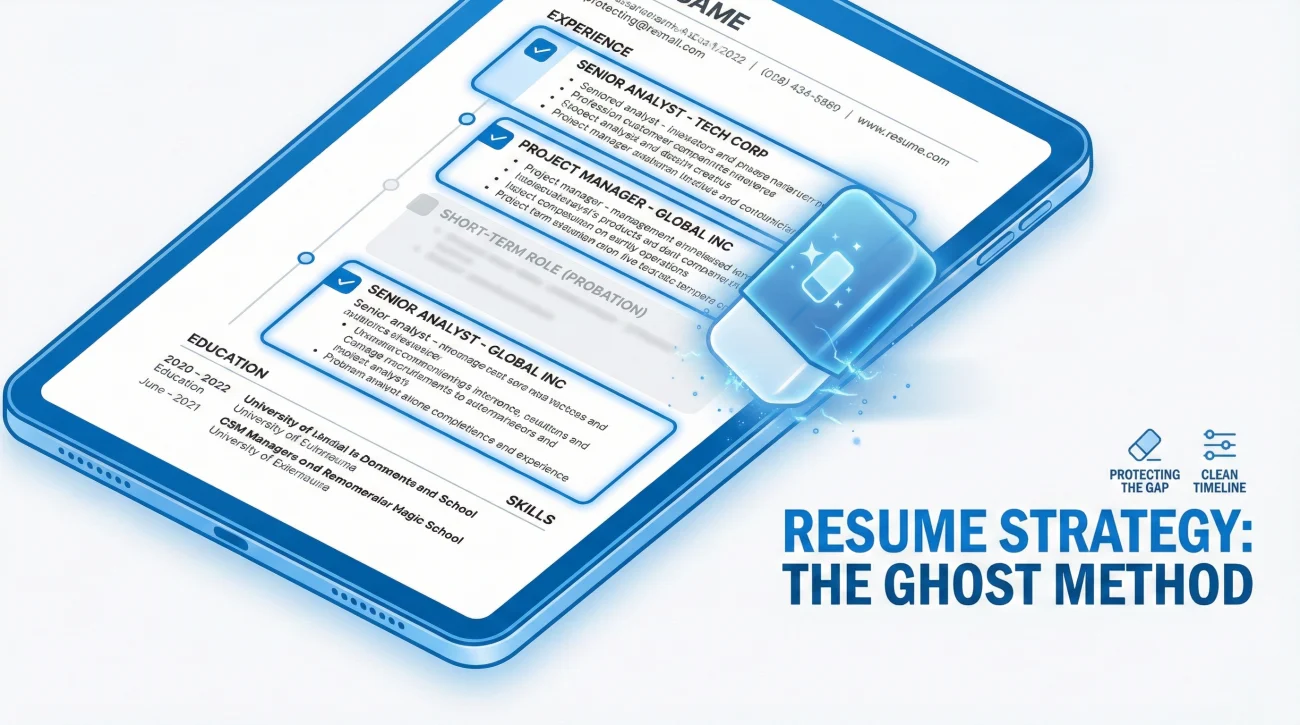
- Reputation control: If the stint is under 3 months, consider the “ghost” option, if you list it, frame it cleanly and never lie about dates.
- Templates and scripts: Pick a matching email template, keep tone calm, and use one tight interview explanation that turns the exit into self-awareness.
The “Fail Fast” Strategy: Why Quitting During Probation is Smart
Sending a resignation email during probation is often accompanied by a heavy dose of guilt. You feel like you have wasted the company’s time, cheated them out of recruitment costs, or worse, that you are a “quitter” before you even really started. However, this mindset is fundamentally flawed and rooted in an outdated view of employment loyalty.
The probation period is not just a test for you; it is a trial for the company. It is a mutually agreed-upon “discovery phase” – a professional dating period designed to test compatibility. If you identify a fundamental mismatch – whether it is cultural, operational, or ethical – resigning immediately is not a failure. It is an act of professional efficiency.
In the startup world, this is called “failing fast.” The logic is simple: The sooner you exit a wrong role, the sooner you stop the bleeding of resources for the company and the sooner you free yourself to find the right fit. Staying out of guilt is not noble; it is expensive for everyone involved.
This comprehensive deep-dive guide will walk you through the delicate art of the early exit. We will cover the legal nuances of probationary notice periods, how to handle “clawback clauses” for signing bonuses, protect your reputation when leaving quickly, and provide battle-tested templates that allow you to resign with your dignity fully intact.
The Probation Paradox: Is It Unprofessional to Leave Early?
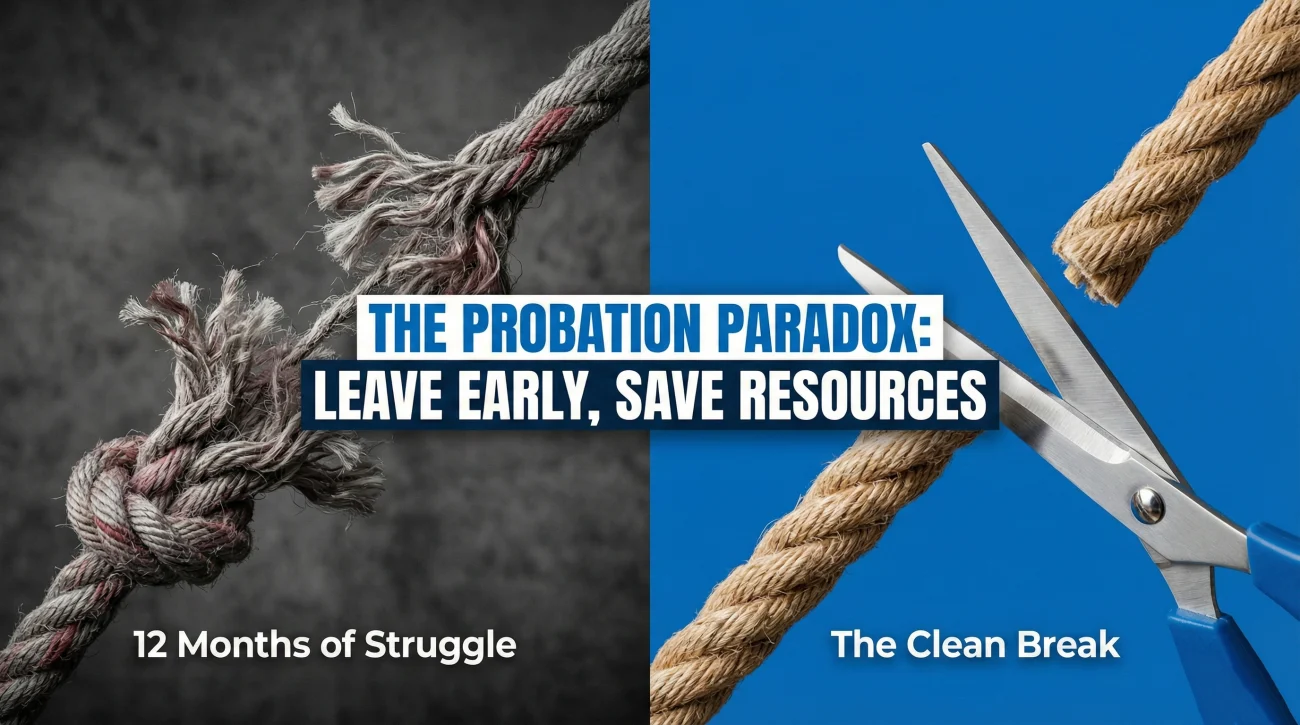
There is a common misconception that you “owe” a company at least a year of service once you accept an offer. This leads to what we call the “Probation Paradox”: Employees suffer in silence for months to avoid looking flighty, only to quit exactly one year later. This leaves the company with a disgruntled, checked-out employee for 12 months instead of a clean break at 2 weeks.
The Strategic Case for an Early Exit
Leaving during the first 90 days (the typical probation window) has distinct strategic advantages that long-term suffering does not:
- ✅ Resource Preservation: The company hasn’t fully invested in your long-term training or assigned you critical clients yet. Leaving now saves them thousands of dollars compared to leaving in 6 months when you are fully embedded.
- ✅ Resume Protection (The “Ghost” Strategy): If you leave within a few weeks, you can often scrub the role from your resume entirely. A 1-month gap is invisible; a 6-month job looks like a mistake you have to explain forever.
- ✅ Integrity Signal: It is more honest to admit a mismatch now (“This isn’t working for either of us”) than to fake engagement for a year while secretly interviewing elsewhere.
The “Fine Print”: Financial and Legal Risks
Before you draft your resignation letter during probation period, you must audit your employment contract. Leaving early can be expensive if you are not careful.
1. The Signing Bonus “Clawback”
If you received a signing bonus, relocation package, or tuition reimbursement, there is a 90% chance your contract contains a “clawback clause.” This usually states that if you leave within 12 months, you must repay the gross amount (pre-tax) immediately.
Strategy: Do not spend your bonus until the clawback period expires. If you must leave, be prepared to write a check on your last day.
2. Notice Period Requirements
Probationary notice periods differ significantly from standard employment contracts. While standard employees might need to give 2-4 weeks, probation clauses often reduce this to:
| Contract Type | Typical Probation Notice | Strategic Advice |
|---|---|---|
| At-Will (Standard US) | Zero / Immediate | Standard courtesy is 1 week, but you can leave immediately. |
| Contract/Freelance | Check specific terms | Usually 1-2 weeks to finish a specific milestone. |
| Executive/Senior | 2-4 Weeks | Higher stakes; negotiate a shorter exit if possible. |
🎯 Strategic Insight: Even if your contract says “1 week notice,” be prepared to leave immediately. Companies often prefer to cut access instantly (Garden Leave) for probationary employees to prevent data theft or morale damage. Pack your personal items before you send the email.
Valid Reasons to Resign During Probation
While you don’t legally need a reason in at-will employment, psychologically, you need to feel justified, and professionally, you need a “cover story.” Here are the most common, professionally acceptable reasons.

1. The “Bait and Switch” (Role Misalignment)
This is when the job description said “Strategic Marketing Manager” but the daily reality is “Cold Calling Sales.” You are not quitting the job you accepted; you are quitting a job you never applied for.
Script: “The scope of this role differs significantly from the position described during the hiring process.”
2. The “Cultural Fit” Card
This is your strongest diplomatic card because it is subjective. If you say, “I thrive in highly structured environments, and this startup is too fluid for me,” no one can argue with you. It frames the exit as a matter of working style rather than a criticism of their toxic management.
3. The “Better Offer” (The Boomerang)
Sometimes a dream company calls you back 3 weeks after you started a “safety job.” It is risky, but acceptable to leave. You must be humble and apologetic.
Script: “An opportunity I interviewed for previously has unexpectedly made an offer that aligns perfectly with my long-term specialization.”
5 Resignation Email Templates for Probation Period
These templates are calibrated to address the awkwardness of an early departure while maintaining high professional standards. Choose the one that best fits your reality.

Template 1: The “Role Mismatch” (Honest & Professional)
Best for: When the job responsibilities are completely different from the interview.
Subject: Resignation – [Your Name]
Dear [Manager’s Name],
Please accept this letter as formal notification that I am resigning from my position as [Job Title]. Per my contract terms regarding the probation period, my last day will be [Date].
This was not an easy decision. However, over the past [Time Period], it has become clear that the daily responsibilities of this role differ significantly from the scope we discussed during the hiring process. I believe it is best for both the company and myself to part ways now so you can find a candidate whose skills and interests are better suited to the specific needs of this position.
I appreciate the time you took to onboard me. I have organized my current files on the shared drive to ensure a smooth handover.
Sincerely,
[Your Name]
Template 2: The “Cultural Fit” (Diplomatic Exit)
Best for: When the environment is toxic, chaotic, or simply not your vibe, but you want to leave politely.
Subject: Resignation Notice – [Your Name]
Dear [Manager’s Name],
I am writing to inform you of my resignation from [Job Title], effective [Date].
After careful reflection during this probationary period, I have realized that the working style and environment here are not the right fit for me at this stage in my career. I believe in the philosophy of being transparent early – it is better to recognize this mismatch now than to continue in a role where I cannot contribute my best work long-term.
I want to thank you for the opportunity to join the team and wish [Company Name] nothing but success in the future.
Best regards,
[Your Name]
Template 3: The “Dream Offer” (The Pivot)
Best for: When a previous interview process comes through with an offer you can’t refuse.
Subject: Resignation – [Your Name]
Dear [Manager’s Name],
Please accept this email as my resignation from the position of [Job Title], effective [Date].
I want to be transparent with you: I have unexpectedly received an offer for a role that I had interviewed for prior to joining [Company Name]. This new opportunity aligns perfectly with my specific specialization in [Industry/Skill], and after much thought, I feel I must accept it.
I sincerely apologize for the timing and any disruption this causes. My intention is never to inconvenience the team, but I wanted to be honest rather than stay in a role when my commitment lies elsewhere.
Thank you for your understanding.
Sincerely,
[Your Name]
Template 4: The “Immediate Departure” (Emergency/1 Week In)
Best for: When you’ve only been there a few days and a notice period is pointless.
Subject: Resignation Effective Immediately – [Your Name]
Dear [Manager’s Name],
I am writing to formally resign from my position as [Job Title], effective immediately.
After my first week, it has become apparent that this role is not aligned with my professional path. I believe it is most professional to step aside immediately so the company can resume its search for a suitable candidate without further delay or investment in my training.
I have returned my badge and laptop to [HR/Reception]. Thank you for the opportunity.
Respectfully,
[Your Name]
Template 5: The “Personal Circumstances” (Privacy Shield)
Best for: Health issues or family emergencies where you can’t continue working.
Subject: Resignation – [Your Name]
Dear [Manager’s Name],
I regret to inform you that I must resign from my position as [Job Title], effective [Date/Immediately].
Due to unforeseen personal circumstances that require my full attention, I am unable to continue with the probation period. I apologize for the inconvenience this sudden departure may cause.
Thank you for the opportunity to work with [Company Name].
Sincerely,
[Your Name]
Damage Control: Your Resume and Reputation
The biggest fear about quitting during probation is the “Resume Gap” and the stigma of being a job hopper. Here is exactly how to handle it strategically.
To List or Not To List?
If you were at the job for less than 3 months, you have two options:
- 🛑 Option A: The Ghost (Recommended).
Omit the job entirely. A 1–3 month gap on a resume is negligible and rarely questioned. If asked, you were “taking a sabbatical,” “traveling,” or “focusing on professional development courses.” This is the cleanest break. - ✅ Option B: The Contract Frame.
If you learned a specific skill or filled a gap, list the job but label it as “Contract” or “Consultant” (only if you can frame the work that way truthfully). Or, simply list it and be honest: “The role was not a cultural fit, so I exited early to find the right match.”
Warning:
Do not lie about dates. Background checks can reveal employment dates. If you omit it, do not claim you were working elsewhere. Claim you were “seeking the right opportunity.”
What to Say in Future Interviews
When a future employer asks, “Why did you leave that job after 2 months?” use this script:
“I realized early on that the role wasn’t the right fit for my strengths in [Skill]. Rather than staying and offering mediocre performance, I decided to leave professionally to save the company’s resources. I learned from that experience that I thrive best in environments like [Target Company’s Environment], which is why I’m so excited about this role.”
This turns a negative into a positive: You are decisive, self-aware, and respectful of company resources.
Once you have your story straight, make sure your CV reflects it clearly. Rebuild your resume with clean, modern resume templates at FreeResumeHub.com so your timeline and messaging stay consistent across every application.
❓ FAQ
💼 Will quitting during probation burn bridges?
💰 Do I have to pay back my signing bonus?
📅 Can I just give 24 hours notice?
📧 Should I resign via email or in person?
👋 Do I get an exit interview?
Final Thoughts
Resigning during probation is uncomfortable, but staying in a job you hate is unbearable. The probation period is a safety valve designed for exactly this situation. Pulling the handle is not a sign of weakness; it is a sign of high professional standards.
By using the templates above and maintaining a respectful tone, you can exit the revolving door without getting hit on the way out. Protect your time, protect your sanity, and move on to the next opportunity with your head held high. A short stint is a blip in a 40-year career; do not let it define you.
For more situations, browse our resignation email examples. If you need a refresher on the basics, check our guide on how to write a resignation email, or return to the homepage.
⚠️ Legal Disclaimer: ResignSmartly provides general informational guidance about resignation, workplace communication, notice periods, handovers, and career transitions. Content does not constitute individualized legal advice. Employment laws, contracts, workplace policies, and individual circumstances vary, so review the requirements that apply to your situation and consult an appropriate qualified professional when needed.