- Short-notice resignations are not usually illegal: It is mostly etiquette vs contract terms, but the real cost is reputation.
- Know your bucket before you write: Crisis gets direct tone, hard opportunity gets apologetic tone, soft reasons require extra strategy.
- If you cannot give time, give value: Build a master handover doc, link everything, list in-flight work, and record quick walkthrough videos.
- Use the template that matches your timeline: One-week compromise, 3 to 4 day rapid exit, immediate exit, or contract-shortening request.
- Protect rehire and future interviews: Offer limited post-exit help, stay positive, control the narrative, and avoid bragging right after you leave.
Writing a Resignation Email With Short Notice: The Strategic Guide to Damage Control
In the idealized corporate playbook, every employee gives a standard two-week notice. They finish their projects, train their replacements, and enjoy a farewell cake. But reality is rarely so tidy. Life happens. Crises strike. Dream jobs demand immediate start dates. Suddenly, you find yourself staring at a screen, needing to draft a resignation email with short notice.
Resigning with less than two weeks’ notice is one of the most anxiety-inducing professional maneuvers you will ever execute. It violates the “unwritten contract” of corporate etiquette. The fear is palpable: Will I be blacklisted? Will they refuse to give me a reference? Will I burn a bridge I might need later?
This guide is your crisis management handbook. We will move beyond simple apologies. We will explore the “Etiquette of Urgency,” how to leverage the “Bus Factor” to salvage your reputation in 48 hours, and how to craft a short notice quitting email that preserves your professional standing even when you are breaking the rules.
The “Notice Period” Reality: Etiquette vs. Law
⚠️ Disclaimer: This guide is for general educational purposes only and does not constitute legal, tax, or financial advice. Laws and company policies vary by country, state, and employer. Always review your own documents and consult a qualified professional before making final decisions.
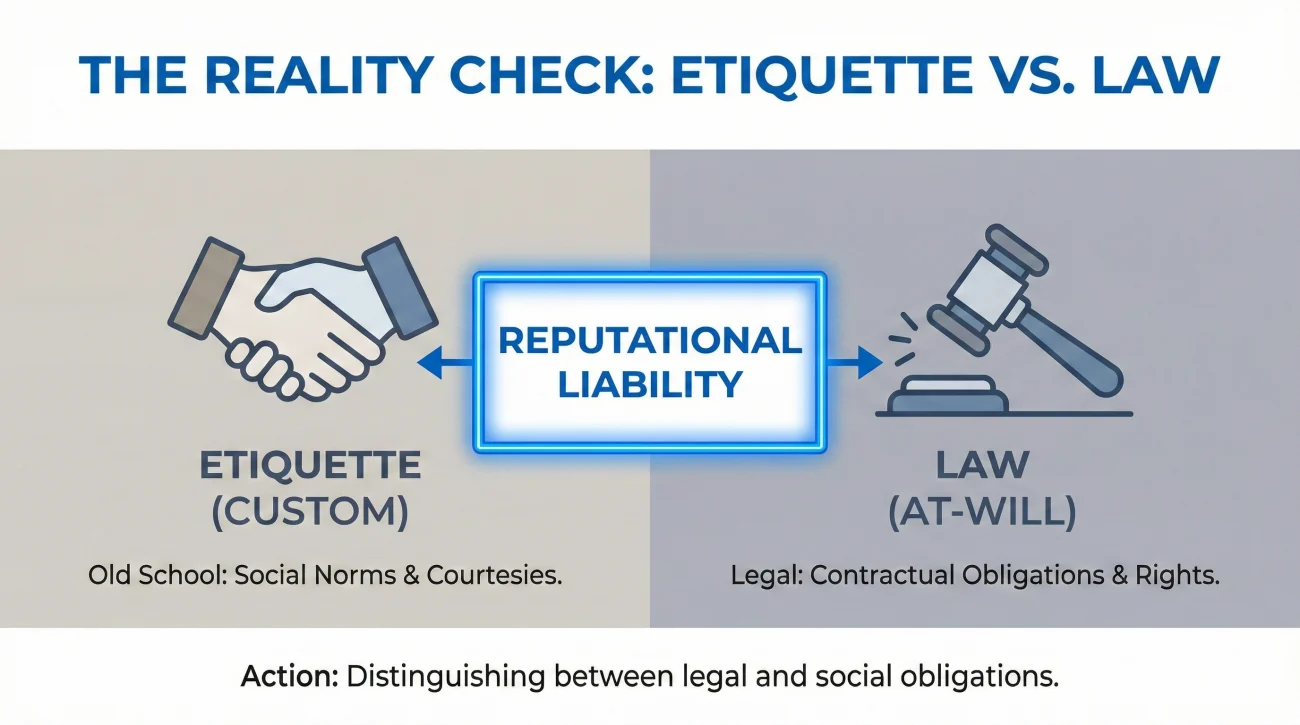
Before you panic, it is crucial to distinguish between professional courtesy and legal obligation. In the majority of employment contracts (specifically in “At-Will” states in the US), the two-week notice is a custom, not a law.
The “At-Will” Double Edge Sword
At-will employment means your employer can terminate you at any moment without notice. Conversely, it means you can leave at any moment without notice. While leaving with insufficient notice resignation email is not illegal (unless you have a specific contract stating otherwise, common in executive or union roles), it carries “reputational liability.”
Calculating the Reputational Cost
When you leave early, you are essentially transferring your workload onto your remaining colleagues instantly. The resentment usually stems from this sudden burden, not the act of leaving itself. Therefore, your resignation strategy must focus entirely on mitigation. You are not just saying “goodbye”; you are saying, “I am leaving, but I have done the heavy lifting so you don’t have to.”
The Justification Matrix: When is Short Notice Acceptable?
Not all short-notice resignations are created equal. Employers generally categorize them into “Forgivable” and “Unforgivable” buckets. Knowing where your reason falls helps you determine the tone of your email.
| Category | Examples | Employer Empathy Level |
|---|---|---|
| The Crisis (Force Majeure) | Medical emergency, sudden family crisis, unsafe working conditions. | ⭐⭐⭐⭐⭐ (High Understanding) |
| The “Hard” Opportunity | Competitor offer with a rigid start date, unexpected relocation. | ⭐⭐⭐ (Grudging Acceptance) |
| The “Soft” Reason | “I just want a break,” “I’m bored,” general burnout. | ⭐ (High Risk of burned bridges) |
If you fall into the “Crisis” category, be direct. If you fall into the “Opportunity” category, be apologetic. If you fall into the “Soft” category, you must be strategic to avoid being marked as “Not Eligible for Rehire.”
The “Rapid Response” Handover Protocol
If you cannot give time, you must give value. The only way to salvage a relationship when sending a less than 2 weeks notice email is to execute a handover so flawless that it shocks them.
1. The “Bus Factor” Document
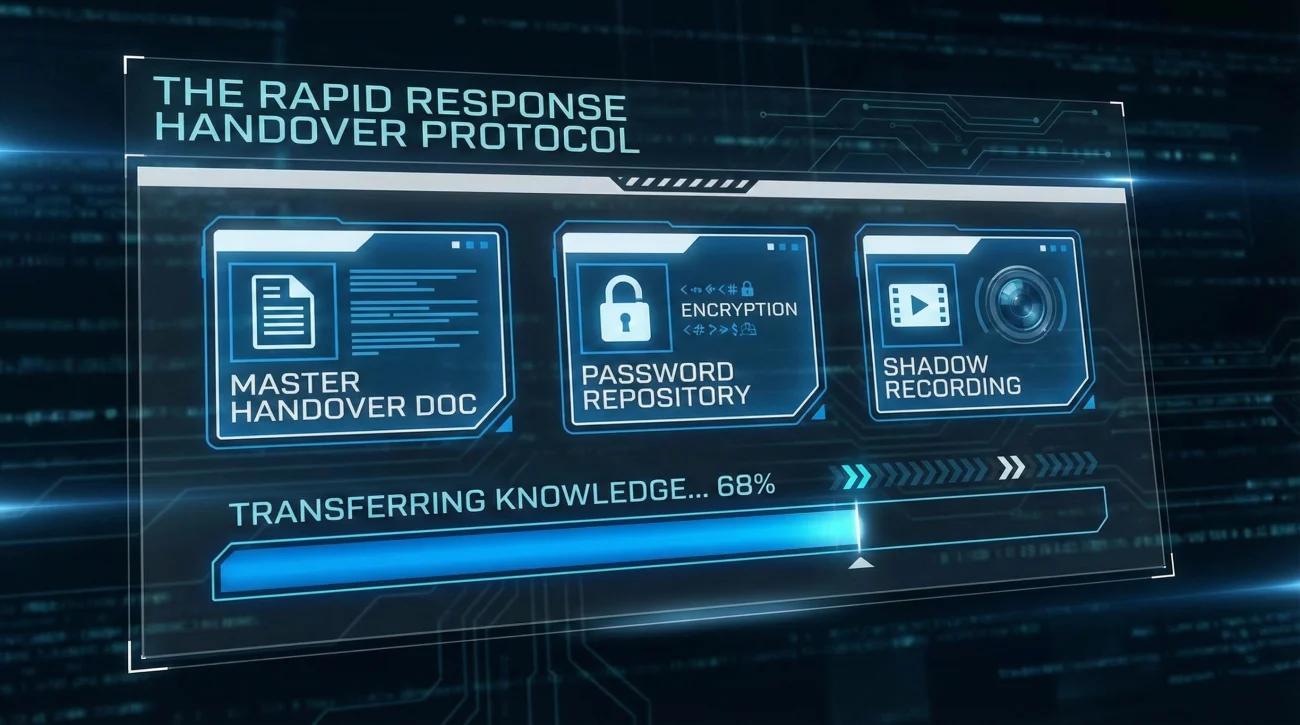
In software engineering, the “Bus Factor” is the number of people who would need to get hit by a bus for a project to fail. When you leave abruptly, that number is you. Before you send your resignation, spend 4 hours creating a “Master Handover Doc.”
- ✅ Link Everything: Do not say “It’s on the drive.” Provide direct hyperlinks to folders.
- ✅ Password Repository: Use a secure tool to share credentials.
- ✅ “In-Flight” Status: List every active task with a status: Stopped, Waiting on X, or Ready to Ship.
2. The “Shadow” Recording
You don’t have time to train someone. Instead, record your screen. Use Loom or Zoom to record yourself performing complex tasks (e.g., “How to run the monthly payroll report”). A library of 5 videos is worth 2 weeks of vague shadowing.
Resignation Templates for Short Notice Scenarios
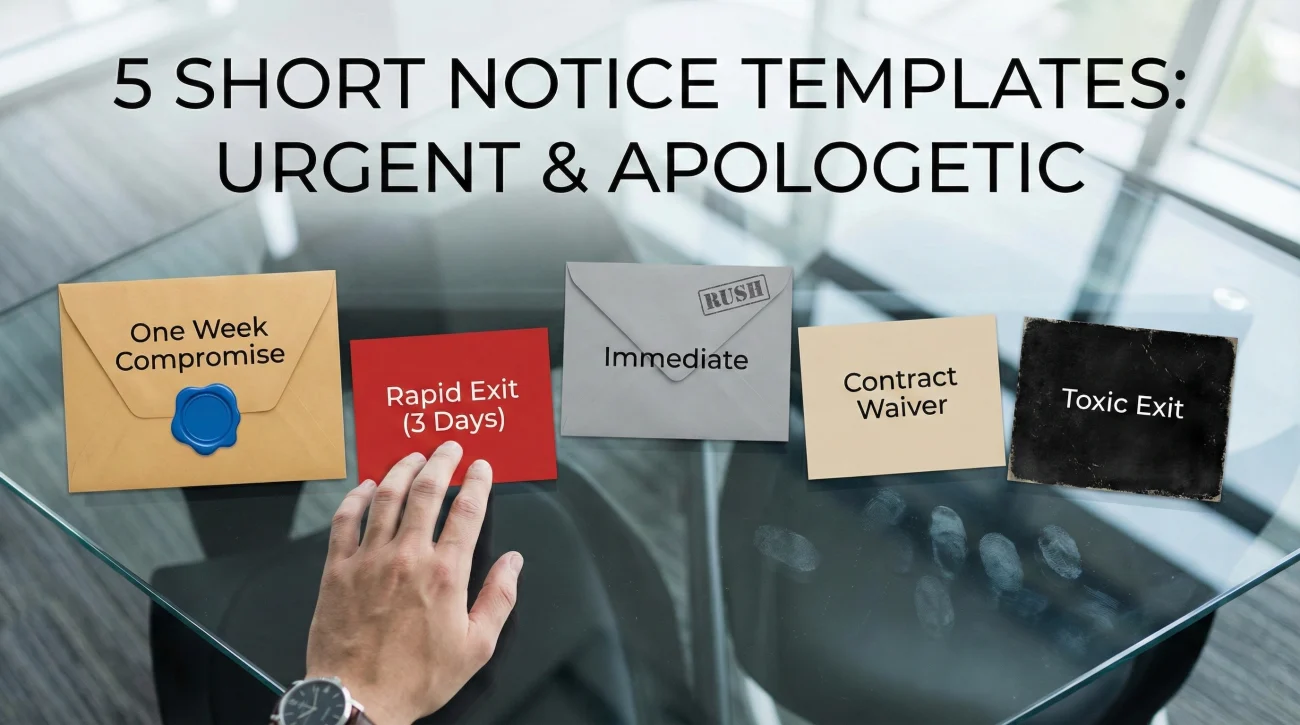
These templates are engineered to diffuse anger and focus on logistics. Choose the one that matches your timeline and situation.
1. The “One Week” Compromise
This is the most common short-notice scenario. A one week notice resignation email is often a compromise between the standard two weeks and an immediate start date elsewhere.
Subject: Resignation Notice – [Your Name]
Dear [Manager’s Name],
Please accept this letter as my formal resignation from my position as [Job Title] at [Company Name]. My final day of work will be [Date, one week from today].
I sincerely apologize for not providing the standard two-week notice. I have received an offer for a new opportunity that aligns with my long-term career goals, but unfortunately, it comes with a firm and immediate start date requirement. I attempted to negotiate a longer timeline to support a fuller transition here, but I was unable to secure an extension.
I understand this creates a compressed timeline for the team. To mitigate this, I have already:
- Drafted a complete status document for [Project A] and [Project B].
- Recorded video walkthroughs of my daily reporting process.
- Cleared my calendar for the next 5 days to focus exclusively on knowledge transfer.
I am committed to making this week as productive as possible to ensure you are not left in a lurch. I appreciate the opportunities I have had here and hope to maintain our professional relationship.
Sincerely,
[Your Name]
2. The “Rapid Exit” (3-4 Days)
When the timeline is even tighter, you must pivot from “transition” to “emergency download.” Use this 3 days notice resignation email to set immediate priorities.
Subject: Resignation – [Your Name] – Time Sensitive
Dear [Manager’s Name],
I am writing to formally resign from [Company Name], effective [Date, 3 days from now].
I deeply regret that I am unable to provide the customary notice period. Due to unexpected personal circumstances that require my immediate attention, I must expedite my departure. This was not a decision I made lightly, as I have great respect for you and the team.
Given that I have only three days remaining, I propose we prioritize the following:
- Day 1: Transfer of all administrative access and client contacts.
- Day 2: Intensive handover meeting with [Colleague Name] for the [Project].
- Day 3: Finalizing documentation and exit administration.
I have prepared a “Critical Tasks” list attached to this email to guide us. Thank you for your understanding during this quick transition.
Best regards,
[Your Name]
3. The “Immediate” Departure (24 Hours or Less)
This is the nuclear option. Use this short notice quitting email only for emergencies or toxic environments where staying is impossible.
Subject: Resignation Effective Immediately – [Your Name]
Dear [Manager’s Name],
Please accept this email as notification of my resignation from the position of [Job Title], effective immediately, [Today’s Date].
Due to unavoidable personal reasons, I am unable to continue my employment or work a notice period. I apologize for the abrupt nature of this notification and any disruption it causes to the department’s workflow.
I have uploaded all my active files to the shared drive under the folder “Handover_[Your Name]” and have left my company badge and keys [Location/with HR]. I am available via email for the next 48 hours to answer critical questions regarding file locations.
Thank you for the opportunity to work at [Company Name].
Sincerely,
[Your Name]
4. Dealing with “Contractual” Notice
If your contract asks for 30 days but you can only give 10, use this insufficient notice resignation email. It acknowledges the breach while asking for a waiver.
Subject: Resignation – [Your Name]
Dear [Manager’s Name],
I am writing to resign from my role, with my last day being [Date].
I realize that my employment agreement requests a [Number] day notice period. However, due to [Reason], I am requesting your permission to shorten this period to [Number] days. I believe that with focused effort, I can complete a full handover in this shorter timeframe, saving the company the cost of my salary during a period of lower productivity.
I have already prepared a transition plan that compresses the necessary training into this week. I hope we can agree to this modified timeline.
Best regards,
[Your Name]
5. The “Toxic Environment” Exit
When you are leaving because of mental health or safety, you do not owe an apology. Keep it professional but distant.
Subject: Resignation Notice – [Your Name]
Dear [Manager’s Name],
I am writing to resign from my position at [Company Name], effective [Date].
After careful consideration, I have decided to move on to a new chapter. While I cannot provide the standard notice period, I will ensure that my projects are left in a state where a new hire can pick them up easily.
All my work is saved in [Location], and I will spend my final day organizing these files.
Regards,
[Your Name]
Negotiating the Exit: How to Avoid “Not Eligible for Rehire”
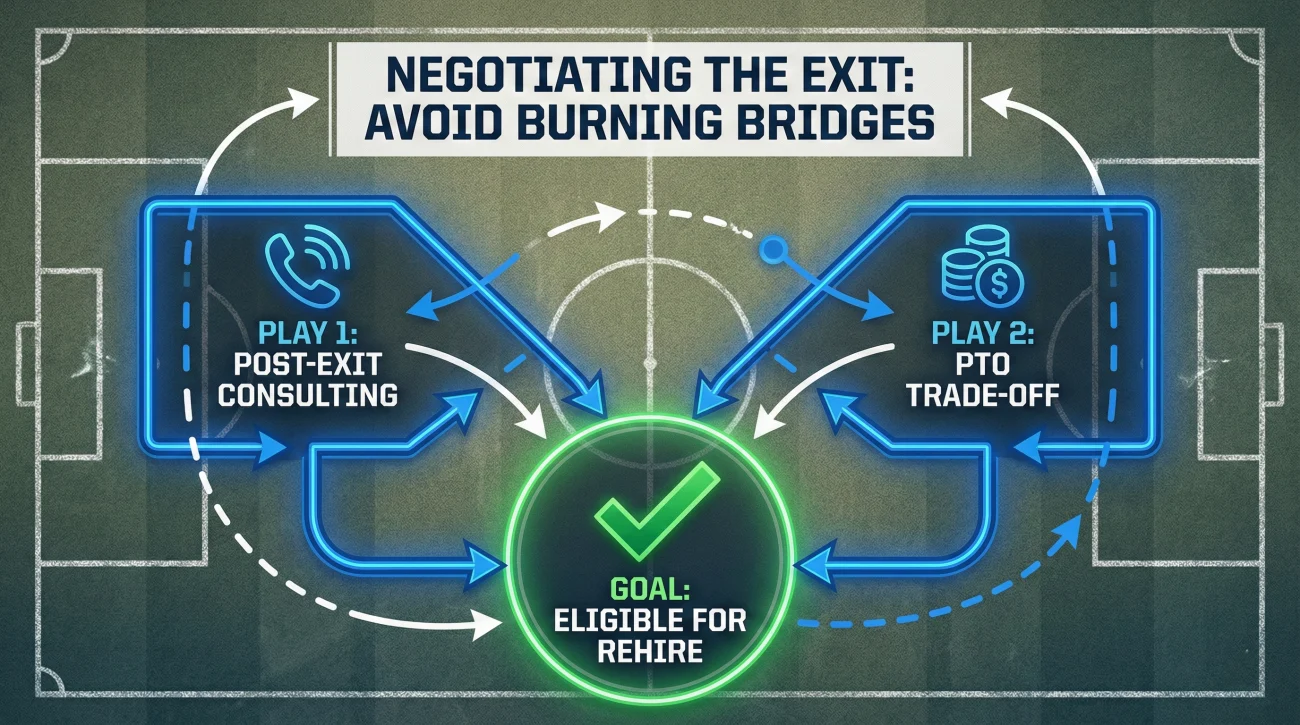
Many large corporations have a checkbox in their HR system: “Eligible for Rehire? Yes/No.” Leaving with short notice is the fastest way to get that box checked “No.” Here is how to fight it.
1. Offer Post-Exit Consulting
If you can’t stay for two weeks, offer to be available after you leave.
Script: “I know leaving in 3 days is difficult. While I can’t be here physically next week, I am willing to be available for 5 hours of remote consulting/calls next week to help the team if they get stuck. I won’t charge for this; I just want to ensure a smooth transition.”
This gesture often saves your reputation. Managers remember the help, not just the early exit.
2. The PTO Trade-Off
In some cases, you might lose your payout for unused vacation days if you don’t give full notice (check state laws). You can use this as leverage.
Script: “I understand that by giving short notice, I may forfeit my accrued PTO payout. I accept that penalty as the cost of this transition, and I hope we can part on good terms.”
Post-Exit Damage Control: Controlling the Narrative
Once you leave, the story of your exit belongs to the company – unless you control it.
- 🛑 Don’t Brag: Do not post on LinkedIn about your “amazing new job” the day after you left your old team in the lurch. Wait at least 2-3 weeks before updating your profile. It shows respect.
- 🛑 The Reference Check: If you are worried about a bad reference, ask a sympathetic colleague (not your boss) to be your reference. “I worked closely with Jane, and she can speak to my skills.”
- 🛑 The Narrative: When asked in future interviews why you left quickly, use the “Opportunity Framing”: “I loved that team, but a once-in-a-lifetime opportunity came up with an rigid start date. I did a comprehensive handover in a short time to make it work.”
❓ FAQ: The Mechanics of Fast Exits
⚖️ Can my employer sue me for not giving two weeks’ notice?
🔥 Should I tell my new employer I need more time?
👋 What if they tell me to leave immediately after I give notice?
🗣️ How do I tell my coworkers?
Final Thoughts: Professionalism is a Behavior, Not a Duration
Sending a resignation email with short notice is stressful, but it does not have to be a career-ending move. Professionalism is not measured solely by the number of days you stay after resigning; it is measured by how you treat people and responsibilities during your exit.
If you leave with 3 days’ notice but leave behind impeccable documentation, a calm demeanor, and a grateful attitude, you will be remembered far more fondly than the employee who gives two weeks’ notice but spends that entire time checking Facebook and distracting the team.
Own the decision. Apologize for the inconvenience, not the choice. Execute the handover with military precision. Then, walk out the door with your head high, knowing you handled a difficult situation with grace.
For more specific scenarios, you can review our resignation email examples or read our pillar guide on how to write a resignation email.
⚠️ Legal Disclaimer: ResignSmartly provides general informational guidance about resignation, workplace communication, notice periods, handovers, and career transitions. Content does not constitute individualized legal advice. Employment laws, contracts, workplace policies, and individual circumstances vary, so review the requirements that apply to your situation and consult an appropriate qualified professional when needed.