
- Core move: Use “personal reasons” as a professional boundary so you can resign without oversharing or inventing a story.
- Why it works: Less detail prevents the “fix-it” counteroffer trap and keeps the narrative in your control.
- HR baseline: They only need intent to resign and a last-day date, the reason is optional and mostly for their internal tracking.
- How to sound strong: Pick executive phrasing and use simple scripts to redirect nosy questions or defuse hostile reactions.
- Exit hygiene: Choose the right template for your relationship, keep handover clean, and avoid leaks like social posts or office gossip.
The Strategic Silence: Mastering the “Personal Reasons” Resignation
In the age of radical transparency, retaining your privacy is a professional super-power. A resignation email for personal reasons is your professional way of saying “I’m leaving, and the details are none of your business.” You don’t owe your employer a detailed explanation of your private life, and a well-crafted resignation lets you exit gracefully without oversharing or lying.
Whether you are battling burnout, navigating a family crisis, or simply need a career break, you have the absolute right to exit without submitting your private life for corporate review. However, the execution is delicate. This masterclass will teach you the nuance of the private exit: how to say enough to be polite, but little enough to stay safe.
For a broader roadmap of the resignation process, consult our foundational guide on how to write a resignation email.
The Psychology of Privacy: Why Less Is More
In a high-stakes professional environment, silence is often interpreted as strength. Over-explaining is a trauma response; under-explaining is a power move. When you resign for “personal reasons,” you are establishing a boundary that commands respect.
1. The Emotional Boundary
When you share a personal tragedy (e.g., divorce, illness) with a manager, you inadvertently shift the dynamic from “Employer-Employee” to “Confidant-Confidant.” While this feels human, it blurs professional lines. If the relationship sours later, that vulnerability can be weaponized or used to label you as “unstable.” Keeping it vague protects your emotional bandwidth.
2. Controlling the Narrative
If you tell your boss a sob story, the narrative becomes “They couldn’t handle the pressure.” If you say “personal reasons,” the narrative remains a mystery. People tend to fill mysteries with their own assumptions, often assuming you have a bigger, better plan (like starting a company or retiring early). Silence allows you to leave with an aura of competence rather than defeat.
The Strategy of Vague: Why “Personal Reasons” is Your Best Shield
Many people feel pressured to justify their resignation with a compelling story. In reality, a resignation due to personal reasons is perfectly acceptable and common. Choosing this route is rarely about having no reason; it is about having a reason that cannot – or should not – be solved by your employer.
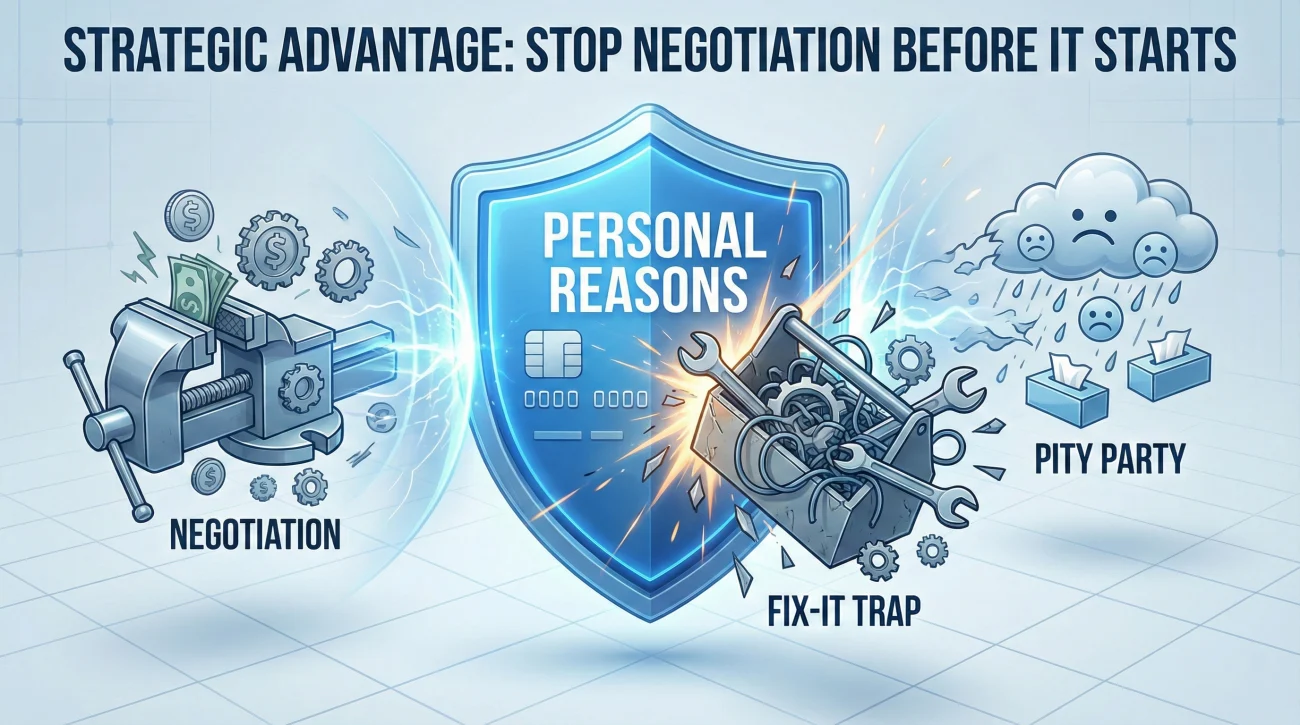
1. Escaping the “Fix-It” Trap
Managers are trained to solve problems. If you give a specific reason, you invite a specific counter-offer.
- 🛑 The Trap: “I’m resigning because the commute is destroying my work-life balance.”
The Manager’s Move: “We can authorize 3 days of remote work.” (Now you are trapped). - ✅ The Shield: “I am resigning for personal reasons.”
The Manager’s Move: “I see. We will miss you.” (There is no counter-move to “personal”).
2. The “Teflon” Integrity Layer
Life is fluid. If you resign saying “I need to care for a sick relative,” and two weeks later you are seen at a networking event, your integrity takes a hit. By using a vague resignation email strategy, you cover every possible scenario – from mental health days to starting a stealth startup. It is technically accurate for any choice you make, rendering you immune to accusations of dishonesty later.
3. Preventing the “Sympathy Economy”
Oversharing creates an emotional debt. If you tell your boss a sob story, you shift the dynamic from “Professional-to-Professional” to “Parent-to-Child.” While human connection is valuable, a private resignation email ensures your professional legacy is defined by your achievements, not your personal crisis.
The HR Reality: What Do They Actually Need?
There is often a vast gap between what a manager wants to know and what HR needs to know.
The “Need to Know” Baseline
In almost all At-Will employment structures, your employer requires exactly two data points to process a resignation legally:
- The Intent: “I am resigning.”
- The Timeline: “My last day is [Date].”
That is it. The “Reason for Leaving” field in the HR database is for their retention analytics, not your legal obligation. You can leave it blank, or write “Personal.” They cannot withhold your final paycheck because you refused to explain your resignation email personal matters.
The Phrasing Matrix: Weak vs. Strong Language
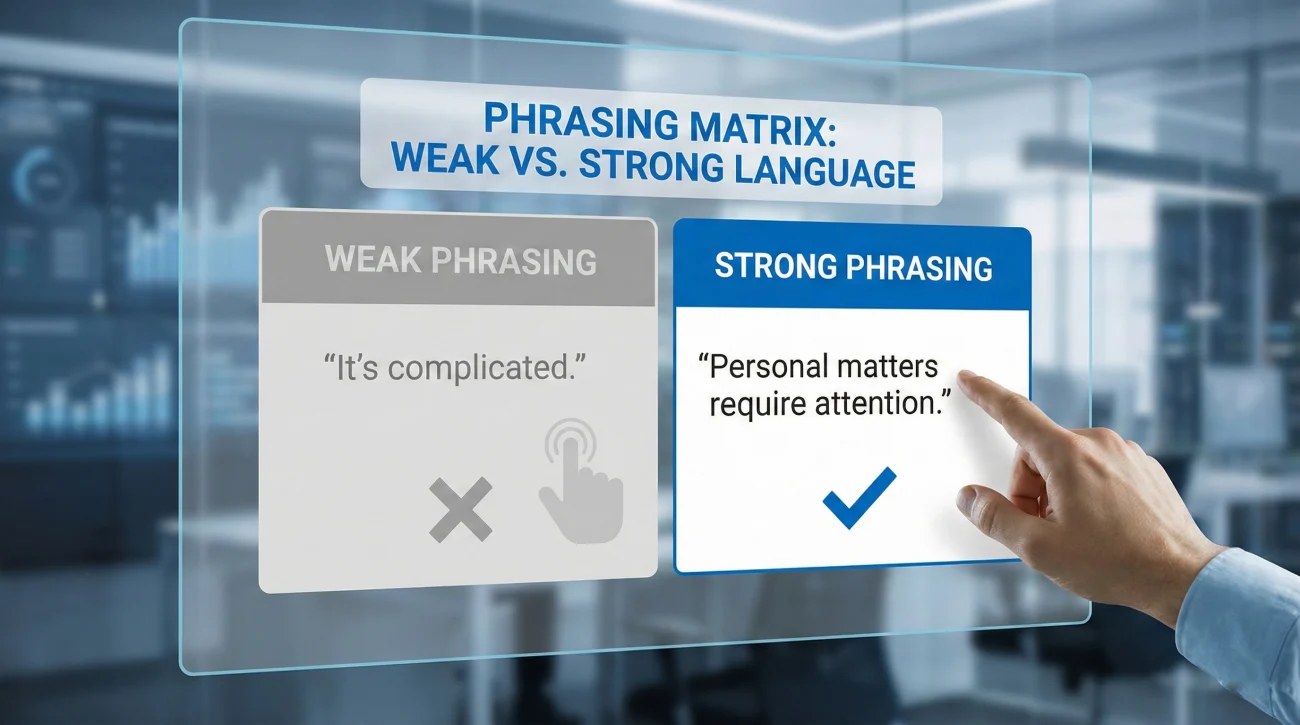
The difference between sounding “shady” and sounding “executive” lies entirely in your word choice.
| Weak / Evasive Phrasing ❌ | Strong / Executive Phrasing ✅ | Why It Works |
|---|---|---|
| “I have to deal with some stuff.” | “I am resigning to attend to personal matters.” | “Matters” implies weight and gravity; “stuff” implies drama. |
| “It’s complicated.” | “Recent changes in my personal life require my full attention.” | Removes the mystery and focuses on the time commitment. |
| “I don’t want to talk about it.” | “I prefer to keep the details private.” | Asserts a professional boundary rather than expressing emotion. |
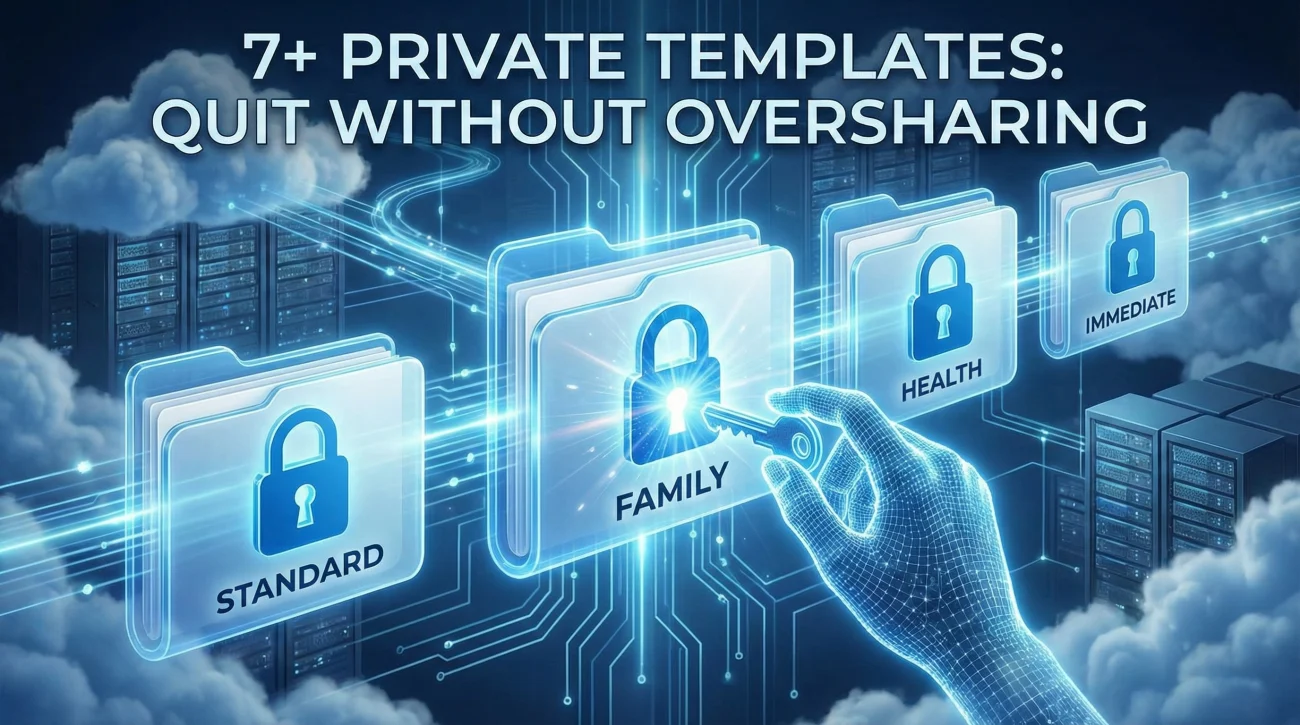
7 Strategic “Personal Reasons” Resignation Templates
Select the template that matches the “temperature” of your relationship. For more standard options, browse our resignation email examples.
1. The “Fort Knox” (Maximum Privacy)
Use this quitting for personal reasons email sample when you want zero follow-up questions.
Subject: Resignation – [Your Name]
Dear [Manager’s Name],
I am writing to formally resign from my position as [Job Title] at [Company Name]. My final day of employment will be [Date].
I have decided to step down from my role due to personal reasons. I appreciate the opportunities I have had with the company and wish the team continued success.
I will ensure a smooth handover of my responsibilities during my notice period.
Sincerely,
[Your Name]
2. The “Family Circumstances” (The Unquestionable Card)
A family reasons resignation email acts as a universal “Stop” sign for inquiries. No one questions “family.”
Subject: Resignation Notice – [Your Name]
Dear [Manager’s Name],
Please accept this email as my formal resignation from [Job Title], effective [Date].
Due to changing family circumstances that require my full attention, I am unable to continue in my current role. I have truly valued my time at [Company Name] and the support of the management team.
I am committed to making this transition as seamless as possible for the department.
Best regards,
[Your Name]
3. The “Health Focus” (Burnout/Recovery)
Best for mental health breaks or physical recovery. HR treats this delicately.
Subject: Resignation – [Your Name]
Dear [Manager’s Name],
I am writing to resign from my position as [Job Title], effective [Date].
I have made the difficult decision to step away from my professional duties to focus on personal health matters. I am grateful for the understanding of the leadership team during this time.
My priority during my remaining time is to complete [Project X] and train [Colleague Name] to take over my duties.
Sincerely,
[Your Name]
4. The “Immediate Exit” (Crisis Mode)
Best for severe crises where working notice is impossible.
Subject: Resignation – Effective Immediately – [Your Name]
Dear [Manager’s Name],
Please accept this letter as notification that I am resigning from my position as [Job Title], effective immediately today, [Date].
Due to urgent personal matters that have arisen unexpectedly, I am unable to fulfill the standard notice period. I sincerely apologize for the disruption this causes the team.
I will make arrangements to return my company laptop and badge by [Date/Method].
Regards,
[Your Name]
5. The “Grateful but Firm” (Preserving Relationships)
Best for good bosses you want to keep as friends, but you still can’t tell them the truth.
Subject: Resignation – [Your Name]
Dear [Manager’s Name],
I am writing to let you know that I will be leaving my position as [Job Title], with my last day being [Date].
This was not an easy decision, as I have loved working with you, but personal reasons necessitate that I move on at this time. I want to thank you specifically for your mentorship over the last [Year/Month].
I want to leave the team in the best possible position, so I have prepared a transition plan attached to this email.
Warmly,
[Your Name]
6. The “Relocation” (Vague Geography)
Best for moving for a partner or digital nomadism without stating WHERE you are moving.
Subject: Resignation Notice – [Your Name]
Dear [Manager’s Name],
I am writing to resign from my role as [Job Title], effective [Date].
Due to personal circumstances requiring me to relocate, I will no longer be able to continue my employment with [Company Name]. I have enjoyed my time here immensely.
I will spend my final two weeks focused on handing over my accounts to ensure no disruption to our clients.
Best,
[Your Name]
7. The “Under Investigation” (Legal Safety)
Use this only if you are resigning while under a performance improvement plan (PIP) or internal investigation and want to leave quietly.
Subject: Resignation – [Your Name]
Dear [Manager’s Name],
Please accept this letter as my formal resignation from [Company Name], effective [Date].
I have decided that it is in my best interest to resign for personal reasons at this time. I will cooperate fully with the transition process and return all company property before my departure.
Regards,
[Your Name]
The “Inquisition”: Scripting the Face-to-Face
Sending the email is the easy part. The hard part is the meeting 10 minutes later when your boss asks, “Is everything okay? Why are you leaving?”
Defense Scripts for Nosy Managers
- 🛡️ The “Pivot” Technique:
“I appreciate your concern, truly. It’s a private matter I need to handle, but I really want to make sure I don’t leave the team in a lurch. Can we review the project list?” - 🛡️ The “Soft Wall” Technique:
“It’s just a personal situation that needs my full focus right now. I’m not moving to a new job immediately, just taking some time to sort things out.” (Use only if true). - 🛡️ The “HR Shield” (For aggressive prying):
“I’m not comfortable discussing the details, but I assure you it doesn’t reflect on the company. I hope you can respect my privacy on this.”
Handling Hostility: When “Personal” Makes Them Angry
Some toxic managers take “personal reasons” as an insult. They might say, “After all I did for you, you won’t even tell me why?” or “I can’t accept this without a reason.”
Your Strategy: Do not engage emotionally.
Script: “I understand your frustration, and I value the opportunities I’ve had here. However, my decision is final and private. My focus now is purely on the handover.”
Remember: They cannot “reject” a resignation. It is a unilateral notification.
Common Pitfalls: How “Personal” Becomes “Unprofessional”
Avoid these behaviors which can sabotage your exit.
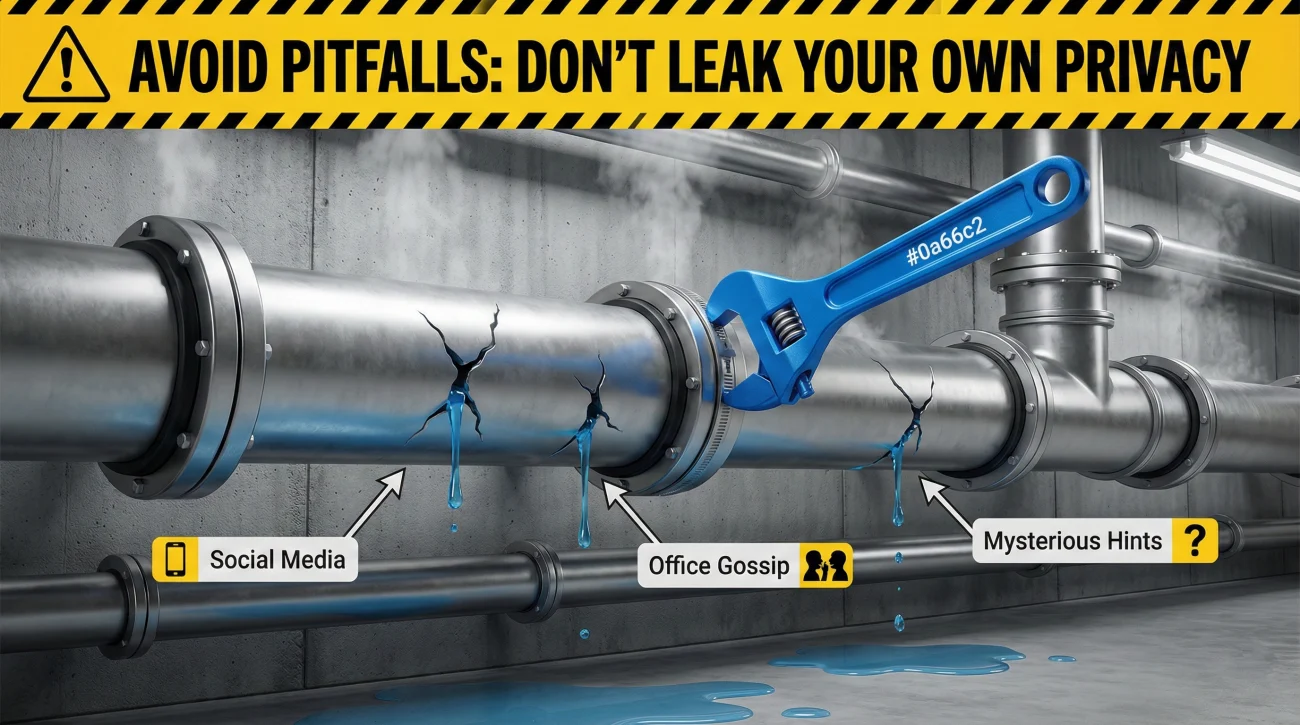
1. The Social Media Leak
Do not resign for “personal reasons” and then post on LinkedIn or Instagram 24 hours later about your “exciting new journey.” If your digital footprint contradicts your resignation email, you look like a liar.
2. The “Office Wife/Husband” Confession
Do not tell your boss “it’s personal” and then tell your work bestie the real reason over lunch. Office gossip travels faster than fiber optics. Consistency is your only protection.
Final Thoughts
Resigning for personal reasons is an exercise in boundaries. It forces you to validate your own needs without seeking external permission. By stripping away the need to “explain yourself,” you reclaim control over your career narrative.
Remember: Your employment is a business transaction, but your life is your own. You can honor both by leaving with a short email, a strong handover, and your privacy intact.
⚠️ Legal Disclaimer: The resignation templates, email samples, and professional guidance provided in this guide are for informational purposes only and do not constitute legal advice. Employment laws and contract requirements vary by jurisdiction and individual circumstances. Please review your employment agreement and consult your HR department and/or a qualified attorney to ensure compliance with applicable laws and policies.