- Privacy Line: You only need to share resignation, last day, and “health reasons” – details and diagnoses are optional.
- Timing Choice: Go immediate if a doctor says stop or safety is at risk, give notice if stable and you want to protect references.
- Template Set: Includes maximum privacy, “On medical advice,” immediate health crisis, mental health or burnout, caregiver, and chronic condition versions.
- Do Not Quit Too Fast: Check leave and protection options first: FMLA, ADA accommodations, and short term disability if offered.
- Exit Logistics: Plan insurance and benefits, provide only minimal doctor notes if required, and leave with a simple future story for the resume gap.
The Comprehensive Guide to Resigning Due to Health Reasons
Writing a resignation email due to health reasons is a delicate balancing act between professional transparency and personal privacy. Unlike leaving for a better salary, leaving for health reasons is often not a choice, but a necessity. You need to communicate clearly that your condition is forcing you to step away, yet you are under no obligation to disclose your complete medical history or specific diagnosis details to your employer.
Health-related resignations are emotionally complex. Whether you are navigating a sudden chronic diagnosis, battling severe burnout, or facing a mental health crisis, the pressure to “power through” can be immense. However, staying in a role that compromises your physical or mental well-being is unsustainable. You have the right to prioritize your recovery.
This guide serves as your compassionate, strategic partner. We will not only provide copy-paste templates for every scenario – from immediate resignation due to health reasons to planned medical leaves – but also deep-dive into the legal protections (like FMLA and ADA) you might be overlooking. We will help you navigate the “privacy paradox” – how to say enough to be understood, but not enough to be vulnerable.
Your Right to Privacy vs. Professional Transparency
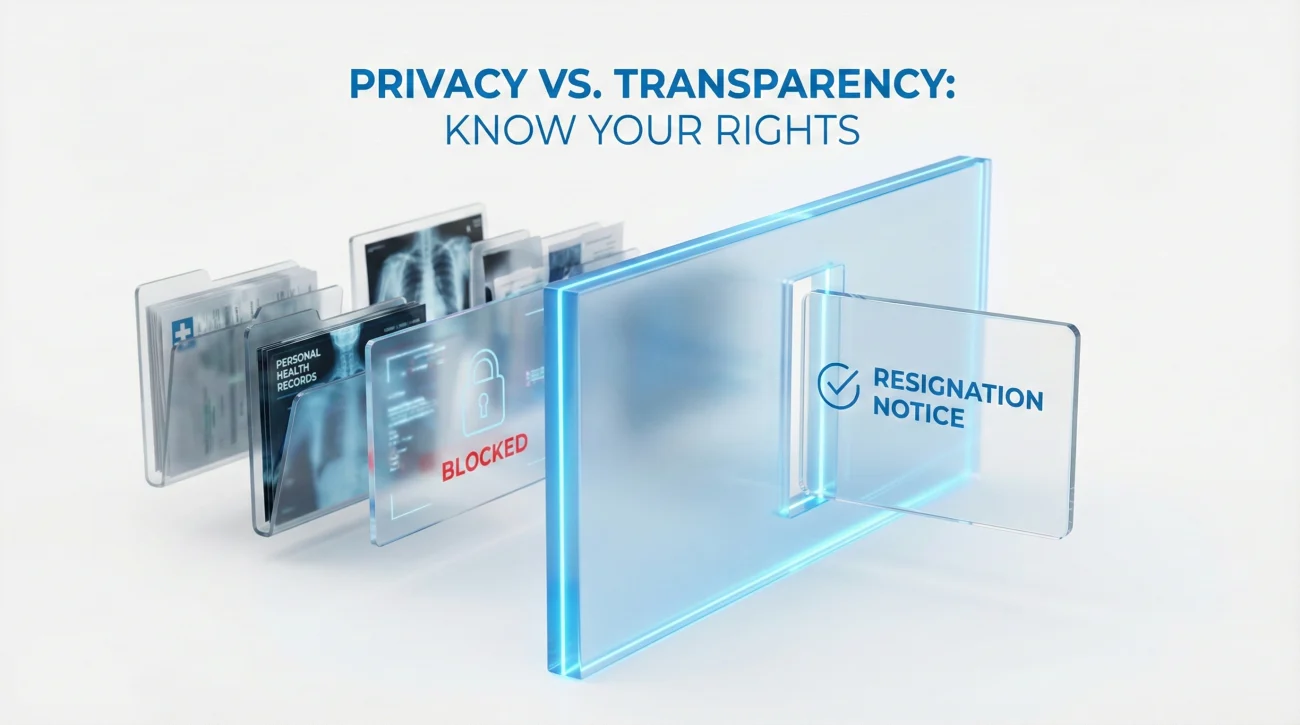
The most critical concept to grasp when drafting a resignation letter for health reasons is the distinction between what you must share and what you can share. Legally and professionally, the bar for disclosure is lower than you think.
The Essential “Need-to-Know” Information
To resign effectively, your employer only requires three specific data points:
- The Fact of Resignation: A clear statement that you are leaving.
- The Timeline: Your official last day of work.
- The General Cause: Stating “health reasons” or “medical circumstances” is sufficient to categorize the exit.
That is it. You do not need to attach X-rays, therapy notes, or detailed prognoses. In fact, over-sharing can sometimes complicate the exit process for HR, who must then manage sensitive data compliance (HIPAA in the US).
Optional Disclosures for Context
Depending on your relationship with your manager, you might choose to share more to maintain the bond or explain the suddenness of your departure.
- 🏥 General Category: Clarifying “physical health issue” vs. “family health emergency” can help manage expectations about your potential return.
- ⏰ Duration/Permanence: indicating if this is a “pause” vs. a “permanent exit” helps them plan workforce needs.
- 👨⚕️ Medical Authority: Using the phrase “On the advice of my physician” shifts the decision from a personal preference to a medical mandate, which is much harder for an employer to challenge.
Strategies to deflect Intrusive Questions
If a manager presses for details, use these deflection scripts:
“I prefer to keep the specific medical details private, but please know this decision was not made lightly.”
“My focus right now is entirely on recovery, so I won’t be discussing the specifics of the condition.”
The Timing Dilemma: Immediate Resignation vs. Two Weeks Notice
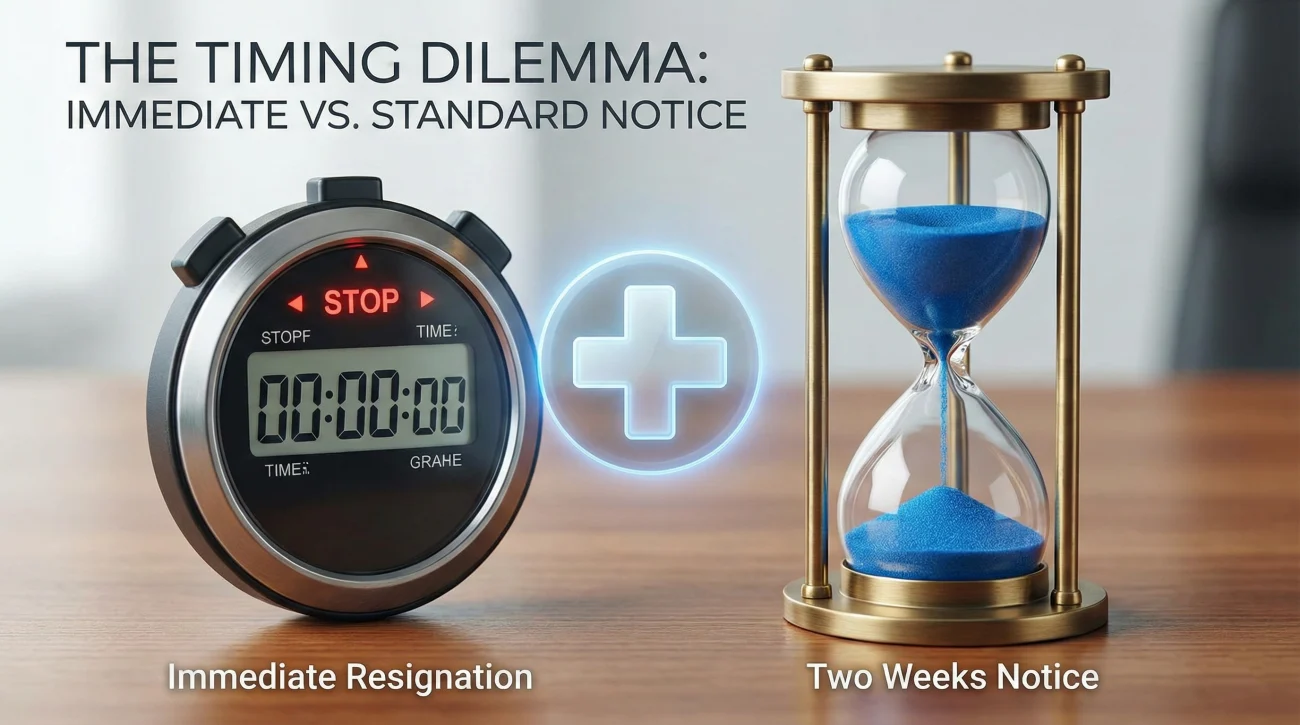
Standard professional etiquette dictates a two-week notice period. However, health crises rarely follow a convenient schedule. Knowing when to break this rule is key to protecting your health.
When Immediate Resignation Due to Health Reasons is Justified
You should consider resigning effective immediately (or with very short notice) if:
- ⚕️ Doctor’s Orders: A medical professional has explicitly told you to stop working to prevent permanent damage.
- ⚕️ Safety Risk: Your condition impairs your ability to work safely (e.g., operating machinery while on new medication, severe fatigue while driving).
- ⚕️ Mental Health Crisis: The workplace environment is the direct trigger for severe anxiety, panic attacks, or depression. Staying “two more weeks” in a toxic environment can be dangerous.
- ⚕️ Urgent Treatment: Surgery or hospitalization is scheduled immediately.
When to Provide Standard Notice
If your condition is chronic but stable, or if you are resigning preemptively before a future surgery, giving notice is beneficial. It preserves your relationship for future references and ensures you leave on good terms. It also gives you time to wrap up projects, which can provide a sense of closure.
Resignation Email Templates for Various Health Scenarios
Below are tailored templates. Select the one that matches your urgency and comfort level. We have integrated key phrases like resignation letter due to health issues naturally to help you frame your narrative.
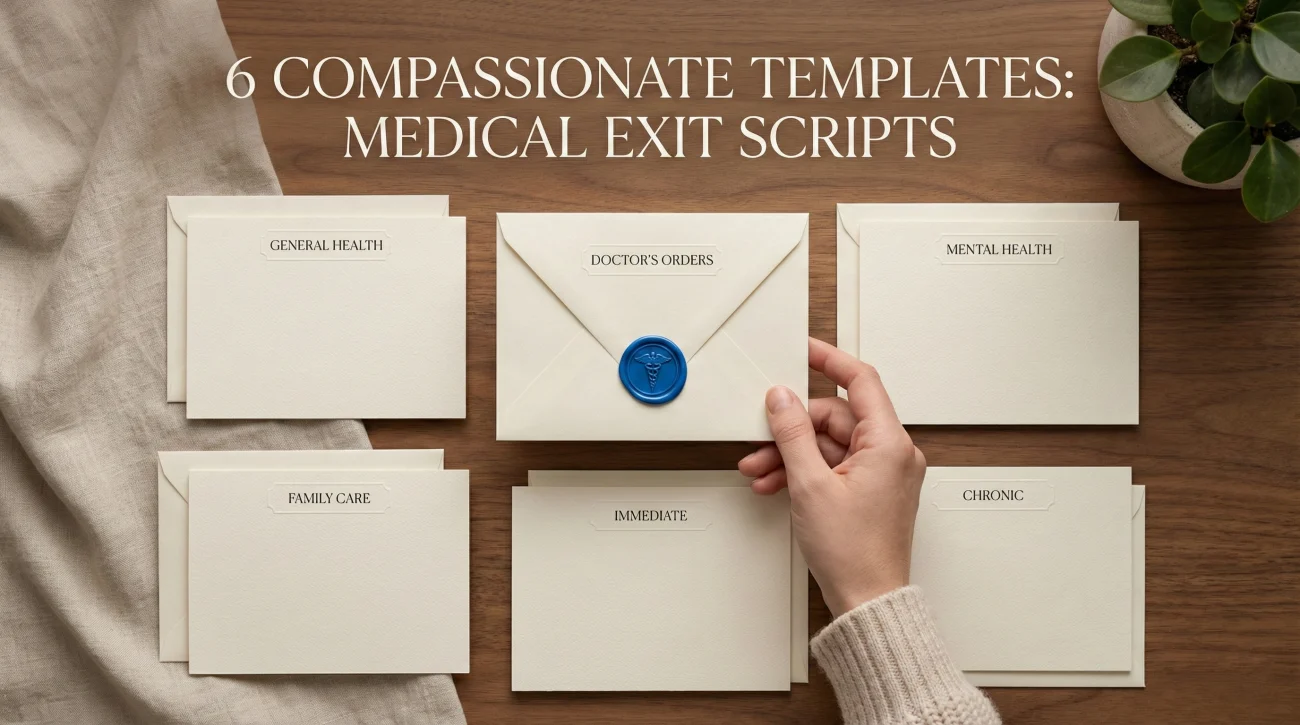
Template 1: General Health Reasons (Maximum Privacy)
Use this template when you want to disclose absolutely nothing about the nature of your illness. It is professional, firm, and protective.
Subject: Resignation – [Your Name]
Dear [Manager’s Name],
Please accept this letter as formal notification that I am resigning from my position as [Job Title] at [Company Name]. My last day will be [Date].
Unfortunately, I need to step away from my role due to personal health reasons that require my full and immediate attention. This was not an easy decision to make, but it is necessary for my long-term wellbeing.
I appreciate the opportunities I have had here and the support of the team. I will do my best to assist with the handover of my current tasks during my remaining time.
Thank you for your understanding.
Sincerely,
[Your Name]
[Phone Number]
Template 2: The “Medical Advice” Approach
This medical reasons resignation email leverages the authority of a doctor. It is extremely effective at shutting down counter-arguments or guilt trips from management.
Subject: Resignation Notice – [Your Name]
Dear [Manager’s Name],
I am writing to formally resign from my position as [Job Title], effective [Date].
On the specific advice of my physician, I need to stop working to address health issues that prevent me from fulfilling the responsibilities of this role. Continuing to work in my current capacity would be detrimental to my recovery process.
I have valued my time at [Company Name] and deeply appreciate the support I have received. I want to ensure a smooth transition and will work to document my processes before my departure.
Thank you for your understanding during this difficult time.
Best regards,
[Your Name]
[Phone]
Template 3: Immediate Resignation Due to Health Crisis
Use this only for genuine emergencies where you cannot work another day.
Subject: URGENT: Immediate Resignation – [Your Name] – Health Emergency
Dear [Manager’s Name],
I am writing to inform you of my immediate resignation from [Job Title] at [Company Name], effective today, [Date].
I have recently been diagnosed with a serious health condition that requires immediate treatment and makes it physically impossible for me to continue working. This decision was not made lightly, and I sincerely apologize for the lack of notice and any disruption this causes.
I have [briefly mention any immediate handover action, e.g., emailed my status report to X]. I will be available via email for critical questions over the next 48 hours as my health permits.
Thank you for your compassion and support.
Respectfully,
[Your Name]
Template 4: Resignation Due to Mental Health/Burnout
Mental health is a valid medical reason. This template asserts that boundary without over-sharing or using stigmatized language.
Subject: Resignation – [Your Name]
Dear [Manager’s Name],
I am writing to resign from my position as [Job Title], with my final day being [Date].
After careful consideration and consultation with healthcare professionals, I have realized that I need to prioritize my mental health and wellbeing at this time. I need to step away from the workforce to focus fully on my recovery.
I am grateful for the professional experiences I have gained here. I will ensure all my current responsibilities are documented and transitioned appropriately before I leave.
Thank you for your support.
Sincerely,
[Your Name]
Template 5: Resigning to Care for a Family Member
Often, the “health reason” is not yours, but a loved one’s. This is known as a caregiver resignation.
Subject: Resignation Notice – [Your Name]
Dear [Manager’s Name],
I am writing to resign from my role as [Job Title] at [Company Name], effective [Date].
A close family member has been diagnosed with a serious illness, and I need to step away from my professional duties to provide full-time care and support during their treatment. My family must be my priority right now.
I have appreciated working with you and the team. I will do everything possible to ensure a smooth transition of my responsibilities during the notice period.
Best regards,
[Your Name]
Template 6: Managing a Chronic Condition
For when a long-term issue (autoimmune, chronic pain, etc.) has finally become too much to manage alongside work.
Subject: Resignation – [Your Name]
Dear [Manager’s Name],
Please accept this as formal notice of my resignation from [Job Title], with [Date] as my final day of employment.
As you may know, I have been managing a chronic health condition. Unfortunately, it has reached a point where I can no longer balance the treatment requirements with my work responsibilities. I need to focus fully on my health management.
I want to thank you for the flexibility you have shown me. I will work diligently to train my replacement.
Sincerely,
[Your Name]
Wait: Should You Resign or Take Leave? (Legal Protections)
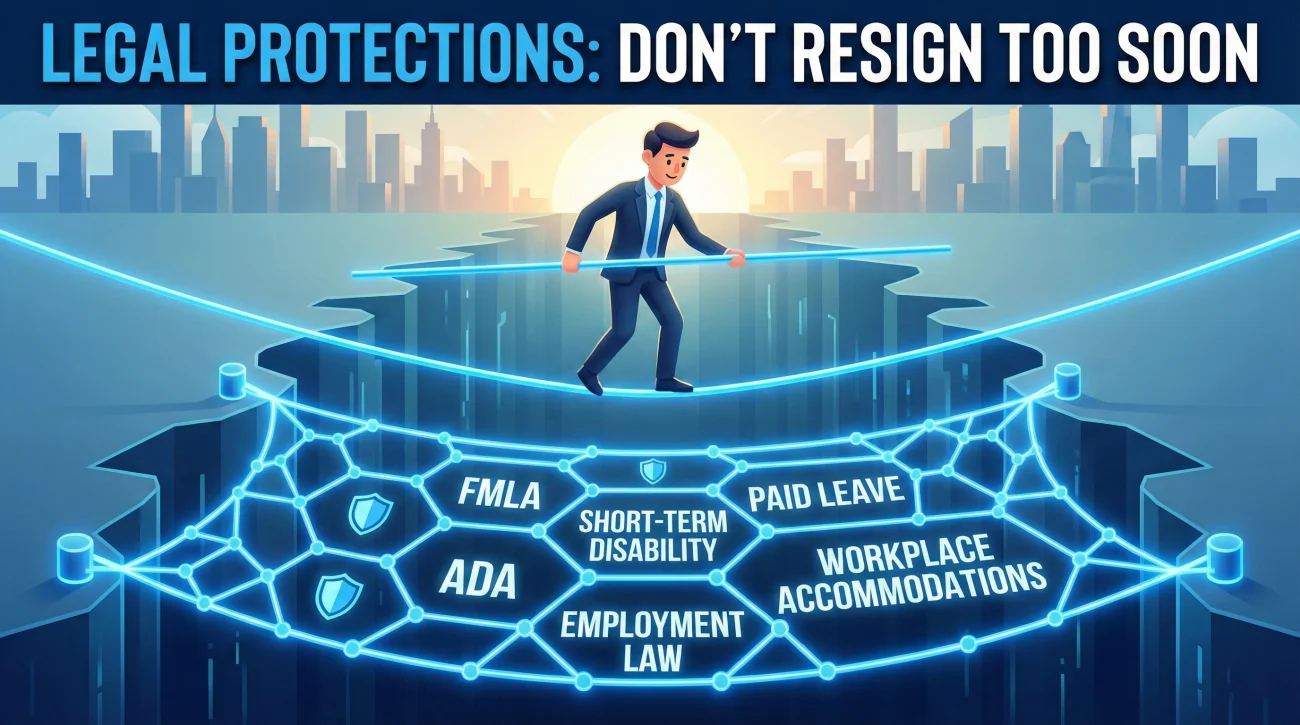
Before you hit send, pause. Resignation is final. Are you sure you cannot pause your employment instead? You may have legal rights to keep your job while you recover.
The Family and Medical Leave Act (FMLA)
In the US, FMLA provides up to 12 weeks of unpaid, job-protected leave per year.
Check Eligibility: You generally need to have worked for the employer for 12 months (1,250 hours) and the company must have 50+ employees.
Why Choose FMLA: It keeps your health insurance active (you usually just pay your portion of the premium) and guarantees your role is waiting for you. It buys you three months to see if you get better.
The Americans with Disabilities Act (ADA)
If your condition qualifies as a disability, your employer is legally required to provide “reasonable accommodations” unless it causes undue hardship.
Examples: Switching to remote work, modifying your schedule to attend therapy, or purchasing ergonomic equipment.
Strategy: Instead of resigning, you could write: “I am requesting a reasonable accommodation under the ADA to manage my health condition.” This triggers a formal interactive process rather than an exit.
Short-Term Disability (STD) Insurance
Does your company offer STD insurance? If you resign, you lose this coverage instantly. If you go on medical leave, you might receive 60-100% of your salary while you recover. Never resign before checking your STD policy. You could be walking away from thousands of dollars in income protection.
The Logistics of Leaving: Benefits and Insurance
Health resignations have a unique complication: you are leaving your job exactly when you need health insurance the most. Navigating this is critical.
The COBRA Safety Net
In the US, COBRA allows you to continue your exact same employer health insurance for up to 18 months.
The Catch: It is expensive. You pay the full premium (employer portion + employee portion) plus a 2% admin fee.
The Strategy: You have 60 days to elect COBRA, and it applies retroactively. If you think you might get a new job (or get on a spouse’s plan) in 30 days, you can wait to see if you actually need to pay for it.
Handling “Doctor’s Note” Requests
If you resign immediately, HR might ask for a doctor’s note.
What to Provide: A simple note from your doctor stating “Patient is medically unable to work from [Date] to [Date]” is sufficient.
What NOT to Provide: Detailed diagnosis codes or therapy notes. Your employer does not have a right to your full medical file unless you are claiming workers’ compensation or specific disability benefits.
The Emotional Toll: Guilt and Identity
Resigning for health reasons attacks your sense of professional identity. You aren’t leaving because you want to; you’re leaving because your body is forcing you to. This creates a specific type of grief.
Managing the “I Let Them Down” Guilt
Many high-performers feel they are “abandoning” their team.
Reframing: If you stayed, you would be working at 40% capacity, potentially making mistakes due to illness. Leaving allows the team to hire someone who can be 100% present. Resigning is actually the responsible, professional choice for the business.
The “Career Gap” Anxiety
You might worry about the hole in your resume.
Future Strategy: When you are ready to return, simply state: “I took a planned career break to manage a health matter which is now fully resolved. I am energized and ready to return.” Most recruiters accept this and move on. “Resolved” is the keyword that alleviates their fear of recurrence.
❓ FAQ: Resigning Due to Health
🏥 Do I legally have to disclose my specific illness?
💰 Can I get unemployment if I quit for health reasons?
📧 Should I tell my team the truth?
🔄 Can I ask to be rehired later?
Final Thoughts: Health is the Ultimate Asset
Writing a resignation email due to health reasons is one of the most courageous things a professional can do. It is an admission that you are human, not a machine. Remember: Careers are long; health is fragile. You can get another job; you cannot get another body.
Use the templates above to handle the logistics with grace and professionalism. Once you hit send, try to release the guilt. Your only job now is recovery. The work will still be there when you are ready.
For more specific templates on other scenarios, browse our resignation email examples or read our complete guide on how to write a resignation email.
⚠️ Legal Disclaimer: The resignation templates, email samples, and professional guidance provided in this guide are for informational purposes only and do not constitute legal advice. Employment laws and contract requirements vary by jurisdiction and individual circumstances. Please review your employment agreement and consult your HR department and/or a qualified attorney to ensure compliance with applicable laws and policies.