
Core Idea: Treat your resignation letter as a networking tool that protects your reputation and future options.
Tone Choice: Use formal as a compliance shield, use professional as a relationship bridge.
Template Spine: State resignation and last day, give a neutral forward reason, add specific gratitude, offer concrete handover help.
Framing Rule: Frame forward not backward, keep thanks specific so it sounds real instead of generic noise.
Exit Strategy: In hard exits stay brief and impenetrable, then finish with a plan and leave the door open for a boomerang return.
The Long Game: Why Your Resignation Is a Networking Tool
There is an old saying in the corporate world: “You never truly leave a job; you only change the nature of the relationship.” Today’s manager could be tomorrow’s client. The colleague you sit next to might be the hiring director at your dream company in five years. In this interconnected professional ecosystem, your resignation is not an end – it is a pivot point. A well-crafted professional resignation letter does more than just give notice; it protects your network, cements your reputation, and ensures that the final impression you leave is one of grace, integrity, and class.
Many professionals view the resignation letter as a mere formality – a bureaucratic box to check before the farewell party. This is a missed opportunity. While formal letters satisfy HR requirements, professional resignations are strategic assets. They actively manage your personal brand during a moment of high vulnerability. They are designed to neutralize resentment, facilitate a smooth handover, and keep doors unlocked for future opportunities.
This guide goes beyond the basics of “two weeks’ notice.” We will explore the psychology of a graceful exit, providing you with templates and strategies that turn a potentially awkward departure into a masterclass in professionalism. Whether you are leaving for a better offer, escaping a toxic environment, or simply pivoting careers, we will show you how to write a letter that serves your long-term interests long after you have handed in your badge.
Professional vs. Formal: The Strategic Distinction
While the terms are often used interchangeably, there is a distinct nuance between a “formal” resignation and a “professional” one. Understanding this difference is key to choosing the right tone for your exit.
Formal Vs Professional Resignation Difference
Formal: The Shield
Formal resignation letters are about compliance. They are defensive documents designed to satisfy HR protocols, establish legal timelines, and adhere to contracts. They are cold, precise, and objective. You use them when you need to protect yourself legally or when the organizational culture is rigid.
Professional: The Bridge
Professional resignation letters are about relationships. They prioritize tone, warmth, and the human element of your departure. They are strategic tools used to preserve goodwill. A professional letter says, “I respect you, I value my time here, and I want to leave the team in good hands.”
You can write a technically “correct” formal letter that feels cold and alienating. Conversely, a professional resignation letter combines the necessary legal elements (dates, clear intent) with the emotional intelligence required to maintain your network.
The Core Professional Resignation Letter Template
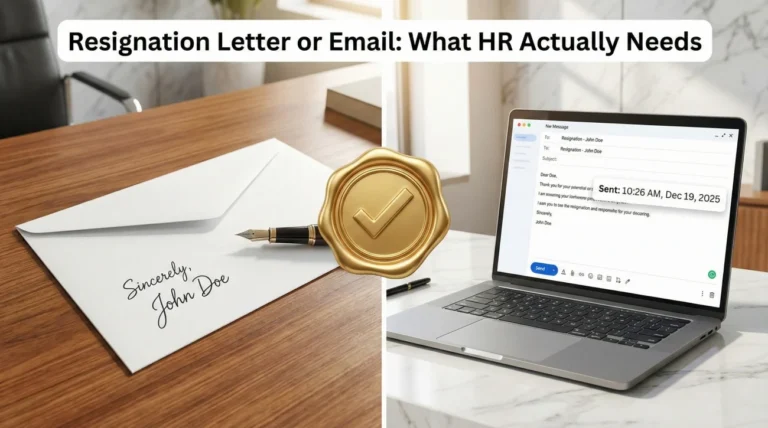
This template is designed for the modern professional who wants to leave a lasting positive impression. It balances administrative necessity with genuine gratitude. As a printed letter, it carries a weight of seriousness and respect that an email often lacks.
[Your Full Name]
[Your Street Address]
[City, State, Zip Code]
[Your Phone Number] | [Your Email Address]
[Date]
[Manager’s Name]
[Title]
[Company Name]
[Company Address]
Dear [Manager’s Name],
Please accept this letter as formal notification that I am resigning from my position as [Your Job Title] at [Company Name]. My final day will be [Specific Date], providing the full notice period as outlined in my employment agreement.
This decision comes after careful consideration of my long-term career path. I have accepted a new position that aligns with my current professional goals, though the decision to leave [Company Name] was not made lightly.
I want to express my sincere gratitude for the opportunities I have had here. Working on [Specific Project, e.g., the Q3 Marketing Launch] was a highlight of my tenure, and I have learned a great deal about [Specific Skill] under your mentorship. These are experiences I will carry forward with me.
I am fully committed to ensuring a seamless handoff during my remaining time. I will complete [Specific Deliverable], document my current workflows, and assist in training my successor. Please let me know how I can best support you and the team during this transition.
I hope we can stay connected professionally. I wish [Company Name] continued success.
Sincerely,
[Your Signature]
[Your Printed Name]
Deconstructing the Strategy
✅ The “Bad News” First: The opening paragraph rips the band-aid off immediately. It clearly states the resignation and the end date. Directness shows respect for your manager’s time and avoids confusion.
✅ The “Pivot” Explanation: Notice the phrase “aligns with my long-term professional goals.” This is a neutral, unarguable reason for leaving. It doesn’t criticize the current company; it simply frames the move as a personal growth step.
✅ The Specific Gratitude: Generic “thanks for everything” reads as lazy. By citing a specific project or skill, you demonstrate that you were engaged and that you value the investment the company made in you.
✅ The Concrete Offer: Instead of a vague “let me know if I can help,” this template offers specific actions (documentation, training). This relieves the manager’s immediate anxiety about the workload.
Strategic Reputation Protection: The Art of Framing
Your resignation letter is a marketing document. You are marketing your own professionalism. To do this effectively, you must master the art of “Forward Framing.”
Always Frame Forward, Never Backward
Even when leaving a stagnant role, professional letters focus on where you are going (the pull factors), not what you are escaping (the push factors). A career growth resignation letter emphasizes opportunity, evolution, and future challenges.
The Internal Thought (Negative)
The Professional Frame (Positive)
“I’m bored and hate this dead-end job.”
“I am seeking new challenges to further develop my skills.”
“My boss micromanages everything.”
“I am moving to a role that offers increased autonomy.”
“The pay here is terrible.”
“I am pursuing an opportunity that aligns with my financial goals.”
Both columns communicate the same reality, but the right-hand column preserves your dignity and avoids insulting your current employer.
The Power of Specificity
If you want your gratitude to ring true, it must be specific. Generic appreciation is “white noise” – managers hear it so often it means nothing. Mentioning a specific win (“The rollout of the CRM system”), a shared struggle (“Navigating the supply chain crisis”), or a personal kindness (“Your support during my family leave”) makes the letter memorable and human.
Navigating Difficult Departures with Grace
It is easy to be professional when you love your job. The true test of character – and the moment your reputation is most at risk – is when you are leaving a difficult situation. Whether it is a toxic culture or a bad boss, your letter must remain the adult in the room.
The “Polite Shield” Email for Toxic Workplaces
When resigning from a hostile environment, resist the temptation to set the record straight. Your resignation letter is a permanent file; it is not the place for a manifesto. A polite resignation email in this context is a strategic defense mechanism. It gives them nothing to attack.
Subject: Resignation – [Your Name]
[Date]
Dear [Manager’s Name],
Please accept this email as notice of my resignation from the position of [Your Job Title], effective [Date].
I have decided to move on to a new opportunity. I want to ensure a professional departure and will work to complete my outstanding tasks before my final day.
Thank you for the opportunity to work at [Company Name].
Sincerely,
[Your Name]
Note the brevity. There is no fake praise, but there is also no venom. It is purely functional. This protects you from accusations of unprofessionalism while allowing you to exit quickly.
The “Short Tenure” Notification
Leaving a job after only a few months is awkward. You need to address the elephant in the room without apologizing for making the right decision for yourself.
Subject: Resignation – [Your Name]
[Date]
Dear [Manager’s Name],
I am writing to submit my resignation from [Company Name], effective [Date].
While my time here has been brief, I have appreciated the chance to learn about the team and the business. After significant reflection, I have realized that this role is not the right fit for my long-term career path, and I have decided to pursue a different direction.
I want to be respectful of the team’s time and resources by making this transition now. I will ensure all my current projects are handed off cleanly.
Best regards,
[Your Name]
The Smooth Handover: Your Final Professional Act
Proactive Handover Plan Documents
The “two weeks” after you resign are often more important for your legacy than the two years prior. This is when your colleagues are stressed about your departure. By proactively managing this stress, you become a hero rather than a deserter.
Move from Promises to Plans
Don’t just say “I’ll help.” Present a plan. In your resignation email (or the immediate follow-up), include a bulleted list of what you will achieve before you walk out the door:
“I will finalize the Q4 budget report.”
“I will record loom videos explaining the daily reporting process.”
“I will introduce my key clients to [Colleague Name] via email.”
This level of proactivity shocks most managers – in a good way. It signals that you are still “on the team” until the very last minute.
The Boomerang Strategy: Leaving the Door Open
The Boomerang Employee Strategy
“Boomerang employees” – those who leave and later return – are a massive trend in the modern workforce. You might want to return to this company in three years when you are more senior, or when leadership changes. A resignation letter leaving on good terms is the seed for that future return.
[Your Full Name]
[Your Email] | [Your Phone]
[Date]
[Manager’s Name]
[Title]
[Company Name]
Dear [Manager’s Name],
I am writing to let you know that I will be leaving my position as [Your Job Title] at [Company Name] on [Date].
This was a difficult decision. I have genuinely loved working with this team, and I am proud of what we achieved with [Project Name]. I am leaving only because I have an opportunity to [Specific Growth Goal] that isn’t currently available here.
I have great respect for [Company Name]’s mission and would love to cross paths again in the future. I hope we can stay in touch as I navigate this next chapter.
Thank you for everything.
Warmly,
[Your Signature]
[Your Printed Name]
This letter makes it clear: “I am leaving the job, not the people.” It explicitly invites future connection, keeping you on the “hirable” list.
❓ FAQ
🤝 Should I mention my new employer’s name?
Generally, no. In a written document, it is safer to be vague (“a new opportunity”). Mentioning a specific competitor can trigger immediate removal from the building (security protocol) or legal reviews of non-competes. Share that information verbally if you trust your manager, but keep it out of the permanent file.
⏰ Is email acceptable for a professional resignation?
Yes, absolutely. In the modern workforce, an email is the standard method, especially for remote or hybrid teams. However, the professional etiquette is to request a quick meeting to tell your manager verbally first, then hit “send” on the email immediately after. The email serves as the official confirmation.
💬 Can I be “too nice” in my letter?
Yes. If you pour out your heart with effusive praise that doesn’t match reality, you risk looking fake or sarcastic. Keep your gratitude grounded and realistic. If the experience was just “okay,” a simple “Thank you for the opportunity” is far more professional than three paragraphs of manufactured joy.
📋 What if I want to give feedback on why I’m leaving?
Do not put negative feedback in the resignation letter. The letter is for notification, not negotiation or evaluation. If you want to give constructive feedback to help the company improve, save it for the Exit Interview with HR, where it can be documented anonymously and appropriately.
🔄 How do I ask for a reference in the resignation letter?
It is better to ask for a reference separately, after you have demonstrated a strong finish during your notice period. However, you can hint at it by saying, “I hope to maintain our professional relationship.” Once you have successfully handed over your work, send a separate note asking if they would be comfortable serving as a reference in the future.
Final Thoughts
Professional Network Growth Map
Your professional network is your net worth. A thoughtfully crafted professional resignation letter is an investment in that network. It allows you to control the narrative of your departure, ensuring that the last thing people remember about you is your class, your competence, and your integrity.
The templates and strategies provided here are designed to help you exit any situation with your head held high. Use them to bridge the gap between where you are and where you are going. For more tools on managing your career transition, from notice period etiquette to exit interview tips, explore our complete library at ResignSmartly. Remember, how you leave matters just as much as how you started. Finish strong.
⚠️ Legal Disclaimer: ResignSmartly provides general informational guidance about resignation, workplace communication, notice periods, handovers, and career transitions. Content does not constitute individualized legal advice. Employment laws, contracts, workplace policies, and individual circumstances vary, so review the requirements that apply to your situation and consult an appropriate qualified professional when needed.