- Core idea: A formal resignation letter is your final compliance-safe record in regulated or traditional institutions.
- Who needs it: Finance, legal, healthcare, government, and matrix-heavy corporates where dates, audit trails, and liability matter.
- Template essentials: Legal name and address blocks, unambiguous resignation line, exact effective date and last day, transition commitment, request for exit procedures.
- Formatting standards: Business-safe fonts, left alignment, clean spacing, and PDF or wet signature when the organization expects it.
- Risk control: Exclude emotions and future employer info, use bureaucracy vocabulary, and deliver via a meeting-first sequence that respects chain of command.
The Strategic Importance of Formality in Corporate Exits
In the polished corridors of high finance, legal firms, or government agencies, accuracy is the currency of reputation. You have navigated your tenure with precision, meeting strict compliance standards and navigating complex hierarchies. Now that you are leaving, the paperwork you submit is not just a notice – it is the final seal on your professional file. In these environments, where one misplaced comma can delay administrative approvals or trigger compliance flags, a formal resignation letter is your shield.
This is not about sounding self-important or stiff. It is about understanding the bureaucratic machinery that governs your departure. HR departments in regulated industries scrutinize every document for liability; legal teams review employment actions for contractual adherence; and boards require specific audit trails. An informal email saying “I quit” might work for a startup, but in the corporate world, it looks like negligence.
When you resign from a position of significant responsibility or from a highly structured organization, your letter does more than announce your departure. It sets the tone for your transition, dictates the terms of your notice period, and often serves as a primary exhibit in future reference checks. A casual approach can be misinterpreted as a lack of professionalism or, worse, a sign of grievance. Conversely, a meticulously crafted formal letter signals that you are in control, that you respect the institution’s protocols, and that you intend to leave with the same level of excellence you maintained while employed.
This guide is your deep dive into the specific protocols of corporate departures. We will provide you with HR-approved templates that satisfy strict documentation requirements, explain the psychology behind official language, and show you how to execute a flawless exit that preserves your standing in the most traditional institutions.
Who Actually Needs a Formal Resignation Letter?
Not every job requires this level of documentation rigor. In fact, sending a stiff, highly formal letter to a casual tech manager might signal that you are disgruntled or “lawyering up.” However, for specific sectors, an official resignation letter is mandatory. Understanding whether you fall into these categories is the first step in your exit strategy.

Heavily Regulated Industries: The Audit Trail
If you work in financial services, healthcare systems, or legal practices, you operate under strict compliance frameworks. Here, your resignation is not just a letter; it is a legal document that may be subject to external audits (like SEC, FINRA, or FDA reviews) years down the line. Compliance officers need to see a clear timeline: When did you resign? Did you have access to sensitive data after that date? Did you fulfill your fiduciary duties during the notice period?
A formal structure signals to these officers that your departure fits their established protocols. It protects you from accusations of data mishandling or “abandonment of duty.” For example, in banking, a clear “effective date” protects you from liability for trades or decisions made after your departure.
Traditional Corporate Structures: Navigating the Matrix
In Fortune 500 companies with multiple management layers (Matrix Organizations), your resignation letter often travels further than your boss’s desk. It moves to HR regional directors, payroll processing centers, legal counsel, and potentially the Board of Directors if you are an executive.
In these systems, verbal agreements vanish. If you told your boss, “I’m leaving around the end of the month,” but the letter doesn’t specify a date, payroll might cut your benefits prematurely or extend them illegally, causing tax nightmares for you later. A well-crafted corporate resignation letter respects these institutional norms, ensuring your notice flows smoothly through the chain of command without requiring “clarification” calls that delay your exit process.
Government and Public Sector: The Code of Bureaucracy
Civil service positions and government contractors operate in a world of their own. Resignation procedures here are often codified in federal regulations, municipal codes, or union contracts. These roles frequently require letters to reference specific policy sections, civil service grades, or employment categories.
In these contexts, an informal letter can be deemed “insufficient notice,” potentially affecting your payout of accrued leave or your eligibility for rehire. The formality here is not a courtesy; it is a regulatory requirement.
The Standard Formal Resignation Template
This template incorporates all elements expected in traditional business correspondence. It is designed to be “bureaucracy-safe” – impersonal, precise, and impossible to misunderstand. It strips away emotion to focus purely on the transaction of ending employment.
[Your Full Legal Name]
[Your Home Address]
[City, State ZIP Code]
[Your Phone Number] | [Your Email Address]
[Current Date]
[Manager’s Full Name and Title]
[Department Name]
[Company Legal Name]
[Company Address]
[City, State ZIP Code]
Dear [Manager’s Title and Last Name],
I hereby submit my resignation from the position of [Your Official Job Title] at [Company Legal Name], effective [Specific Date].
In accordance with my employment agreement, I am providing [number] weeks’ notice. My final day of employment will be [Day of Week, Full Date, Year].
I appreciate the professional opportunities afforded to me during my tenure with [Company Name]. I remain committed to ensuring a comprehensive transition of my responsibilities and will work diligently to support continuity of operations during this period.
Please advise regarding any specific exit procedures or documentation requirements.
Respectfully submitted,
[Your Signature]
[Your Typed Full Name]
[Your Employee ID – if applicable]
Decoding the Format Requirements: Why Each Line Matters
To the untrained eye, this template looks stiff. To an HR Director, it looks perfect. Here is the strategic reasoning behind every element:
- ✅ The Dual Address Block: Traditional business letter formatting requires both sender and recipient information at the top. This dates back to when letters were filed physically; it ensures that even if the letter is separated from your file, it is identifiable. Use your legal name exactly as it appears in payroll records – nicknames create administrative confusion.
- ✅ The Formal Salutation: Use the recipient’s title and last name – “Dear Mr. Johnson” or “Dear Dr. Chen” – not first names. This distance signals professional formality. Even if you play golf with your boss on weekends, this document is a transaction between an employee and a manager, not two friends.
- ✅ The Declarative Opening (“I hereby submit”): The phrase “I hereby” carries legal weight. It acts as a performative verb – saying it makes it so. It is far more definitive than “I am writing to let you know,” which sounds like the start of a discussion. Legal teams respond to traditional language that explicitly states the status change.
- ✅ The Compliance Check: Note how the template references the “employment agreement.” This subtle addition proves you are aware of your contractual obligations regarding notice periods. It preemptively shuts down any accusation that you are leaving abruptly or in violation of your contract.
- ✅ The “Continuity of Operations”: Instead of saying “I’ll help train the new guy,” we use “support continuity of operations.” This is language that speaks to organizational stability, reassuring leadership that their business metrics won’t suffer during your exit.
Critical Formatting Standards: The Visual Language of Authority
The visual presentation of formal letters carries as much weight as the content itself. In formal correspondence, “the medium is the message.” If you send a text-heavy, poorly spaced document in Comic Sans, you have already lost credibility before they read a word. Following a strict professional resignation letter format demonstrates your attention to detail.
| Element | Standard Rule | Why It Matters |
|---|---|---|
| Margins | Standard 1-inch (2.54cm) on all sides | Ensures the document looks balanced and professional when printed. |
| Font | Times New Roman, Arial, or Calibri (11-12pt) | These are the “safe” fonts. They are universally readable and standard in legal contracts. |
| Alignment | Left-aligned (Never justified or centered) | “Justified” text can create weird spacing gaps. Left-aligned is the business standard. |
| Spacing | Single-space paragraphs; Double-space sections | White space makes the document readable and allows room for marginal notes by HR. |
| Paper (If Printed) | White or Ivory Bond Paper (20-24 lb) | Substantial paper weight feels “official” in hand. Never use printer paper that is transparently thin. |
Physical Submission: The “Wet Signature”
While email is common, many traditional organizations still expect a “wet signature” – a physical letter signed in ink. This is not just nostalgia; in some jurisdictions, a physical signature carries different evidentiary weight than a digital one. If you are printing this, use blue or black ink only. This physical document often becomes the “master copy” in your personnel file, outlasting digital notifications.
Industry-Specific Formal Templates
One size does not fit all in the corporate world. A bank manager needs different protections than a government contractor. Here are specialized variations for high-stakes environments.
Government/Public Sector: The Bureaucrat’s Choice
Government positions often require references to specific personnel regulations, civil service classifications, or ID numbers to be processed correctly. Missing these details can result in your resignation being “returned for correction” – a humiliating and frustrating delay.
[Your Full Name]
[Position Classification] | [Employee ID]
[Department/Agency]
[Date]
[Supervisor’s Title and Last Name]
[Department Head]
[Agency Name]
RE: Resignation – [Your Name], [Employee ID]
Dear [Supervisor’s Title and Last Name],
This letter constitutes formal notice of my resignation from the position of [Official Position Title, Classification Level] with [Agency/Department Name], effective [Date].
In accordance with [relevant civil service regulation/personnel policy – e.g., Civil Service Rule 12.1], I am providing [number] days/weeks notice. My last day of service will be [Complete Date].
I will ensure all assigned duties are properly documented and transferred according to established departmental protocols. Please advise regarding required exit clearance procedures and the return of government property.
Respectfully,
[Signature]
[Typed Name]
[Classification/Grade]
Financial Services/Banking: The Compliance Shield
In banking, the primary concern is client transition and regulatory compliance (SEC/FINRA). Your letter must preemptively address the fear that you might “poach” clients or mishandle data. This template addresses those specific anxieties upfront.
[Your Full Name]
[Your Email] | [Your Phone]
[Date]
[Manager’s Name]
[Title]
[Institution Name]
[City, State, Zip]
Dear [Title Last Name],
I hereby submit my resignation from [Position Title] at [Institution Name], effective [Date].
I am providing [number] weeks notice in accordance with my employment agreement and firm policy. My final business day will be [Date].
I will ensure proper client transition protocols are followed and all regulatory compliance requirements are met during my departure period. I am prepared to work with designated personnel to facilitate the comprehensive transfer of portfolio responsibilities and client records in full compliance with data privacy standards.
I confirm that I have not retained any proprietary information or client data on personal devices.
Respectfully,
[Signature]
[Your Name]
[CRD Number / Registration Numbers if applicable]
The Executive Exit: Board Level Protocol
When C-suite executives resign, the letter is often read by the Board of Directors and potentially investors. It must be gracious, devoid of any negativity, and focused entirely on a “smooth succession.”
[Your Full Name]
[Your Address]
[Date]
Board of Directors
c/o [Chairperson’s Name]
[Company Name]
[Headquarters Address]
Dear Members of the Board,
Please accept this letter as formal notification of my resignation as [Executive Title] of [Company Name], effective [Date].
After careful consideration, I have decided to [brief, neutral reason, e.g., pursue a new opportunity/retire]. It has been a privilege to lead this organization and work alongside such a talented team. I am proud of what we have achieved together.
My priority now is ensuring a seamless leadership transition. I am fully committed to working with the Board to onboard my successor and transfer my fiduciary responsibilities in an orderly manner.
Sincerely,
[Signature]
[Your Name]
[Title]
The Vocabulary of Bureaucracy: What to Say and Why
To write a successful business resignation letter, you must speak the language of the institution. Specific phrases signal competence and help your letter navigate processes smoothly.
Strong Opening Declarations
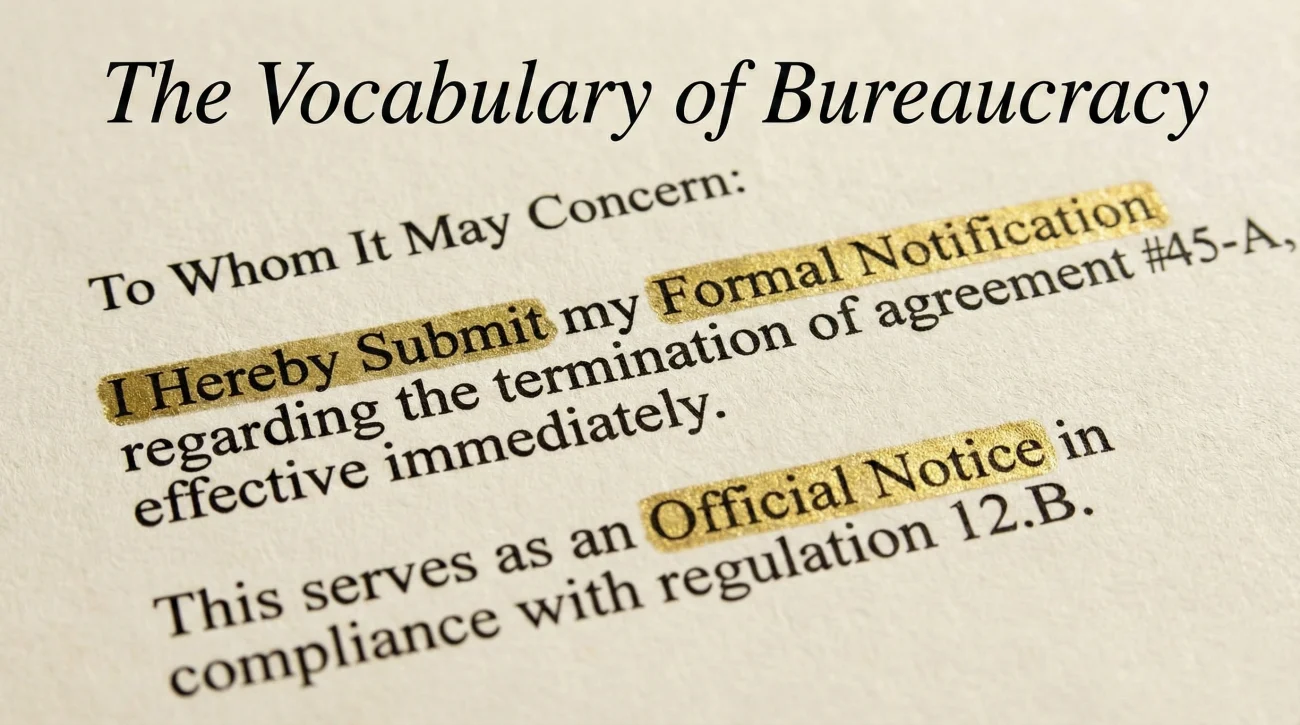
Begin with unambiguous formal language that leaves no room for interpretation. In a legal dispute, ambiguity favors the drafter, but in resignation, ambiguity creates chaos. Avoid casual openings like “I wanted to let you know.” Instead, use:
- “I hereby submit my resignation…” (The strongest, most legalistic option)
- “Please accept this letter as formal notification…” (Polite but firm)
- “This letter serves as official notice…” (Purely functional and objective)
Professional Transition Statements
Express transition support using formal business language. You are not “helping out”; you are “ensuring continuity.” This distinction matters because “helping” is a favor; “ensuring continuity” is a professional obligation.
- “I remain committed to ensuring a comprehensive transition…”
- “I will work diligently to support continuity of operations…”
- “I am prepared to facilitate knowledge transfer…”
Strategic Exclusions: What Could Get You Sued (or Fired Early)
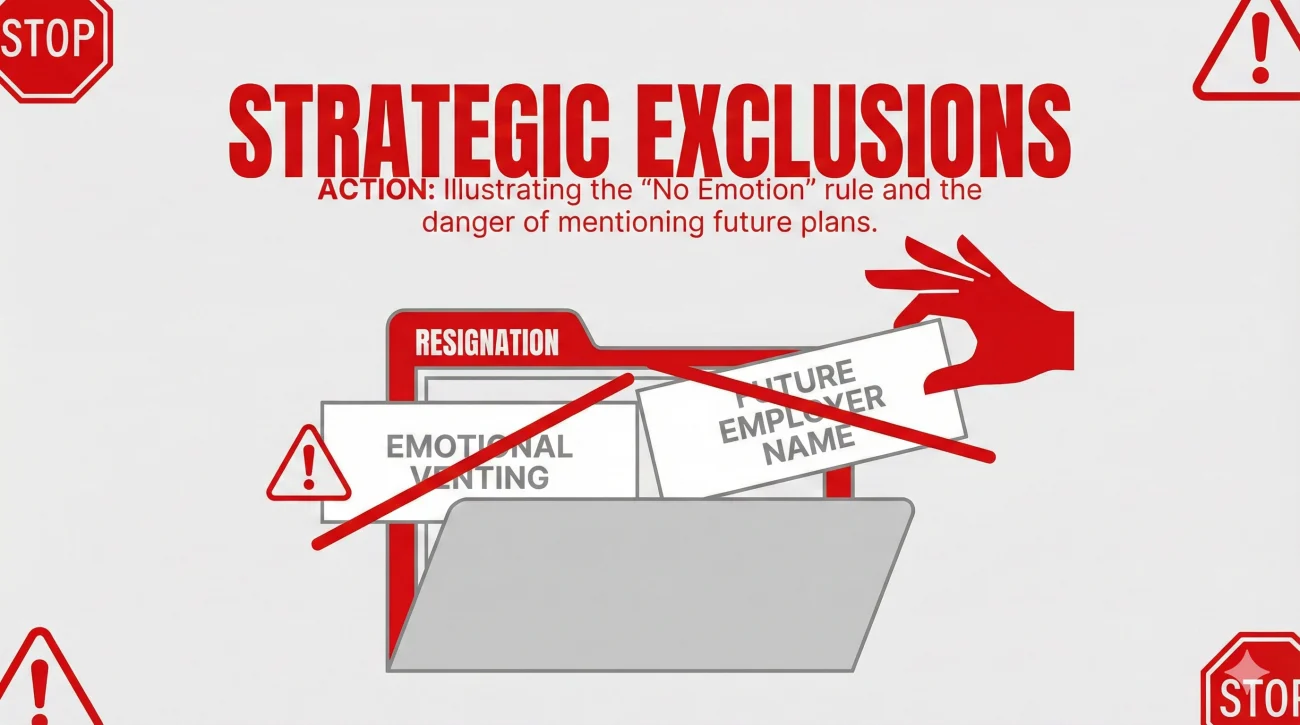
In formal letters, what you leave out is as important as what you put in. Writing too much is the rookie mistake that exposes you to liability.
The “No Emotion” Rule
Your resignation letter is not the place to vent, nor is it the place to be overly sentimental. Complaining about a toxic boss in a formal letter creates a permanent record of conflict that can be used to label you as “difficult” during future reference checks. Conversely, gushing about how much you love the team can undermine you if you were actually negotiating a severance package due to constructive dismissal. Keep it neutral. Neutrality is safe.
Silence on Future Plans
Never, under any circumstances, mention your new employer in a formal resignation letter. Why?
1. Non-Compete Triggers: If you mention you are going to a competitor, you might be escorted out of the building immediately (Garden Leave) rather than being allowed to work your notice period.
2. Tortious Interference: If your current employer knows where you are going, a vindictive manager might make a “friendly call” to your new boss.
3. Relevance: Where you are going is none of their business legally. It does not belong in the permanent file.
The “White Glove” Submission Protocol
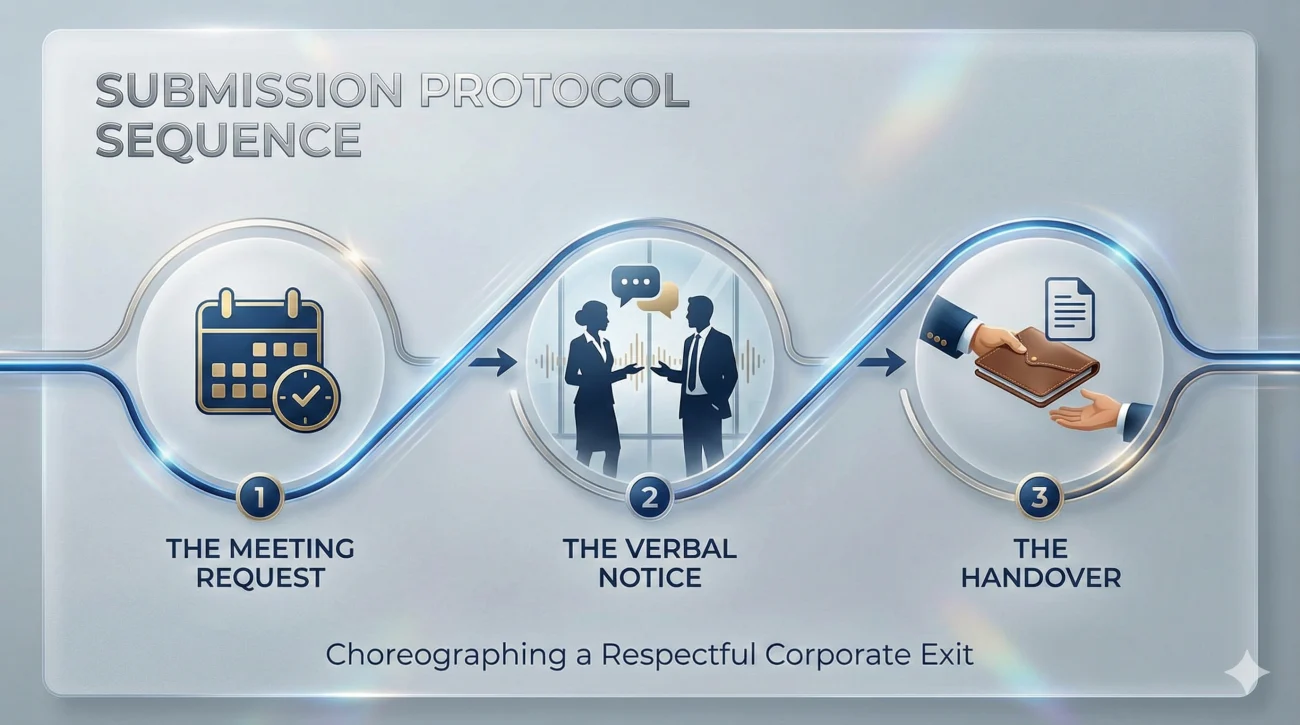
In formal organizations, the “how” is just as important as the “what.” You don’t just email this letter. You choreograph its delivery.
The Sequence of Events
- The Meeting Request: Send a vague calendar invite to your direct manager: “Quick Sync” or “Touch Base.” Do not put “Resignation” in the subject line – it causes panic before you are in the room.
- The Verbal Notice: In the meeting, state your resignation clearly. “I have decided to move on and my last day will be [Date].”
- The Handover: Hand them the physical folder containing your formal resignation letter. If remote, hit “Send” on the email while you are on the video call.
- The Follow-up: Ask, “Do you want me to forward this to HR, or will you handle that?” This shows you respect the chain of command.
For more detailed scripts on how to handle the verbal conversation without burning bridges, you can refer to our comprehensive guide.
❓ FAQ: Handling the Complexities
📋 Do I need a formal resignation letter for a startup?
Probably not. Formal letters serve traditional corporate environments, regulated industries, and government positions. Startups typically prefer straightforward, brief resignations. Using overly formal language in a hoodie-and-jeans culture can seem pretentious or passive-aggressive. However, if you have equity or stock options, a slightly more formal letter documenting the date is wise to protect your vesting schedule.
⏰ How far in advance should I submit a formal resignation?
Check your employment contract immediately. While “two weeks” is standard courtesy, many executive and specialist roles have “Notice Period” clauses requiring 30, 60, or even 90 days. Failing to provide contractually required notice can impact your severance, result in a clawback of bonuses, or lead to a negative reference (“Not Eligible for Rehire”). Always adhere to the contract.
💼 What if they ask me to change the “Effective Date” in the letter?
This is a common negotiation tactic. They might ask you to stay longer to finish a project, or leave sooner to save money. If you agree to a new date, submit a revised formal resignation letter reflecting the new date. Never rely on a verbal agreement for the date change; the payroll department only pays based on the document in the file.
📄 Can I email a formal resignation or must it be printed?
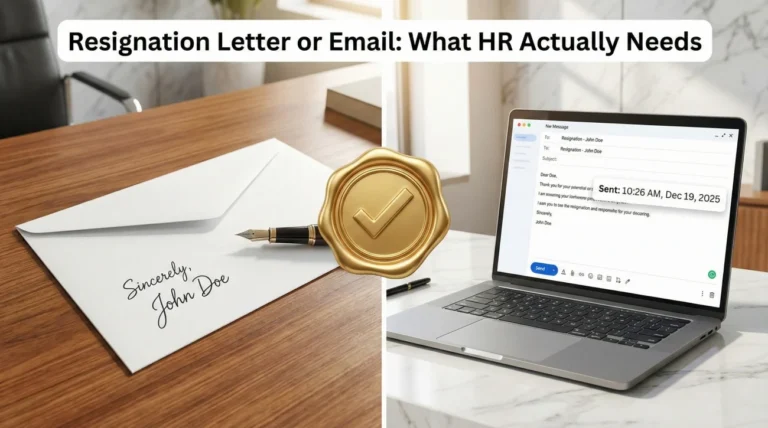
Email is acceptable and often necessary for the timestamp, but prepare both. Send a professionally formatted email with a PDF attachment of your formal letter. The PDF preserves exact formatting and prevents the text from getting mangled on mobile devices. The body of the email can be a shorter summary: “Please find attached my formal letter of resignation.”
🔒 What if my resignation triggers a non-compete or confidentiality review?
If you are in a role with a non-compete, expect an immediate meeting with Legal or HR. Your formal letter should already include the “compliance shield” language mentioned above. Be prepared to return all devices immediately. Do not access any company data after you have sent the letter – IT will often log your activity precisely from that timestamp to check for data theft.
Final Thoughts: The Art of the Graceful Exit
A well-executed formal resignation letter is more than paperwork; it is a demonstration of professional competence. It shows that even when you are walking out the door, you operate with the precision and respect of a leader. In the small world of corporate industries, this reputation for professionalism is the most valuable asset you take with you.
Remember that formality serves specific purposes – satisfying HR procedures, meeting regulatory requirements, and respecting organizational culture. If your workplace doesn’t operate within these frameworks, you might want to explore other resignation templates that are less rigid. Always choose the format that best fits your specific professional context.
⚠️ Legal Disclaimer: ResignSmartly provides general informational guidance about resignation, workplace communication, notice periods, handovers, and career transitions. Content does not constitute individualized legal advice. Employment laws, contracts, workplace policies, and individual circumstances vary, so review the requirements that apply to your situation and consult an appropriate qualified professional when needed.