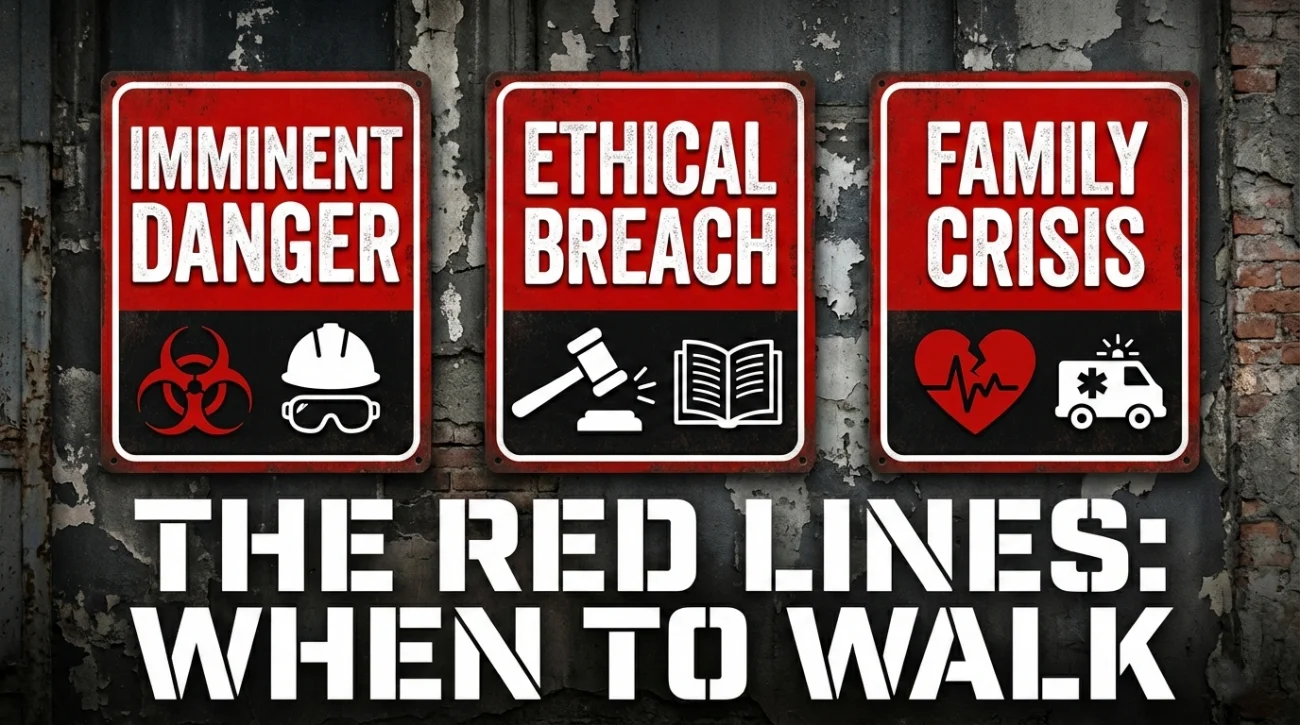
- Use “effective immediately” only for red-line scenarios: Health and safety danger, ethical-legal compulsion, or an unforeseeable family crisis.
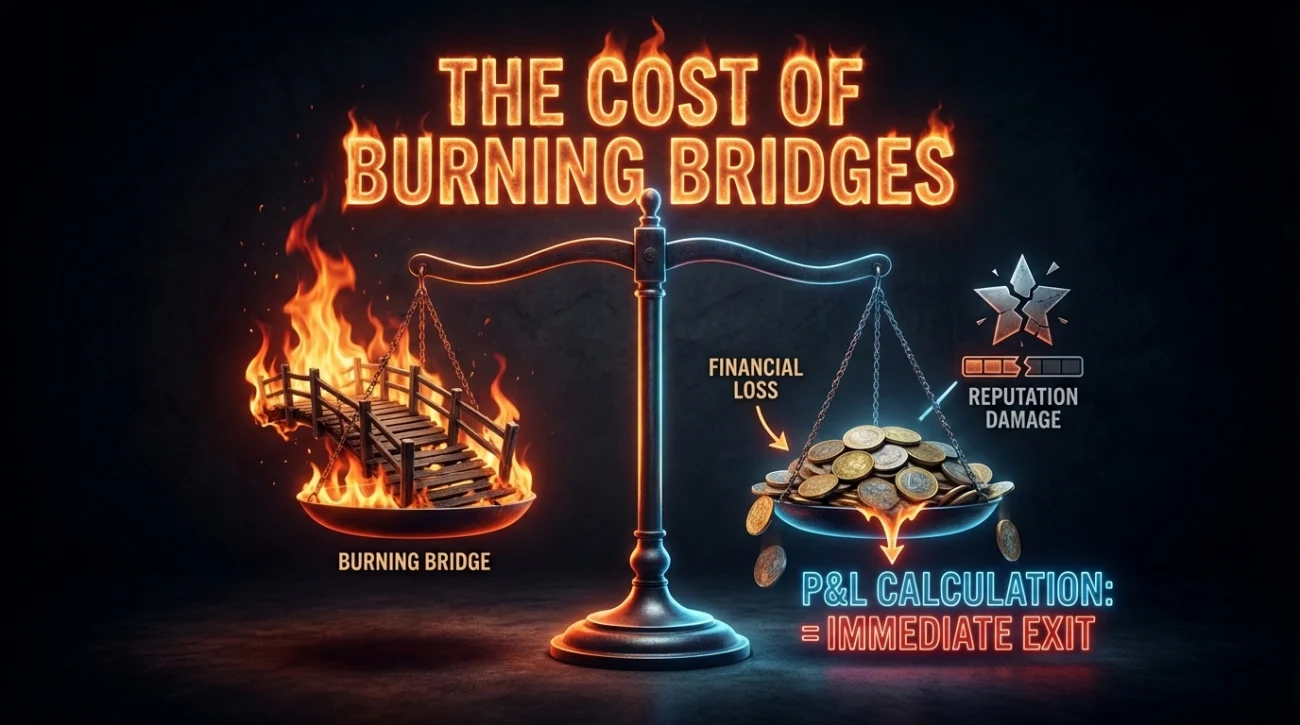
- Calculate the downside before you burn the bridge: Financial clawbacks or lost payouts, contract risk, and “not eligible for rehire” reputation damage.
- Write the letter like a legal closeout, not a rant: State the fact, date the end, keep the reason high-level, and spell out return-of-property logistics.
- Match the template to the trigger so it stays defensible: Medical emergency, unsafe environment with documentation trail, family crisis, or mental health break.
- Expect fast fallout and plan your story for later: Immediate IT lockout, final pay and benefits follow-up, and a calm “personal matter now resolved” interview explanation.
The Nuclear Option: When “Effective Immediately” Is the Only Choice
In the structured world of corporate employment, the standard two-week notice is the rhythm of doing business. It is polite, predictable, and safe. But life is rarely so orderly. Sometimes, a situation arises that is so toxic, so dangerous, or so critically urgent that the standard rules of engagement simply collapse. This is the moment you reach for the immediate resignation letter.
Submitting a resignation that is effective immediately is the professional equivalent of pulling the emergency brake on a speeding train. It is jarring, it creates sparks, and it stops everything instantly. For most professionals, this decision is not made lightly. It usually comes after sleepless nights, weighing the risk of burning a bridge against the cost of staying one more day. Whether you are facing a severe medical crisis, an unsafe working environment, or an ethical breach that you cannot stomach, the decision to quit without notice is a defining career moment.
This guide is your emergency handbook. We will move beyond the fear-mongering and look at the strategic reality of an immediate exit. You will learn when it is justified, how to minimize the inevitable fallout, and exactly what to write in a resignation letter effective immediately to protect your legal and professional standing.
The Red Lines: When Is Walking Out Justified?
Let’s be clear: quitting on the spot is an aggressive move. If you do it because you are bored, frustrated, or simply found a better offer that starts tomorrow, you are committing career suicide. Recruiters talk, and “job abandonment” is a label that sticks.
However, there are “Red Line” scenarios where your duty to yourself outweighs your duty to your employer. In these cases, an immediate resignation letter is not just acceptable; it is necessary.
1. Health and Safety Imminent Danger
If your workplace poses a physical threat to your safety – exposed wiring, lack of PPE, violent threats from customers or colleagues – you have no obligation to stay. The same applies to mental health crises. If the stress of the role has pushed you to a breaking point where a medical professional advises immediate cessation of work, your health takes precedence over their schedule.
2. Ethical and Legal Compulsion
If you are asked to cook the books, lie to a federal regulator, or cover up harassment, the standard notice period does not apply. Staying “two more weeks” in a criminal conspiracy makes you complicit. In these rare but terrifying situations, immediate departure is a legal defense strategy.
3. The Unforeseeable Catastrophe
Life happens fast. A parent falls ill, a spouse is transferred, or a house burns down. These are “Force Majeure” events in your personal life. Reasonable employers understand that you cannot prioritize a quarterly report over a life-or-death family emergency.
Conversely, here is what does not qualify as an emergency:
- ❌ You hate your boss’s management style.
- ❌ You want to use your accrued vacation time before starting a new job.
- ❌ You feel “burned out” but haven’t sought medical advice.
The Cost of Burning the Bridge: Calculating the Risk
Before you hit “send” on that quitting without notice letter, you must coldly calculate the P&L (Profit and Loss) of your decision. The consequences are real and can linger for years.
The Financial Hit
Check your employment contract. Many companies have “clawback” clauses. If you received a signing bonus or relocation package within the last 12-24 months, leaving without notice might trigger immediate repayment. Furthermore, in many jurisdictions, if you fail to give notice, the employer may not be obligated to pay out your accrued vacation time (unless state law overrides this). You are also instantly cutting off your health insurance, often before the end of the month.
The Legal Exposure
While we rarely see companies suing mid-level employees for quitting, it is possible. If your sudden departure causes demonstrable financial loss (e.g., a canceled project, a lost client), and you are in a contract that stipulates notice, you could theoretically be sued for breach of contract. This is rare, but if you are a senior executive, the risk is non-zero.
The “Do Not Rehire” List
HR systems have a checkbox: “Eligible for Rehire?” Leaving without notice almost guarantees this box is unchecked. When a future employer calls for a reference verification, they will be told: “Employee is not eligible for rehire.” That is a massive red flag. You lose control of your narrative.
Crafting the Message: Precision Over Emotion

The goal of your resignation letter is not to vent. It is to close the legal relationship with as little debris as possible. When writing a resignation effective immediately, brevity is your shield.
The Golden Rules of the Immediate Exit Letter:
- 🔒 State the Fact: “I am resigning effective immediately.” Do not say “I am thinking about quitting.”
- 📅 Date the End: “My last moment of employment is today, [Date].”
- 🛑 Limit the “Why”: Give a reason, but keep it high-level. “Due to personal health reasons” is better than a three-page essay on your back pain.
- 🤝 The Logistics: “I will mail my laptop tomorrow.” Don’t make them chase you for assets.
Emergency Exit Scripts: Templates for Every Crisis
Use these templates as a base. They are designed to be firm legally but polite professionally. Choose the one that matches your specific trigger.
The Medical Emergency Template
Use this when your health absolutely prevents you from working another day.
[Your Name]
[Your Phone]
[Your Email]
[Date]
[Manager Name]
[Company Name]
Dear [Manager Name],
Please accept this letter as formal notification that I am resigning from my position as [Job Title], effective immediately. My final day of employment is today, [Date].
This is not a decision I have made lightly. Due to an urgent and serious medical condition, I have been advised by my healthcare provider to cease working immediately to focus on treatment and recovery. Unfortunately, this makes it impossible for me to serve out a standard notice period.
I apologize sincerely for the disruption this sudden departure will cause the team. I have left my key files and access badges on my desk.
Please forward any final paperwork or benefits information to my home address.
Sincerely,
[Your Signature]
The Unsafe Environment Template
Use this when you are leaving due to harassment or safety violations. This creates a paper trail.
Dear [HR Manager / Boss Name],
I am writing to resign from my position as [Job Title], effective immediately. Today, [Date], is my last day.
As I have documented in previous emails dated [Date 1] and [Date 2], the working conditions regarding [mention issue briefly, e.g., lack of safety protocols / ongoing harassment] have not been resolved. These conditions pose an immediate risk to my well-being that I can no longer accept.
Therefore, I have no choice but to terminate my employment effective immediately. I will return all company property via courier by [Date].
Regards,
[Your Name]
The Family Crisis Template
For when a family emergency requires your full-time presence instantly.
Dear [Manager Name],
Please accept my resignation as [Job Title], effective immediately.
An unforeseen family crisis has arisen that requires my full and immediate attention. Under these circumstances, I am unable to continue my professional duties or provide the standard two-week notice.
I value the time I have spent at [Company Name] and deeply regret the inconvenience my sudden departure causes. I hope to be able to reconnect in the future under better circumstances.
Thank you for your understanding.
Sincerely,
[Your Name]
The Mental Health / Burnout Template
Use this when the job is severely impacting your mental state.
Dear [Manager Name],
I am writing to formally resign from my position as [Job Title], effective immediately.
For the sake of my personal well-being and mental health, I must step away from my role right away. This was a difficult decision, but a necessary one. I want to ensure I do not compromise the quality of work or my own health by continuing.
I have organized my current project files in the shared drive to assist whoever takes over my tasks. Thank you for the opportunity to work with this team.
Best regards,
[Your Name]
The Fallout: What Happens After You Hit Send?
Once you send an immediate resignation letter, the machinery of the corporation turns quickly. Do not expect a goodbye party. Expect a security protocol.
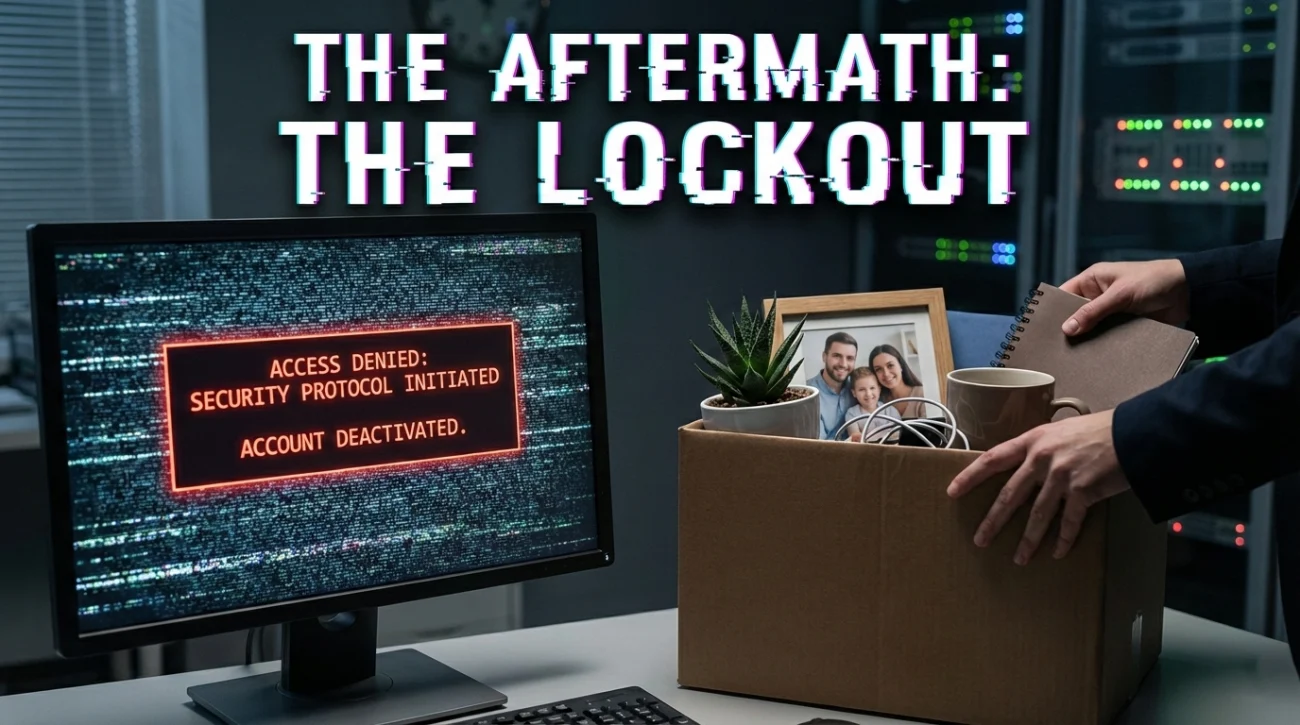
The “Lockout”
In many companies, resignation without notice triggers an immediate IT lockout. Your email will stop working, your Slack access will be cut, and your badge will be deactivated – often within minutes. Before you send your letter, ensure you have:
- 💾 Downloaded your pay stubs and tax forms (W2s).
- 📱 Deleted personal data from your work phone/laptop.
- 📒 Copied the contact info of colleagues you want to keep in touch with (do this discreetly).
The Final Paycheck Battle
Federal law requires you be paid for time worked, regardless of how you left. However, the timing varies by state. Some states require immediate payment (within 24 hours), while others allow the company to wait until the next regular payday. Do not panic if you don’t get a check the same day, but do send a follow-up email to HR from your personal address asking for the specific payout date and details on COBRA benefits.
For more detailed guidance on navigating the complexities of leaving a job, including standard protocols that you might be bypassing, refer to our comprehensive pillar on resignation letter with notice period.
Damage Control: Explaining the Gap Later
The hardest part of an immediate resignation isn’t leaving; it’s explaining it in your next interview. “Why did you leave your last job so suddenly?” is a guaranteed question.
The Strategy: Pivot to the Personal, then Back to Professional.
Do not badmouth the old company. Say: “I had to leave to attend to an urgent family/personal matter that required my full attention. That issue is now fully resolved, and I am ready to commit 100% to a new role.” Most recruiters will respect the boundary of “personal matter” and move on.
❓ FAQ
⚖️ Can my employer sue me for quitting immediately?
In most “at-will” employment states in the US, no, they generally cannot sue you just for quitting. You have the right to leave. However, if you are under a specific contract (not just an offer letter) that mandates notice, you could be in breach. Also, if your sudden departure causes specific, provable financial damage (tortious interference), the risk increases. Always read your contract.
💸 Will I lose my unemployment benefits if I quit without notice?
Generally, yes. Resigning voluntarily (with or without notice) typically disqualifies you from unemployment benefits, which are reserved for people who lose their jobs through no fault of their own (layoffs). However, if you can prove “constructive discharge” – that is, the working conditions were so intolerable or illegal that a reasonable person had to quit – you might have a case. This is hard to prove.
🤐 Should I explain why I’m leaving in the letter?
Keep it vague and high-level. “Personal reasons,” “Health reasons,” or “Family emergency” are sufficient. Anything you write in that letter goes into your permanent personnel file and could be used against you legally if you over-explain. Save the details for a verbal conversation if you trust your manager, but never put emotional rants in writing.
📞 Can I use them as a reference later?
It is risky. The official company reference will likely only confirm dates of employment. However, if you had a good relationship with a specific colleague or manager before the crisis, ask them for a personal reference rather than an official company one. Ask them: “I know I left suddenly, but can you speak to the quality of my work while I was there?”
Final Thoughts
Pulling the ripcord on your job with an immediate resignation letter is a drastic measure for drastic times. It is the emergency exit, not the front door. Use it only when you must.
If you find yourself in this position, forgive yourself. Your health, safety, and family are more important than any job title or quarterly deadline. Write the letter with professional detachment, send it, and then focus on resolving the crisis that made it necessary. Careers are long; they can survive a sudden stop. What matters most is that you survive the situation that caused it.
⚠️ Legal Disclaimer: ResignSmartly provides general informational guidance about resignation, workplace communication, notice periods, handovers, and career transitions. Content does not constitute individualized legal advice. Employment laws, contracts, workplace policies, and individual circumstances vary, so review the requirements that apply to your situation and consult an appropriate qualified professional when needed.