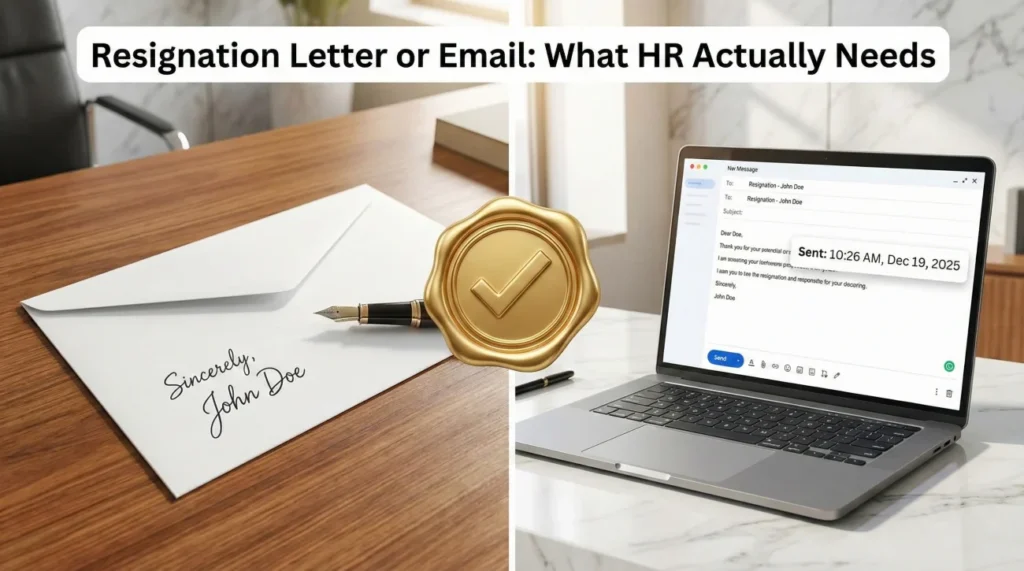
- Real question: What creates a clean, timestamped record, not whether you choose paper or email.
- What makes it official: Clear resignation statement, exact last working day, correct recipient, and your name and role.
- When paper still matters: Formal or policy-heavy workplaces, contract requirements, or when you want extra clarity, but paper alone needs traceable delivery.
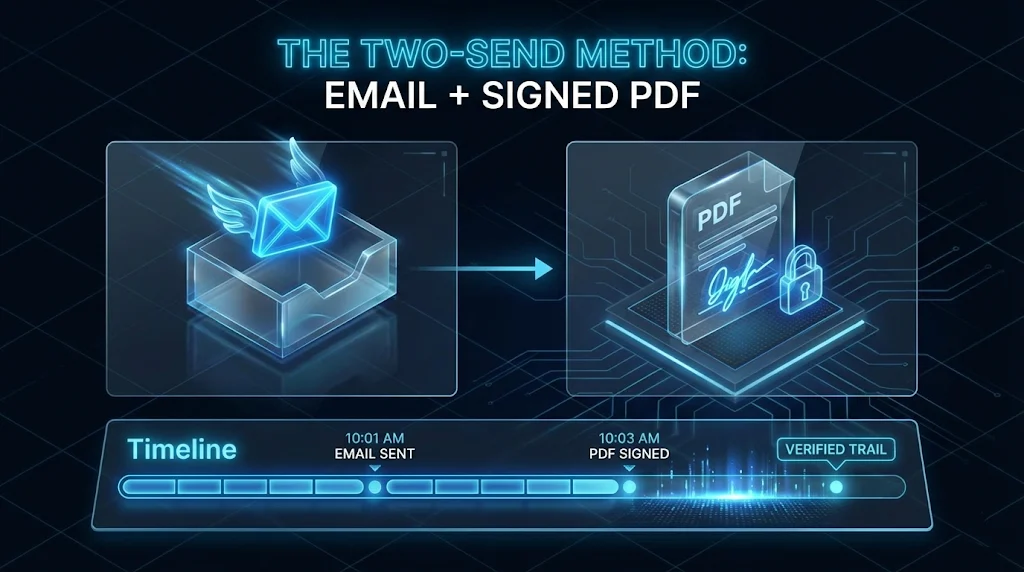
- Best default: Use the two-send method, email for the timestamp and a signed PDF letter for formality.
- What makes exits messy: Vague last day, oversharing reasons, sending to the wrong inbox, or offering zero transition support.
The Real Question Is Not “Paper or Email,” It’s “What Creates a Clean Record?”
If you’re stuck between a resignation letter or email, you’re usually trying to protect two things at once: your relationships and your paper trail. You want to leave without drama, but you also want something that’s clear, time-stamped, and hard to argue with later.
Most resignation problems don’t come from the format. They come from vagueness. “I think I’m leaving soon.” “I’m considering resigning.” “Let’s talk about my future.” None of those are a clean signal to HR. A clean signal is simple: you are resigning, your last working day is X, and you’re willing to support a transition.
This guide helps you choose the right channel for your situation, explains when paper still matters, and gives you templates you can copy without overthinking.
What HR Actually Needs to Treat Your Resignation as “Received”
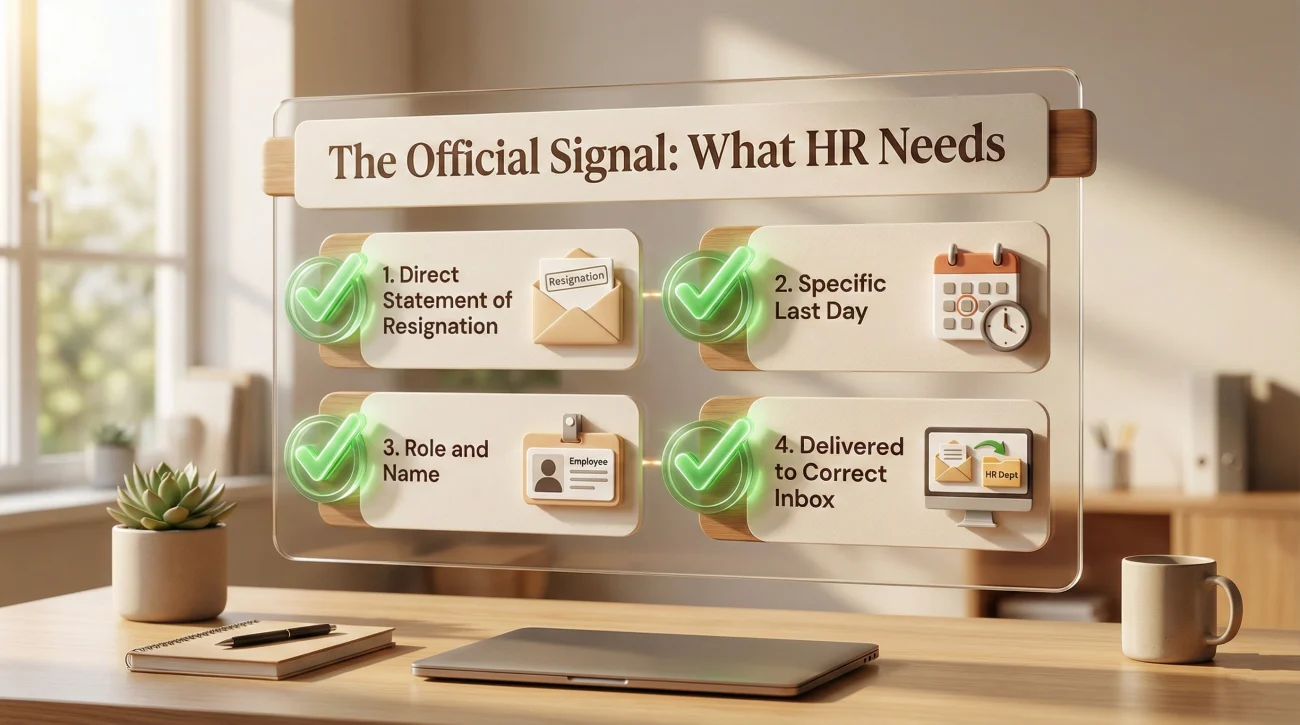
Think like HR for a second. They’re not judging your writing style. They’re trying to process an employment change with minimal confusion. To do that, they need a record that is clear enough to trigger offboarding steps without guesswork.
The minimum elements that make it official in practice
- ✅ A direct statement that you are resigning.
- ✅ Your last working day (specific date).
- ✅ Your name and role (so it can be filed correctly).
- ✅ Delivery to the right person or inbox (manager and/or HR, depending on your policy).
So, is email “valid”?
The question is email resignation legal depends on your country, contract language, and workplace policy, but there’s a practical reality most employees care about: if your company routinely accepts email resignations, then email is often treated as a valid written notice inside their HR systems.
Where people get burned is assuming “I told my manager verbally” counts as a documented resignation. Verbal notice can be respectful, but it’s not always traceable. If you want a clean record, you still send something in writing.
When a Hard Copy Letter Still Matters
A hard copy resignation letter isn’t outdated by default. It’s just situational. There are environments where paper (or a signed PDF) reduces risk because it matches how the organization expects official documentation.
Situations where paper can be the safer move
- You work in a highly formal environment where signed documents are standard (government, regulated industries, strict corporate policy).
- Your contract or employee handbook explicitly says a letter is required.
- You’ve had communication issues in the past and want extra clarity that your notice was delivered.
- Your manager is disorganized and you don’t trust “we talked about it” to survive the next week.
The downside of paper-only
Paper by itself can fail if it’s not traceable. Handing someone a letter in a hallway feels official, but it can also disappear into a desk drawer. If you want paper, pair it with a written follow-up that creates a timestamped trail.
A Simple Decision Rule: Choose the Channel That Creates the Cleanest Trail
If you’re still unsure, don’t overthink “politeness.” Choose the method that produces the cleanest, lowest-friction record in your environment.
| Situation | Paper (or signed PDF) | |
|---|---|---|
| Fastest way to create a timestamp | ✅ Strong | ⚠️ Depends on delivery method |
| Your workplace is formal/document-heavy | ⚠️ Sometimes accepted | ✅ Often preferred |
| You want proof it was received | ✅ Sent time + thread history | ✅ If acknowledged or followed by email |
| You expect pushback or confusion | ✅ Clear trail if sent to the right people | ✅ Useful signal, but still follow up |
The “two-send” best practice that covers almost every scenario
If you want the safest option without turning it into a big performance, do this: send an email that states your resignation and last day, and attach a signed letter as a PDF. The email creates the timestamp. The PDF satisfies formality. Together, they remove ambiguity.
Templates: One Email, One Letter, Both Clean and Easy to Process
Below are two templates designed for clarity. They follow a simple standard: direct intent, clear date, calm tone, and a transition offer that doesn’t overpromise. If you want a broader format you can adapt quickly, you can also use this template.
Template 1: Resignation email (clean, timestamped record)
Subject: Resignation Notice
Hi [Manager Name],
Please accept this email as formal notice of my resignation from my role as [Job Title]. My last working day will be [Day, Month Date].
Between now and then, I will document current responsibilities and support a smooth handover.
Thank you,
[Your Name]
Template 2: Formal resignation letter (paper or signed PDF)
[Your Name]
[Your Address]
[City, State ZIP]
[Date]
[Recipient Name]
[Title]
[Company]
Dear [Recipient Name],
Please accept this letter as formal notice of my resignation from my position as [Job Title]. My last working day will be [Day, Month Date].
I appreciate the opportunity to work with the team. I will support a smooth transition by documenting key responsibilities and assisting with the handover process before my departure.
Sincerely,
[Your Signature]
[Your Name]
If you want a simple structure for what to say and what not to say in the message, use this guide as your checklist.
Mistakes That Make Resignations Messy (No Matter the Format)

Most people don’t regret choosing email over paper. They regret choosing words that create room for debate. If you want clean, you follow basic resignation etiquette: clarity, professionalism, and minimal emotional content in the official record.
Mistake 1: Being vague about your last day
“Two weeks from now” sounds clear until someone argues about what “two weeks” means. Use a date. Always.
Mistake 2: Oversharing your reason
If you want to share your reason, keep it neutral. The resignation record is not the place to explain your entire life story or litigate workplace issues.
Mistake 3: Sending it to the wrong person
Some companies want HR copied. Some want manager first. If you’re unsure, send to your manager and copy HR. The goal is that the resignation lands where it can be processed, not where it can be ignored.
Mistake 4: Offering zero transition support
You don’t need to promise heroics, but one sentence that you will document your work and support a handover makes your exit harder to criticize.
❓ FAQ
📧 Is an email resignation enough, or do I need a signed letter?
If your workplace accepts written notice by email, email is often enough in practice. If your environment is formal or policy-heavy, attaching a signed letter as a PDF is a safe way to cover both expectations.
🗓️ What is the one detail that makes a resignation “official”?
A clear statement that you are resigning and an exact last working day. Without a date, you leave room for confusion and unnecessary back-and-forth.
🧾 When does a hard copy resignation letter make the most sense?
A hard copy resignation letter makes sense in formal workplaces, when policy requires it, or when you want extra clarity for your personnel file. Pair it with an email follow-up to create a timestamped trail.
📨 Should I resign verbally first, then send the email?
Yes, if you have a workable relationship with your manager. A short conversation is respectful, and the written message creates the record. The order should be talk first, then document.
✅ What tone should I use if I want to leave on good terms?
Keep it calm and procedural. State the resignation, state the date, offer a transition plan, and avoid emotional detail. That style protects you and keeps doors open.
Final Thoughts
A clean resignation is not about being fancy. It’s about being unambiguous. Email creates a fast, traceable record. Paper can add formality when your environment expects it. The best move for most people is the two-send method: a clear email with a signed letter attached.
When you treat resignation letter or email as a “record-creating decision” instead of a style debate, the choice becomes easy. Pick the format that HR can process cleanly, and keep your message short enough that nobody can twist it later.
⚠️ Legal Disclaimer: ResignSmartly provides general informational guidance about resignation, workplace communication, notice periods, handovers, and career transitions. Content does not constitute individualized legal advice. Employment laws, contracts, workplace policies, and individual circumstances vary, so review the requirements that apply to your situation and consult an appropriate qualified professional when needed.