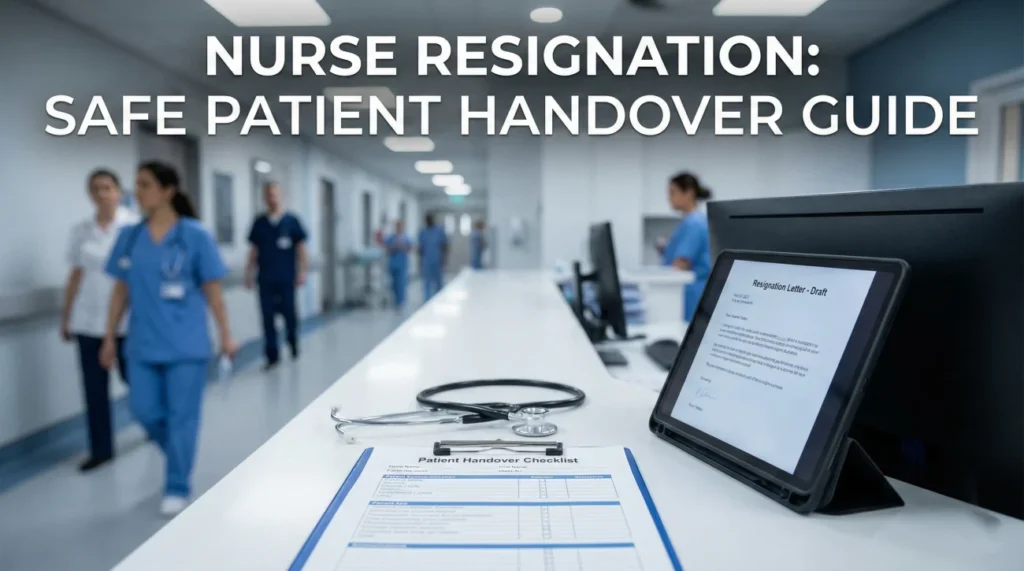
- Higher Stakes: Nursing resignations are patient-safety transitions, so your email must protect continuity of care and your license.
- Abandonment Line: Resigning with notice is not abandonment, but leaving a shift or breaking assignments without proper handoff can trigger board risk.
- Notice Reality: Two weeks is often too short in healthcare, common guidance is longer based on role and scheduling cycles.
- Burnout Framing: Use a “Safety and Standards” narrative that prioritizes health without accusing the unit or management.
- Exit Protocol: Work remaining shifts, close charts, resolve med counts, and leave a thorough handover so your last weeks define you well.
The Stakes of Stepping Away from the Bedside
Drafting a nurse resignation email is fundamentally different from leaving a corporate desk job. In most industries, a resignation is an administrative inconvenience; in healthcare, it is a clinical transition that directly impacts human lives. You are not just handing over a keycard; you are handing over the continuity of care for vulnerable patients, the stability of a unit shift, and the license you worked years to earn.
The decision to send a nursing resignation email is often fraught with what we call “caregiver guilt” – the fear that your departure will burden your already exhausted colleagues or compromise patient safety. This emotional weight is compounded by the rigorous legal and ethical standards of the profession. A poorly handled exit can trigger accusations of “patient abandonment,” jeopardize your standing with the State Board of Nursing, and burn bridges in a healthcare community that is surprisingly small.
This comprehensive guide is designed to protect your license and your legacy. Whether you are drafting a standard hospital resignation email to advance your career, or you need to send a difficult rn resignation email due to severe burnout, we will provide the protocols, legal safeguards, and compassionate scripts you need to resign with professional integrity.
Why Healthcare Resignations Are Legally and Ethically Distinct
Before you draft your letter, it is critical to understand the unique ecosystem of healthcare employment. Resigning as a nurse involves navigating a minefield of scheduling logistics, patient safety ethics, and licensure laws.
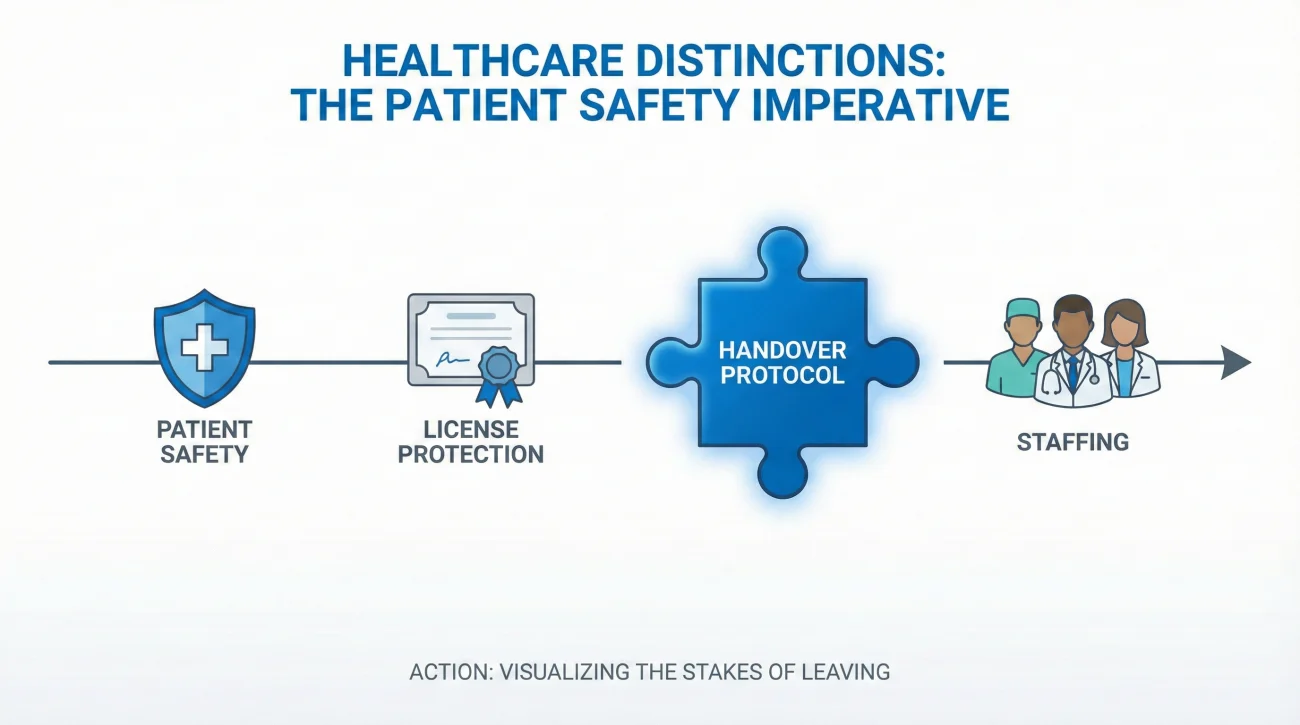
The Patient Safety Imperative
In other jobs, an unfinished project can be paused. In nursing, care is continuous (24/7/365). Your departure creates a “care gap.” If not managed with a proper handover protocol, this gap can lead to medication errors, missed treatments, or loss of critical patient history. Your resignation email to nurse manager leadership must explicitly address how you intend to bridge this gap during your notice period.
The Threat of “Patient Abandonment”
This is the most terrifying phrase in nursing. Legally, patient abandonment occurs when a nurse accepts a patient assignment and then severs the nurse-patient relationship without reasonable notice to the appropriate person, leaving the patient without nursing care.
Crucial Distinction: Resigning with proper notice is not abandonment. However, walking off a shift, refusing to show up for a scheduled shift without notice, or leaving before your relief arrives is considered abandonment in many jurisdictions and can result in serious disciplinary action, up to and including license suspension or revocation, depending on your state.
The “Staffing Crisis” Factor
With the chronic nursing shortage, you likely know your unit is already understaffed. Management may try to weaponize this guilt to keep you (“How can you leave the team like this?”). It is vital to remember: Staffing is an administrative responsibility, not a martyr’s burden. You are responsible for your assigned shift, not for solving the systemic nursing shortage.
Strategic Timing: How Much Notice is Enough?
The “two-week notice” standard is often insufficient in clinical settings due to the complexity of scheduling and the difficulty of finding qualified replacements. Here is the industry breakdown for proper notice.
| Role / Position | Recommended Notice | Reasoning |
|---|---|---|
| Staff Nurse (RN/LPN/CNA) | 3–4 Weeks | Schedules are often posted in 4-6 week blocks. Giving 3+ weeks allows the manager to adjust the next schedule without scrambling to fill holes in the current one. |
| Nurse Manager / Charge Nurse | 4–6 Weeks | Leadership roles require a longer handover to transfer administrative duties, audits, and personnel management. |
| Nurse Practitioner / APRN | 60–90 Days | Provider contracts often mandate long notice periods to ensure patients can be transferred to new providers without gap in care. |
| Travel Nurse | Check Contract | Usually governed strictly by the agency contract (often 14 days). Breaking a travel contract early can result in “Do Not Rehire” status across large hospital systems. |
| Per Diem / PRN | 2 Weeks | Since you are not counted in core staffing ratios, standard notice is usually acceptable. |
Resigning Due to Burnout: The “Safety” Argument

One of the most common reasons for sending a healthcare resignation email today is burnout. However, nurses often struggle to articulate this professionally.
The Wrong Way: “I am quitting because this unit is toxic, the ratios are unsafe, and I am exhausted.” (This burns bridges and puts management on the defensive).
The Professional Way: Frame your resignation as a “Safety and Standards” decision. Use the concept of Safe Harbor logic. You are resigning because you recognize that your current state of health prevents you from practicing at the level of excellence your license requires.
“After careful reflection, I have decided to step away to prioritize my health. This decision is necessary to ensure I can sustain the level of focus and compassion that patients deserve.”
Master Templates: Nurse Resignation Scenarios
Below are field-tested templates designed to protect your license and professional relationships. Customize the bracketed details to fit your specific situation.
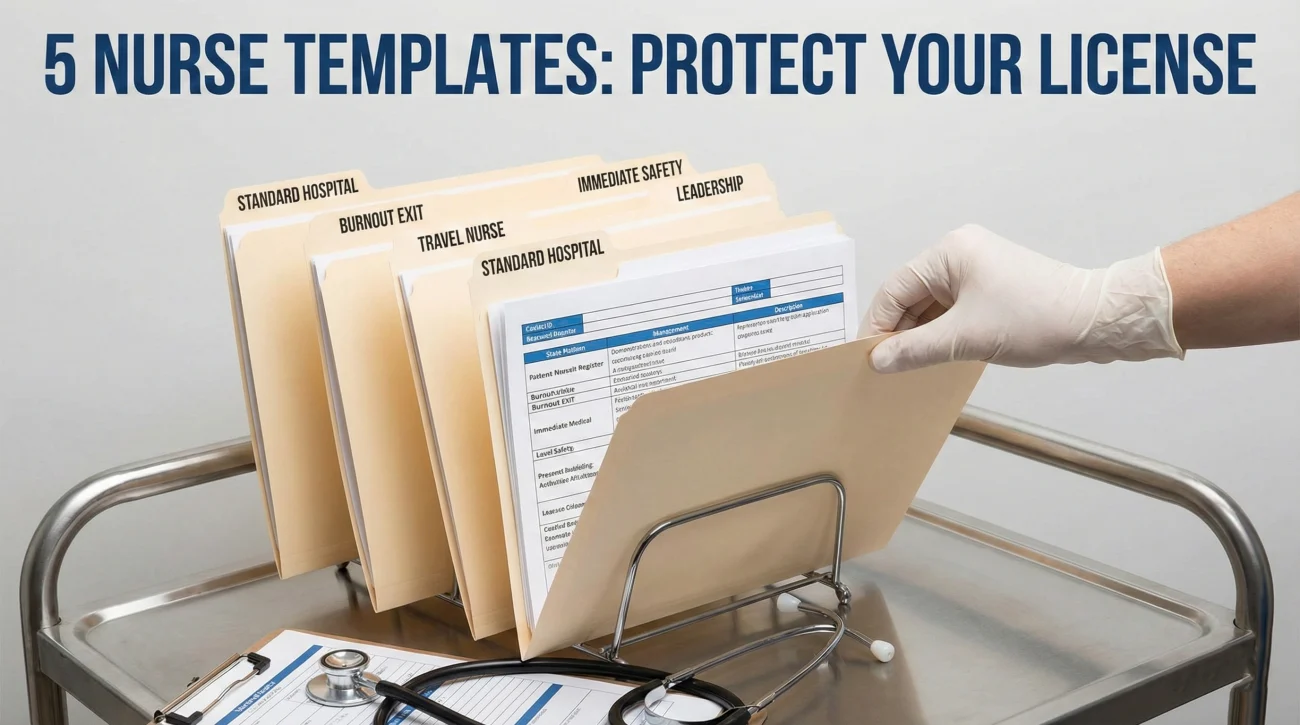
Scenario 1: The Standard Hospital Departure
Use this hospital resignation email when you are leaving on good terms for a new job, relocation, or school. It focuses on continuity and gratitude.
Subject: Resignation Notice – [Your Name], RN – [Unit Name]
Dear [Manager Name],
Please accept this letter as formal notification that I am resigning from my position as a Registered Nurse on the [Unit Name/Floor], effective [Date]. My final scheduled shift will be [Date/Shift, e.g., Night Shift on May 20th].
I have accepted a position at another facility that aligns with my long-term career goals in [Specialty/Education]. This was not an easy decision, as I have truly valued the teamwork and clinical experience I have gained here at [Hospital Name].
I am committed to ensuring a smooth transition during my final [Number] weeks. I plan to:
- Work all my remaining scheduled shifts.
- Ensure all my charting and care plan audits are up to date.
- Assist in orienting [New Nurse Name] to my charge nurse duties (if applicable).
Thank you for your leadership and for the opportunity to care for our community alongside such a dedicated team.
Respectfully,
[Your Name], RN, BSN
[Employee ID if required]
Scenario 2: The “Burnout” Exit (Preserving Relationships)
Use this nursing resignation email when you need to leave for your mental or physical health. It is firm but professional, avoiding accusations.
Subject: Resignation – [Your Name], RN
Dear [Manager Name],
I am writing to submit my resignation from my position as [Title] in the [Unit Name], effective [Date].
After considerable reflection regarding my professional path and personal well-being, I have decided it is time for me to step away from bedside nursing in this capacity. This decision is made with the intention of prioritizing my health so that I can continue to serve the nursing profession sustainably in the long term.
I want to express my gratitude for the skills I have refined during my time here. I care deeply about this unit and my colleagues, and I will do everything possible during my notice period to support them, including ensuring all my patient handovers are thorough.
Thank you for your understanding and support.
Sincerely,
[Your Name], RN
Scenario 3: The Travel Nurse (Contract Completion or Early End)
Travel nursing is contract-based. Use this to formalize the end of an assignment or, if necessary, to give notice of early termination.
Subject: Assignment Update – [Your Name] – Traveler
Dear [Manager Name] and [Agency Recruiter Name],
I am writing to confirm that I will be completing my current travel assignment at [Hospital Name] on [Contract End Date] and will not be renewing for an extension.
[OR Use this paragraph if ending early]:
I am writing to provide formal notice that I must terminate my contract early due to [unforeseen personal circumstances]. My last shift will be [Date], satisfying the [Number]-week notice period required by my contract.
I have enjoyed my time in [City] and appreciate how welcoming the staff on [Unit] has been to me as a traveler. I will ensure my remaining shifts are completed with the same dedication to patient care as day one.
Thank you for the opportunity.
Best regards,
[Your Name], RN
Scenario 4: The Immediate Exit (Emergency Only)
⚠️ Warning: Only use this in true emergencies (severe illness, family crisis, unsafe conditions). It risks a “Do Not Rehire” status but protects you from abandonment charges if you communicate clearly.
Subject: Urgent: Immediate Resignation – [Your Name], RN
Dear [Manager Name],
Please accept this letter as notification of my immediate resignation from my position as [Title], effective today, [Date].
Due to an urgent and unforeseen [medical/personal] emergency, I am unable to fulfill the standard notice period or work my remaining scheduled shifts. I understand the strain this places on the unit and schedule, and I sincerely apologize for this unavoidable disruption.
I have completed all documentation for my current assignment and have handed over all patient care responsibilities to [Charge Nurse Name/Relief Nurse].
Thank you for the opportunity to work at [Facility Name].
Sincerely,
[Your Name], RN
Scenario 5: Resigning from Leadership (Nurse Manager/Director)
A resignation email to nurse manager peers or directors requires a focus on administrative continuity.
Subject: Resignation – [Your Name] – [Unit] Manager
Dear [Director Name],
I am writing to formally resign from my position as Nurse Manager of [Unit], effective [Date, typically 4 weeks out].
I have accepted a new opportunity that allows me to [reason: focus on clinical education/relocate closer to family]. I am incredibly proud of what our team has achieved over the past [Time], specifically [mention one metric: improving patient satisfaction scores/reducing falls].
To ensure a seamless transition for the unit, I have prepared a transition plan which includes:
- Status of all current hiring and disciplinary files.
- Upcoming budget review documents.
- A schedule of 1:1 handoffs with the Interim Manager.
I am committed to leaving the unit in a strong position.
Respectfully,
[Your Name], MSN, RN
The “Golden Handover” Protocol
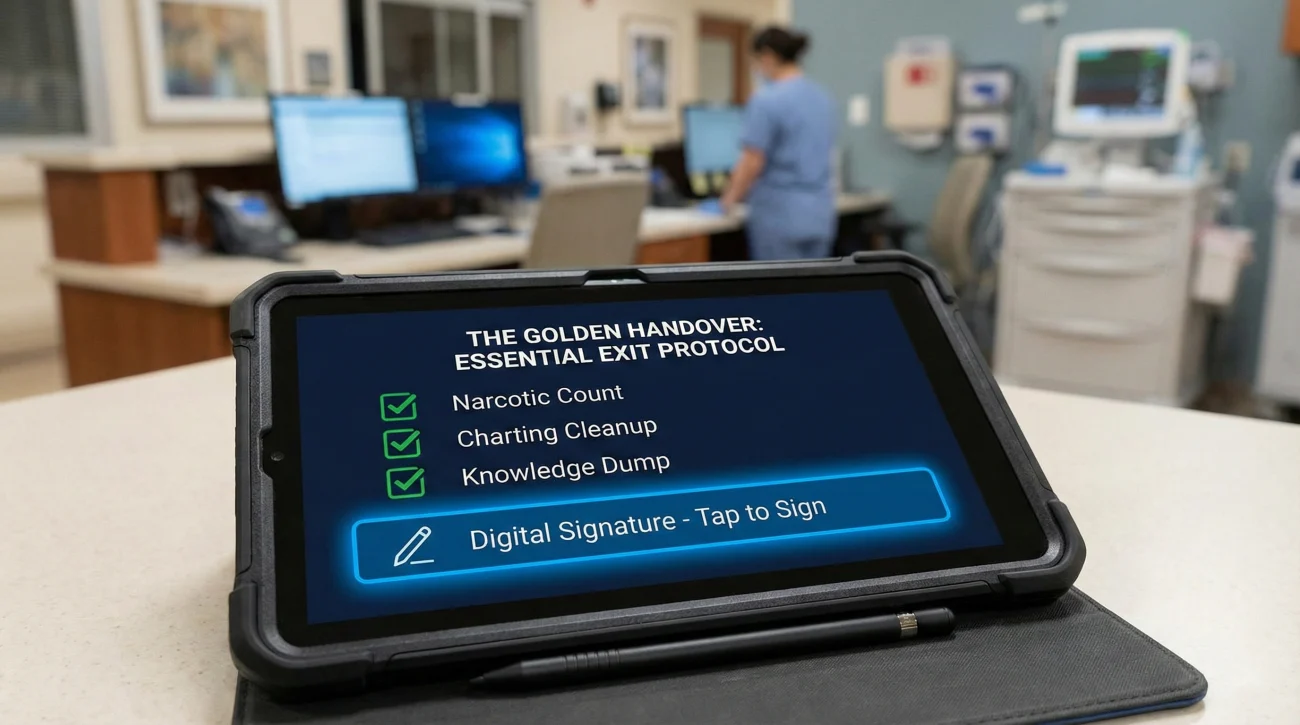
Your legacy as a nurse is defined by how you leave your patients. To protect your license and your colleagues, follow this handover checklist during your final weeks.
- 💊 Narcotic Diversion Check: Ensure all your pyxis/medication counts are resolved. Do not leave with any open discrepancies.
- 📝 Charting Cleanup: Close all open charts. Unsigned notes are a legal liability for you and the hospital.
- 🤝 The “Knowledge Dump”: If you are a specialized nurse (e.g., wound care, dialysis), write a “Cheat Sheet” for your replacement regarding specific patient quirks or doctor preferences.
- 📅 Schedule Integrity: Do not call in sick during your notice period unless you are contagious. “Sick-calling” your notice is seen as unprofessional and burns bridges instantly.
❓ FAQ: Nursing Resignation & Licensure
⚖️ Can I be reported to the Board of Nursing for quitting without notice?
🏥 My manager refused my resignation. Can they do that?
😰 I am a new grad nurse quitting my residency early. Do I have to pay back my bonus?
📄 Should I mention “unsafe staffing” in my resignation letter?
💉 What happens to my benefits (Health Insurance) when I resign?
Final Thoughts
Resigning from a nursing position is a heavy decision, often accompanied by guilt and relief in equal measure. But remember: You are a human being first, and a nurse second. Protecting your physical and mental health is not a violation of your oath; it is the prerequisite for fulfilling it.
By using these nurse resignation email templates and following the proper notice protocols, you ensure that your exit is safe, legal, and professional. You protect your hard-earned license and leave the door open for future opportunities in the vast world of healthcare.
For more specific templates on leaving jobs, check our guide on resignation email examples or read our detailed breakdown on how to write a resignation email. For other career transition advice, visit the homepage.
⚠️ Legal Disclaimer: ResignSmartly provides general informational guidance about resignation, workplace communication, notice periods, handovers, and career transitions. Content does not constitute individualized legal advice. Employment laws, contracts, workplace policies, and individual circumstances vary, so review the requirements that apply to your situation and consult an appropriate qualified professional when needed.