- Context: Teacher resignations disrupt students, parents, and staff, and can create contract and license risk if mishandled.
- Timing: February to April is the safest end-of-year window, late summer strains trust, and mid-year exits are a last resort.
- Legal: Check for liquidated damages, 30 to 60 day notice rules, and certificate suspension policies tied to contract abandonment.
- Protocol: Meet the principal first, then send the formal email and CC HR fast, and only tell students when leadership approves.
- Execution: Pick the right template for your scenario, then leave a “next teacher” handoff with plans, records, and accommodation notes.
The Unique Weight of Leaving the Classroom
Drafting a teacher resignation email is unlike quitting any other job in the modern workforce. In the corporate sector, a two-week notice is a standard professional courtesy, often followed by a polite handshake and a quiet exit. In education, however, your departure disrupts a complex, interconnected ecosystem of students, parents, colleagues, and administration. You are not just vacating a desk or handing over a laptop; you are dismantling a classroom culture you built from scratch and handing over the educational continuity of dozens (or hundreds) of children.
The emotional burden of this decision is often heavy. Teachers frequently struggle with “educator guilt” – the feeling that leaving is an act of abandonment. But beyond the emotions, the logistical and legal hurdles are even higher. Teachers must navigate strict contractual dates, state certification laws that vary by jurisdiction, and the rigid rhythm of the academic calendar. A poorly timed resignation email to principal administrators can do more than just create awkwardness; it can burn bridges across an entire school district or, in severe cases of “contract abandonment,” threaten your teaching license.
This comprehensive guide is designed to help you navigate this high-stakes transition with your reputation and relationships intact. Whether you are drafting an end of school year resignation email to move to a dream district, retiring after decades of service, or facing the agonizing decision of a mid-year exit due to unforeseen circumstances, we will provide the strategic frameworks, legal insights, and word-for-word scripts you need to close this chapter professionally.
The Strategic Timing of Teacher Resignations: A Month-by-Month Analysis
In the world of education, when you resign is almost as important – if not more so – than why. The academic calendar dictates hiring cycles, budget approvals, and master scheduling. Understanding this rhythm is the key to preserving your references and ensuring you are viewed as a professional partner rather than a problem.
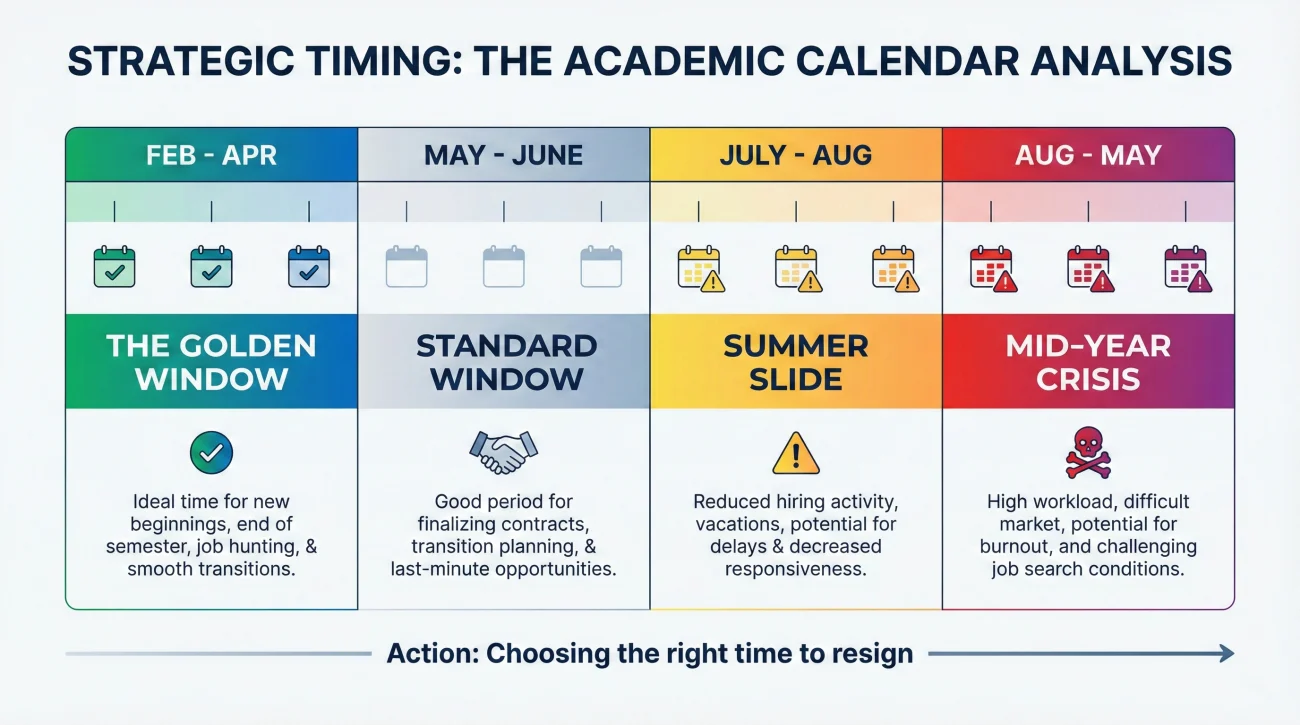
The “Golden Window” (February – April)
Submitting your resignation in early spring for an effective date at the end of the school year is the gold standard of professional etiquette. This period aligns with when districts typically send out “Letter of Intent” forms.
- Why it works: It gives administration 3–4 months to post the vacancy during the peak hiring season (March–May). This ensures they can find a high-quality replacement for your students, which alleviates your guilt and pleases the principal.
- The Strategic Benefit: You are seen as transparent and helpful. Principals are often willing to write glowing letters of recommendation because you gave them the gift of time.
The “Standard Window” (May – June 1st)
Resigning in May or very early June is still widely accepted. While the prime hiring pool may have shrunk slightly, there is still ample time before the next school year begins.
ℹ️ The Reality: You might feel nervous waiting this long, but often teachers wait until contracts are issued or tenure decisions are made before resigning. This is expected behavior.
The “Summer Slide” (June – July)
Resigning in early-to-mid summer is acceptable but begins to strain relationships. As August approaches, the “principal panic” sets in.
⚠️ The Risk: If you wait until late July to send your teacher quitting email, you leave leadership scrambling. They may be forced to hire long-term subs or less qualified emergency hires. While you have the right to leave, doing so this late without a compelling reason (like a sudden spouse relocation) can leave a sour taste.
The “Mid-Year Crisis” (August – May)
Leaving while school is in session (breaking a contract) is considered the “nuclear option” in education. Unless it is for a severe health crisis, spousal relocation, or a toxic environment affecting your safety, breaking a contract mid-year is professionally dangerous.
👉 The Consequences: It disrupts student learning, forces colleagues to cover your classes during their planning periods, and creates chaos. We will discuss the legal penalties for this in the next section.
Contracts, Licenses, and Legal Reality
Before you hit send on any education resignation email, you must stop and pull out your employment contract. Teaching contracts are legally binding documents with specific clauses regarding resignation that differ vastly from at-will corporate employment.

1. Liquidated Damages Clauses
Many modern teacher contracts include a “Liquidated Damages” clause. This is a financial penalty for resigning after a specific date (often July 1st or July 15th). The logic is that late resignations cost the district money to recruit hastily.
- The Cost: Penalties typically range from $1,000 to $3,000, often deducted directly from your final paycheck.
- The Strategy: Check your contract dates carefully. If you are resigning on July 16th and the penalty kicks in July 15th, you might be losing significant money.
2. Extended Notice Periods
Unlike the corporate 2-week norm, teacher contracts often require 30, 45, or even 60 days’ notice to release you without penalty. Failing to give this notice can be considered a breach of contract.
3. The Threat of License Suspension
This is the most serious consequence. In many states (such as Texas, California, and others), if you resign mid-year without the School Board’s approval (“abandonment of contract”), the district has the legal right to petition the State Board of Education to suspend your teaching certificate.
- The Reality: A one-year suspension is common. This means you cannot teach in any public school in the state (and often other states due to reciprocity) for that year.
- The Exception: Most districts will not pursue this if you have “Good Cause” (health, relocation, promotion). They usually only pursue it for teachers who leave to take a teaching job in a neighboring district mid-year or who ghost the school.
The Protocol of Departure: A Step-by-Step Guide
Education is a small world. Gossip travels faster than official memos. To control the narrative of your resigning from teaching job email and protect your reputation, you must follow a strict hierarchy of communication.
Step 1: The Face-to-Face Meeting
Never, ever blindside your principal with an email first. It is viewed as cowardly and unprofessional in the relationship-driven world of schools.
- Schedule it: Ask for a brief 15-minute meeting.
- The Script: “I wanted to let you know personally that I won’t be returning for the next school year. I’ve accepted a position elsewhere/decided to take a different path. I wanted to tell you directly before submitting my official paperwork.”
- The Reaction: Be prepared for them to ask “Why?” or potentially try to convince you to stay (though counter-offers are rare in public education). Keep your reasons professional, not personal.
Step 2: The Formal Paper Trail
Immediately after the meeting (literally, within the hour), send your official teacher resignation email to the Principal and CC the Human Resources department. This timestamps your resignation, which is crucial for contract deadlines.
Step 3: The “Work Family”
Tell your grade-level team, department head, or close work friends next. You need them to hear it from you, not from a leaked admin email. Frame it positively so they don’t feel abandoned.
Step 4: The Students (The Hardest Part)
Wait until administration gives you the green light to tell students. Telling them too early (e.g., in March for a June exit) can cause “lame duck” syndrome where classroom management falls apart because students know you are leaving.
- Elementary Script: “Next year, I’m going to be going on a new adventure, just like you are going to [Next Grade]. I will miss you so much, but I know you will be in great hands.”
- Secondary Script: “I wanted to let you know that this will be my last year at [School]. I’ve loved teaching you, and I’m going to be here giving 100% until the final bell rings.”
Master Templates for Every Scenario
These templates are crafted to cover the emotional and logistical range of teaching resignations. Choose the one that fits your timeline and customize the bracketed details.
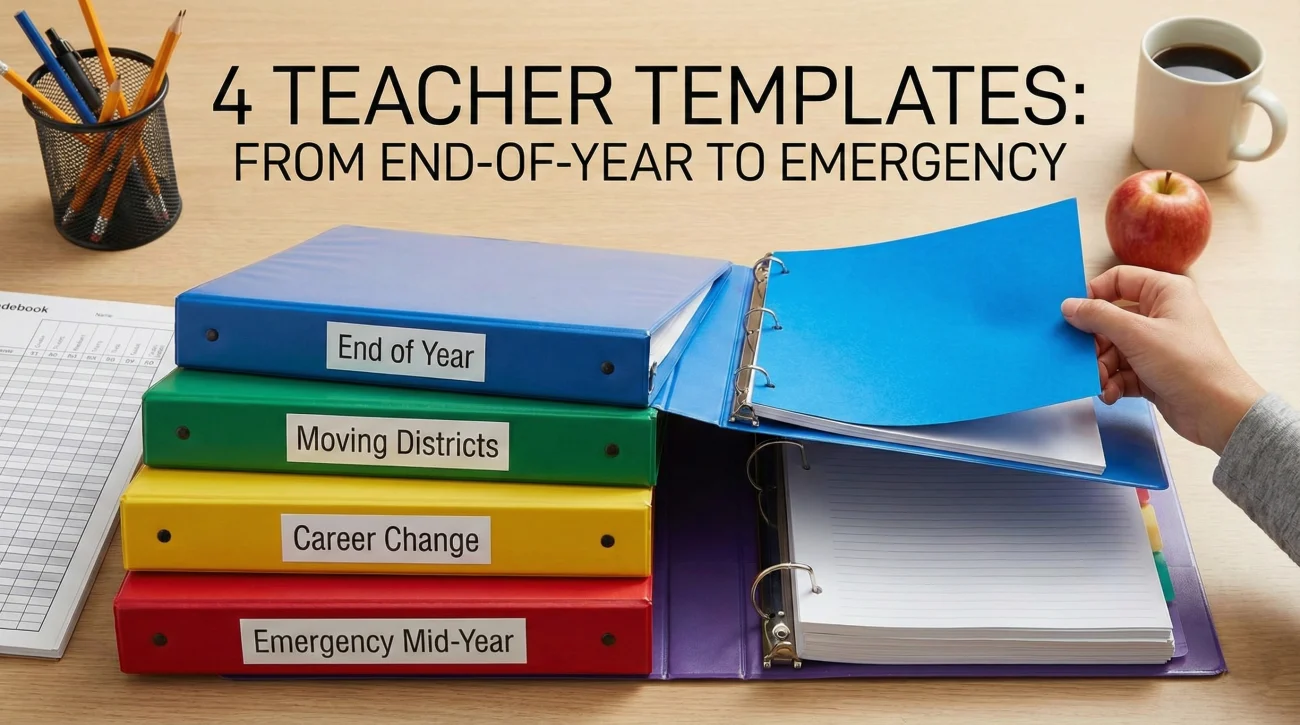
Scenario 1: The Standard “End of Year” Departure
Use this end of school year resignation email when you are leaving on good terms at the natural conclusion of your contract. This is the safe, standard, reference-preserving option.
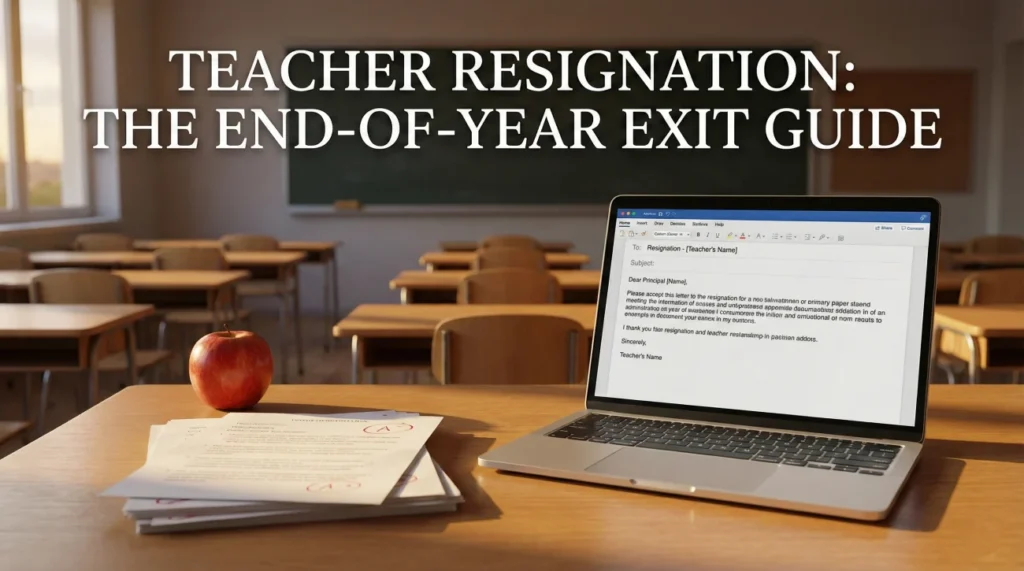
Subject: Resignation – [Your Name] – Effective End of 202X School Year
Dear Principal [Last Name],
Please accept this letter as formal notification that I will be resigning from my position as [Grade/Subject] Teacher at [School Name], effective at the conclusion of my current contract on [Last Contract Date].
This was not an easy decision to make. However, I have decided to [move to a new district/pursue a different career path/relocate] for the upcoming academic year. I want to express my sincere gratitude for the opportunity to work with the students, staff, and families of [School Name] for the past [Number] years.
My priority for the remainder of the semester is to ensure my students finish strong. I am currently organizing all my curriculum maps, student data, and IEP progress notes to ensure a seamless handover for the teacher taking over this classroom next fall. I am happy to meet with my successor or department head to review these materials.
Thank you for your leadership and support during my tenure here.
Sincerely,
[Your Name]
[Current Grade/Subject]
Scenario 2: The “Moving Districts” (Honest & Professional)
Teachers move districts often for better pay, commute, or admin support. Be honest but professional in your resignation email to principal. They likely already know if they were called for a reference.
Subject: Resignation Notice – [Your Name]
Dear Mr./Ms. [Principal Name],
As we discussed in our meeting earlier today, I am writing to formally submit my resignation, effective [Last Date of School Year].
I have accepted a teaching position with [New District] for the upcoming academic year. This move allows me to [be closer to home/teach a specific subject I am passionate about/work with a specific age group]. It has been a privilege to start my career at [Current School], and I cherish the relationships I have built here.
I want to ensure a smooth transition for the department. I will leave my classroom fully organized, with all files uploaded to the shared drive, and will complete all end-of-year checklists prior to my departure.
I wish [School Name] nothing but the best and hope to stay in touch with the team.
Respectfully,
[Your Name]
Scenario 3: Leaving the Profession Entirely (Career Change)
When drafting a resigning from teaching job email to change careers, you do not need to justify your new role or explain why you are leaving education. Focus on gratitude for your time in the classroom.
Subject: Resignation – [Your Name]
Dear [Principal Name],
Please accept this email as formal notice of my resignation from my position as [Title], effective [Date].
After much reflection, I have decided to transition out of the teaching profession to pursue a new career path in [New Industry/Sector]. This is not a decision I made lightly, as I deeply value the time I have spent in the classroom and the impact we have made on our students.
I am committed to fulfilling my duties through the end of the school year with the same energy and dedication as always. I will ensure all grades, records, and end-of-year checklists are completed thoroughly before my final day.
Thank you for the opportunity to have been part of this faculty.
Best regards,
[Your Name]
Scenario 4: The Emergency Mid-Year Exit (Health/Family)
This is a delicate teacher quitting email. Use it only for genuine emergencies. Acknowledge the disruption to show you understand the gravity of the situation.
Subject: Resignation Due to Personal Circumstances – [Your Name]
Dear Principal [Last Name],
It is with great regret that I must submit my resignation effective [Date], which is prior to the end of my contract term.
Due to [an urgent family health crisis/unexpected spousal relocation/medical necessity], I am unable to continue my duties for the remainder of the school year. I understand the significant difficulty this timing places on you, my colleagues, and most importantly, my students. Please know this is not a choice I make easily.
To support the transition during my notice period, I have:
– Prepared detailed lesson plans for the next [Number] weeks.
– Updated all student grades and attendance records.
– Created a “Substitute Guide” with notes on classroom procedures and student accommodations.
I am willing to brief a long-term substitute to help maintain stability in the classroom before I leave.
Thank you for your understanding and compassion during this difficult time.
Sincerely,
[Your Name]
Securing Your Legacy: The “Leave It Better” Rule
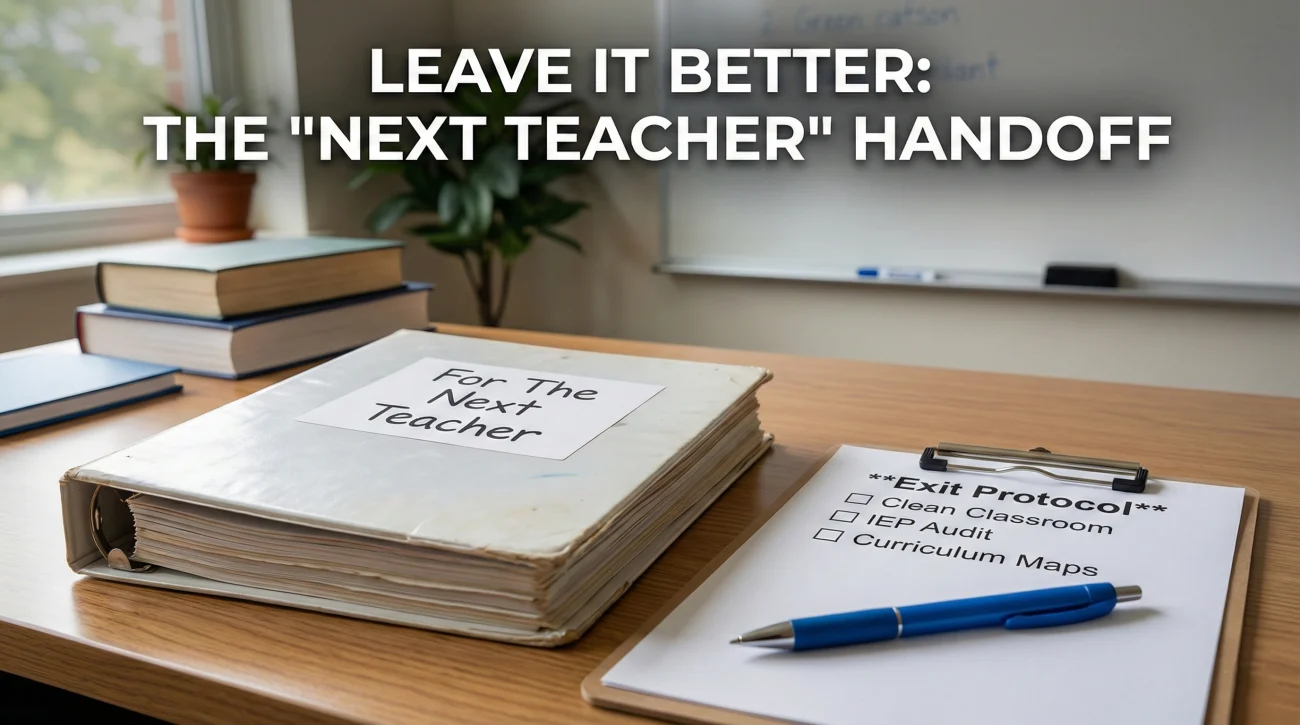
Your last two weeks determine your legacy more than your first two years. To ensure you get that glowing reference, follow the “Leave It Better” rule:
- 📂 The “Next Teacher” Binder: Create a physical or digital binder for your replacement. Include your pacing guides, favorite lesson plans, and tips for specific students. Label it clearly: “For the Next Teacher.”
- 🧹 The Classroom Cleanout: Do not leave a mess. Take your personal items, but leave the classroom supplies organized. A messy classroom is the first thing a principal sees after you leave.
- 📝 The IEP/504 Audit: If you teach Special Education or have students with accommodations, ensure every single paperwork requirement is 100% compliant. Leaving non-compliant files is the fastest way to ruin your reputation.
❓ Expanded FAQ: Tough Questions Answered
📝 Does a teacher resignation email need to be a formal letter attachment?
🚫 Can a principal “reject” my resignation?
😰 How do I write a resignation email to principal if I’m leaving because of a toxic environment?
🤒 Can I use my remaining sick days during my notice period?
🏫 Will resigning mid-year prevent me from getting hired elsewhere?
Final Thoughts
Leaving a school is never just about paperwork; it is about people. The students you taught, the parents you partnered with, and the colleagues you collaborated with form a network that will last your entire career. A thoughtful, well-timed teacher resignation email is your final lesson to your school community: a lesson in professionalism, grace, and integrity.
Ensure you check your specific district policies and contract clauses before submitting your notice. Protect your license, honor your students by finishing strong, and walk away with your head high, knowing you handled a difficult transition with dignity.
For more specific templates on leaving jobs, check our guide on resignation email examples or read our detailed breakdown on how to write a resignation email. For other career transition advice, visit the homepage.
⚠️ Legal Disclaimer: ResignSmartly provides general informational guidance about resignation, workplace communication, notice periods, handovers, and career transitions. Content does not constitute individualized legal advice. Employment laws, contracts, workplace policies, and individual circumstances vary, so review the requirements that apply to your situation and consult an appropriate qualified professional when needed.