
- Why It Matters: A professor reference can validate your potential when you do not have much work history yet.
- Who To Ask: Pick professors who actually know your work, research supervisor, seminar leader, capstone mentor, avoid “DWIC” strangers.
- How To Get A Yes: Reduce friction with a clear ask, a real deadline, and a complete briefing kit so they do not have to hunt for context.
- What To Send: Include the exact class and term, key projects, CV, transcript if relevant, target role or program, and a bullet list of traits to highlight.
- Execution Plan: Use scenario scripts (grad school, job, research, reconnect), follow a simple countdown, and handle ghostwriting requests without sounding arrogant.
For the broader post-resignation process, see our guide to resignation etiquette.
The “Academic Currency”: Why Professors Hold the Keys to Your First Career Door
Picture this: It is 11:00 PM on a Tuesday. A professor is sitting in their office, grading a stack of midterms, trying to finish a grant proposal, and preparing a lecture for the next morning. Their inbox pings. It is an email from a student whose name sounds vaguely familiar, asking for a recommendation letter due in three days.
The professor sighs. They want to help – educators generally care deeply about student success – but they have nothing to work with. No context, no resume, no memory of what grade this student got three semesters ago. The result? Either a polite “No” or a generic, lukewarm letter that says, “This student took my class and passed.”
This scenario plays out thousands of times every semester. For students and recent graduates, asking professor for a reference is often the first high-stakes professional email they ever write. It is intimidating. It feels like you are bothering a celebrity. But when executed correctly, an academic reference is powerful currency. It validates your intellectual horsepower, your work ethic, and your potential – qualities that entry-level resumes often fail to capture.
In this comprehensive guide, we are going to dismantle the anxiety around emailing faculty. We will step into the professor’s shoes to understand what makes them say “Yes” enthusiastically versus “No.” You will learn how to curate your “Briefing Kit,” time your request perfectly, and secure the kind of endorsement that opens doors to top graduate programs and top-tier internships.
The “Potential” vs. “Performance” Gap: Why Academic References Are Unique
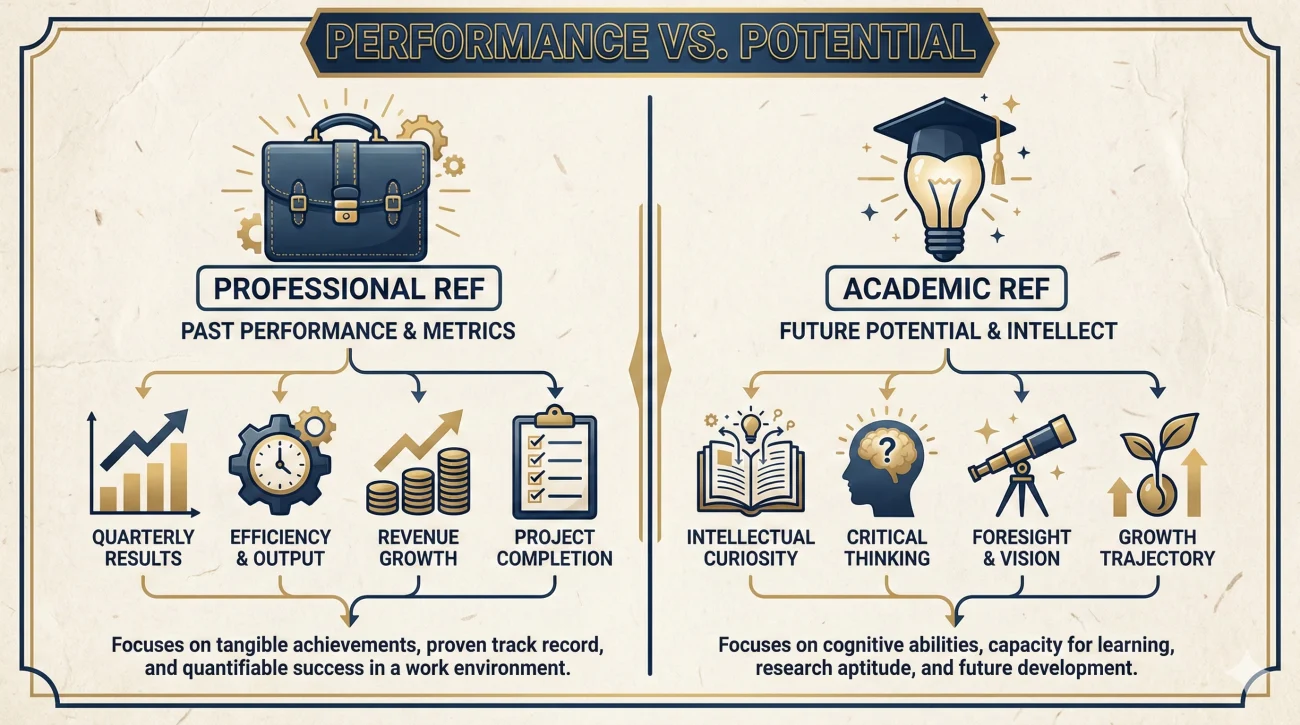
Why do employers and grad schools care so much about what your Intro to Psychology professor thinks? To the uninitiated, it seems irrelevant to a job in Marketing or Data Science.
It comes down to a fundamental difference in what references measure:
- Professional References (Bosses): They verify past performance. Did you hit your sales quota? Did you show up on time? Did you debug the code correctly?
- Academic References (Professors): They verify future potential. Can this person analyze complex data? Do they ask insightful questions? Do they have the intellectual stamina for a PhD or a rigorous analyst role? Can they take abstract concepts and apply them?
For a student asking for a reference, you likely don’t have 10 years of work history. Your “job” has been being a student. Therefore, your professors are your de facto managers. A strong letter from a respected academic tells a recruiter or admissions officer: “This person is a thinker, a problem-solver, and a serious intellectual asset.”
Furthermore, in fields like Law, Medicine, and Academia, the “pedigree” of your recommender matters. A letter from a well-published researcher serves as a signal of quality assurance that transcends your GPA.
The Selection Hierarchy: Drafting Your Academic Dream Team
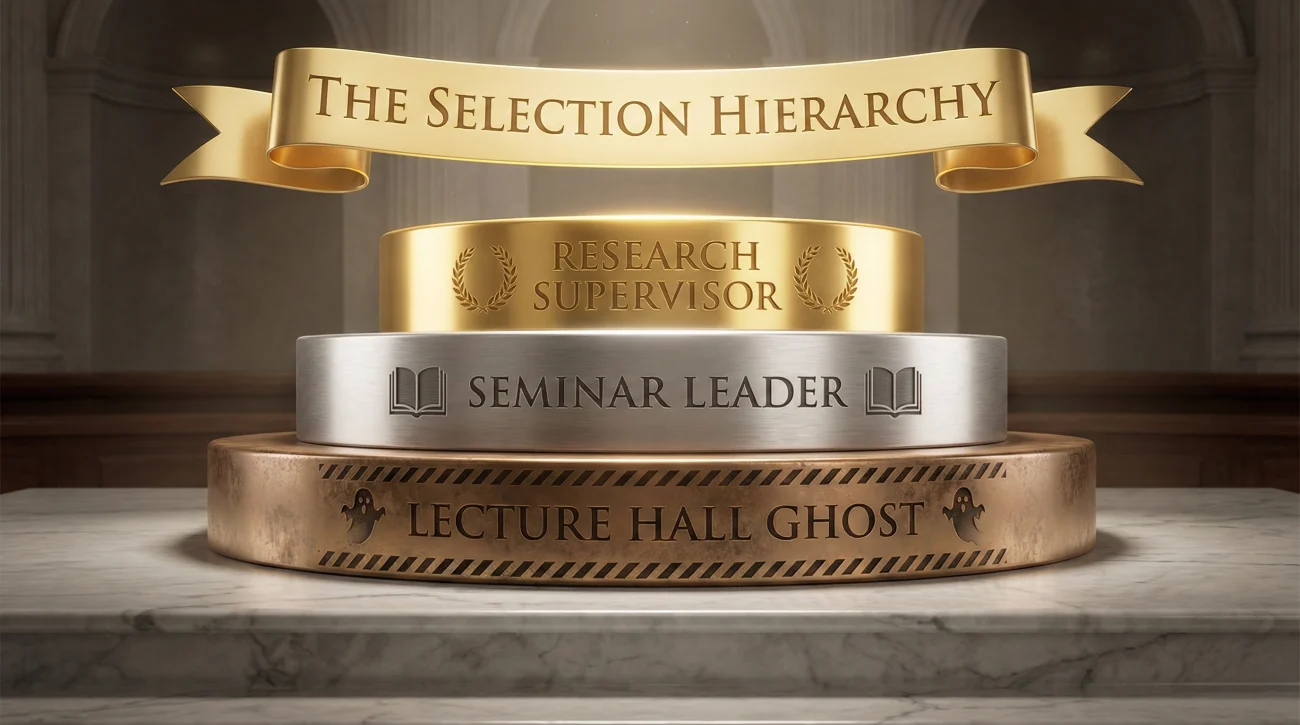
Not all professors carry the same weight. A generic “She got an A” letter from a famous professor is worth less than a detailed, personal narrative from a lesser-known lecturer who actually knows you. Use this hierarchy to choose your targets wisely.
Tier 1: The Gold Standard (Ask These First) 🏆
These are the people who can write about you as a colleague in training, not just a student.
- The Research Supervisor: If you worked in their lab, coded data for them, or wrote a thesis under them, they are your best bet. They have seen you work, struggle, and solve problems.
- The Seminar Leader: A professor who taught a small class (10-20 students) where you participated actively in debates. They know your voice and your mind.
- The Capstone Mentor: The faculty member who oversaw your final year project. They have seen your ability to execute a long-term project.
Tier 2: The Solid Choice (Good Backups) ✅
These professors know you, but perhaps not as deeply. They are safe, reliable choices.
- The “Office Hours” Professor: You took a larger class, but you went to office hours consistently to discuss the material (not just to beg for points). They know your curiosity.
- The Advisor: Your academic advisor who has tracked your progress over 4 years. They can speak to your growth and trajectory, even if they didn’t teach you directly.
- The Club Advisor: If you led a student organization where a professor was the faculty sponsor, they can speak to your leadership skills.
Tier 3: The Danger Zone (Avoid Unless Desperate) ⚠️
Asking these professors is a gamble that often results in a weak letter.
- The “Lecture Hall” Ghost: You got an A in their 300-person lecture but never spoke to them. They will likely write a “DWIC” letter (Did Well In Class) – which is code for “I don’t know this person.”
- The “Grade Grubber”: If your only interaction was arguing about a B+, do not ask them. They remember you, but not fondly.
- The TA (Teaching Assistant): For grad school, a letter from a PhD student carries less weight than a Professor. However, see the “Co-Signing Strategy” below for a workaround.
The Psychology of the Professor: How to Get a “Yes”

To write a successful email to professor for reference, you need to understand their pain points. Professors are typically overwhelmed by administrative tasks. Writing letters is unpaid labor that takes time away from their research and teaching.
Therefore, your strategy must be: Reduce Friction.
When a professor sees your email, they are making a quick calculation: “How much work will this be for me?”
- High Friction Ask: “Can you write me a letter for grad school?” (Result: They have to look up your grade, ask you for details, guess the deadline. Outcome: Procrastination or No.)
- Low Friction Ask: “I am applying to Stanford. Attached is my resume, my paper from your class, and a bulleted list of my achievements. Deadline is Jan 15.” (Result: They have everything they need. Outcome: Yes.)
You need to hand them everything on a “Silver Platter.” We call this the Briefing Kit, and it is the single most important part of your strategy.
The Master Scripts: Professional, Clear, and Persuasive
These templates are designed to trigger memory, provide context, and make the “Yes” easy. Do not copy them blindly – adapt them to your voice.
Scenario 1: The Grad School Application (The Classic)
Context: You are applying for a Master’s or PhD. This is the highest stakes request. The letter needs to speak to your research potential.
Use this for: asking professor for recommendation letter for advanced degrees.
Subject: Recommendation Request: Alex Chen (Econ 301, Fall 2023)
Dear Professor Martinez,
I hope you are having a productive semester. I was a student in your Advanced Macroeconomics seminar last Fall, where I wrote my final research paper on “Inflation Dynamics in Emerging Markets” (which you graciously noted was “publication quality”).
I am writing to ask if you would be willing to support my application to the PhD program in Economics at Stanford. Your mentorship during that seminar was pivotal in my decision to pursue research, and given your expertise in macro policy, your endorsement would carry immense weight.
I know this is a busy time. To make this easy, I have attached a “Briefing Kit” containing:
• My transcript and CV.
• A copy of that final paper (to refresh your memory).
• My Statement of Purpose.
• A bulleted list of the specific research skills I hope to highlight.
The deadline is January 15th. Would you be open to writing this letter?
Sincerely,
Alex Chen
Scenario 2: The First Job / Internship (The Pivot)
Context: You are applying for a corporate role. Employers care less about theory and more about soft skills (deadlines, teamwork, analysis). You need the professor to pivot from “academic” praise to “professional” praise.
Use this for: An academic reference request email for industry jobs.
Subject: Reference Request: Jordan Park (Stats 202, Spring 2024)
Dear Professor Kim,
I hope you are well. I am currently in the interview process for a Data Analyst Internship at McKinsey.
Since I do not have extensive industry experience yet, the hiring manager asked for an academic reference who can speak to my quantitative skills. I immediately thought of you because of my work in your Statistics for Data Science course, specifically the final project where we modeled consumer behavior using R.
Would you be willing to serve as a reference? They would likely send a short digital survey or request a brief 10-minute phone call. I would be happy to send you the job description so you can see exactly what skills they are looking for.
Thank you for your time and mentorship.
Best,
Jordan
Scenario 3: The Research Assistant (The Deep Dive)
Context: You worked in their lab. This relationship is closer to an employer/employee dynamic.
Subject: Recommendation for MIT Media Lab Application
Dear Dr. Thompson,
I am writing to share some exciting news – I am applying for a full-time Research Assistant position at the MIT Media Lab!
Given that I spent two semesters in your lab working on the gesture-interface project (and co-authored the CHI submission), you are the single best person to speak to my experimental design skills and lab etiquette.
Would you be willing to write a strong letter of support for this role? The deadline is December 1st. I have attached a draft of my application materials for your review.
Gratefully,
Sarah
Scenario 4: The “Old Professor” (The Reconnect)
Context: You graduated 2 years ago and haven’t spoken since. You need to warm them up first.
Subject: Life update from [Your Name] (Class of 2022)
Dear Professor Williams,
I hope you are well! I was a student in your Modern History course back in Spring 2022. I’m writing to give you a quick update – since graduating, I’ve been working as a paralegal, applying the critical thinking skills I learned in your seminars every day.
I am now preparing to apply to Law School, and I was hoping you might be willing to write an academic reference for me. I know it has been a while, so I’d be happy to send over my old papers from your class and a summary of what I’ve been up to.
Let me know if you’d be open to this.
Best,
David
The Secret Weapon: The “Briefing Kit”
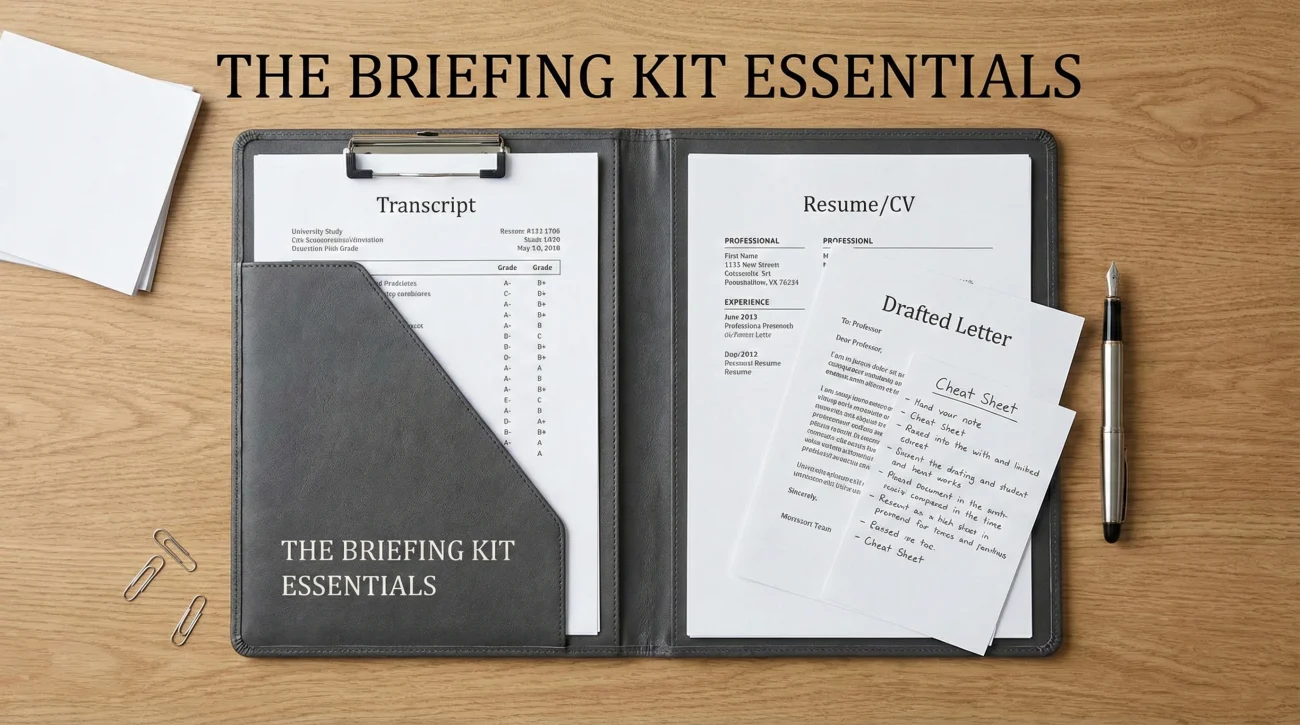
Once a professor says “Yes,” do not just send a link to the portal. Send a follow-up email with the Briefing Kit. This is the difference between a generic letter and a stellar one.
The Briefing Kit should be a single PDF or a well-structured email containing:
- The “Cheat Sheet”: Remind them of the exact semester, grade, and specific projects you did. Quote their feedback to you if you have it (e.g., “You mentioned my analysis was novel”).
- The Narrative Arc: Tell them what you are selling. “For this grad program, I am positioning myself as a quantitative researcher. It would be helpful if you highlighted my stats skills over my writing skills.”
- The Logistics Table: If you are applying to 8 schools, create a simple table: School Name | Deadline | Submission Method. Do not make them hunt for dates.
- The “Why This School”: A brief sentence on why you want to go to this specific program helps them tailor the letter.
The “Ghostwriting” Strategy: What If They Ask You to Write It?
It is very common for busy professors to say: “Sure, draft a letter for me and I’ll sign it.”
Do not be offended. This is a gift. It gives you 100% control over the narrative. Here is how to ghostwrite your own letter without sounding arrogant:
- Adopt Their Voice: If they are formal, write formally. If they are warm, write warmly.
- Use “Observation” Language: Instead of saying “I am smart,” write “I observed Alex tackle complex problems with a maturity rarely seen in undergraduates.”
- Be Specific: “Alex got an A” is boring. “Alex’s paper on monetary policy was the best I have received in 5 years” is powerful.
- Include a Comparison: “I would rank Alex in the top 5% of students I have taught.”
The Timeline: A Countdown to Submission
Academic time moves slower than corporate time. Respect the semester rhythm.
| Timeframe | Action Item |
|---|---|
| 8 Weeks Out | Identify your “Dream Team.” Reconnect with them if you haven’t spoken in a while. Update your CV. |
| 6 Weeks Out | Send the formal request email. (The “Ask”). |
| 4 Weeks Out | If they said yes, send the “Briefing Kit.” If no reply, follow up gently. |
| 2 Weeks Out | Check the portal. If not submitted, send a polite reminder (“Just floating this to the top of your inbox…”). |
| Deadline Day | Send a thank you note regardless of the outcome. |
❓ FAQ: Troubleshooting Your Academic Asks
📝 What if I didn’t get an A in their class?
You can still ask, provided you showed growth. Frame it as: “Although I struggled initially, I was proud of how I improved by the final project.” Professors love a “grit” narrative. However, if you got a C or lower, it is best to look elsewhere unless you have a very strong personal relationship.
📧 What if they ghost me?
Professors are notorious for missing emails. If you asked 4 weeks out, follow up at 2 weeks out. Subject: “Gentle Bump: Recommendation for Alex Chen.” Keep it polite. “Just floating this to the top of your inbox as the deadline is approaching.” If they still don’t reply 1 week out, you need to activate your backup recommender immediately.
🎓 Can I ask a TA (Teaching Assistant)?
This is tricky. For grad school, a letter from a PhD student carries less weight than a Professor. The Hack: Ask the Professor, but mention that the TA knows your work best. Often, the Professor will ask the TA to write the draft, and then the Professor will sign it. This gets you the detailed knowledge of the TA with the letterhead authority of the Professor (“Co-Signing”).
🤝 How do I say thank you?
Handwritten cards remain the gold standard in academia. A physical card slipped under their office door or mailed to the department stands out. Also, update them! If you get in, tell them. They invested in you; give them the ROI of knowing it worked. “I got into Stanford! Thank you for helping me get there.”
Final Thoughts: You Are Not Bothering Them
Let’s end with a mindset shift. Writing recommendations is part of a professor’s job description. It is not a personal favor; it is a professional duty to the next generation of scholars and workers. By asking professor for a reference with clarity, preparation, and gratitude, you are helping them do their job effectively.
You have done the work in the classroom. Now, do the work in the inbox. Curate your story, manage the logistics, and empower your mentors to be your champions. The endorsement they sign today could be the document that changes the trajectory of your entire career.
⚠️ Legal Disclaimer: ResignSmartly provides general informational guidance about resignation, workplace communication, notice periods, handovers, and career transitions. Content does not constitute individualized legal advice. Employment laws, contracts, workplace policies, and individual circumstances vary, so review the requirements that apply to your situation and consult an appropriate qualified professional when needed.