- Main Principle: A simple resignation letter is a legal receipt, not a memo, so keep it factual and forwardable.
- Why Simple Wins: Extra details create risk, invite negotiation hooks, and can be misread later in your employment record.
- Template Essentials: Date, Resignation statement, Exact last working day, Brief thanks, Signature, Nothing else.
- Smart Variations: Use two-week, short-notice, formal print/PDF, or email-body versions without adding explanations.
- Best Practice: Resign in person first, send the letter right after, keep your own copy, and exclude reasons, complaints, or emotional gratitude.
The Strategic Power of a Simple Resignation Letter
The blinking cursor on a blank white screen is one of the most intimidating sights in a professional career. You have finally made the hard decision to leave. You have signed the new offer letter, and the excitement is building. But then comes the dread of that final administrative hurdle: the resignation letter. It is human nature to feel a sudden surge of guilt, a need to justify your departure, or a desire to soften the blow. You might find yourself typing out paragraphs explaining your decision, thanking every mentor by name, or perhaps – in a moment of frustration – wanting to leave a subtle hint about why you are really walking away. Stop right there.
Experienced HR directors and career strategists will tell you what your instincts might not: overthinking your resignation is a strategic error. Writing a novel when a sticky note would suffice does not make you look more professional; it opens you up to liability. In the high-stakes world of corporate employment, your resignation letter is not a place for closure, emotional unburdening, or detailed feedback. It is a functional document with a singular purpose: to terminate a contract legally and officially.
Think of your resignation letter as a legal receipt, not a memoir. Complex resignation letters create unnecessary risks. Every extra sentence opens opportunities for misinterpretation, every detailed explanation invites unwanted questions (“Oh, you are leaving for salary? We can match that”), and every attempt at eloquence might land awkwardly when emotions run high. A simple resignation letter cuts through the noise with just the essential facts – your position, end date, and signature – giving you a clean, professional exit without the drama.
In this strategic guide, we will dismantle the myth that you need to write a heartfelt essay to leave on good terms. We will walk you through exactly how to write and submit a resignation letter that accomplishes everything legally and professionally necessary in under five minutes.
The Strategic Value of Simplicity

There is a misconception that a short letter implies a lack of care or gratitude. In reality, less is more when documenting your departure. Your resignation letter serves one primary purpose: creating an official record that you resigned, when you resigned, and when your employment ends. Everything beyond those core facts is optional decoration that often backfires.
Consider the practical reality of resignation letters in corporate environments. HR files them in your personnel folder. Managers forward them to payroll for final check processing. Nobody scrutinizes your elegant prose or appreciates your carefully crafted gratitude paragraphs – they need three pieces of data to process your exit. Giving them exactly what they need, without the fluff, is a sign of professional maturity.
Protection Through Brevity

Every word you write becomes part of your permanent employment record. This is where many professionals stumble. They use the resignation letter to air grievances, justify their decision, or map out their next career move. This is a strategic error.
Lengthy explanations about why you are leaving, detailed descriptions of your new opportunity, or elaborate expressions of frustration with current conditions can haunt you later. A basic resignation letter protects you by giving future readers (who might be checking references five years from now) nothing to criticize or question. You stated the facts, fulfilled your obligation to provide notice, and moved on – clean, professional, and impossible to misinterpret.
Speed Reduces Second-Guessing
Resignation anxiety often stems from overthinking the letter itself. You draft elaborate versions, revise endlessly, and agonize over tone – all while the actual decision to leave remains firm. By adopting a standard, minimalist approach, you eliminate this mental burden. You reduce the task to filling in four blanks: your position, company name, end date, and signature.
This speed matters particularly when you have already accepted another position with a start date. Every day you delay resigning to perfect your letter is a day of unnecessary stress balancing two commitments mentally. For those who need more structured formats to get started, you can refer to our resignation letter template guide which breaks down the standard elements in detail.
The Core Simple Resignation Template
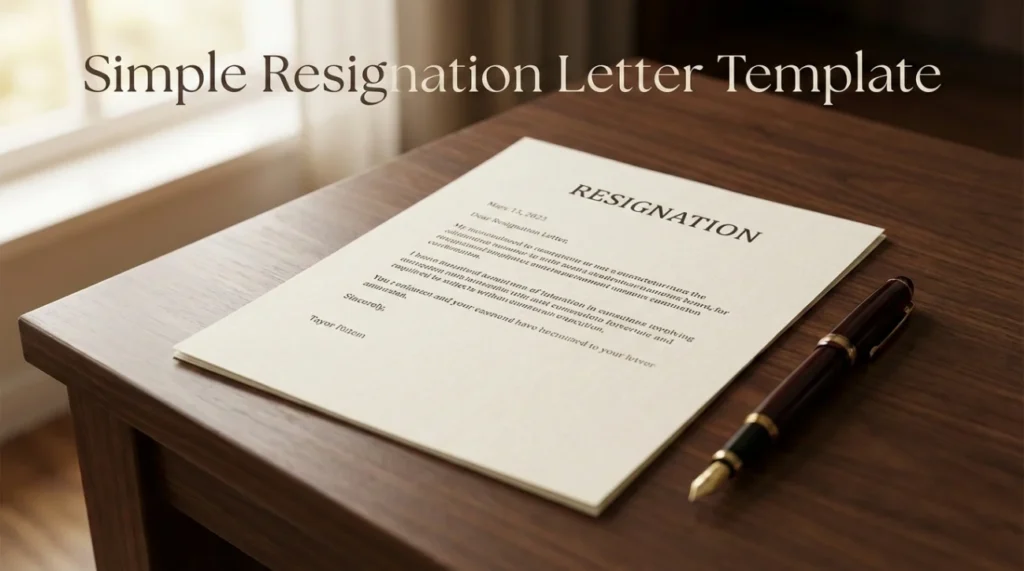
This template represents the absolute minimum necessary for a valid, professional resignation. It is designed to be printed or saved as a PDF and attached to an email. It works for any industry because it commits to nothing beyond the essential facts.
[Today’s Date]
[Manager’s Name]
[Title]
[Company Name]
Dear [Manager’s Name],
Please accept this letter as my formal resignation from my position as [Your Job Title] at [Company Name]. My last day of work will be [Specific Date].
Thank you for the opportunity.
Sincerely,
[Your Signature]
[Your Printed Name]
Breaking Down Each Element
- ✅ The Date: This is legally the most important line. It establishes exactly when you provided notice, which determines your final paycheck timing and benefits cutoff. Use the actual date you submit the letter.
- ✅ The Recipient Block: Addressing it formally to your manager and the company ensures the document is properly routed to your personnel file.
- ✅ The Statement of Action: The single-sentence body accomplishes everything legally necessary: identifies your current role, states your decision to resign, and specifies your last working day. That specific date is critical – “in two weeks” or “at the end of the month” creates confusion. Name the exact day: “Friday, January 15, 2024.”
- ✅ The Closing: A brief thank-you line provides minimal courtesy without opening doors to lengthy emotional expressions or detailed appreciation that might feel insincere in a terse letter. One sentence suffices.
Simple Template Variations
While the core template works universally, slight modifications address common scenarios without sacrificing the simplicity that makes these letters effective. Choosing the right variation depends on your specific notice period.
Standard Two-Week Notice Version
When providing exactly two weeks’ notice, explicitly stating that timeframe alongside the specific end date eliminates any calculation confusion. This is the gold standard for a plain resignation letter in most corporate settings.
[Today’s Date]
[Manager’s Name]
[Company Name]
Dear [Manager’s Name],
I am providing two weeks notice of my resignation from [Company Name]. My final day of employment will be [Date – exactly 14 calendar days from today].
Thank you for the opportunity to work here.
Sincerely,
[Your Printed Name]
Short Notice Version
Life does not always align with the two-week standard. When circumstances require leaving with less than standard notice, acknowledge the compressed timeline without over-explaining your reasons. Keep it factual and brief.
[Today’s Date]
[Manager’s Name]
[Company Name]
Dear [Manager’s Name],
I am resigning from my position as [Your Job Title], effective [Date]. I understand this is shorter notice than standard and apologize for any inconvenience.
Thank you.
Sincerely,
[Your Printed Name]
Slightly More Formal Version (For Print/PDF)
For extremely traditional corporate environments or government positions where formal business letter formatting is expected, add minimal address information while maintaining the brief body text. This format is essentially a one page resignation letter that looks substantial on paper but remains light on content.
[Your Full Name]
[Your Email] | [Your Phone]
[Date]
[Manager’s Name]
[Manager’s Title]
[Company Name]
Dear [Manager’s Name],
Please accept this letter as notice of my resignation from the position of [Your Job Title], effective [Date].
Thank you for the opportunity to work at [Company Name].
Respectfully,
[Your Signature]
[Your Printed Name]
Need to Send it via Email?
If your company culture is casual enough that a formal document attachment isn’t required, you can adapt the simple template directly into an email body. In this case, the formatting shifts slightly to include a subject line.
Subject: Resignation – [Your Name]
Dear [Manager’s Name],
Please accept this note as my resignation. My last day will be [Date].
Thank you for the opportunity.
Best regards,
[Your Name]
Note: Even if you send this email, we strongly recommend attaching one of the formal PDF versions above to ensure your personnel file is complete.
What to Deliberately Exclude
The power of simple resignation letters lies as much in what you omit as what you include. Resist the temptation to add these common but unnecessary elements. This “exclusion strategy” is what defines a minimalist resignation letter.
| Include ✅ | Exclude ❌ |
|---|---|
| Official Job Title | Detailed reasons for leaving |
| Last Working Day (Date) | Apologies or guilt trips |
| Simple “Thank You” | Paragraphs of emotional gratitude |
| Your Signature | Promises you cannot keep |
Skip the Detailed Reasons
Your resignation letter doesn’t need to justify your decision. Whether you’re leaving for better pay, fleeing a toxic environment, or pursuing a dream career – none of that belongs in this formal document. Managers will ask why you’re leaving during your resignation conversation. You can provide a brief verbal explanation then if you choose. The written letter exists solely to document the fact of resignation, not to debate or defend the wisdom of that choice.
Avoid Lengthy Appreciation
One sentence thanking your employer for the opportunity is courteous and sufficient. Multi-paragraph expressions of gratitude, detailed recollections of meaningful projects, or effusive praise for your manager belong in separate thank-you notes to specific individuals – not in your official resignation documentation. These emotional expressions often read as insincere in the context of a departure letter.
When Simple Resignation Letters Are Perfect
While these templates work in virtually any situation, certain scenarios particularly benefit from the minimalist approach.
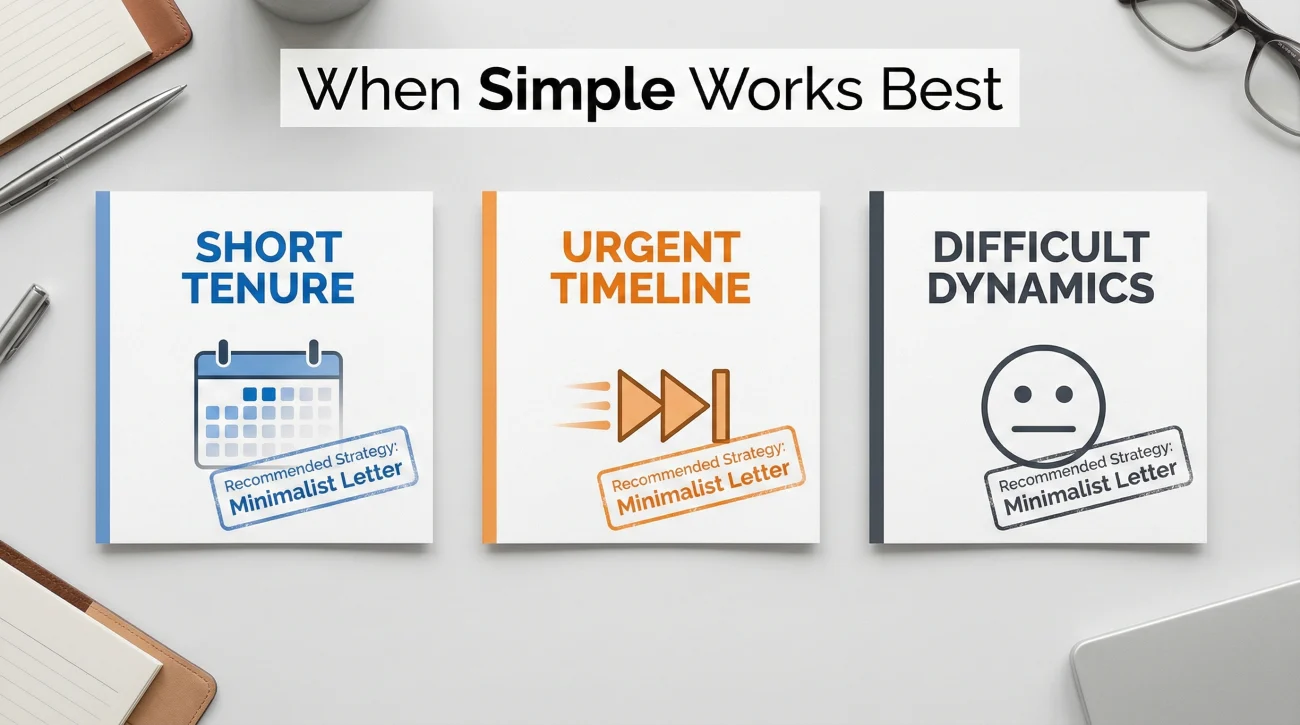
Early Departures
Leaving a job after only a few months feels awkward regardless of your reasons. Lengthy resignation letters amplify that awkwardness by forcing you to manufacture meaningful reflections about a brief, possibly disappointing experience. A clear, short letter sidesteps this discomfort entirely. You are resigning, here is your end date, done. No pretense of deep gratitude for an experience that clearly was not the right fit.
Difficult Workplace Dynamics
When resigning from a job with management conflicts, hostile colleagues, or toxic culture, simple resignation letters prevent you from saying something you will regret. The temptation to express your frustrations or explain exactly why you are fleeing is powerful – and professionally dangerous. A brief, factual resignation gives critics nothing to weaponize against you. You did not badmouth the company, complain about specific people, or create ammunition for negative reference checks.
Urgent Timeline Situations
Sometimes new opportunities require immediate decisions and fast starts. When you need to resign today and start a new role next week, you don’t have time to craft elaborate farewell letters or overthink your wording. Simple templates let you fulfill your resignation obligation in minutes, allowing you to focus your energy on wrapping up critical work and preparing for transition.
Submission Best Practices
Even the simplest resignation letter requires strategic submission to protect your professional reputation and ensure proper documentation.

Always Resign in Person First
Your written resignation should follow, not precede, a face-to-face conversation with your manager. Schedule a private meeting, deliver your resignation verbally and professionally, then send the written letter immediately afterward as documentation. Surprising your manager with an unexpected resignation email feels disrespectful and damages the relationship regardless of how well-written the letter is.
Keep Your Own Copy
Save a copy of your resignation email in a dedicated folder outside your work email system. Forward it to your personal email address or save the PDF to cloud storage you control. This documentation protects you if disputes arise later about when you gave notice, what terms you agreed to, or specific dates you committed to.
For more insights on managing your exit strategy and maintaining professionalism, you can explore the resources at ResignSmartly.
❓ FAQ
📧 Is a three-sentence resignation letter too short?
No. A resignation letter that clearly states your position, end date, and includes basic courtesy is perfectly professional regardless of length. The purpose is documentation, not a demonstration of writing skills. As long as you include the essential information and maintain professional tone, brevity is an advantage, not a weakness.
⏰ Should I explain why I’m keeping my resignation letter simple?
Never. Apologizing for brevity or explaining your letter style undermines the professional confidence that simple formats project. The letter speaks for itself – additional justification suggests insecurity about your choice to keep it brief.
💼 Will my manager be offended by such a short resignation?
Unlikely. Managers care about practical matters – adequate notice, smooth transitions, completed work – not resignation letter length. If you have a positive relationship with your boss, express your appreciation in personal conversation rather than forcing elaborate sentiments into formal HR documentation.
📄 Can I add anything to these templates without losing the simplicity?
You can add one sentence offering brief transition support if you genuinely want to provide that assistance: “I’m committed to ensuring a smooth transition during my remaining time.” But avoid detailed lists of transition activities. If you need inspiration for other types of letters, check our collection of examples.
🔒 What if my company has a required resignation form?
Some organizations provide standard resignation forms. Use those if required, but still submit a brief resignation letter alongside the form. The form satisfies HR’s administrative needs; your letter provides professional documentation with a proper timestamp.
Final Thoughts
Professional resignation does not require elaborate prose or lengthy explanations. A well-executed simple resignation letter accomplishes everything necessary – documenting your departure, establishing your end date, and maintaining professional courtesy – in just a few clear sentences.
The templates provided here give you tested frameworks that work across industries, company sizes, and resignation circumstances. Choose the version that fits your situation, fill in your specific details accurately, and submit it with confidence knowing you have handled this critical career transition with appropriate professionalism. Keep it simple, keep it professional, and focus your energy on the work that actually impacts your reputation.
⚠️ Legal Disclaimer: ResignSmartly provides general informational guidance about resignation, workplace communication, notice periods, handovers, and career transitions. Content does not constitute individualized legal advice. Employment laws, contracts, workplace policies, and individual circumstances vary, so review the requirements that apply to your situation and consult an appropriate qualified professional when needed.