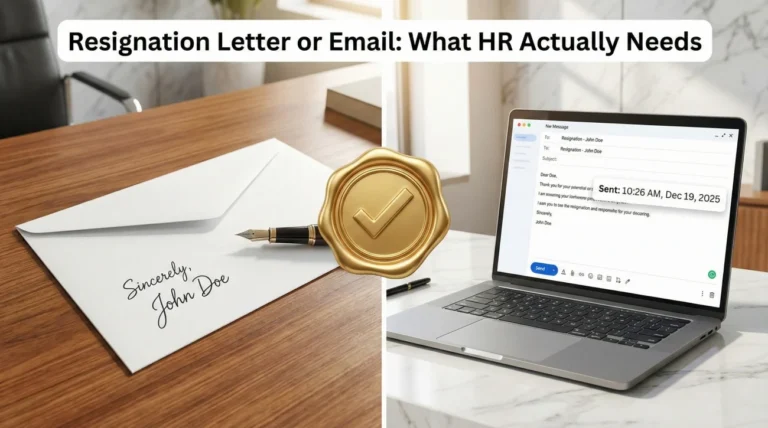
- Purpose: A retirement resignation letter triggers pensions, distributions, and healthcare transitions, so it must be treated as an administrative document.
- Date: Use one unambiguous official retirement date, because even a one-day difference can change benefit calculations and processing.
- Timing: Submit 3 to 6 months early when benefits are complex, and explicitly reference early retirement provisions if you are using them.
- Documentation: Include years of service and reliable post-retirement contact details since this letter becomes a long-term proof document.
- Final months: Do structured knowledge transfer and actively verify benefits processing so errors are caught before your last day.
Retirement as Administrative Trigger
Your resignation letter for retirement serves a fundamentally different purpose than other resignations. You’re not just notifying your employer – you’re activating pension benefits, triggering retirement account distributions, initiating healthcare transitions, and documenting the official end date that determines decades of accumulated benefits. This administrative function demands precision that casual resignation letters don’t require.
Retirement resignations carry financial stakes others don’t. Your official retirement date affects pension calculations, determines when retirement accounts become accessible without penalties, impacts Social Security strategies, and establishes when employer healthcare ends and Medicare becomes necessary. Documentation errors can cost thousands in miscalculated benefits or create healthcare coverage gaps.
Triggering Pension Benefit Processing
Your retirement letter initiates complex administrative processes that determine your financial security for decades. Understanding what your letter triggers helps you ensure proper benefit activation and avoid costly timing mistakes.

The Official Retirement Date Matters
Your stated retirement date determines pension benefit calculations with precision that makes days matter. Many pension formulas incorporate your final average salary, length of service, and specific retirement date into benefit amounts. Retiring on June 30th versus July 1st might seem trivial, but if that crosses a fiscal year or affects years-of-service calculations, the financial difference could be substantial.
Your retirement resignation letter should state your retirement date unambiguously: “My official retirement date is June 30, 2025” rather than vague statements like “I plan to retire at the end of June.” Pension administrators need precise dates to calculate benefits correctly. Ambiguity can delay processing or trigger incorrect calculations that require lengthy appeals to correct.
Coordinating Benefits Administration Timing
Multiple administrative processes trigger from your retirement date. HR departments must process final paychecks, calculate accrued vacation payouts, initiate COBRA notices, begin pension distributions, and coordinate 401(k) rollovers. Each process has specific timelines and requirements that your retirement letter sets in motion.
Submit your letter far enough in advance to allow proper processing. Three months minimum for standard retirements; six months for complex situations involving pension calculations, healthcare transitions, or early retirement provisions. This timing isn’t about courtesy – it’s about ensuring administrators have time to calculate benefits accurately and set up distributions before your income stream ends.
Early Retirement Benefit Implications
If retiring before normal retirement age under your pension plan, your letter must reference early retirement provisions explicitly. Many pension plans offer early retirement options with reduced benefits or specific eligibility windows. Your letter should state:
“I am retiring under the early retirement provisions of [Plan Name], effective [Date], having met the eligibility requirements of [age/years of service criteria].”
This specificity ensures HR processes your retirement under the correct plan provisions. Failing to reference early retirement provisions might result in your retirement being processed as standard resignation, potentially forfeiting early retirement benefits you’ve earned or triggering penalties you could have avoided.
Documentation Requirements for Benefit Claims
Your retirement letter becomes the foundation document for benefit claims that might span decades. Pension administrators, Social Security offices, and healthcare insurers all reference this letter when processing claims, resolving disputes, or verifying eligibility.

Documenting Years of Service
Include your total years of service if relevant to benefit calculations: “I am retiring after 32 years of service with [Company], having begun employment on March 15, 1993.” This documentation helps pension administrators verify service credits, particularly important if you’ve had breaks in service, transferred between divisions, or worked part-time periods that might affect benefit calculations.
For government employees or union positions with complex seniority systems, this documentation becomes even more critical. Your notice of retirement letter creates the official record of service length that determines benefit levels, so accuracy matters.
Post-Retirement Contact Details
Provide accurate contact information for post-retirement correspondence: permanent address, personal email, and phone number. Pension administrators need to reach you for benefit elections, tax withholding selections, and distribution confirmations. Using work email or addresses you’re vacating creates communication gaps that can delay benefit processing.
Specify:
“After retirement, I can be reached at [permanent address], [personal email], and [personal phone].” This ensures benefits paperwork reaches you reliably rather than being sent to work addresses you’ll no longer access.
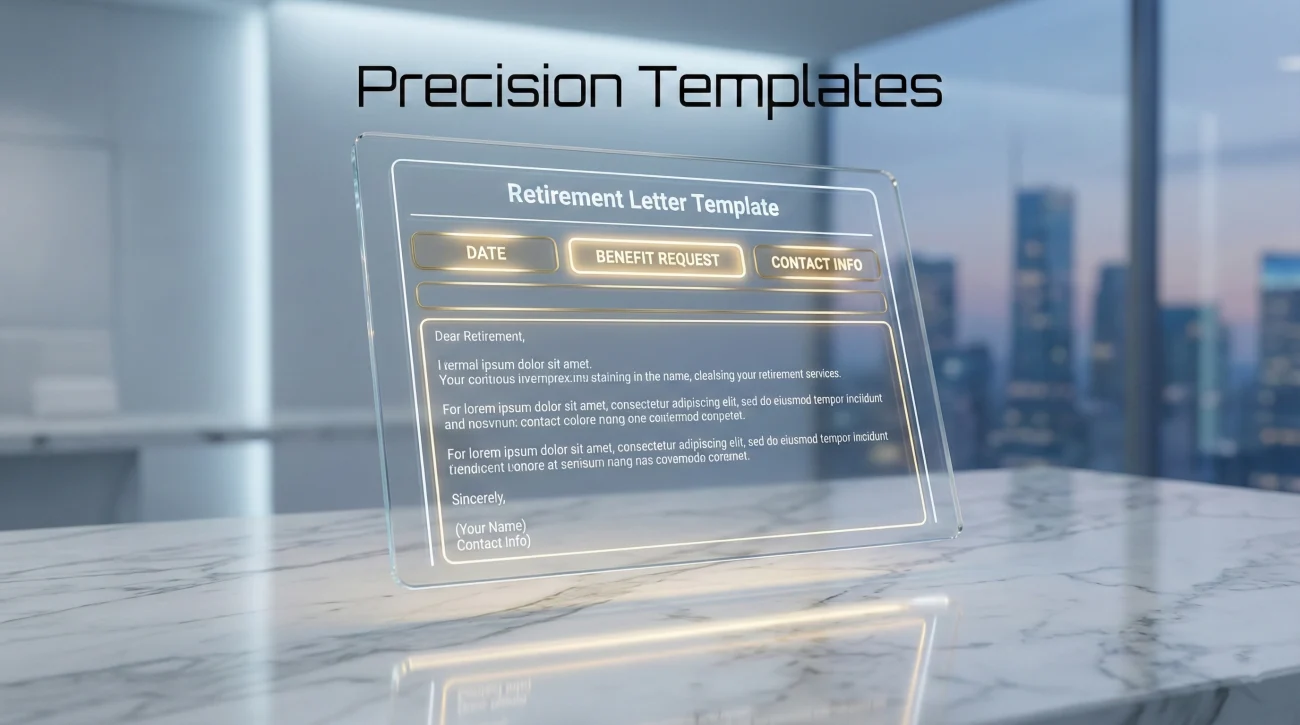
Retirement Letter Templates
These templates address the administrative precision retirement letters require while maintaining appropriate professional tone. For broader resignation guidance, see our resignation letter with reason guide.
Standard Retirement Template
Patricia Morrison
567 Maple Drive
Minneapolis, MN 55401
March 1, 2025
David Richardson
Human Resources Director
Northern Financial Services
Dear David,
I am writing to formally announce my retirement from Northern Financial Services, with my official retirement date being June 30, 2025.
After 28 years of service beginning August 15, 1997, I have reached the point where retirement aligns with both my personal goals and eligibility under the company pension plan. This decision follows considerable planning and coordination with my financial advisors.
Please initiate the necessary pension benefit processing and provide information regarding healthcare continuation options, 401(k) distribution elections, and any other retirement-related administrative requirements. I understand there are multiple forms and elections to complete, and I’m ready to work with Benefits Administration on all necessary paperwork.
During my remaining months, I’m committed to comprehensive knowledge transfer and mentoring my successor. I will document all processes, client relationships, and institutional knowledge to ensure smooth continuity after my departure.
After retirement, I can be reached at this address, patricia.morrison.personal@email.com, and (612) 555-0147.
Thank you for nearly three decades of opportunities, professional growth, and meaningful work. I look forward to transitioning into retirement while maintaining positive connections with the colleagues and organization that have been such an important part of my professional life.
Sincerely,
Patricia Morrison
This retiring from work letter provides specific dates, documents years of service, requests necessary administrative processing, and establishes post-retirement contact information. The tone balances professional formality with appropriate reflection on career conclusion.
Early Retirement Template
James Chen
234 Oak Street
Seattle, WA 98102
January 15, 2025
Michelle Roberts
Vice President, Human Resources
Pacific Northwest Manufacturing
Dear Michelle,
I am formally notifying you of my retirement under the Early Retirement Incentive Program, effective April 30, 2025.
Having reached age 58 with 25 years of continuous service since May 1, 2000, I meet the eligibility criteria (age 55+ with 20+ years service) for early retirement benefits under our pension plan. I am electing to retire under these provisions rather than continuing to normal retirement age.
Please process my retirement under the Early Retirement Incentive Program provisions and provide documentation regarding reduced pension calculations, healthcare bridge coverage until Medicare eligibility, and the enhanced severance package included in the early retirement offer.
I will work with my manager to ensure comprehensive transition of my production management responsibilities. The next three months provide sufficient time to train my successor and document all operational procedures.
My permanent contact information: james.chen.home@email.com, (206) 555-0198, and this mailing address.
I appreciate Pacific Northwest Manufacturing’s early retirement program and the opportunity to transition into retirement while the company addresses its restructuring needs.
Sincerely,
James Chen
This letter explicitly references early retirement provisions, documents eligibility criteria, and requests processing under specific program terms. The clear statement of meeting eligibility requirements (age 58, 25 years service) prevents processing errors and ensures proper benefit calculations under early retirement formulas.
Your Final Months Priorities
The time between submitting your retirement announcement letter and final day differs from standard notice periods. You’re concluding a career, cementing legacy, and ensuring benefits processing completes smoothly.

Systematic Knowledge Transfer
Your institutional knowledge represents decades of expertise organizations can’t replace quickly. Dedicate final months to systematic transfer: document processes, explain decision rationales, introduce key relationships, and train successors on role nuances formal job descriptions don’t capture.
This ensures your retirement doesn’t create organizational crises. Companies seeing smooth retiree transitions are more likely to hire retirees for consulting work and maintain positive professional relationships.
Monitor Benefits Processing
Don’t assume HR completes everything automatically. Follow up monthly on pension processing, healthcare transitions, and final payouts. Verify years of service calculations, confirm retirement date accuracy, and review benefit estimates.
Mistakes are easier to fix before retirement than after. Catching errors while employed and HR has immediate access to records solves problems faster than post-retirement appeals.
❓ FAQ
📅 How far in advance should I submit my retirement letter?
Three to six months minimum, depending on position complexity and benefit calculations required. Senior positions or complex pension formulas warrant longer notice. This allows HR to calculate benefits accurately and ensure smooth transitions. Some companies require specific notice periods for pension processing – check plan documents. Submitting too close to retirement can delay benefit distributions and create income gaps.
💰 Can I change my retirement date after submitting my letter?
Usually yes, but complications increase as your retirement date approaches. If you need to adjust timing, notify HR immediately in writing with your new retirement date. Be aware that benefit calculations may need recalculation, distribution setup may need revision, and replacement hiring may be affected. Frequent date changes signal indecision that could complicate your transition. If uncertain about timing, wait to submit your letter until you’ve finalized your date through consultation with financial advisors.
🏥 What happens to my health insurance when I retire?
Employer coverage typically ends on your retirement date or end of the month. You’ll receive COBRA continuation offers allowing temporary coverage at full premium costs. If you’re 65+, enroll in Medicare three months before retirement to avoid coverage gaps. If retiring before 65, plan for COBRA, spouse’s coverage, or ACA marketplace insurance to bridge until Medicare eligibility. Your retirement letter triggers these notifications, so ensure HR has correct address for sending time-sensitive enrollment information.
🎯 Should I mention Social Security claiming strategy in my letter?
No, Social Security claiming is separate from your employer relationship. Your retirement date from work doesn’t determine when you claim Social Security benefits. Many people retire from employment years before claiming Social Security to maximize delayed retirement credits. Your employer doesn’t need information about Social Security plans – that’s between you and Social Security Administration. Focus your letter on employer-specific benefits: pension, 401(k), healthcare, and final compensation.
📝 Do I need to explain why I’m retiring?
Not required beyond stating you’re retiring. Unlike other resignations, retirement is self-explanatory – you’ve reached retirement age and eligibility. Brief context can be appropriate: “after 30 years of service” or “having reached normal retirement age.” Avoid over-explaining health issues, financial situations, or personal circumstances unless relevant to early retirement provisions. Keep focus on administrative processing rather than justifying your decision.
Final Thoughts
Your resignation letter for retirement marks formal conclusion of your working career – a moment decades in making. Unlike other resignations where you’re moving toward new opportunities, retirement represents transition from career to next life chapter.
Approach this letter with administrative precision it requires while allowing appropriate career reflection. Balance practical benefit processing needs with genuine appreciation for opportunities, relationships, and experiences your career provided.
Remember retirement doesn’t mean disappearing from professional circles. Many retirees maintain industry connections, serve as consultants, or mentor former colleagues. How you handle retirement resignation affects whether those doors remain open and whether your professional reputation continues serving you after career conclusion.
⚠️ Legal Disclaimer: ResignSmartly provides general informational guidance about resignation, workplace communication, notice periods, handovers, and career transitions. Content does not constitute individualized legal advice. Employment laws, contracts, workplace policies, and individual circumstances vary, so review the requirements that apply to your situation and consult an appropriate qualified professional when needed.