
- Core Move: A notice waiver is a negotiation, not a resignation, so you must sell a business case, not ask for a favor.
- Manager Psychology: They keep you for coverage, policy, or spite, so your job is to neutralize fear with a clean handover plan.
- Leverage Points: Money saved, Work already completed, Security risk or conflict of interest if you are moving to a competitor.
- How To Ask: Use a give get script, offer a concession like post exit support, a short sprint, or PTO to cover the gap.
- Outcomes: Get any yes in writing, accept garden leave if offered, and if it is a no negotiate a soft exit like remote days or PTO.
For the full notice process and more examples, see our guide to resignation letter with notice period.
The Art of the Deal: Negotiating an Early Exit
Resigning is usually a rigid dance: you give two weeks’ notice, you serve your time, and you leave. It is the corporate equivalent of a prison sentence – you do the crime (quitting), you do the time (notice period). But what happens when that timeline doesn’t work for you? Perhaps your dream job starts next Monday and they won’t budge. Maybe you have finished all your work and are literally staring at the wall for eight hours a day. Or maybe, the environment has become so toxic that two weeks feels like two years.
This is where the request to waive the notice period comes in. It is the “get-out-of-jail-free” card of the corporate world. But unlike a standard resignation, which is a unilateral declaration (“I am leaving”), a waiver is a negotiation (“Can we agree that I leave sooner?”). It shifts the power dynamic from a notification to a conversation.
To succeed, you cannot just ask for a favor. You must construct a business case. You have to prove to your boss that keeping you on the payroll for another ten days is actually a bad idea. This guide is your masterclass in that negotiation. We will dissect the psychology of the manager, the leverage points you didn’t know you had, and the exact language to use in your resignation letter requesting a notice period waiver to turn a “No” into a “Yes.”
Psychology of the Manager: Why They Want You to Stay (And How to Change Their Mind)
To negotiate an early release, you first need to understand why companies insist on the two-week notice in the first place. It is rarely about the work. Most employees are incredibly unproductive in their final days. So why force you to stay?
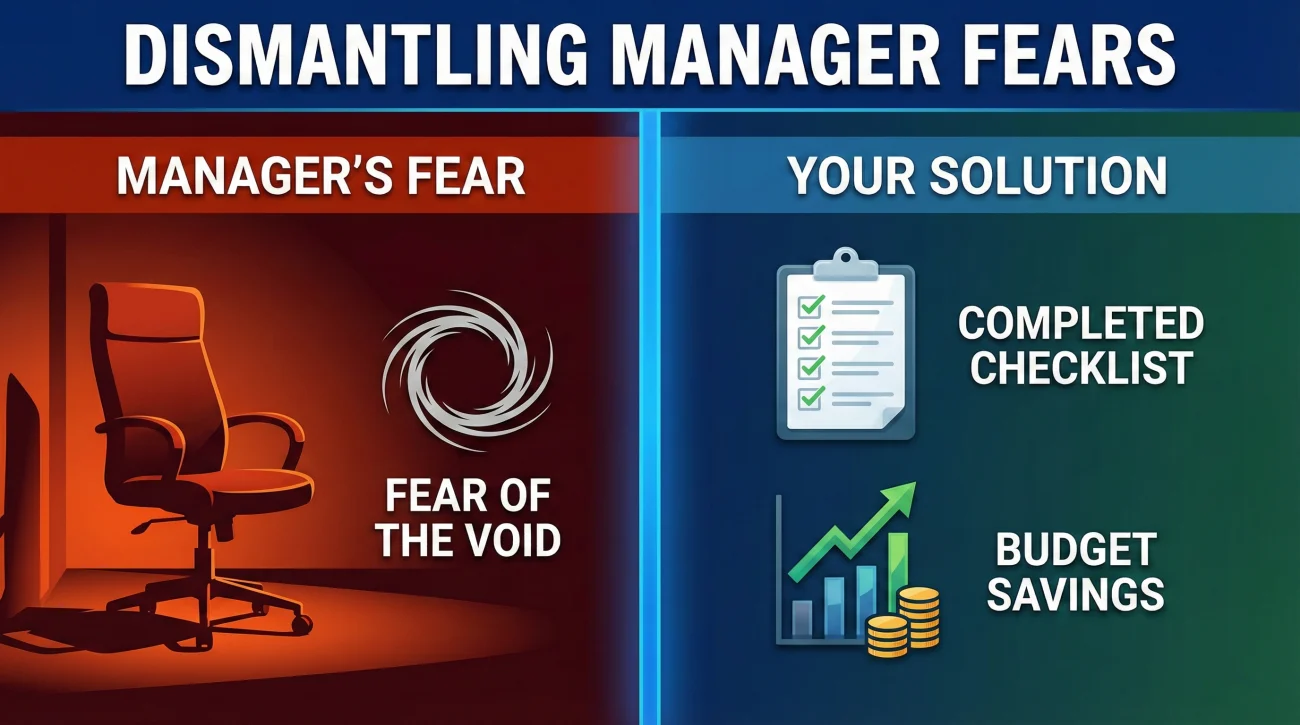
- 🛑 Fear of the Void: They are panicked about who will do the work. They want a warm body in the chair, even if that body is doing nothing.
- 🛑 Protocol & Policy: “It’s just what we do.” HR policies often mandate it to avoid setting a precedent.
- 🛑 Spite (Rare but Real): If you are leaving for a competitor or leaving them in a lurch, forcing you to sit out your notice can be a subtle form of punishment.
Your Counter-Strategy: You must dismantle these fears. You need to show them that:
1. The work is covered (The Handover Plan).
2. Making an exception saves them money (The Budget Argument).
3. Keeping you is more dangerous than releasing you (The Security Argument).
Your Secret Leverage Points
You have more power than you think. You aren’t just begging; you are trading. Here are three currencies you can trade for an early exit.

1. The Financial Trade (Money for Time)
This is the cold, hard logic of business. Every day you stay costs the company real dollars. Calculate your daily rate (Salary / 260 working days). If you earn $100k, you cost them roughly $384 a day. Leaving 5 days early saves them nearly $2,000.
The Pitch: “By releasing me on Friday instead of next Friday, the department saves $2,000 in Q4 payroll – budget that could be reallocated to the hiring bonus for my replacement.”
2. The “Completed Work” Trade (Output for Time)
Managers fear a messy transition. If you can prove the transition is already done, their reason for keeping you vanishes.
The Pitch: “I have already finished the Q3 reports and trained Sarah on the new software. If I stay next week, I will effectively be idle. It is more efficient to hand over the keys now while everything is stable.”
3. The “Conflict of Interest” Trade (Risk for Time)
If you are going to a competitor, you are a security risk. They don’t want you seeing next month’s strategy. Lean into this delicately.
The Pitch: “Since I am moving to [Competitor], I want to respect [Current Company]’s data privacy. It is probably best for everyone if I step away from the internal systems immediately to avoid any conflict of interest.”
The “Give-Get” Negotiation Script

Before you send the letter, you usually have a verbal conversation. Here is the script for that high-stakes chat.
You: “I have submitted my resignation with the standard two weeks’ notice. However, I have a request. I have an opportunity to start my new role earlier, and I’ve worked hard to finish my handover tasks ahead of schedule.”
Manager: “We really need you for the full two weeks.”
You: “I understand. Here is my proposal: If we can agree on an end date of [Date], I will agree to [Concession]. This creates a win-win.”
The “Concessions” You Can Offer:
- ✅ Post-Exit Support: “I will be available via email for 30 days to answer questions.”
- ✅ The Sprint: “I will work late every night this week to finish the Alpha Project so I can leave on Friday.”
- ✅ Vacation Forfeiture: “I am willing to use my accrued vacation days to cover the notice period gap.”
Strategic Templates for Every Scenario
Writing an early-release resignation letter requires nuance. You must be firm on the resignation but flexible on the date. Use these templates as your starting point.
Scenario 1: The “Rational Business Case” (Best for Corporate Roles)
This template focuses on efficiency and cost-saving. It removes emotion and focuses on logic.
[Your Name]
[Your Email]
[Your Phone]
[Date]
[Manager’s Name]
[Title]
[Company Name]
Dear [Manager’s Name],
Please accept this letter as formal notification that I am resigning from my position as [Job Title]. In strict accordance with my employment contract, my final date of employment would be [Standard Notice Date, e.g., two weeks from now].
However, I would like to formally request a waiver of the remaining notice period to allow for an earlier departure on [Requested Early Date].
I make this request based on the following business factors:
- Transition Complete: I have already finalized the handoff documentation and cross-trained [Colleague Name] on my core duties.
- Project Status: All my active projects have been closed out or transferred.
- Cost Efficiency: An early release would save the department salary costs for a period where my workload would be minimal.
To ensure you feel supported, I am willing to remain available via email/phone for urgent questions for two weeks following my departure. I believe this arrangement protects the company’s interests while allowing me to transition to my new opportunity.
Thank you for considering this request. I am happy to discuss the details in person.
Sincerely,
[Your Signature]
Scenario 2: The “Competitor / Sensitive Role” (Best for Sales/Tech)
Use this when you are going to a rival. You are essentially inviting them to walk you out for their own safety.
Dear [Manager’s Name],
I am writing to resign from my role as [Job Title]. Per my contract, I am providing two weeks’ notice.
However, I want to be transparent that my next role is with [Competitor Name]. Given the sensitive nature of our work and the competitive landscape, I want to ensure there is no conflict of interest.
Therefore, I respectfully request an early-release resignation letter agreement, effective [Date, e.g., Today or Tomorrow]. I believe it is in the best interest of [Current Company]’s data security for me to step away from internal systems immediately.
I have already organized my files and am ready to hand over my keys and assets at your convenience. I want to ensure this exit is handled with the highest level of professional integrity.
Best regards,
[Your Name]
Scenario 3: The “Personal Hardship” (Best for Sympathy)
Use this when a personal issue makes staying difficult, but not impossible.
Dear [Manager’s Name],
I am resigning from my position as [Job Title]. My contractual final day is [Date].
I am writing to ask for your compassion regarding this shorten notice period letter. Due to [a family relocation issue / a gap in childcare / a personal health matter], fulfilling the final week of my notice period would cause significant personal hardship.
I have worked hard during my tenure to be a reliable team member, and I am asking for this flexibility as a final courtesy. I promise to work double-time over the next [Number] days to ensure my desk is clear before I leave on [Requested Early Date].
Thank you for your understanding and kindness.
Sincerely,
[Your Name]
The Aftermath: What Happens Next?
Once you submit the request, the ball is in their court. You need to be prepared for three outcomes.
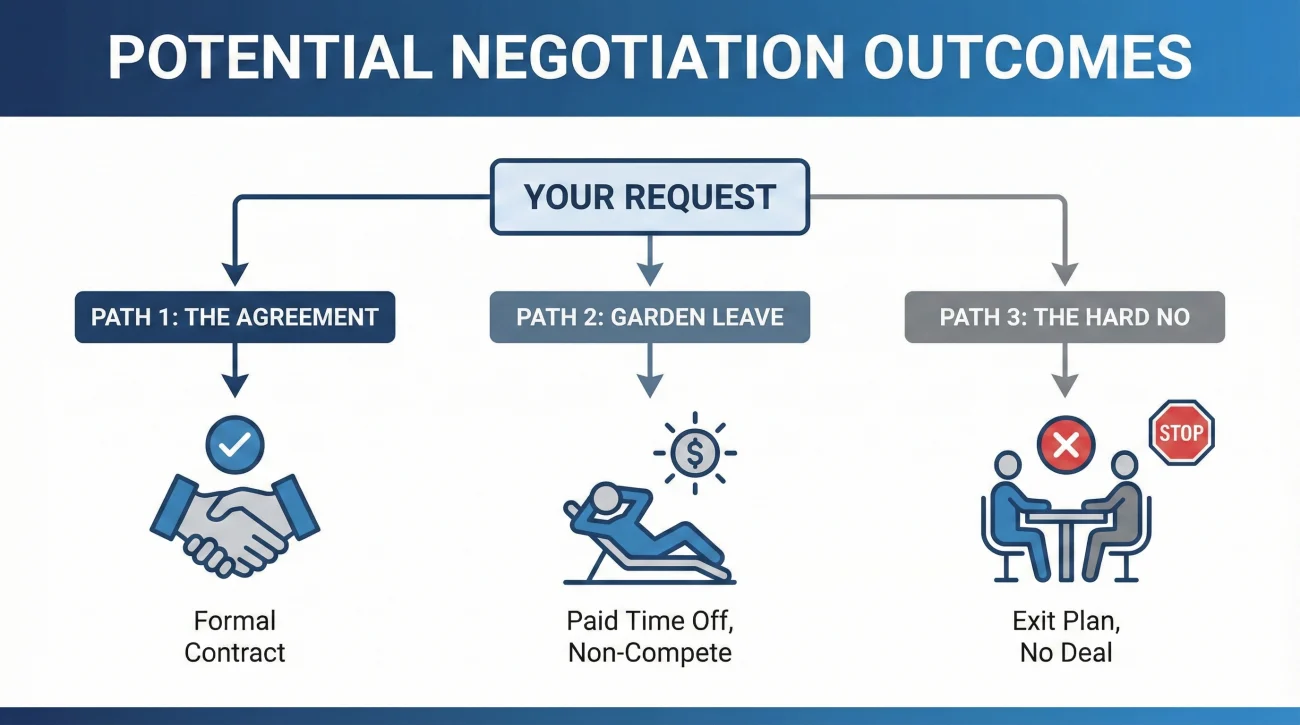
Outcome 1: The Agreement (Best Case)
They agree! Fantastic. Get it in writing. Do not rely on a verbal “Sure, go ahead.” Send an email: “Just confirming our conversation that my final day will be [Date] and the remaining notice period is waived.” This protects you from being marked as “Job Abandonment.”
Outcome 2: The Garden Leave (Profitable Case)
They say: “We accept your resignation, and actually, we want you to leave today. But we will pay you for the two weeks.” This is the jackpot. It’s called “Garden Leave.” You get paid to sit in your garden. Accept it, sign the paperwork, and enjoy your vacation.
Outcome 3: The Hard No (Worst Case)
They say: “No. We expect you here until the 14th.”
Do Not: Throw a tantrum. Do not “Quiet Quit” (slack off visibly).
Do: Negotiate a “Soft Exit.” Ask: “Okay, I understand. Can I work remotely for the final week?” or “Can I use my remaining PTO days to cover the last 3 days?” Even if they say no to the waiver, they might say yes to flexibility.
❓ FAQ
💰 If they waive my notice, do I still get paid for those weeks?
Usually, no. If you request the waiver, you are voluntarily giving up the right to work and get paid. You trade money for time. However, if they initiate the early release (involuntarily), they often have to pay you. Be careful with your wording.
📉 Does asking for a waiver look unprofessional?
Not if done correctly. If you say “I’m leaving, deal with it,” yes. If you say “I propose a mutually beneficial adjustment to the timeline,” you look like a savvy negotiator. It shows you understand business efficiency.
⚖️ Can they sue me if I leave early anyway?
Technically yes, but rarely. In “at-will” employment, they can’t force you to work. However, leaving early can breach a contract, causing you to lose bonuses, vacation payouts, or face “damages” if your absence caused financial loss. It is safer to get permission.
🤐 What if I have a signed contract with a penalty clause?
Read it carefully. Some contracts say “If you leave without 4 weeks notice, you owe us $5,000.” In this case, a waiver is the only way to avoid the fine. You must get them to sign a document saying “We waive the penalty clause.” Do not leave without this signature.
Final Thoughts: It is Business, Not Personal
Remember, a request to waive the notice period is just a business transaction. You are selling your time; they are buying it. If the price (your salary) is higher than the value (your output during the notice period), they should logically want to stop buying.
Make that logical case. Remove the emotion. Frame your early exit as a cost-saving, risk-reducing efficiency measure for the company. You might be surprised at how quickly they hold the door open for you.
⚠️ Legal Disclaimer: ResignSmartly provides general informational guidance about resignation, workplace communication, notice periods, handovers, and career transitions. Content does not constitute individualized legal advice. Employment laws, contracts, workplace policies, and individual circumstances vary, so review the requirements that apply to your situation and consult an appropriate qualified professional when needed.