
- Two-week notice letter is strategic: Legal clarity, reputation protection, and a smoother handoff.
- Two weeks became the default: A safe harbor for references, payouts, and contract or handbook clauses.
- Flawless letter anatomy: State resignation, name a hard final date, and confirm two-week notice.
- Exit-date math matters: Treat it as 10 business days or 14 calendar days, and watch Fridays and holidays.
- Close strong in the notice window: Tell your manager first, send the written notice immediately after, document the handover, and stay calm through counteroffers or early offboarding.
The Strategic Importance of the Two-Week Window
There is a specific moment in every professional’s career that carries a unique blend of adrenaline, relief, and anxiety: the moment you decide to move on. You have secured the new offer, signed the contract, and now only one barrier remains between you and your next chapter. Drafting your resignation letter with two weeks notice is not merely an administrative task; it is the final strategic move in your current role and the first impression you make on your soon-to-be former employer.
While it might be tempting to view this letter as a formality – a piece of paper to be filed and forgotten – seasoned professionals understand its true weight. This document serves as your legal safety net, your reputation guardian, and the roadmap for your departure. It sets the tone for your final days, influencing whether you leave with handshakes and future recommendations or silence and burned bridges.
In the following guide, we move beyond basic templates to explore the psychology, strategy, and execution of a perfect exit. We will dissect how to craft a standard notice resignation letter that protects your interests, how to navigate the awkward conversations that follow, and how to ensure your professional legacy remains intact long after your email account is deactivated.
Why Two Weeks Became the Universal Standard
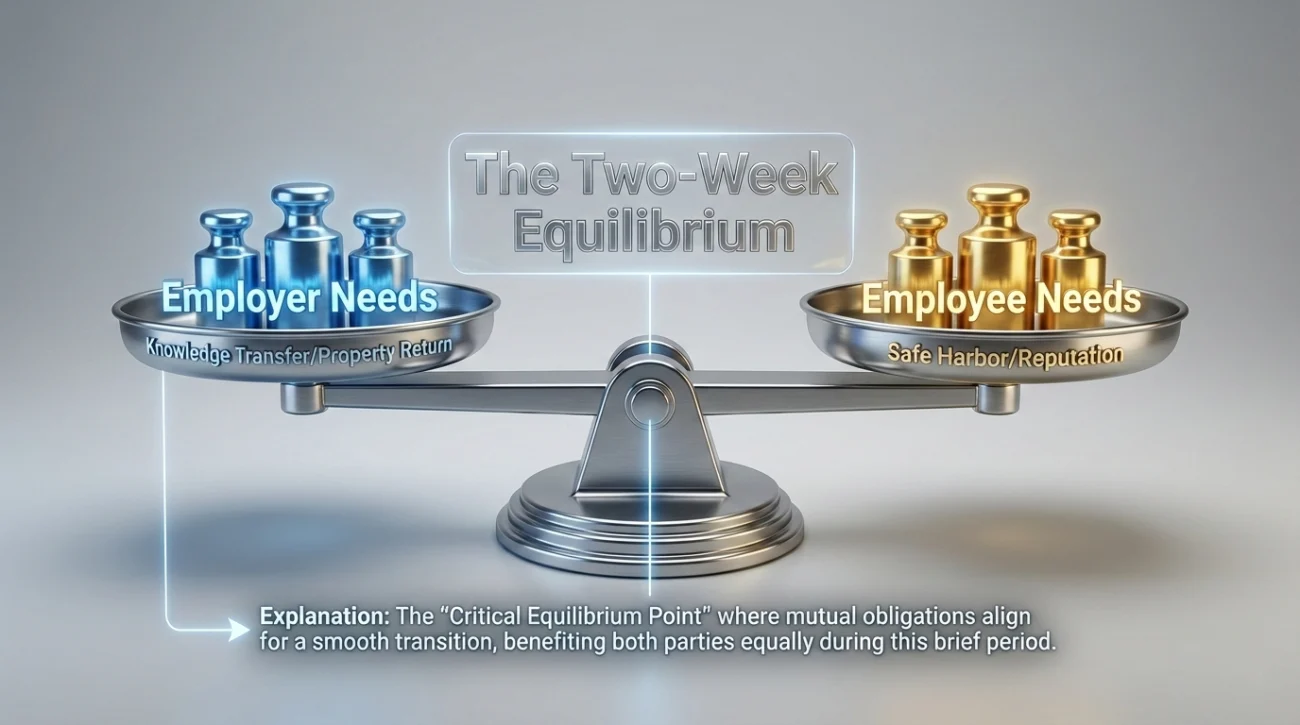
You might wonder why, in an era of rapid change, the two-week period remains the unshakable norm of the corporate world. It is not codified in federal law, and in “at-will” employment states, you technically have the right to pack up your desk and leave at lunch. However, exercising that right is rarely a wise career move.
The two-week convention has evolved as a critical equilibrium point in the workplace ecosystem. For employers, it provides just enough runway to secure company property, transfer knowledge, and perhaps identify an interim solution, though rarely enough time to hire a full replacement. For you, the employee, it offers a “safe harbor” – a period short enough to see the finish line but long enough to demonstrate integrity.
Reputation as Professional Currency
Think of the notice period as an investment in your professional network. Industries are surprisingly small. The manager you leave in the lurch today might be the hiring director at your dream company five years from now. By submitting a formal 2 weeks notice letter, you are signaling that you respect the team’s operational stability. You are showing that you value the relationship more than your immediate convenience. This courtesy is often the deciding factor in whether you receive a glowing reference or a cold confirmation of dates in the future.
The “At-Will” Myth vs. Contractual Reality
While at-will employment is common, many senior roles or specialized positions have specific clauses buried in employment handbooks or initial offer letters. Some companies tie the payout of accrued vacation time or quarterly bonuses strictly to the provision of adequate notice. Failing to provide this window could cost you thousands of dollars in final payouts. Always review your original employment agreement. If it is silent on the matter, the two-week standard is your safest default to avoid breaching implied good faith.
The Anatomy of a Flawless Notice Letter
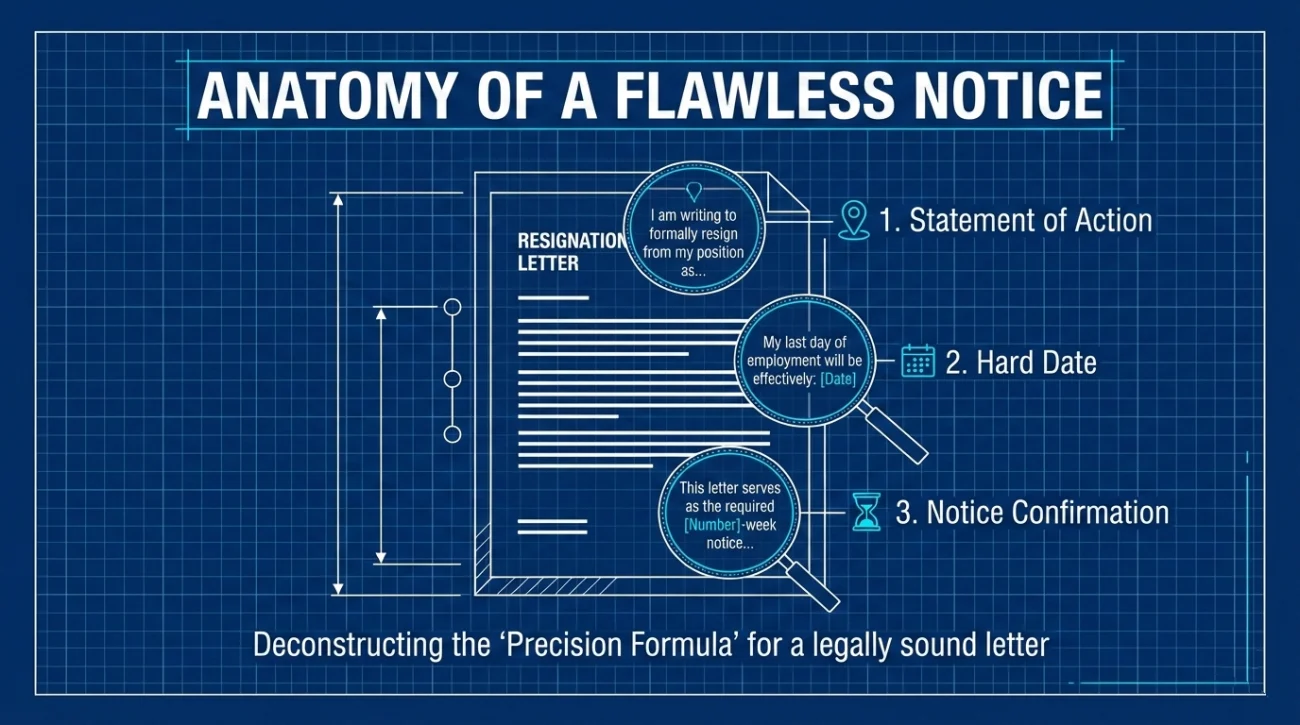
Writing this letter requires a shift in mindset. You are not writing a memoir, a grievance list, or a thank-you card (though it contains elements of the latter). You are writing a formal HR document. HR departments look for three specific data points. If these are missing or vague, you create administrative friction that can delay your final paycheck or complicate benefits rollover.
The Precision Formula
Ambiguity is the enemy of a clean exit. We often see letters that say “I am resigning effectively in two weeks.” This is a trap. Does that mean two weeks from the date on the header? Two weeks from when the manager reads it? Does it include weekends? To avoid this, your opening sentence must be absolute.
A robust standard notice resignation letter must contain:
- 📌 The Statement of Action: “I resign…” (Not “I am thinking about…” or “I intend to…”)
- 📅 The Hard Date: “My final day of employment will be Friday, October 24.”
- ⏳ The Notice Confirmation: “Per professional standards, I am providing this two-week notice.”
This structure eliminates the “he said, she said” scenarios regarding your official termination date, which is crucial for COBRA health insurance triggers and 401(k) vesting schedules.
Calculating Your Exit Date: Avoiding HR Nightmares
The math of resignation is surprisingly complex. A miscalculation here can lead to awkward gaps in insurance coverage or pay. The most common point of confusion is the difference between business days and calendar days.
Business Days vs. Calendar Days
When we say “two weeks,” the corporate world almost universally interprets this as 10 business days or 14 calendar days. If you resign on a Monday, your last day is typically the Friday of the following week. However, submitting notice on a Friday afternoon often pushes the “start clock” to the following Monday, potentially extending your obligation longer than you planned.
To assist you in planning your transition to a new role, use this reference table to align your dates:
| Submission Day | Standard Last Day (10 Business Days) | Why Choose This? |
|---|---|---|
| Monday | Friday (Next Week) | Best option. A clean two-week cycle that allows weekend prep. |
| Wednesday | Tuesday (Week after next) | Awkward. Mid-week departures often feel anticlimactic. |
| Friday | Thursday/Friday (Week after next) | Risky. HR may not process it until Monday, delaying the clock. |
The Holiday Trap
Be hyper-aware of company holidays. If you resign on December 15th, and your office closes for the final week of the year, do those closed days count toward your notice? Most companies will say no. They expect ten working days of handover. If you try to use pre-scheduled holidays to “wait out” your notice period, you risk burning bridges. It is always better to have a transparent conversation: “I know the office is closed next week, so I am happy to extend my official end date to ensure a proper handover,” or conversely, “I will ensure all files are transferred before the holiday break.”
Battle-Tested Templates for Every Scenario
One size rarely fits all. The tone you use for a manager you have worked with for five years should differ from the tone you use for a job you started three months ago. Below are tailored scripts designed to meet specific strategic needs.
The “Good Terms” Standard
Use this when you have a positive relationship, want to keep the door open, and are following standard protocol. This is the safe, professional default.
[Your Name]
[Your Personal Email]
[Your Phone Number]
[Date]
[Manager’s Name]
[Title]
[Company Name]
Dear [Manager’s Name],
Please accept this letter as formal notification that I am resigning from my position as [Job Title] at [Company Name]. My last day will be [Day of Week], [Month Day, Year], providing the standard two weeks of notice.
This was not an easy decision, as I have genuinely enjoyed my time with the team. I am particularly grateful for [mention 1 specific project or opportunity], which has contributed significantly to my professional growth.
For the next two weeks, my priority is to ensure a seamless handoff. I have already begun drafting a status document for my open projects and am available to help train my replacement or distribute my workload as you see fit.
I hope to stay in touch and look forward to seeing [Company Name] continue to thrive.
Sincerely,
[Your Signature]
The “Short Tenure” Resignation
Leaving a job after only a few months is delicate. You need to be firm but appreciative to avoid looking unreliable. This template minimizes the “job hopper” stigma.
Dear [Manager’s Name],
I am writing to formally resign from my position as [Job Title]. My final day of work will be [Date].
While my time here has been brief, I appreciate the opportunity to have worked with you and the team. An unexpected opportunity has arisen that aligns closely with my long-term career path, and after careful consideration, I have decided it is the right time for me to move forward.
I am fully committed to ensuring my departure causes as little disruption as possible. I will work diligently over the next two weeks to wrap up my current tasks and hand over all materials.
Thank you for your understanding.
Sincerely,
[Your Name]
The Remote/Hybrid Worker
Remote exits have logistical hurdles – returning laptops, revocation of digital access, and lack of face-to-face closure. This template addresses those logistics upfront.
Dear [Manager’s Name],
Please accept my resignation as [Job Title], effective [Date]. This letter serves as my formal 2 weeks notice letter.
I have valued the flexibility and trust involved in working with this remote team. To ensure a smooth offboarding, I plan to:
- Upload all local files to the shared Drive by [Date].
- Schedule Zoom handover sessions with [Colleague Name].
- Coordinate with IT regarding the return shipment of my laptop and monitor.
Thank you for the support during my tenure. I wish the team nothing but the best.
Best regards,
[Your Name]
How to Deliver a Two Weeks’ Notice Letter
The document is ready, but the delivery is where the anxiety peaks. There is a right way and a wrong way to handle the act of giving two weeks notice letter to your superior. The “email bomb” – sending the letter at 5:00 PM on a Friday and logging off – is a unprofessional move that will tarnish your reputation instantly.

The Golden Sequence of Events
Respect hierarchy. The news should flow in a specific order to control the narrative.
Step 1: The Calendar Invite. Send a vague but prompt meeting request to your direct manager. Use a subject like “Quick Sync” or “Touch base.” Do not put “Resignation” in the subject line; you do not want them to panic before you can speak.
Step 2: The Face-to-Face (or Zoom). This is the hardest part. Keep it short. “I have enjoyed working here, but I have accepted an offer elsewhere. I wanted to tell you personally before submitting my official notice.” Watch their reaction. Be prepared for shock, silence, or immediate logistical questions.
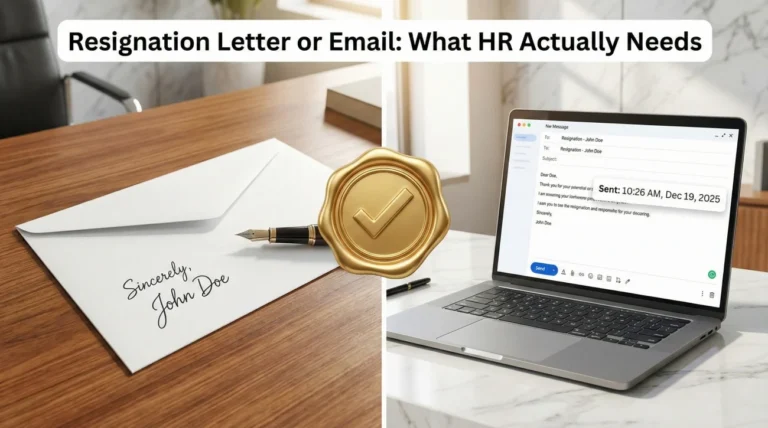
Step 3: The Digital Paper Trail. Immediately after the meeting ends – literally within minutes – hit send on your resignation email. Attach the formal letter. This timestamps your notice and prevents any “I forgot you told me” issues later.
The fourteen days following your resignation can be surreal. You are physically present but organizationally detached. This period is known as the “Lame Duck” session, and it is full of potential pitfalls. Your goal is to remain helpful without being exploited.

The “Bus Factor” Documentation
The greatest gift you can leave your team is a “How-To” guide for your job. We call this reducing the “Bus Factor” – ensuring the project survives if you get hit by a bus (or in this case, resign). Create a shared document containing:
- Key Contacts: Who do you call for X problem?
- Outstanding Deliverables: What is 80% done and needs a final push?
- File Paths: Where is the “final_final_v3.ppt” actually stored?
By handing this over proactively, you control your exit. You prevent the panic calls three weeks later asking, “Where is the password?” For more insights on professional transitions, you can explore our detailed guide on resignation letter with notice period which covers additional logistical steps.
Emotional Discipline
You may feel a sudden urge to be brutally honest about the company’s flaws now that you have “nothing to lose.” Resist this. The exit interview or the lunchroom is not the place to air five years of grievances. Vent to your partner or your therapist, not your coworkers. The “high road” is not just a moral choice; it is a strategic one. Negative comments made during the notice period tend to be amplified and remembered far longer than years of good performance.
Special Scenarios & Curveballs
Sometimes, the standard script falls apart. Real life throws curveballs, and you need to be ready to swing.
The Counteroffer Trap
In practice, many people who accept counteroffers leave within 6 months anyway. Why? Because the underlying issues – lack of growth, bad culture, burnout – are rarely solved by a 10% raise. Furthermore, you have now revealed you have one foot out the door. Your loyalty is compromised in management’s eyes. Unless the offer includes a fundamental change in role and trajectory, a polite “Thank you, but my decision is final” is usually the wisest path.
“You Can Leave Now”
In competitive industries like sales or tech, submitting notice might trigger an immediate security walk-out. They take your badge, cut your email, and escort you out. Do not take this personally; it is often standard data security policy. Before you resign, ensure you have removed all personal files (tax forms, personal photos) from your work laptop. Once you say the words “I resign,” assume you will never touch that keyboard again.
❓ FAQ
🤔 Is the two-week notice legally binding?
In most US states (at-will employment), no, it is not legally binding unless you have a specific employment contract stating otherwise. However, failing to provide it can lead to “Not Eligible for Rehire” status in HR systems and can result in the forfeiture of payout for accrued vacation days, depending on company policy and state law.
🗓️ Do weekends count in the two weeks?
Yes and no. The “two weeks” generally refers to a time period of 14 calendar days, which typically encompasses 10 business days. If you resign on Monday the 1st, your last day is usually Friday the 12th. HR focuses on the number of working days available for knowledge transfer.
🤧 Can I use sick days during my notice period?
This is highly discouraged. Calling in sick during your final two weeks looks suspicious and unprofessional (“senioritis”). Unless you are genuinely ill with a doctor’s note, try to show up. Using sick days to shorten your notice period burns bridges faster than almost any other action.
🗣️ What should I say in the Exit Interview?
Keep it constructive and vague. Focus on “better opportunities” rather than “bad management.” If you must give feedback, frame it as “I think the team would benefit from…” rather than “My manager was terrible at…” Remember, HR protects the company, not you.
Final Thoughts
Resigning is an art form. It requires balancing legal precision with emotional intelligence. By following the protocols outlined above, you ensure that your departure is remembered for your professionalism, not for the chaos you left behind. A well-executed resignation letter with two weeks notice is more than a goodbye; it is the final seal on your track record.
As you move forward, focus on the excitement of the new chapter while closing the current one with grace. Clear your desk, document your work, and shake hands with genuine gratitude. For more detailed guides on specific resignation nuances, ensure you check our full library on resignation strategies and templates.
⚠️ Legal Disclaimer: The resignation templates, email samples, and professional guidance provided in this guide are for informational purposes only and do not constitute legal advice. Employment laws and contract requirements vary by jurisdiction and individual circumstances. Please review your employment agreement and consult your HR department and/or a qualified attorney to ensure compliance with applicable laws and policies.