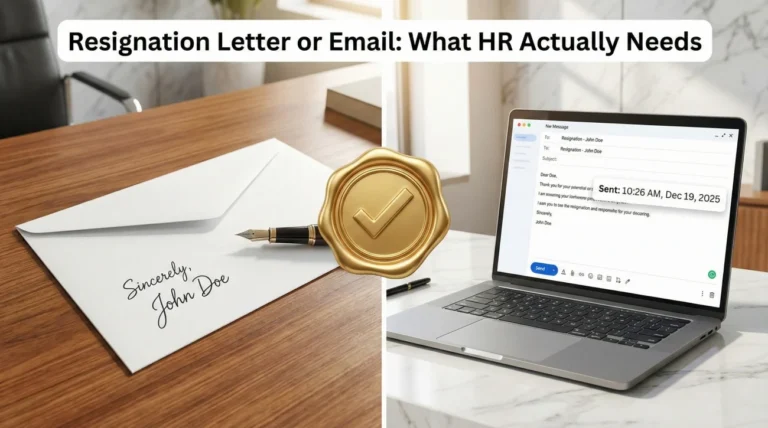
- What it is: A 24-hour notice resignation is an emergency exit, better than ghosting but still a major etiquette breach.
- Why one day matters: It shifts the story from betrayal to crisis, giving your manager one last shift to secure assets, grab knowledge, and control the narrative.
- Money and policy risk: You may forfeit PTO payouts, trigger bonus or tuition clawbacks, and should only expect pay for hours actually worked.
- 8-hour execution plan: Notify early, build one survival handoff doc, do 1:1 handoffs with the true inheritors, then clean up digital and physical loose ends.
- Letter templates and reactions: Use a short apologetic but firm letter by scenario, and be ready for immediate dismissal, reference freeze, or a limited post-exit support ask.
For the full notice process and more examples, see our guide to resignation letter with notice period.
The Final Countdown: Mastering the 24-Hour Notice Resignation
There are moments in a professional career that feel less like a transition and more like an emergency landing. You are not walking away with a slow, graceful two-week glide; you are pulling the parachute cord at the very last possible second. Providing a resignation letter with 24 hours notice is one of the most stressful, high-stakes maneuvers you can execute in the corporate world. It sits in a complex gray zone: it is infinitely better than “ghosting” (quitting without a word), yet it falls far short of the standard professional etiquette we are all taught to respect.
Why does this happen? The reasons are rarely trivial. Perhaps a family medical emergency has spiraled out of control overnight, demanding your immediate, full-time presence. Maybe a new employer has presented a “take it or leave it” offer that starts immediately, forcing you to choose between your past and your future. Or perhaps, you have simply reached a mental or physical breaking point where the thought of one more week feels not just difficult, but impossible. Whatever the driver, you are now in a position where you have exactly one business day – one shift, one rotation, eight hours – to wrap up your affairs, salvage your reputation, and say goodbye.
This guide is your tactical manual for that single, critical day. We will move beyond the guilt and focus entirely on execution. How do you condense two weeks of handover protocols into eight hours? How do you craft a 24 hour notice resignation letter that preserves your dignity and legal standing? And how do you look your manager in the eye and deliver the news without crumbling? Let’s dissect the strategy of the one-day exit, ensuring you leave with your head high and your bridges as intact as possible.
The Psychology of “One Day”: Why It Matters More Than You Think
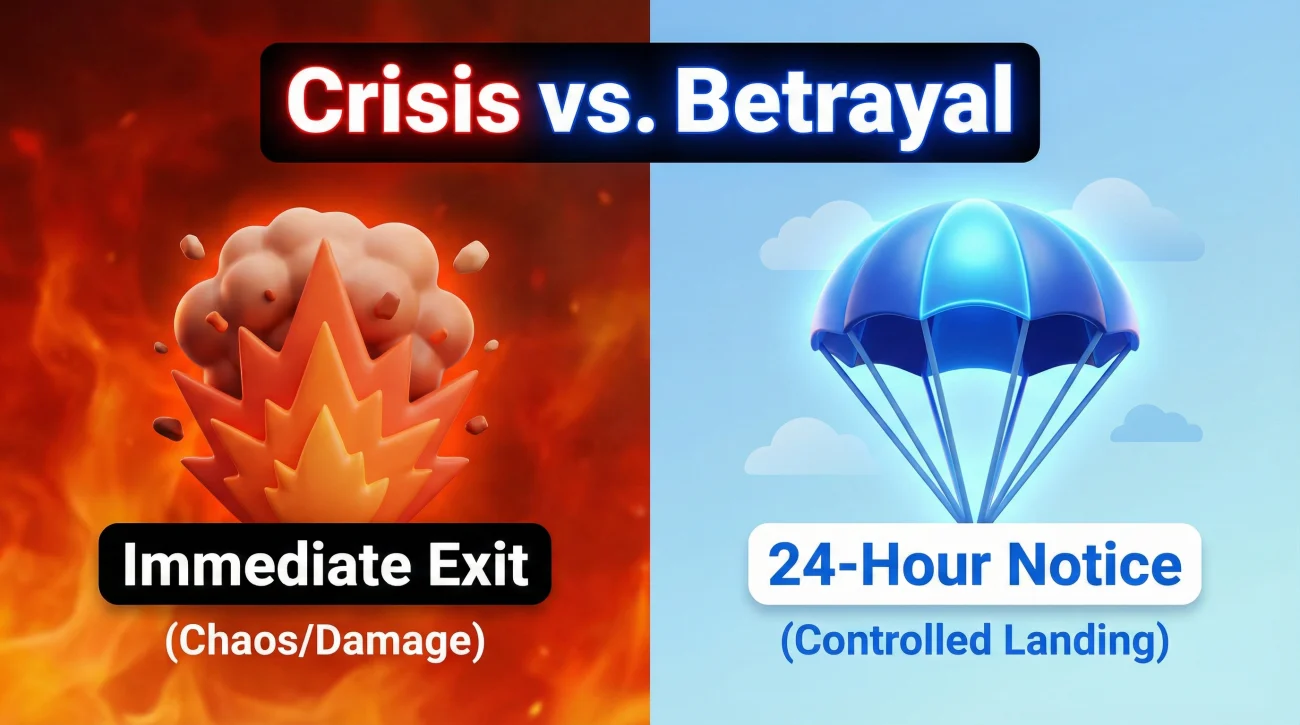
You might wonder: “If I’m leaving so abruptly, does one day even make a difference compared to quitting on the spot?” The answer is a resounding yes. In the eyes of a manager and the broader organization, immediate resignation feels like an attack; a one day notice resignation feels like a desperate compromise. That 24-hour buffer changes the entire psychological narrative of your departure.
The Manager’s Perspective: Crisis vs. Betrayal
When you give 24 hours’ notice, you are essentially signaling: “I am in a crisis, but I respect you enough to give you a fighting chance.” That single day allows the manager to process the shock and take critical actions:
- ✅ Security & Assets: They can secure your keys, access badges, and company credit cards formally, removing immediate security risks.
- ✅ Knowledge Retrieval: They can ask you “where are the files?” and “what is the password?” before your email is deactivated, preventing operational paralysis.
- ✅ Narrative Control: They can control the narrative to the rest of the team, framing your exit as “urgent and personal” rather than “angry and sudden,” which protects morale.
By offering this final shift, you shift the narrative from “they abandoned us maliciously” to “they had to leave urgently due to circumstances.” It is a thin line, but it is often the difference between a neutral reference and a “do not rehire” blacklist status in the HR system.
The Financial & Legal Reality Check
Before you commit to the 24-hour path, you must understand the ledger. Leaving with insufficient notice triggers specific contract clauses and policy quirks that can cost you money.
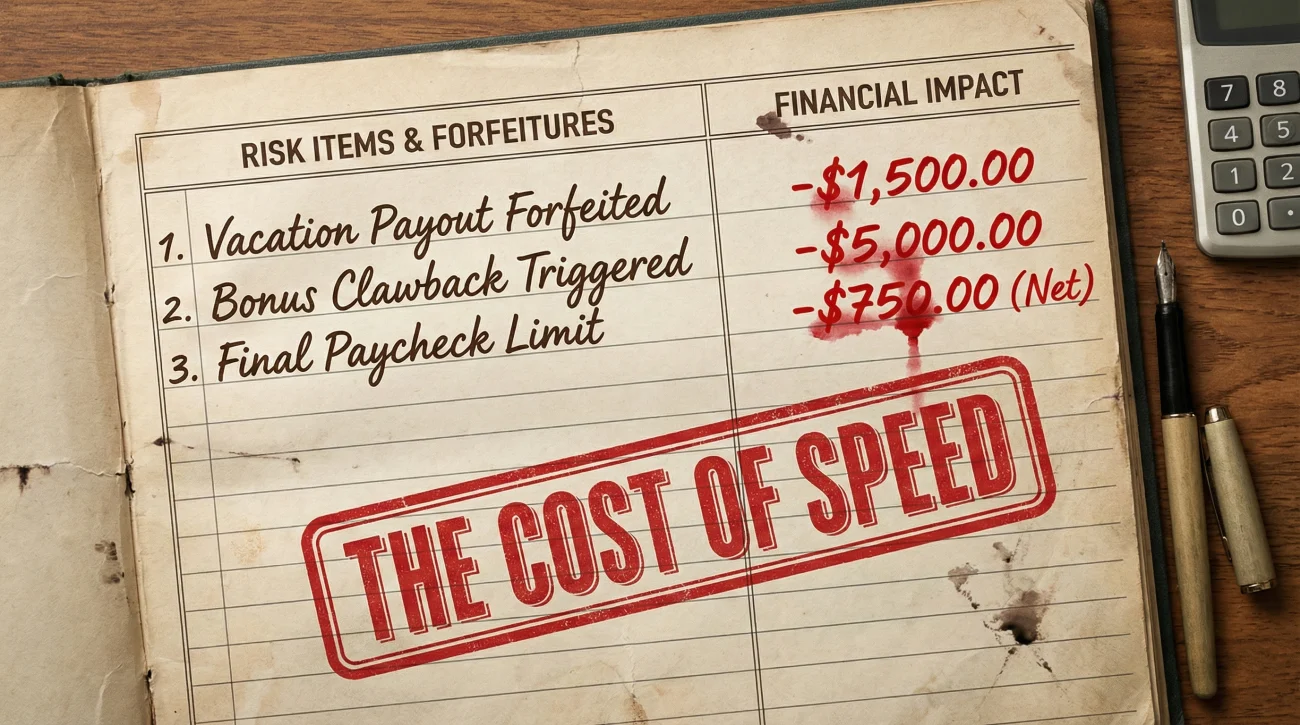
The Cost of Speed
1. Vacation Payouts: In many states (like New York or Texas), companies are only required to pay out accrued vacation time if their written policy says so. Many employee handbooks explicitly state: “Accrued PTO will be forfeited if the employee fails to provide and work a full two-week notice.” By giving only 24 hours, you may be walking away from thousands of dollars in earned leave. Check your handbook immediately.
2. Bonus Clawbacks: If you received a signing bonus, relocation assistance, or tuition reimbursement within the last 12-24 months, check the repayment terms. Often, these agreements require you to not only stay for a set period but also to leave “in good standing.” A short-notice resignation might be classified as “not in good standing,” triggering an immediate demand for repayment.
3. The Final Paycheck: Federal law requires you be paid for the hours you work. If you work that final 8-hour shift, they must pay you for it. However, they are not obligated to pay you for the “notice period you didn’t work.” Do not expect two weeks of severance; expect only pay for the day you are physically present.
The 8-Hour Triage: A Minute-by-Minute Battle Plan
If you only have tomorrow, you cannot do everything. You must operate like an ER doctor: Triage. You need to identify what will “die” without you and save only those things. Here is your battle plan for the final 8 hours.
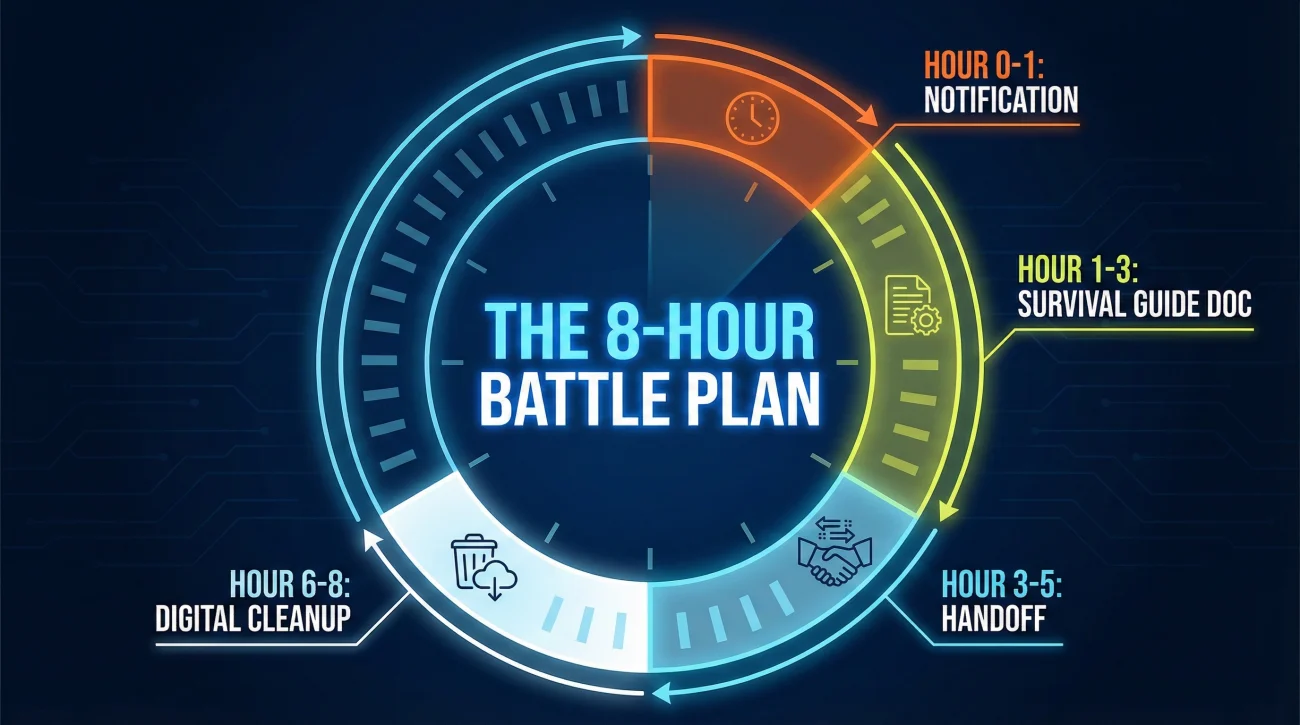
Hour 0-1: The Notification (9:00 AM – 10:00 AM)
Do not wait until the end of the day. Ideally, notify your boss the evening prior (or first thing in the morning before your final shift). Rip the band-aid off. Be direct, apologetic, and firm: “I need to speak with you urgently. I am resigning, and my last day is tomorrow.” Then, when you arrive for your final shift, hand them the printed letter and confirm the handover plan.
Hours 1-3: The “Doomsday” Document
Forget polished reports or long-term strategy docs. Open a blank document and write a “Survival Guide.” This is a raw, functional list. List the passwords only you know. List the client who is angry and needs a call on Tuesday. List the file path for the Q3 budget. Write down the status of every “Red” project. This document is your shield. When you hand it over at 5:00 PM, you prove you aren’t leaving them blind.
Hours 3-5: The Stakeholder Handoff
Do not call a general team meeting; that creates chaos. Identify the 2-3 people who will actually inherit your mess. Sit with them one-on-one. Walk them through your Survival Guide. Say: “I am leaving tomorrow. Here is exactly where I left off.” These colleagues are the ones who will control your reputation after you leave; treat them well. Give them your personal email for “emergency questions only.”
Hours 6-8: The Digital & Physical Clean-Up
Delete your personal files from the laptop. Download your pay stubs and W2s (you will lose access to the portal tonight). Send your farewell emails to mentors and close friends (blind copy them to your personal email). Pack your box discreetly. Do not leave a physical mess for someone else to clean up – that generates more resentment than the resignation itself.
Templates for the 24-Hour Exit
Writing a resignation letter for tomorrow requires a specific tone: Apologetic, firm, and laser-focused on the transition. You do not have the luxury of fluff or flowery gratitude. You need to acknowledge the inconvenience immediately and pivot to the solution.
Scenario 1: The Personal Emergency (High Sympathy)
Use this when a family or health crisis forces your hand. Most employers will soften their reaction when they realize it is a life-event driver. It effectively shuts down any argument.
[Your Name]
[Your Personal Email]
[Your Phone Number]
[Date – Evening prior or Morning of]
[Manager’s Name]
[Title]
[Company Name]
Dear [Manager’s Name],
Please accept this letter as formal notification that I am resigning from my position as [Job Title]. I am providing 24 hours’ notice, with my final working day being tomorrow, [Date].
I sincerely apologize for the abruptness of this notice. A severe personal emergency has developed rapidly that requires my immediate and full-time attention starting [Date after tomorrow]. Under these circumstances, I am physically unable to work the standard two-week notice period.
My goal for tomorrow is to ensure the team is not left in the lurch. I will dedicate my final shift exclusively to:
- ✅ Compiling a status list of all active projects (The “Handoff Doc”).
- ✅ Transferring pending client approvals to [Colleague Name].
- ✅ Organizing all digital assets on the shared drive for easy access.
I will make myself available via email for urgent questions during the next week as I am able. Thank you for your understanding and support during this difficult time.
Sincerely,
[Your Signature]
Scenario 2: The “Take It or Leave It” Job Offer
This is trickier. You are leaving for a better opportunity, which can breed resentment. Frame it as an unavoidable scheduling conflict, not a preference. Do not brag about the new role.
Dear [Manager’s Name],
I am writing to resign from my role as [Job Title], effective tomorrow, [Date].
I recognize that giving a 24 hour notice resignation letter is a significant deviation from professional standards, and for that, I offer my sincere apologies. I have been offered a career-defining opportunity that requires an immediate start date. Despite my efforts to negotiate a standard transition period, the timeline was non-negotiable.
I want to make my final day as productive as possible. I plan to work extended hours tomorrow to finalize the [Key Project] and brief the team on the next steps. I want to leave the team in the best possible position.
I value the relationship I have built with [Company Name] and hope to minimize the disruption of my departure.
Best regards,
[Your Name]
Scenario 3: The Urgent Relocation / Life Change
Use this when housing, visa issues, or partner transfers force a sudden move. It creates a logical “hard stop” date.
Dear [Manager’s Name],
Please accept my resignation from [Company Name]. My last day of work will be tomorrow, [Date].
Due to unexpected changes in my housing/visa arrangements requiring an immediate relocation, I am unable to continue my employment beyond this date. This situation was unforeseen, and I regret that I cannot provide the customary notice.
I have already prepared a handover document outlining my daily responsibilities and key contacts. I will spend tomorrow reviewing this with [Supervisor/Colleague] to ensure a smooth handoff.
Thank you for the opportunity to work here.
Sincerely,
[Your Name]
Employer Reactions: Preparing for the Impact
When you drop a 24-hour notice, you lose control over how the company reacts. You must be prepared for three specific outcomes. Do not be blindsided.
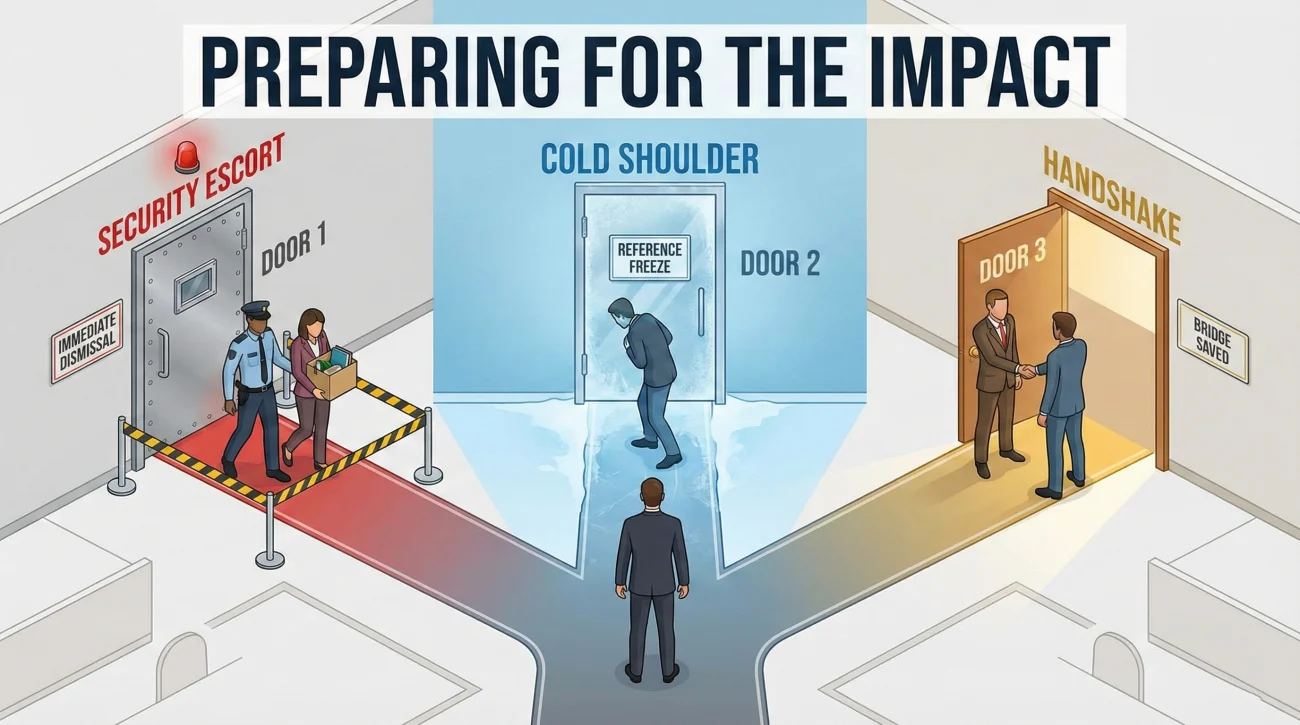
1. The “Just Go Now” (Immediate Termination)
Many managers, upon hearing you are leaving tomorrow, will say: “Don’t bother coming in.” They may view a “short-timer” as a security risk, a distraction, or a morale killer.
Strategy: Be ready to leave today. Have your personal items packed before you send the email. Ensure you have copied your essential contacts to your phone. If they tell you to leave, accept it gracefully: “I understand. I will return my badge now.” Do not argue.
2. The Reference Freeze
You probably won’t get a glowing reference from this manager. They may be angry. However, you can mitigate this by asking for a “Certificate of Service” (confirming dates only, which is standard policy in many large corps) or asking a sympathetic peer for a personal recommendation on LinkedIn. Focus on the work you did, not how it ended.
3. Saving the Bridge via Post-Departure Support
You are burning bridges, but you might be able to save the foundation. The key is “Post-Departure Availability.” In your letter, offer limited support after you leave. “I am happy to answer emails for the next week.” This gesture is powerful. It costs you very little time (most people won’t actually email you), but it signals that you are not abandoning them maliciously. It changes the psychological interpretation of your exit from “selfish” to “unfortunate necessity.”
❓ FAQ
⏰ Is 24 hours notice better than no notice?
Yes, significantly. No notice (walking out) creates panic, chaos, and security fears. 24 hours notice allows for a “knowledge dump,” the return of company property, and a formal goodbye. It preserves a shred of professionalism that “ghosting” destroys completely. It shows you tried.
📧 Should I tell my team or just my boss?
Tell your boss first. Do not let them hear it from the rumor mill. Once you have spoken to your boss, ask how they want to handle the team announcement. In a 24-hour scenario, usually, a quick email or a brief stand-up meeting is best to control the narrative. Do not create drama.
💰 Do I get paid for the last day?
Yes. It is illegal for an employer to withhold pay for hours actually worked. If you work that final 8-hour shift, you must be paid for it. However, if they tell you to leave immediately and not work the shift, you typically will not be paid for that day (unless you have a specific contract stating otherwise).
📉 Will this go on my permanent record?
Internal HR files will likely mark you as “Ineligible for Rehire” due to failure to provide standard notice. However, there is no “permanent record” shared between all companies. Future employers will only know if they call for a reference and your former employer chooses to disclose that you left without proper notice.
🗣️ What do I say in the exit interview?
If they schedule one on such short notice, keep it brief and positive. Do not air grievances. You are already creating friction by leaving early; do not add fuel to the fire by complaining about the culture. “I loved my time here, I just have a personal situation I need to handle.”
Final Thoughts: Execution Over Emotion
Giving a resignation letter with 24 hours notice is uncomfortable. You will feel guilty. You will feel anxious. But remember: employment is a contract, not a marriage. Sometimes, the terms of that contract no longer fit the reality of your life.
Your job now is not to feel bad; it is to execute well. Be professional, be helpful, and be gone. If you handle your final 24 hours with grace and efficiency, you will be surprised at how much respect you can retain, even as you race toward the exit. Finish strong, even if you are finishing fast.
⚠️ Legal Disclaimer: ResignSmartly provides general informational guidance about resignation, workplace communication, notice periods, handovers, and career transitions. Content does not constitute individualized legal advice. Employment laws, contracts, workplace policies, and individual circumstances vary, so review the requirements that apply to your situation and consult an appropriate qualified professional when needed.