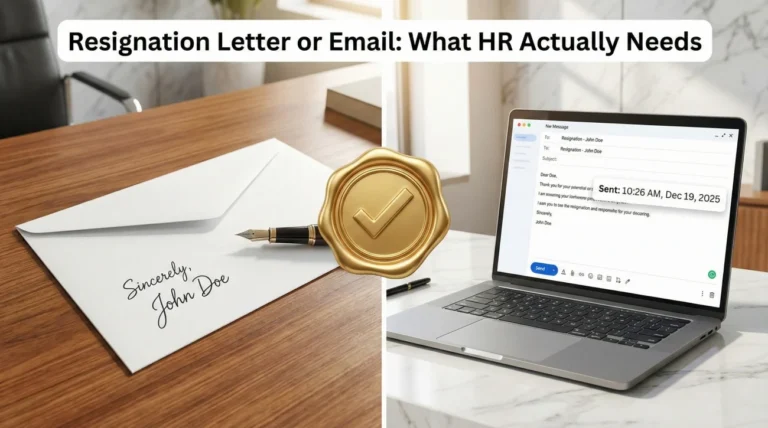

- Core idea: A one-month notice for senior roles is reputation management, because you are exiting with institutional knowledge, client trust, and political capital.
- Why two weeks can backfire: Contract clauses, bonus and equity forfeits, and a rushed handover can turn years of good work into a “left us in chaos” memory.
- 4-week blueprint: Week 1 control the narrative and notify in the right order, Week 2 document bus-factor knowledge and transfer access, Week 3 reverse-shadow your successor, Week 4 close loops and transfer trust with stakeholders.
- Counter-offer trap: Most counter-offers do not fix root issues and can damage trust, so decline politely and stay focused on a clean transition.
- Execution tools: Use a role-appropriate letter template with a concrete transition plan, avoid lame-duck drift by shifting into advisor mode, and finish with gratitude that keeps bridges intact.
The Strategic Art of the Long Goodbye: Mastering the One-Month Notice
In the high-stakes theater of corporate leadership, the exit is just as critical as the entrance. When a junior associate leaves, it is a logistical hiccup – a shift to cover, a password to reset. But when a senior manager, a technical architect, or a director departs, it triggers a structural tremor. You hold the keys to client relationships, the historical context of critical decisions, and the subtle political capital that keeps projects moving. This is why the standard two-week notice is often deemed insufficient for your level. Drafting a resignation letter with one month notice is not merely a bureaucratic checkbox; it is a sophisticated maneuver in reputation management.
For many high-performers, the prospect of lingering for thirty days after dropping the resignation bomb feels excruciating. It creates a professional limbo – a “lame-duck” period where you are physically present but strategically detached. The impulse is often to hide, to coast, or to count down the hours. However, this perspective is a strategic error. This extended timeline is arguably the most defining month of your tenure. It is your final opportunity to solidify your legacy, transforming what could be a chaotic vacuum into a masterclass in leadership succession.
If handled poorly, these four weeks can unravel years of hard work, leaving your team feeling abandoned and your professional network fractured. But if executed with precision, this period becomes the ultimate testament to your integrity. This comprehensive guide goes far beyond the basics of “giving notice.” We will dissect the granular strategy of a 30-day exit, covering everything from the psychology of the “counter-offer panic” to the specific architecture of a handover that preserves your bridges for decades to come.
Why the “Standard” Two Weeks Is Dangerous for Senior Roles
In the landscape of American employment, the concept of “at-will” work creates a widespread illusion of instant mobility. While you technically can often leave with minimal notice, the professional norms for senior roles operate on a much higher frequency of obligation. The complexity of your portfolio dictates the courtesy required, and violating this unwritten code can have repercussions that echo throughout your career.

The Burden of Institutional Knowledge
Senior roles are rarely plug-and-play. You do not just execute tasks; you own outcomes and histories. You know why the Q3 marketing strategy failed two years ago, you hold the personal cell phone numbers of key clients, and you understand the “spaghetti code” of the legacy system that holds the database together. A 4 weeks notice resignation is often the minimum viable timeframe to extract this deep, tacit knowledge from your mind and document it for your successor. Leaving sooner often forces the company into crisis mode, scrambling to decipher your work. This panic is exactly what will be remembered vividly during future reference checks, overshadowing years of excellent performance. You want to be remembered as the person who left a roadmap, not a riddle.
The Legal Reality: Read Before You Leap
Beyond professional courtesy, there are often hard legal realities lurking in your filing cabinet. Unlike standard employment offers, executive or senior technical contracts frequently contain explicit notice clauses. These can range from 30 days to 3 months – standard practice in finance, healthcare, and high-tech sectors where continuity is paramount. Violating a contractual 30 day notice resignation letter requirement can trigger severe financial penalties.
We have seen cases where executives forfeited substantial unvested stock options, lost out on quarterly bonuses, or triggered “clawback” provisions simply because they cut their notice period short by a few days. Before you set your exit date, dust off your original employment contract and read the fine print. If the contract stipulates 30 days, 29 days is a breach.
Preserving Relationship Equity
Finally, consider the human element. Your team relies on you for direction, protection, and mentorship. An abrupt exit signals a lack of care for their wellbeing. By committing to a full month, you are sending a powerful signal: “I care enough about this team to ensure you are safe before I go.” This preserves your “relationship equity” – the goodwill you have built up over time. In a small industry, your former direct report today could be your client, partner, or even hiring manager tomorrow.
The 4-Week Blueprint: A Weekly Tactical Guide
The biggest danger of a one-month notice is drifting aimlessly while the organization bypasses you. To avoid this, you must treat your resignation period as a distinct project with clear phases, KPIs, and deliverables. Here is the week-by-week battle plan.
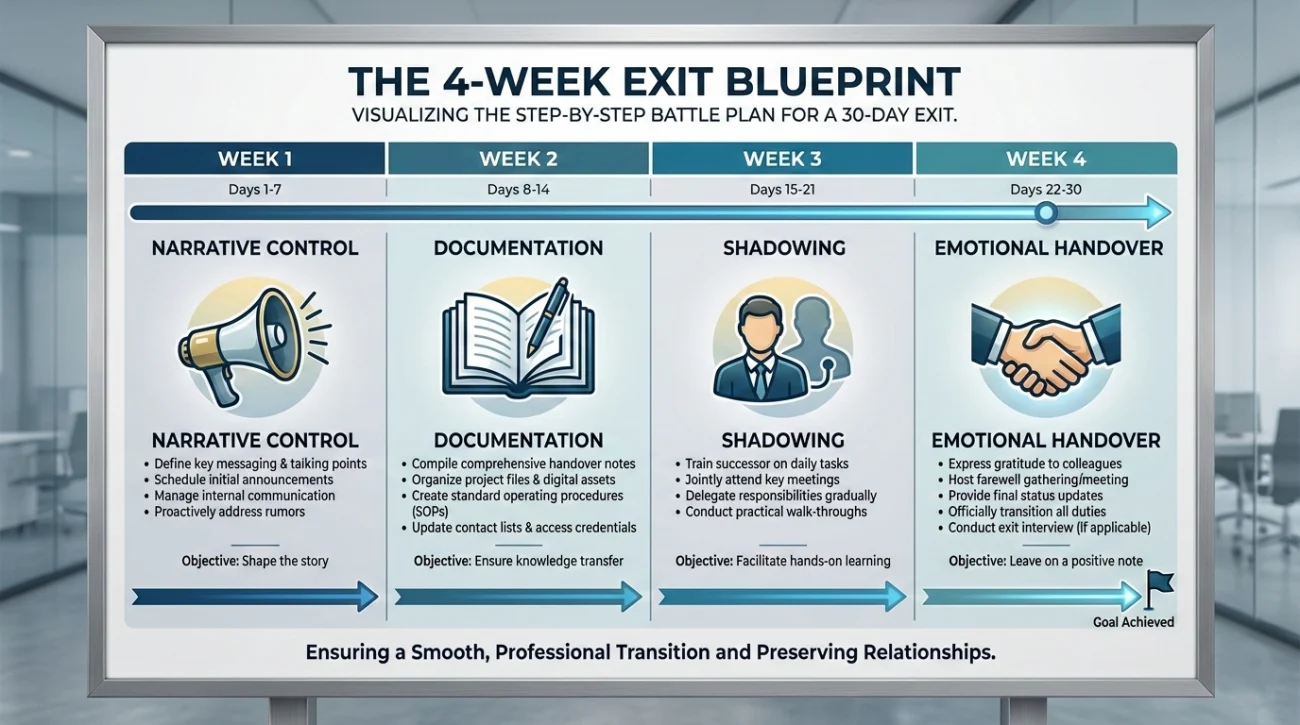
Week 1: The Narrative Control & The Shock Absorber
The Objective: Manage the emotional fallout and control the rumor mill.
Once you submit your resignation letter with one month notice, the clock starts ticking. Your first and most urgent priority is controlling the story. In the absence of facts, people invent fiction. If you disappear into closed-door meetings with HR without explanation, rumors will start: “Is the company in trouble?” “Was she fired?”
Action Items:
- • The Hierarchy of Notification: Tell your boss first, then your direct reports, then key peers. Do not let your team find out from a company-wide email. That is a betrayal of trust.
- • The “Why” Script: Develop a consistent, positive script. “I’ve been offered an opportunity to lead a new division at X, which aligns with my long-term goals.” Keep it about pull factors (what draws you to the new job), not push factors (what you hate about this one).
- • The Client Triage: Identify the top 20% of clients who generate 80% of revenue. Plan personal calls for them. Do not email this news.
Week 2: The “Bus Factor” Documentation
The Objective: Extracting knowledge from your head to paper.
This is the “heavy lifting” phase. You need to reduce the “Bus Factor” – the risk that if you got hit by a bus, the project would die. Do not just forward emails and hope for the best. You need to create a master document – often jokingly referred to as “The Bible” or “The Survival Guide.”
Action Items:
- • Project Status Dashboard: Create a simple Red/Yellow/Green status for every active initiative. What is on fire? What is on cruise control?
- • The “Who’s Who” Map: If you are a sales director, annotate your CRM not just with contact info, but with the personal quirks of your biggest clients. “John at Acme Corp hates Monday morning calls. Verify invoices twice for Sarah at TechGlobal.”
- • Access & Permissions: Audit your digital footprint. Do you own the master admin key for the AWS server? Are you the only signer on a vendor account? Transfer these permissions now, not on your last day.
Week 3: The Shadowing & Training Phase
The Objective: Hands-on succession.
By now, an interim or permanent replacement should be identified. If not, you must designate a delegate from your current team. Week 3 is about “watching and doing.”
Action Items:
- • The Reverse Shadow: Instead of you doing the work while they watch, have them do the work while you watch. Let them run the weekly stand-up meeting. Let them draft the client update. Correct them privately, praise them publicly.
- • The “Skeletons in the Closet” Meeting: Have a candid, off-the-record conversation with your successor. Tell them where the bodies are buried. “This vendor is difficult,” “This metric is currently inflated due to seasonality.” They will appreciate the honesty more than anything else.
Week 4: The Emotional Handover & Exit
The Objective: Closing loops and saying goodbye.
By the final week, the technical work should be finished. If you are still coding or writing reports in Week 4, you have failed at delegation. Now, shift your focus entirely to relationships.
Action Items:
- • The Trust Transfer: When you introduce the new leader to a client, you aren’t just making an introduction; you are transferring your credibility. “I trust this person implicitly” is the most valuable gift you can give.
- • The Gratitude Tour: Send personal notes to mentors, peers, and support staff. Not a blast email. Individual notes. These are the seeds of your future network.
- • The Exit Interview Strategy: Keep it constructive. The exit interview is not a therapy session. Venting now feels good but achieves nothing. Frame feedback as “opportunities for the next person.”
The Psychology of the Counter-Offer: A Trap for the Unwary

When you submit a resignation letter with one month notice, you give your company a long time to panic – and to plot how to keep you. It is highly likely you will receive a counter-offer during this period. They may offer a raise, a title bump, or promises to “fix” the culture issues you complained about.
Why You Should Likely Decline:
A widely cited rule of thumb is that many employees who accept counter-offers still leave within months anyway. Why? Because the trust is broken. You are now the person who “threatened” to leave. The next time there are layoffs, you are at the top of the list. The next time there is a promotion, they might hesitate, wondering if you will just leave again. Furthermore, money rarely solves the structural issues that made you want to leave in the first place.
If you receive a counter-offer, be flattered but firm: “I deeply appreciate the gesture and the valuation of my work, but my decision is based on a new strategic direction for my career, not just compensation. I am committed to making this transition smooth.”
Templates for the Long Goodbye
Writing a letter for a one-month notice differs from a standard resignation. It requires more emphasis on the transition plan. A vague “I will help however I can” is not enough; you need to demonstrate a concrete roadmap to reassure leadership.
The Senior Manager / Director Template
This template is designed for leaders who need to reassure their superiors that the department will not collapse in their absence.
[Your Name]
[Your Private Email]
[Your Phone Number]
[Date]
[Executive’s Name]
[Title]
[Company Name]
Dear [Executive’s Name],
Please accept this letter as formal notification of my resignation from the position of [Job Title], effective [Month Day, Year]. Per our employment agreement and to ensure a comprehensive leadership transition, I am providing this one-month notice.
Leading [Department Name] has been a privilege, and I am proud of the milestones we have achieved, particularly [mention one major win]. My goal now is to preserve this momentum and ensure the team remains focused during this change.
I have outlined a 4-week transition plan to ensure zero disruption:
- • Week 1: Communication & Audit: Announcement to the team and audit of Q3 budgets/performance reviews.
- • Week 2: Documentation: Finalizing the 2024 Strategic Roadmap and documenting key vendor contracts.
- • Week 3: Handover: Intensive shadowing sessions with [Interim Name] and delegation of daily approval workflows.
- • Week 4: External Stakeholders: Introduction calls with our top 10 clients to personally introduce my successor.
I am fully committed to the team’s success until my final hour. Thank you for your mentorship and trust over the years.
Sincerely,
[Your Signature]
The “Key Person of Influence” Template
For specialized roles (Lead Architect, Senior Counsel, Head of Product) where you are the sole owner of critical information. This letter emphasizes knowledge transfer over management transition.
Dear [Manager’s Name],
I am writing to submit my 30 day notice resignation letter for the role of [Job Title], with my final day being [Date].
Given the technical complexity of my current projects, specifically [Project X], I understand the importance of a detailed handover. I want to ensure that my departure does not delay the upcoming launch and that the engineering team feels fully supported.
Over the next month, I will prioritize creating detailed technical documentation and “runbooks” for the system. I propose we schedule weekly milestone check-ins to review the transfer of these assets. Specifically, I will deliver:
- • Complete API documentation for the new module.
- • A troubleshooting guide for known legacy bugs.
- • A recorded walkthrough of the deployment architecture.
Thank you for the opportunity to build such impactful technology here. I look forward to a productive final month.
Best regards,
[Your Name]
The Executive Notice Letter (Board Facing)
At the C-Suite or VP level, your departure is a governance issue. This executive notice letter must be formal, brief, and board-ready. It often becomes part of the official corporate record.
Dear [CEO or Board of Directors],
It is with a mix of gratitude and resolve that I tender my resignation as [Title], effective [Date]. This provides the requisite notification period as stipulated in my contract.
I remain deeply committed to the vision of [Company Name]. My focus during this transition period will be on internal stability and external stakeholder management, ensuring our investors and partners retain full confidence in the organization’s direction.
I will prepare a detailed succession briefing for the Board by [Date], highlighting key strategic risks and opportunities for the incoming leadership. I am also available to assist in the recruitment of my replacement to ensure a seamless fit for the culture we have built.
Respectfully,
[Your Name]
Avoiding the “Lame-Duck” Syndrome

One of the hardest parts of a long notice period is the feeling of irrelevance. You might find yourself uninvited from strategy meetings for next year. Your opinion might carry less weight. This is natural, but painful.
How to Handle It:
- • Accept the Shift: Do not be offended when you are excluded from long-term planning. It is actually appropriate. Why should you vote on a budget you won’t manage?
- • Pivot to “Consultant” Mode: Stop trying to be the decision-maker. Become the advisor. When asked for an opinion, say, “If I were staying, I would do X, but since [Successor] is taking over, you should see if that aligns with their vision.”
- • Don’t Check Out Early: The temptation to come in late and leave early will be strong. Resist it. Your team is watching. If the captain stops caring, the crew stops rowing.
For more insights on maintaining professionalism during this delicate time, you can refer to our comprehensive pillar on resignation letter with notice period.
❓ FAQ
🗓️ Is a one-month notice exactly 30 days or 4 weeks?
This is a common point of confusion. It depends on your contract and company culture. Usually, “one month” implies a calendar month (e.g., Feb 15 to March 15), whereas “four weeks” implies 20 business days (or 28 calendar days). To avoid ambiguity, never just say “one month.” Always state the specific final date in your letter: “My last day will be Friday, November 17.” This clarity prevents payroll disputes later.
💼 Can I leave earlier if I finish my handover?
You can negotiate, but do not assume. If you complete your handover in two weeks, you might propose an early exit to save the company salary costs. However, many companies prefer you stick to the agreed date for availability insurance – just in case something breaks. Always get an early release agreement in writing to protect your final paycheck and ensure you aren’t marked as “job abandoned.”
💰 Do I get my bonus if I resign before the payout date?
This is the most common “gotcha” in senior resignations. Most bonus structures require you to be “employed and in good standing” on the day of payout, not just the end of the quarter. If you submit a 4 weeks notice resignation that ends one day before bonus day, you often lose 100% of that money. Check your compensation plan meticulously before hitting send.
🚫 What if they tell me to leave immediately (Garden Leave)?
In senior roles, particularly in sales or finance, companies often place resigning employees on “Garden Leave.” This means you remain on the payroll for the notice period but are forbidden from working or contacting clients. Enjoy it. It is a protective measure for them and a paid vacation for you. Do not violate the terms by contacting clients secretly – that can lead to lawsuits.
📉 Can they reject my resignation notice?
Legally, resignation is a unilateral notification, not a request. They cannot “reject” it to force you to stay (that would be indentured servitude). However, they can dispute the terms. For example, they might claim you owe them more time per contract or that you must pay back a signing bonus. If you are leaving for a direct competitor, expect a deeper legal review of your non-compete clauses.
Final Thoughts: Your Legacy is Defined by Your Exit
The transition from a senior role is not a single event; it is a month-long process of deliberate action. The resignation letter with one month notice is merely the opening bell of a 30-day performance that requires emotional intelligence, strategic foresight, and unwavering professionalism. How you act in these final weeks will be the enduring memory people hold of you.
Resist the urge to coast. Use this time to mentor, to organize, and to say “thank you” properly. When you treat your exit with the same care and excellence as your tenure, you ensure that your reputation as a leader remains intact. The bridges you reinforce today are the ones you may need to cross again in the future.
⚠️ Legal Disclaimer: ResignSmartly provides general informational guidance about resignation, workplace communication, notice periods, handovers, and career transitions. Content does not constitute individualized legal advice. Employment laws, contracts, workplace policies, and individual circumstances vary, so review the requirements that apply to your situation and consult an appropriate qualified professional when needed.