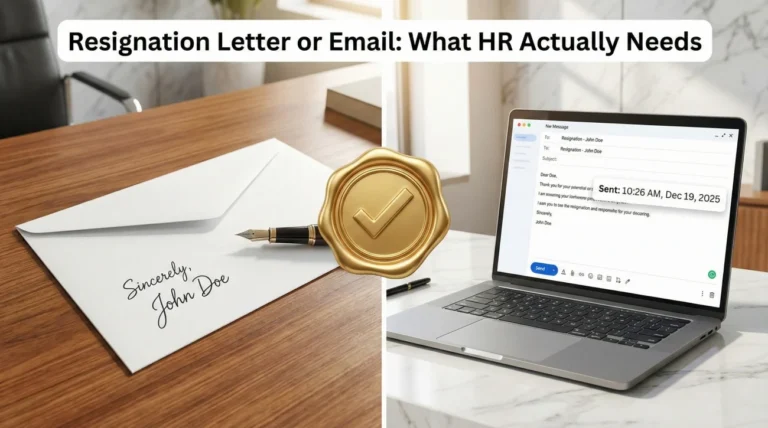

- Main idea: “Personal reasons” is professional boundary language that ends employment without inviting disclosure.
- When to use: Family changes, health or mental health needs, caregiving, private transitions, or values conflicts you do not want documented.
- Letter structure: State resignation, role, effective date, brief “personal circumstances” line, and a clear transition commitment.
- Handling questions: Use calm boundary phrases and redirect to handover, you can keep exit interviews private while still giving work feedback.
- Avoid pitfalls: Do not over-explain or invent reasons, keep integrity, protect references by leaving in good standing and framing it as not performance-related.
The Power of Privacy in Professional Departures
Some departures demand privacy. Whether you’re dealing with family crises, personal health struggles, relationship changes, or simply circumstances you prefer not to discuss at work, a resignation letter for personal reasons provides professional closure without unwanted disclosure. This approach has become the accepted professional language for “I’m leaving, and the specifics are private.”
The phrase “personal reasons” functions as a protective boundary in workplace communications. It signals that your departure stems from private matters beyond employer control while maintaining professional courtesy. Most managers understand and respect this language, recognizing that some life situations require discretion rather than detailed disclosure.
Why Personal Reasons Work
Citing personal reasons isn’t vague or evasive; it’s strategic communication that protects your interests while acknowledging reality. This approach respects both your privacy and your employer’s need for basic documentation.

Establishing Professional Boundaries
The effectiveness of resignation due to personal reasons lies in its universally understood meaning. When you invoke personal reasons, you’re using established professional code that translates to: “This decision involves private matters I’m not obligated to share, and I trust you’ll respect that boundary.”
This language works across industries because it respects both parties’ positions. Your employer receives necessary notification without being forced into prying into your private life or wondering if workplace problems drove your departure. You preserve privacy without appearing defensive.
The key is confident delivery. State clearly that personal circumstances require your departure, then transition immediately to professional transition commitments. This establishes that your boundary is firm and reasonable.
What Qualifies as Personal Reasons
Personal reasons encompass any private circumstances you prefer not to detail in workplace documentation:
- Family relationship changes including separation or divorce
- Mental health needs requiring focused attention
- Caregiving responsibilities for family members
- Personal health concerns you wish to keep private
- Life transitions like returning to education or career exploration
- Personal values conflicts with company direction
- Financial circumstances requiring lifestyle changes
These situations range from deeply sensitive to simply private preference. You don’t need a dramatic crisis to invoke personal reasons – sometimes certain life details simply don’t belong in your employment file.
Writing Your Personal Reasons Letter
The most effective personal reasons resignations balance brevity with professionalism. You’re providing enough context to prevent speculation while maintaining firm boundaries.

Key Components
Every resignation letter for personal reasons should include:
- 📋 Clear resignation statement with your position title
- 📅 Specific effective date (typically two weeks out)
- 🔒 Brief mention of personal circumstances without details
- 🤝 Commitment to support transition within notice period
- ✨ Professional closing acknowledging opportunities gained
What you exclude matters as much as what you include. Avoid apologies seeking permission to leave. Skip explanations of your decision-making process. Don’t justify why personal circumstances outweigh work commitments. Simply state your decision with confident professionalism.
Resignation Letter Templates
These templates demonstrate how to cite personal reasons across different privacy levels and circumstances. Adapt the language to match your comfort level with disclosure while maintaining professional standards.
Maximum Privacy Template
When you want to provide minimal information, this template establishes clear boundaries. For guidance on complementary strategies, see our comprehensive resignation letter with reason guide.
Alexandra Martinez
567 Pine Street
Seattle, WA 98101
April 15, 2024
Robert Chen
Director of Operations
Pacific Software Solutions
Dear Robert,
I am writing to formally resign from my position as Senior Developer, effective April 29, 2024.
Personal circumstances require my immediate attention at this time. I will ensure all current projects are properly documented and work with the development team to facilitate a smooth transition.
Thank you for the professional opportunities during my tenure.
Sincerely,
Alexandra Martinez
This letter provides zero specifics beyond acknowledging personal matters. The phrase “immediate attention” suggests urgency without inviting questions. This approach works when you simply don’t want to discuss your reasons.
Family Matters Template
When you’re comfortable acknowledging family circumstances drive your decision without providing identifying details, this template offers context while maintaining privacy:
David Thompson
892 Oak Avenue
Portland, OR 97204
May 8, 2024
Jennifer Wu
Human Resources Director
Northwest Manufacturing
Dear Jennifer,
I am submitting my resignation from my position as Production Supervisor, effective May 22, 2024, providing the standard two weeks’ notice.
Family matters require my presence and attention in ways that are incompatible with my current work responsibilities. I will work closely with my replacement to document all standard operating procedures and ensure continuity for the team.
I appreciate the leadership opportunities Northwest Manufacturing has provided during my employment.
Sincerely,
David Thompson
This version acknowledges “family matters” without specifying whether that means caregiving needs, relationship changes, or other obligations. The phrase “incompatible with current work responsibilities” explains why adjustments won’t solve the problem without detailing specifics.
Responding to Follow-Up Questions
Even when your vague resignation letter clearly establishes boundaries, you may face questions from managers, HR, or colleagues. Preparing responses helps you maintain privacy without appearing defensive.
Boundary-Setting Phrases
When asked for more details, these phrases help you maintain boundaries respectfully:
“I appreciate your concern, but these are private matters I prefer not to discuss in detail. I’m confident in my decision and committed to a professional transition.”
“Thank you for understanding. This decision involves family situations that require privacy. I’d prefer to focus our remaining time together on ensuring a smooth handover.”
These responses acknowledge concern while firmly maintaining your boundary. The key is confidence without defensiveness – you’re not rudely shutting down conversation, you’re politely indicating that this topic isn’t open for discussion.
For HR exit interviews, you have several options: maintain complete privacy (“My resignation letter accurately reflects my situation”), provide partial context (“Family obligations have changed significantly”), or redirect focus (“Rather than dwelling on my reasons, I’d prefer to provide feedback on what worked well and suggestions going forward”). Exit interviews aren’t interrogations – brief, polite answers maintaining privacy are entirely appropriate.
Common Mistakes to Avoid
Certain approaches to resignation letter personal matters create more problems than they solve. Understanding these pitfalls helps you maintain both privacy and professionalism.
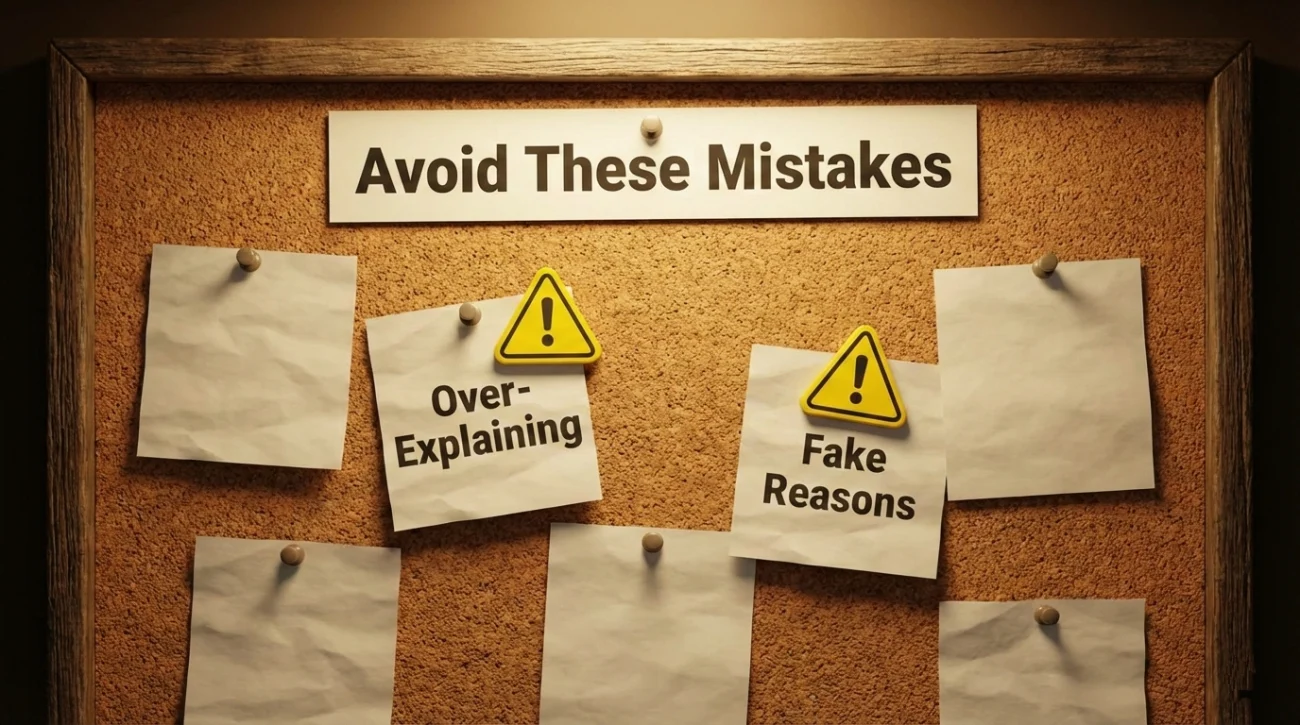
Don’t Over-Explain Your Decision
The impulse to justify your decision often leads to revealing more than necessary. Once you start explaining, managers may feel entitled to question your reasoning or offer solutions that might keep you from leaving.
Problematic:
“My mother’s health has been declining and my father can’t manage alone anymore, plus my sister lives too far away to help regularly, and I’ve been researching care facilities but they’re too expensive…”
Better:
“Family circumstances require my presence and attention in ways that are incompatible with my current position.”
The detailed version invites questions about alternatives. The brief version establishes that you’ve already determined this decision is necessary.
Don’t Fabricate Specific Reasons
Some departing employees create false narratives – claiming they’re moving when they’re not or inventing sick relatives. This strategy backfires when you’re spotted around town after your supposed relocation or when your fabricated story unravels.
“Personal reasons” is already professionally acceptable. You don’t need to upgrade to something more specific. The generic phrase maintains your privacy while preserving your integrity.
Protecting Your Professional Reputation

One concern about personal reasons resignations is whether vagueness damages your ability to secure strong references. Generally, the opposite proves true: professionally handled privacy boundaries often generate more respectful references than detailed explanations that might raise questions.
Before departing, have a brief conversation with managers you hope to use as references: “I want you to know that my resignation stems from personal circumstances requiring my attention. If you’re comfortable serving as a reference, I’d appreciate it. This departure isn’t about dissatisfaction with the role or organization.”
This gives your reference context to share: “She left to handle personal matters unrelated to job performance or workplace issues. She was a strong contributor during her time here.”
❓ FAQ
🔒 Can my employer demand to know my personal reasons?
No, employers generally cannot legally compel disclosure of personal circumstances that don’t affect workplace safety or compliance. Employment is typically at-will, meaning you can resign for any legal reason or no stated reason. However, if claiming certain benefits like FMLA leave or disability accommodations, you may need supporting documentation. For routine resignations, “personal reasons” satisfies documentation requirements without detailed disclosure.
💼 Will citing personal reasons hurt my rehire chances?
Personal reasons resignations typically don’t damage rehire eligibility when you maintain professionalism throughout your departure. Most HR systems note you resigned voluntarily in good standing. To preserve rehire options, ensure your letter remains positive, fulfill your notice period, and maintain good relationships with managers. Personal circumstances that required departure initially may change, and organizations often welcome back strong performers who left on good terms.
⏱️ How much notice should I provide for personal reasons?
Standard two-week notice applies unless your situation constitutes a genuine emergency requiring immediate departure. If circumstances allow, providing full notice demonstrates professionalism that preserves relationships and references. For true emergencies – medical crises, urgent family situations – shorter notice is acceptable. Explain briefly: “Personal circumstances require my immediate attention, making my departure effective this Friday. I will document all critical information during my remaining time.”
📝 Should I provide more details in my exit interview?
You’re not obligated to provide more detail in exit interviews than in your letter. However, if you have workplace feedback unrelated to your personal reasons, exit interviews offer appropriate venues. You can separate topics: “My departure stems from personal circumstances I prefer to keep private. However, I’d like to share observations about team processes that might help improve operations.” Exit interviews aren’t recorded in your personnel file the same way resignation letters are.
🤐 What if colleagues spread rumors about why I’m leaving?
Workplace speculation is common when people resign for stated resignation letter personal matters without details. You can’t control others’ speculation, but you can control your response. Maintain your privacy boundary consistently: “I’m not discussing the specifics, but I appreciate everyone’s support during this transition.” Most rumors fade quickly once you’ve departed. Protecting your privacy proves more valuable long-term than temporarily satisfying colleagues’ curiosity.
Final Thoughts
Privacy in professional contexts isn’t evasion – it’s recognition that not every personal circumstance requires public disclosure. A well-crafted resignation letter for personal reasons honors both your privacy needs and your professional obligations, creating closure without unwanted exposure.
The phrase “personal reasons” has earned its place in professional vocabulary because it serves legitimate purposes. You receive documentation of your voluntary departure without compromising sensitive information. Your employer receives required notification without being forced into intrusive questioning or speculation about workplace problems.
Trust your judgment about what to share and what to protect. If keeping details private feels right, honor that instinct. Your resignation letter becomes permanent documentation that may be reviewed years later. When in doubt, err toward privacy – you can always provide verbal context later, but you cannot retract information once documented.
Handle your departure with professionalism: provide adequate notice when possible, support your team’s transition needs, and maintain positive relationships. Personal circumstances requiring your attention deserve that focus without guilt, apology, or forced disclosure to satisfy others’ curiosity.
⚠️ Legal Disclaimer: ResignSmartly provides general informational guidance about resignation, workplace communication, notice periods, handovers, and career transitions. Content does not constitute individualized legal advice. Employment laws, contracts, workplace policies, and individual circumstances vary, so review the requirements that apply to your situation and consult an appropriate qualified professional when needed.