
- Commute resignations are about geography, not performance: You can value the job and still hit a sustainability limit.
- Make the decision concrete with time math: Hours lost weekly and yearly turn “tough” into “not viable.”
- If the office moved, frame the cause clearly: Employer relocation created the new burden, and you cannot relocate your home.
- Try solutions before exiting when possible: Remote or hybrid options show good faith, even if the role cannot support them.
- Keep the letter clean and future-friendly: State last day, confirm it is logistics not dissatisfaction, and commit to a thorough handoff.
When Geography Defeats Professional Commitment
A resignation letter due to commute acknowledges a practical reality: sometimes distance between home and work becomes unsustainable regardless of how much you value your job. Whether your employer relocated offices farther from where you live, you moved for family reasons, or you reached your breaking point with hours spent traveling, excessive commute creates quality-of-life issues that eventually force difficult employment decisions.
Commute-related resignations occupy unique territory because they’re neither about dissatisfaction with work nor problems with employers. You might love your job, respect your manager, and value colleagues – but spending three hours daily in traffic ultimately proves incompatible with the life you want to live. How you communicate this geographic reality affects whether employers understand and respect your decision.
When Distance Becomes the Deal-Breaker
Understanding why commute length matters helps you articulate your resignation in ways employers comprehend rather than dismiss as lack of dedication.

The Life Hours Cost
A two-hour daily commute equals 10 hours weekly, roughly 40 hours monthly, nearly 500 hours yearly – the equivalent of 62 full workdays spent traveling rather than living. When you frame your long commute resignation letter decision through this lens, the math becomes stark: months of your life annually just getting to and from work.
This calculation particularly resonates when you have young children whose childhoods you’re missing, health issues that long commutes aggravate, or life circumstances where those lost hours matter significantly. The numbers are objective – hundreds of hours annually represents substantial life cost.
When Temporary Becomes Permanent
Many employees initially accept long commutes as temporary arrangements – tolerating distance while house-hunting closer or expecting office relocations back. When “temporary” extends months or years without resolution, the sustainability calculation changes. What seemed manageable short-term becomes unsustainable long-term.
Your resignation letter can acknowledge this evolution: “I initially believed the commute would be temporary, but as it’s become clear this distance is permanent, I’ve had to reassess whether I can continue managing this travel burden long-term.” This frames resignation as thoughtful recalibration rather than impulsive decision.
Office Relocation vs Your Life Circumstances
Resignations prompted by employer office relocations deserve particular framing because the distance change wasn’t your choice – your employer created the commute problem through their relocation decision.

When Employers Create the Distance
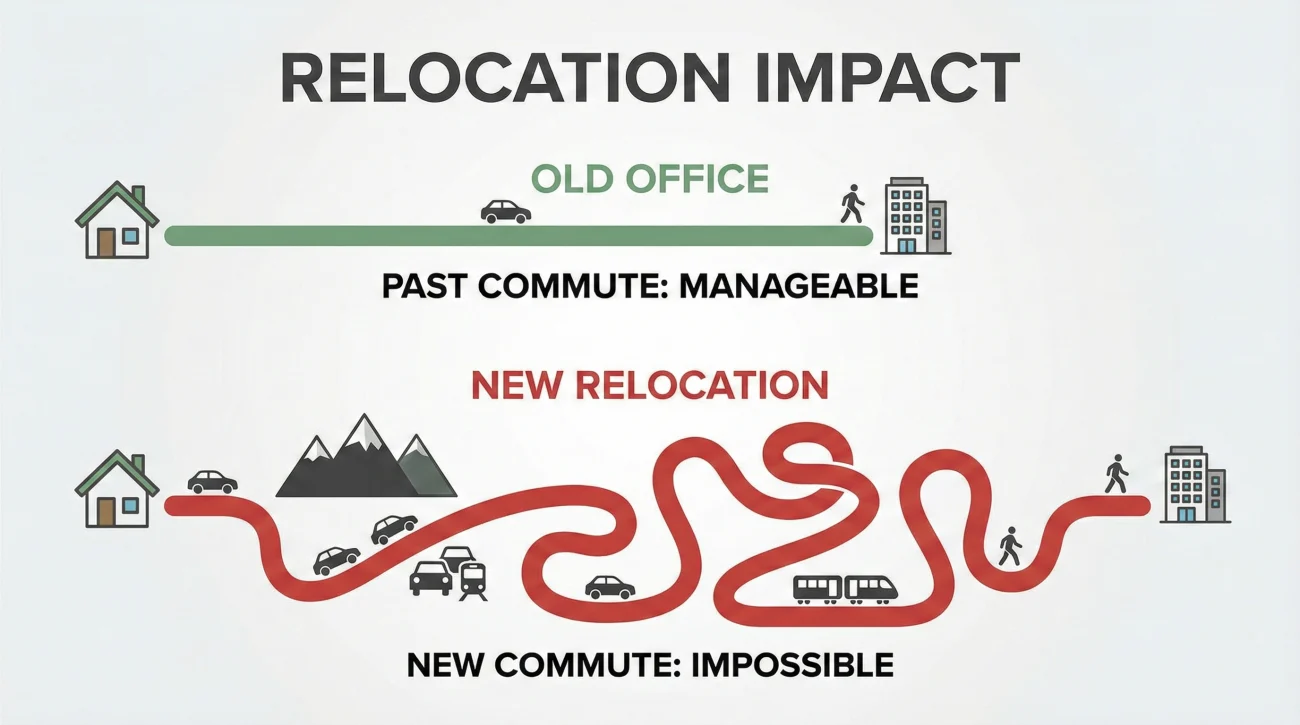
If your company relocated offices significantly farther from where you live, your resignation letter relocation of office should establish that geographic change made by employer created the untenable commute. You accepted employment based on original location; company’s decision to move offices changed fundamental terms of your arrangement.
Effective framing: “The office relocation to [new location] has created a commute that is no longer sustainable for me given my family circumstances and home location. While I’ve attempted to make this new distance work, I’ve concluded that continuing employment under these geographic conditions isn’t viable long-term.”
This language places responsibility appropriately – employer’s location decision created situation requiring your resignation, not your lack of flexibility or commitment. Many organizations understand that office relocations inevitably lose some employees who can’t or won’t follow, and properly framed resignations acknowledge this reality professionally.
Declining to Relocate With Company
Some office relocations expect or assume employees will move their homes to stay with company. When you can’t or won’t relocate – due to family roots, spouse employment, housing commitments, or simply preferring current location – your resignation requires clear communication that you’re not following the office move.
Direct statement works best: “I’m unable to relocate my residence to accommodate the office move to [new location]. My family circumstances require us to remain in [current area], which makes the new commute distance impossible to sustain.” This establishes clearly that you’re not relocating, preventing misunderstandings about whether you’re following the office or leaving permanently.
Explore Remote Options First
Before resigning over commute issues – particularly those caused by office relocations – explore remote work arrangements. Many employers prefer retaining valued employees remotely rather than losing them entirely to commute impossibilities.
Your resignation letter might reference this exploration: “I’ve explored remote work arrangements that would allow me to continue contributing while managing the geographic distance, but understand that’s not feasible for my role. Given these circumstances, I must resign my position.” This demonstrates you sought solutions before resigning, positioning you as reasonable employee rather than someone unwilling to accommodate changed circumstances.
Commute Distance Templates
These templates communicate geographic necessity while maintaining professional relationships. For broader guidance, see our resignation letter with reason guide.
Unsustainable Commute Template
Jennifer Martinez
456 Oak Street
Portland, OR 97204
March 15, 2024
David Chen
Department Manager
Pacific Northwest Technology
Dear David,
I am writing to resign from my position as Project Coordinator, effective March 29, 2024.
After considerable effort to make the commute sustainable, I’ve concluded that the two-hour daily travel time between my home and the office has become incompatible with my family responsibilities and quality of life needs. The commute’s impact on my time with my children and overall wellbeing has reached a point where I must prioritize proximity to home over continued employment.
I’ve appreciated my time at Pacific Northwest Technology and the professional development opportunities provided here. This decision stems entirely from geographic logistics rather than dissatisfaction with my role or the organization.
I will work closely with my team during my remaining time to ensure comprehensive transition of my responsibilities and active projects.
Thank you for understanding regarding these circumstances.
Sincerely,
Jennifer Martinez
This travel distance resignation clearly establishes commute as the issue while acknowledging she tried to make it work. The specific mention of “two-hour daily travel time” provides concrete context about distance burden. The emphasis on family and quality of life frames this as life priorities decision rather than workplace dissatisfaction.
Office Relocation Response Template
Michael Thompson
892 Pine Avenue
Seattle, WA 98101
April 8, 2024
Sarah Williams
Human Resources Director
Northwest Solutions Group
Dear Sarah,
I am submitting my resignation from my position as Operations Analyst, effective April 22, 2024.
The office relocation to Bellevue has created a commute that I cannot sustain given my family circumstances. My spouse’s employment, our children’s schools, and our home location in Seattle make relocating to the Eastside impractical for our family. The resulting daily commute of 90+ minutes each way isn’t viable for me long-term.
I explored remote work arrangements that might allow me to continue contributing to the team, and I appreciate your consideration of those options. However, I understand the role requires regular in-office presence that makes remote work infeasible.
I’ve valued my time with Northwest Solutions and regret that the office move has necessitated this decision. I will ensure thorough documentation and knowledge transfer during my notice period.
Thank you for your understanding regarding these geographic constraints.
Sincerely,
Michael Thompson
This letter clearly attributes resignation to employer’s office relocation decision rather than employee’s lack of flexibility. The specific reasons why he can’t relocate (spouse employment, children’s schools, home location) establish legitimate constraints. The mention of exploring remote work demonstrates good faith effort to find solutions before resigning.
Explore Remote Options Before Resigning
Before resigning over commute issues, explore whether remote or hybrid arrangements might preserve your employment while solving the distance problem. Many roles proved during pandemic that remote work succeeds when properly structured.
Present Remote Work as Solution
Approach your manager before submitting resignation: “The commute has become unsustainable. Before resigning, I wanted to explore whether remote work might be possible for my role. I believe I could maintain productivity while working remotely, and I’d strongly prefer that option to leaving.”
This positions remote work as your preferred solution, demonstrating you want to stay if geographic constraints can be addressed. Some employers prove surprisingly flexible when faced with losing valued employees to commute issues.
Consider Hybrid Arrangements
If full remote work isn’t feasible, propose hybrid schedules: two days in office, three days remote creates 60% commute reduction that might make the arrangement sustainable. This compromise often appeals to employers who value some in-person presence but recognize employee commute burdens.
❓ FAQ
🚗 Is commute distance a valid resignation reason?
Absolutely. Quality of life considerations including commute time represent legitimate employment decisions. Employers understand that excessive travel time impacts employee wellbeing, family life, and work performance. While some might view long commutes as normal, you’re entitled to decide what’s sustainable for your life circumstances. Frame it as life priorities decision rather than workplace dissatisfaction – most reasonable employers respect this boundary even if they’re disappointed to lose you.
⏰ How long should I try making a long commute work before resigning?
No set timeframe, but 3-6 months gives reasonable trial period to assess sustainability. Some people adjust to long commutes over time; others find them increasingly intolerable. If commute resulted from office relocation you didn’t choose, shorter trial period is reasonable – you’re not obligated to endure untenable arrangements just because employer created them. Trust your assessment of what’s sustainable for your life circumstances rather than forcing yourself to tough out arrangements that harm your wellbeing.
💼 Will employers think I’m not committed if I resign over commute?
Depends on employer and circumstances, but most understand geographic realities. Employees with proven track records who resign over commute distance typically maintain good relationships and positive references. Frame it clearly as life logistics issue rather than workplace dissatisfaction. Employers might wish you’d relocate or tolerate longer commute, but reasonable ones respect that employee life circumstances vary and commute tolerance differs. Your commitment shows in your work quality, not your willingness to spend hours daily traveling.
🏢 Can I collect unemployment if I resign due to office relocation?
Possibly, depending on state law and circumstances. Some states consider employer office relocations that significantly increase commute distance as creating “good cause” for resignation that qualifies for unemployment. Typically requires substantial distance increase (often 30+ miles) and inability to relocate with company. Check your state’s unemployment rules and document that office relocation created unsustainable commute. However, don’t assume unemployment eligibility – many resignations for commute reasons don’t qualify even when they feel justified.
🔄 Should I try finding closer job before resigning?
Ideally yes, if circumstances permit. Having new job lined up provides financial security and prevents employment gaps. However, if commute has become truly unsustainable – affecting health, family, or wellbeing severely – you might need to resign before securing replacement employment. Consider your financial situation, job market in your area, and urgency of commute relief. Some people resign first then search; others tolerate bad commutes until finding alternatives. Neither approach is wrong – make decision based on your specific circumstances and risk tolerance.
Final Thoughts

A resignation letter due to commute acknowledges that geography sometimes defeats professional commitment regardless of how much you value your work. Time spent traveling represents life hours you never recover, and at some point, the calculation tips toward prioritizing proximity over employment. This isn’t about lack of dedication – it’s about recognizing that sustainable work arrangements require reasonable geographic logistics.
Handle commute-related resignations with clear communication about distance realities while expressing appreciation for professional opportunities received. Most employers understand that commute tolerance varies and that employee life circumstances legitimately affect what travel burdens people can sustain.
Choosing quality of life over career convenience doesn’t make you uncommitted – it makes you human. The hours you reclaim from brutal commutes can go toward family, health, personal development, or rest that makes you better at whatever work you pursue next, hopefully closer to home.
⚠️ Legal Disclaimer: ResignSmartly provides general informational guidance about resignation, workplace communication, notice periods, handovers, and career transitions. Content does not constitute individualized legal advice. Employment laws, contracts, workplace policies, and individual circumstances vary, so review the requirements that apply to your situation and consult an appropriate qualified professional when needed.