- Context shift: Leaving teaching hits harder than corporate exits because students, parents, and the school community are directly affected.
- Timing rules: End-of-year resignations align with the hiring cycle; mid-year resignations are higher-risk and need a careful “least disruption” approach.
- Contract and license safety: Read your contract first, watch notice dates, penalties, and any license-hold or 60-day clauses before you submit anything.
- Letter essentials: State resignation and effective date clearly, keep emotion out, add brief gratitude, and promise a specific transition handoff.
- Exit execution: Prepare a “handover binder,” coordinate messaging to students and parents, and avoid negativity to protect references and your professional record.
The Strategic Importance of Timing in Education
In the education sector, the calendar dictates everything. Unlike other industries where hiring happens year-round, schools operate on a rigid cycle. Your resignation timing doesn’t just affect HR; it directly impacts student learning outcomes and the school’s ability to find a competent replacement.

Understanding the Hiring Cycle
School administrators typically begin planning staffing for the next academic year in early spring. If you submit a resignation letter end of school year in February or March, you are actually doing your administration a favor. It places them in the “prime hiring window,” allowing them to attend job fairs and interview top candidates before they are snapped up by other districts.
Conversely, resigning in August – weeks before school starts – is a nightmare scenario for principals. It often forces them to hire long-term substitutes or less qualified emergency hires, which inevitably impacts classroom stability. While you cannot always control when life changes happen, understanding this context helps you frame your resignation in a way that shows professional empathy.
The Reality of Mid-Year Departures
Leaving in October or January is technically a “breach of contract” in many districts unless you have specific grounds (medical, spousal relocation). A mid year teacher resignation is sensitive because it disrupts the instructional flow. Students have already bonded with you, learned your routines, and adapted to your teaching style.
If you must leave mid-year, your strategy must shift from “standard notice” to “damage control.” Your goal is to demonstrate that you have done everything humanly possible to prevent your departure from negatively affecting student achievement.
Contractual Obligations and License Safety
Before you draft a single sentence, pull out your contract. Teaching contracts are legally binding documents with specific clauses regarding resignation that don’t exist in the private sector. Ignorance of these clauses can lead to severe consequences, including the suspension of your teaching license.
| Contract Element | Typical Stipulation | Risk Factor |
|---|---|---|
| Notification Date | Specific dates (e.g., “prior to July 15”) for penalty-free resignation. | High: Missing this can trigger “liquidated damages.” |
| Liquidated Damages | Monetary penalty (e.g., $1,000–$3,000) for late resignation. | Moderate: Financial loss, but usually protects license. |
| License Hold | District right to petition the state to suspend your license for 1 year. | Severe: Prevents you from teaching anywhere in the state. |
| 60-Day Hold | Requirement to stay up to 60 days until a replacement is found. | High: Can prevent you from starting a new job on time. |
Most contracts distinguish between “resignation with prejudice” (bad terms) and “resignation without prejudice” (good terms). Writing a professional teacher resignation letter to principal that adheres to these dates is your best defense against negative marks on your permanent employment record.
Structuring Your Official Resignation Letter
This document will likely go into your permanent personnel file. It needs to be concise, formal, and devoid of emotional venting. Even if you are leaving because of burnout or administrative conflict, your letter is not the place to air those grievances. Save the feedback for the exit interview.
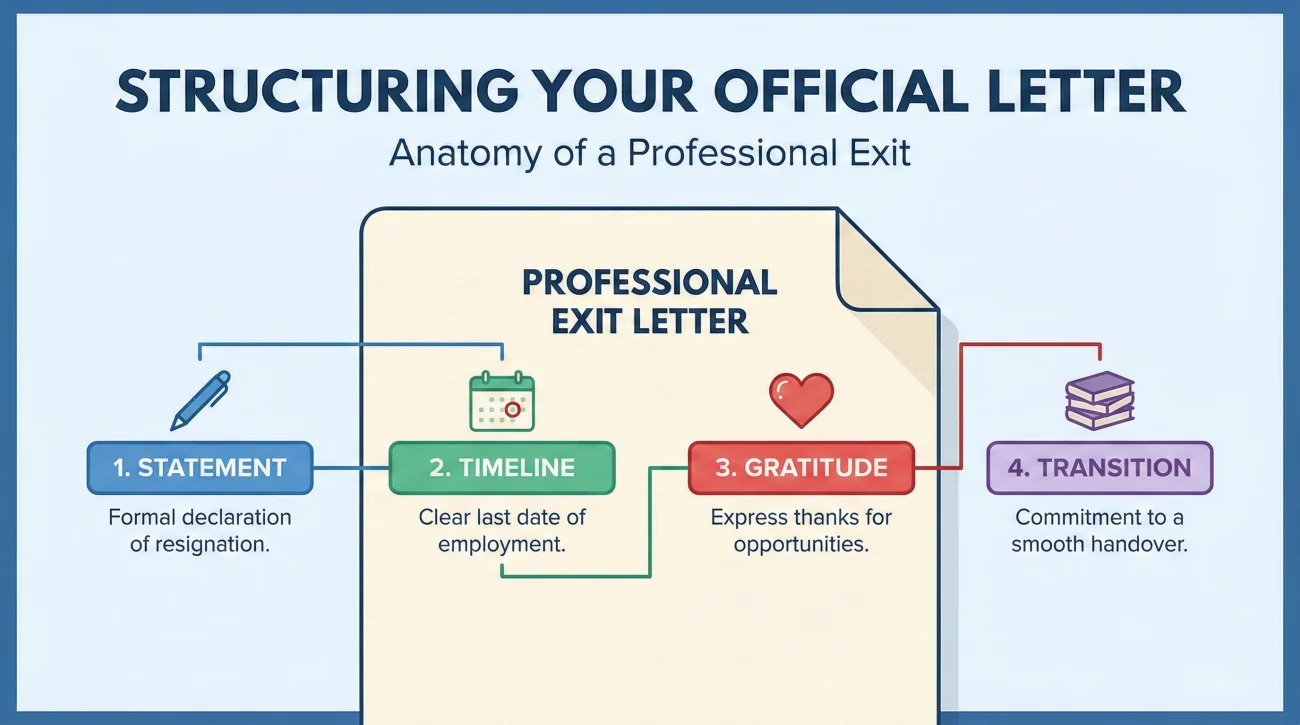
The Anatomy of a Professional Exit
- 📝 The Statement: “I resign from my position as [Grade] Teacher, effective [Date].” Be unambiguous.
- 🗓️ The Timeline: Confirm that this date aligns with your contract (e.g., “the last day of the current school year”).
- 🤝 The Gratitude: Find something positive to say. “I have enjoyed working with the Science Department.”
- 📚 The Transition: Explicitly state what you will leave behind (grades, lesson plans, keys).
End-of-Year Resignation Templates
These are the most common scenarios. You are finishing your contract and moving on. The goal here is to leave the door open for future recommendations.
Standard K-12 Teacher Resignation
This template is ideal for a resignation letter end of school year when you are moving to a new district or changing careers.
[Your Name]
[Your Address]
[City, State ZIP]
[Your Email]
[Your Phone]
[Date]
[Principal’s Name]
[School Name]
[School District Address]
Dear Principal [Name],
Please accept this letter as formal notification that I will be resigning from my position as [Subject/Grade] Teacher at [School Name], effective at the conclusion of my current contract on [Date, usually the last teacher workday].
This was a difficult decision, as I have truly valued the last [Number] years working with our students and staff. However, I have decided to [brief reason: relocate to be closer to family / pursue a new opportunity outside of education].
I want to ensure a seamless start for the incoming teacher next fall. Before my final day, I will ensure that:
- All student cumulative files are updated and organized.
- The classroom inventory is completed.
- A detailed curriculum map of what was covered this year will be left on my desk.
- Final grades and report cards are submitted on time.
Thank you for the professional development opportunities and support you have provided during my tenure. I wish [School Name] nothing but continued success.
Sincerely,
[Your Signature]
[Your Printed Name]
The Retirement Announcement
Retiring is a celebration of a career. This letter can be warmer and more reflective than a standard resignation.
Dear Principal [Name],
It is with mixed emotions that I submit my resignation for the purpose of retirement, effective [Date]. After [Number] years in education, and [Number] years specifically at [School Name], I am looking forward to this next chapter of my life.
Teaching here has been the privilege of my career. I have watched generations of students grow, and I am deeply grateful for the community we have built. I am committed to finishing this year strong and will work closely with my department head to preserve my lesson archives and resources for the next teacher.
Thank you for your leadership and friendship over the years.
Warmly,
[Your Name]
Preschool and Daycare Specifics
Early childhood education is different. The bond between a toddler and their teacher is intense, and parents are often much more anxious about turnover. A preschool teacher resignation letter needs to reassure the director that you aren’t leaving the children in a lurch.
Preschool Teacher Resignation
[Your Name]
[Date]
[Director’s Name]
[Center Name]
Dear [Director Name],
Please accept my resignation as Lead Teacher for the [Age Group] Room, effective [Date, typically 2-4 weeks notice].
Working with the children at [Center Name] has been a joy. However, I have decided to pursue a new career path. I know how important consistency is for children at this age.
Over my notice period, I will:
- Update all developmental portfolios.
- Work alongside the new teacher during transition days to introduce them to the children’s routines.
- Write transition notes for parents to reassure them.
Thank you for trusting me with these wonderful children.
Sincerely,
[Your Name]
The “Golden Handover”: Preserving Your Legacy

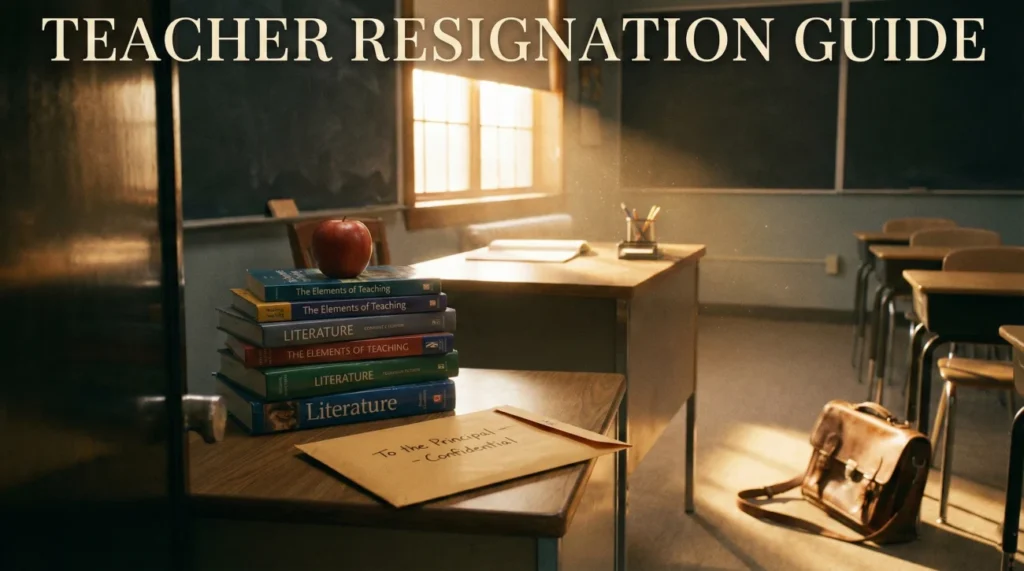
Your legacy isn’t defined by why you left, but by how you left. A messy exit where the next teacher can’t find the answer keys or doesn’t know about a student’s severe allergy will tarnish your reputation faster than anything else. When submitting a resignation letter from teaching position, pair it with a physical “Handover Binder.”
The Ultimate Exit Checklist
Leave this on your desk on your final day:
- 🔑 Logistics: Keys, fobs, laptop passwords, and seating charts.
- 📊 Data: Gradebook hard copies (in case the digital system locks you out), attendance records.
- 🧠 Student Insights: A “Cheat Sheet” on student dynamics. (e.g., “Separate John and Mike,” “Sarah needs front-row seating for focus.”)
- 📅 Pacing Guide: Exactly where you stopped in the curriculum and what is next.
- 🚨 Emergency Plans: Fire drill routes and lockdown procedures specific to your room.
Managing the Emotional Fallout
Once the paperwork is signed, the real work begins: telling the people who matter.
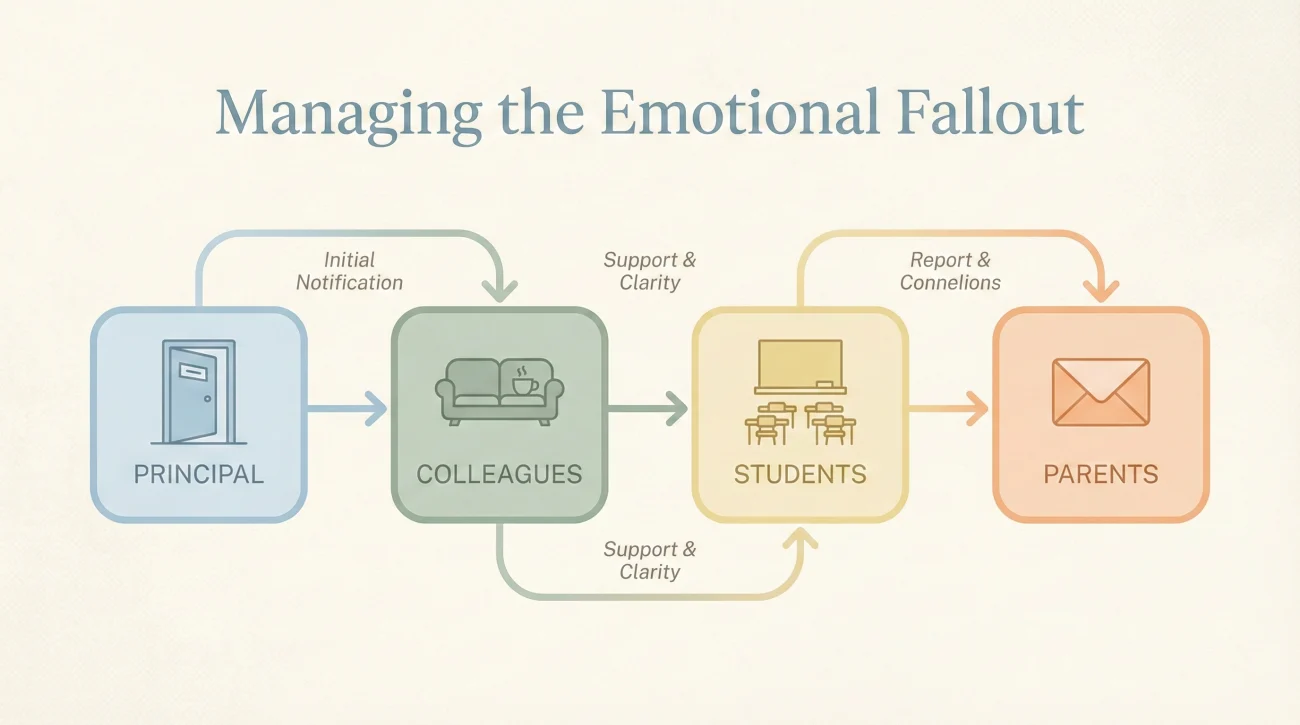
Breaking the News to Students
This is the tearful part. Do not tell students until the Principal has accepted your resignation and you have agreed on a communication timeline. When you do tell them:
- Keep it simple: “I have to move,” or “I am going to work at a new school.”
- Reassure them: “You are going to have a great rest of the year.”
- No drama: Never say, “I’m leaving because the principal is mean” or “I hate this school.”
Notifying Parents
Usually, the Principal sends a formal letter. However, if you have close relationships, you might want to send a brief farewell email after the official announcement.
Subject: Farewell from Mr./Ms. [Name]
Dear Families,
As you may have heard, I will be leaving [School Name] on [Date]. It has been an honor teaching your children. I am working closely with the administration to ensure the new teacher knows exactly where we are in our learning so your child doesn’t miss a beat.
Thank you for your support.
Best,
[Your Name]
❓ FAQ
🚫 Can a school refuse my resignation?
Technically, no one can legally force you to work. However, they can refuse to release you from your contract without penalty. This means if you leave before the contracted date, they might hold your license or fine you, but they cannot physically make you teach.
🤒 What if I am resigning due to mental health burnout?
You do not need to list “burnout” in your official letter. You can simply state “personal health reasons.” If you have a doctor’s note supporting your need to leave, provide that to HR separately. This often helps waive contract penalties for early withdrawal.
🗓️ Is 2 weeks’ notice enough for a teacher?
Rarely. In education, 30 to 60 days is the standard clause in most contracts. Two weeks is considered very short notice and should only be used in extreme emergencies. Always check your specific district agreement.
📨 Should I email my resignation or print it?
Print it. Teaching is a formal profession. Request a brief meeting with your principal, hand them the signed letter, and then follow up with a digital copy to HR for the paper trail. This shows respect for the position.
💼 Can I use my principal as a reference if I leave mid-year?
It is risky. If you leave mid-year, you are putting them in a difficult bind. If you must leave, do everything possible to make the transition smooth (lesson plans, organized files). If you leave professionally, they may still vouch for your teaching ability, even if the timing was bad.
Final Thoughts
The teaching profession is built on relationships, which makes saying goodbye uniquely painful. However, you are entitled to make career moves that benefit your life and family. By adhering to contract dates, preparing a thorough handover, and writing a respectful teacher resignation letter, you protect the professional reputation you have worked so hard to build.
Remember that your ex-students will likely remember how you made them feel, not the date you left. Handle your exit with grace, and you will leave a positive legacy. For more advice on navigating complex career transitions, explore our guide on resignation letter samples for different jobs to ensure every step of your journey is professional.
⚠️ Legal Disclaimer: ResignSmartly provides general informational guidance about resignation, workplace communication, notice periods, handovers, and career transitions. Content does not constitute individualized legal advice. Employment laws, contracts, workplace policies, and individual circumstances vary, so review the requirements that apply to your situation and consult an appropriate qualified professional when needed.