
- Core Frame: A “better opportunity” resignation triggers ego threat, so write it as growth you are running to, not problems you are running from.
- Message Rules: Lead with specific gratitude, frame the move as a natural evolution, promise a clean handover, and explicitly keep the relationship open.
- Timing and Money: Use Tuesday or Wednesday afternoon when possible, and do not mention salary in writing because emails become permanent HR records.
- Template Fit: Choose the scenario template that matches your move, promotion, pivot, dream company, competitor, startup, or remote, and keep details controlled.
- Danger Zones: Expect counter-offer pressure, prepare a classy decline, and if moving to a competitor be ready for immediate exit and protect yourself with clean, legal behavior.
The Art of the Upgrade: How to Resign for a Better Opportunity Without Burning Bridges
Leaving a job for a “better opportunity” is the most delicate maneuver in your career. It is a moment of personal triumph, but for your employer, it often feels like a betrayal. When you resign to escape a toxic boss, the dynamic is clear: you are fleeing a fire. But when you resign purely for advancement – more money, a higher title, or a dream company – you risk triggering a deep-seated psychological reaction in your manager: Ego Threat.
The danger lies in the inherent comparison. By declaring your new role “better,” you implicitly label your current role (and by extension, your manager’s leadership) as “worse” or “insufficient.” If mishandled, this perception can turn a mentor into a critic and sever a valuable networking connection for decades. However, if executed with Strategic Empathy, leaving for growth can actually enhance your reputation as a high-achiever.
This comprehensive guide is not just about writing an email; it is a masterclass in reputation management. We will explore how to frame your departure as a natural evolution rather than an escape, how to dismantle the “Traitor” narrative, navigate the treacherous waters of counter-offers, and write a resignation email for a better opportunity that keeps the door open for a future “Boomerang” return.
For a broader understanding of the exit process basics, you should review our foundational guide on how to write a resignation email.
The Psychology of “Better”: Dismantling the Betrayal Narrative
To write the perfect resignation email, you must first understand the emotional landscape of the recipient. What does your manager hear when you say “I found a better job”?
The Manager’s Dilemma: Loss Aversion
Psychologically, humans feel the pain of loss twice as intensely as the pleasure of gain. To a manager, your resignation represents multiple losses: lost productivity, lost time in retraining, and lost status (i.e., “Why couldn’t I keep them?”).
When you leave for a “better” opportunity, they may internalize it as: “You failed to provide what I needed.” Even if this is true, stating it in writing burns the bridge. Your email must pivot the narrative from “deficiency” to “difference.”
The Strategic Pivot: “Running To” vs. “Running From”
The most effective resignation emails focus 100% on the destination (the Pull factor), never on the departure point’s flaws (the Push factor). This is the strategic distinction between “Running From” and “Running To.”
| The Narrative | What It Sounds Like | The Result |
|---|---|---|
| ❌ Running From (Dangerous) | “I am leaving because I need a higher salary and more growth than I can get here.” | Implies the current company is cheap, stagnant, and holding you back. Triggers defensiveness. |
| ✅ Running To (Strategic) | “I have accepted a role that allows me to specialize in AI-driven marketing, a specific niche passion I am eager to pursue.” | Focuses on a unique opportunity the current company simply cannot offer physically. It absolves the manager of blame. |
Strategic Timing: When to Drop the Bomb
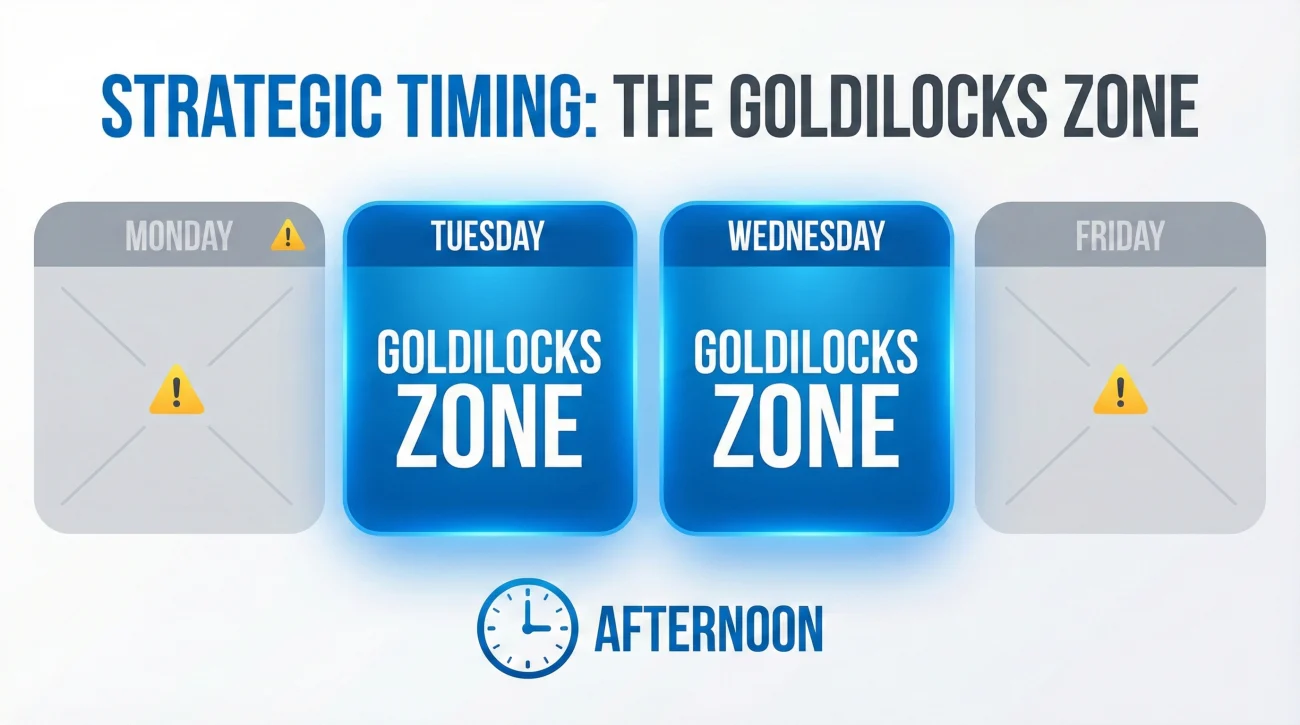
The “When” is just as important as the “What.” Sending your email at the wrong time can amplify the negative impact.
- 🛑 Avoid Mondays: Managers are swamped with the week’s startup tasks. Your resignation adds chaos to chaos.
- 🛑 Avoid Fridays: Resigning on a Friday afternoon leaves the manager stewing over the weekend without a chance to formulate a plan, increasing anxiety.
- ✅ The Goldilocks Zone: Tuesday or Wednesday afternoon. This allows the week to start normally, gives you time to have a face-to-face meeting, and leaves enough days in the week to announce the news to the team and begin the transition plan immediately.
The Compensation Trap: Should You Mention Money?

When the “better opportunity” is primarily about a 40% raise, the temptation to mention money is overwhelming. Resist it in writing.
The Golden Rule: Written is Permanent, Verbal is Negotiable
Your resignation email goes into your permanent HR file. If you write, “I am leaving for a higher salary,” you are forever documented as a “mercenary” employee – someone who operates solely for the highest bidder. Years later, if you want to return (Boomerang), a hiring manager might read that and assume you have no loyalty.
The Strategy: Keep the email focused exclusively on “career growth,” “new challenges,” or “market alignment.” If you want to leverage the offer or explain the money to your boss (so they know they are underpaying), do it verbally in the exit interview. Verbal conversations fade; emails last forever.
Anatomy of a High-Value Resignation Email
A resignation email for career advancement needs to hit four specific emotional beats to neutralize any hard feelings and frame you as a classy professional.
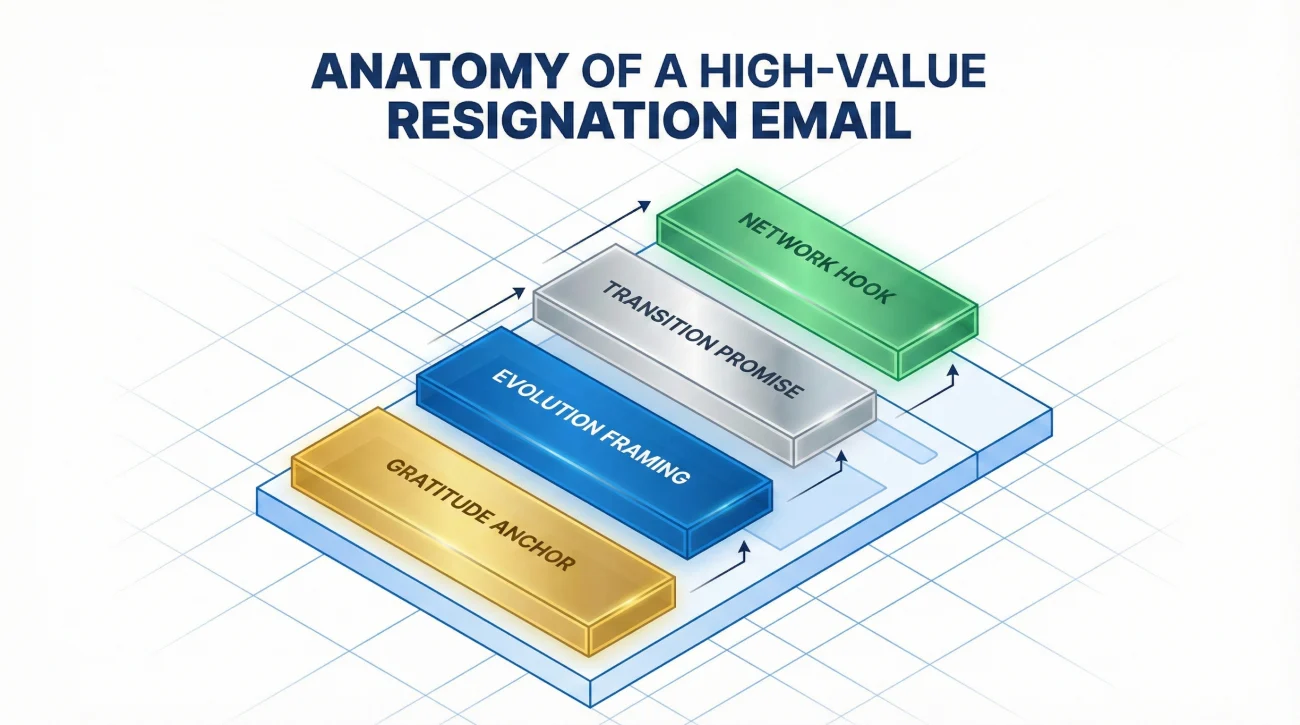
1. The Gratitude Anchor
Before you drop the news, anchor the message in gratitude. But be specific. Generic thanks feel hollow.
“I want to thank you for the mentorship you provided during the Q3 product launch. That experience was pivotal for me.”
2. The “Evolution” Framing
State that you are leaving, but frame it as a necessary step for your long-term goals that simply couldn’t happen here (even if that’s a lie).
“I have accepted a Senior Director position that aligns with my long-term goal of leading a global team.”
3. The Transition Promise
High performers are judged by how they leave. Promise a specific, high-quality handover to alleviate their fear of a productivity gap.
“My goal is to ensure you are not left with any gaps. I will spend my final two weeks documenting the XYZ workflow.”
4. The Network Hook
Explicitly state your desire to stay in their orbit. This signals that you value the relationship, not just the paycheck.
“I deeply respect this team and hope to cross paths again in the future.”
7 Strategic Templates for “Better Opportunity” Resignations
Select the template that best matches your specific scenario. Remember to customize the bracketed information. For more variation, check our library of resignation email examples.

1. The “Vertical Leap” (Leaving for a Higher Title)
Use this when you are taking a step up (e.g., Manager to Director) that wasn’t available at your current company. It validates your ambition.
Subject: Resignation – [Your Name]
Dear [Manager’s Name],
Please accept this letter as my formal resignation from my position as [Current Job Title] at [Company Name]. My final day will be [Date].
I have accepted a position as a [New, Higher Job Title] with another organization. This was a difficult decision, as I have truly enjoyed my time here. However, this new role offers the opportunity to lead a department and take on P&L responsibilities, which aligns with the career trajectory we have discussed in the past.
I am incredibly grateful for your mentorship, particularly regarding [Specific Skill]. You prepared me for this next step, and for that, I am thankful.
I am committed to a seamless handover. I will ensure all my direct reports are settled and my projects are documented before my departure.
Sincerely,
[Your Name]
2. The “Industry Pivot” (Changing Sectors)
Use this when you are changing industries (e.g., Finance to Tech). It is the safest reason because your current boss knows they couldn’t offer this, eliminating any “counter-offer” pressure.
Subject: Resignation Notice – [Your Name]
Dear [Manager’s Name],
I am writing to formally resign from my role as [Job Title], effective [Date].
I have decided to pursue a long-held passion for the [New Industry, e.g., Renewable Energy] sector and have accepted a role that allows me to specialize in this field. While I have loved working in [Current Industry], this is a unique opportunity for me to pivot my career in a new direction.
Thank you for the opportunities I have had at [Company Name]. I have learned a tremendous amount here that I will carry with me.
I will work diligently over the next two weeks to train [Colleague Name] on my accounts to ensure no disruption to the business.
Best regards,
[Your Name]
3. The “Dream Company” (The Unavoidable Offer)
Use this when you are joining a “Tier 1” company (like Google, NASA, or a major brand). Managers usually understand you can’t say no to these (“The Godfather Offer”).
Subject: Resignation – [Your Name]
Dear [Manager’s Name],
I am writing to provide my two weeks’ notice of resignation. My last day at [Company Name] will be [Date].
I have been offered a position at [Dream Company Name], an organization I have admired for many years. It has always been a career goal of mine to work with their [Specific Tech/Product], and I feel I cannot let this opportunity pass.
I want to express my deepest gratitude for your support. I would not have been competitive for this new role without the experience and skills I gained under your leadership.
I want to finish strong here. I have prepared a transition plan and am happy to assist in any way I can during my final days.
Warmly,
[Your Name]
4. The “Growth & Compensation” (Subtle)
Use this when money IS the main factor, but you want to sound professional. Use the phrase “Market Alignment” to sound objective rather than greedy.
Subject: Resignation – [Your Name]
Dear [Manager’s Name],
Please accept this email as my formal resignation from [Company Name], effective [Date].
I have accepted a new position that offers a compensation package and growth trajectory that closely aligns with my current long-term financial and professional goals. This was a tough choice, as I value the relationships I have built here.
Thank you for everything you have taught me over the last [Number] years. I leave with nothing but respect for the team.
I will ensure all my files are organized and handed over smoothly before my final day.
Sincerely,
[Your Name]
5. The “Competitor” Move (High Risk)
Use this if you are going to a direct rival. Be brief, professional, and prepared to be walked out immediately (Garden Leave).
Subject: Resignation Notice – [Your Name]
Dear [Manager’s Name],
I am writing to resign from my position as [Job Title]. My intended last day is [Date].
I have accepted a position with [Competitor Name]. I wanted to be transparent about my next move. I understand if the company policy requires an immediate departure in this scenario, and I respect that decision.
If I remain for the notice period, I am committed to a professional handover. Thank you for the opportunity to work here.
Regards,
[Your Name]
6. The “Corporate to Startup” (Risk Taker)
Use this when leaving a stable job for a risky venture. Frame it as a desire for “building” or “agility.”
Subject: Resignation – [Your Name]
Dear [Manager’s Name],
I am writing to resign from my role as [Job Title], effective [Date].
I have decided to accept a role at an early-stage startup. I have a strong desire to experience the “building phase” of a company from the ground up, and this role offers that specific environment.
I have loved the stability and structure here at [Company Name], and I will miss the team. I’m committed to ensuring a smooth handoff of my projects.
Best,
[Your Name]
7. The “Lifestyle Upgrade” (Remote/Flexibility)
Use this when the “better opportunity” is about remote work or work-life balance, not just title/money.
Subject: Resignation Notice – [Your Name]
Dear [Manager’s Name],
Please accept my resignation as [Job Title], effective [Date].
I have accepted a fully remote position that offers the flexibility I currently need for my personal work-life balance. This was a key factor in my decision.
I have truly valued my time here and want to ensure my departure is as seamless as possible. I will focus my remaining time on training [Name] to take over my workflows.
Sincerely,
[Your Name]
The Danger Zone: Handling the Counter-Offer
When you resign for a “better opportunity,” statistics show that 50% of managers will try to buy you back. They will match the salary, promise that promotion you wanted, or guilt-trip you. This is the Counter-Offer Trap.
Why You Must (Almost Always) Decline
| The Risk Factor | The Reality |
|---|---|
| Trust Decay | Your loyalty is now permanently in question. You are viewed as a “flight risk” who can be bought. |
| Temporary Fix | The money changes, but the culture, the boss, and the problems remain the same. The “better opportunity” elsewhere is usually structural. |
| Replacement Strategy | Managers often buy time to find your replacement (because they know you want to leave), then fire you 6 months later when it’s convenient for them. |
| Statistics | 80% of employees who accept a counter-offer leave within 6 months anyway (voluntarily or involuntarily). |
The “Classy Decline” Script
How do you say “No” to more money without being rude? Use this script:
“I am truly flattered by the counter-offer, and it validates the work I’ve done here. I really appreciate you fighting for me.
However, my decision to leave is not just financial; it’s about a specific new direction/industry/challenge I need to take for my long-term career growth. I am committed to my new path, but I want to help you find a replacement who is just as dedicated as I was.”
The “Garden Leave” Protocol
If you are moving to a competitor (Template 5), be prepared for “Garden Leave.” This means the company accepts your resignation effective immediately, walks you out of the building, but pays you for the notice period to keep you from working for the rival during that time.
Your Strategy:
1. Pre-pack: Have your personal files removed before you send the email.
2. Don’t Take Data: Do not download client lists or proprietary code. It’s illegal and can get your offer rescinded.
3. Be Gracious: If they walk you out, don’t make a scene. Shake hands, say thank you, and leave. Enjoy the paid vacation.
Final Thoughts: The Long Game
Resigning for a better opportunity is the ultimate test of your professional maturity. It is easy to be gracious when you are desperate, but being gracious when you are “winning” shows true character.
By framing your exit as a pursuit of growth rather than a rejection of the past, you preserve the ego of your former managers and keep your network intact. Remember: You are not just leaving a job; you are joining an alumni network. The boss you leave today might be the client you pitch tomorrow.
For further details on exit logistics, consult our homepage resources.
⚠️ Legal Disclaimer: ResignSmartly provides general informational guidance about resignation, workplace communication, notice periods, handovers, and career transitions. Content does not constitute individualized legal advice. Employment laws, contracts, workplace policies, and individual circumstances vary, so review the requirements that apply to your situation and consult an appropriate qualified professional when needed.