
- Core idea: Your goodbye email to coworkers protects long-term reputation because colleagues become future backchannel references.
- Timing rule: Tell your manager first, then inner circle, then team, and send the wider goodbye email 3 to 5 days before your last day.
- Segmentation: Do not use one company-wide blast for everyone, tailor messages for close friends, daily collaborators, and the outer circle.
- Perfect structure: Timeline, Transition owner, Gratitude, Call to action with contact or LinkedIn, keep it under 200 words.
- Avoid traps: No mic drop lines, no humble brag, no negativity, and do not post on LinkedIn until after internal emails, ideally on or after your last day.
The Strategic Value of the “Goodbye” Email
Most professionals obsess over their formal resignation letter to management, treating the resignation email to coworkers as an afterthought. This is a strategic error. While your boss controls your reference for the next job, your colleagues control your reputation for the entirety of your career.
These are the people who will move to other companies, become hiring managers, and serve as your unofficial backchannel references in the future. In the “Peak-End Rule” of psychology, people judge an experience largely by how it ends. A gracious, well-timed farewell email can rewrite the narrative of a mediocre tenure into a positive memory, or cement a legacy of professionalism.
This deep-dive guide moves beyond simple templates. We will analyze the “Hierarchy of Announcement,” the nuances of tailoring your message to different tiers of colleagues, and how to execute a departure that strengthens your professional network rather than severing it.
The “Rumor Mill” vs. The Official Channel: Timing Your Announcement
The single most common mistake in sending a farewell email to coworkers is firing it off too early. Doing so can blindside your manager and create a chaotic environment where rumors outpace facts.
The Non-Negotiable Sequence of Notification
To maintain professional integrity, you must adhere to a strict order of operations. Never let a colleague read about your departure before your manager has processed it.
| Tier | Who | When to Tell | Method |
|---|---|---|---|
| 1 | Direct Manager | Day 0 (Immediate) | Video/In-Person + Formal Email |
| 2 | Inner Circle (Work Besties) | Day 0-1 (After Manager) | Private Chat/Lunch (Sworn Secrecy) |
| 3 | Immediate Team | Day 2-3 (After Plan is Set) | Team Meeting or Group Email |
| 4 | The “Outer Circle” (Company-wide) | 2-3 Days Before Last Day | The “Goodbye” Email |
Strategic Timing Windows
- 🛑 Avoid Fridays: Sending a resignation announcement on a Friday afternoon ensures it gets buried in the weekend slide. It feels like a “dump and run.”
- ✅ Target Tuesday/Wednesday Mornings: These are high-engagement times. People are focused but not overwhelmed (like Mondays). It gives them the rest of the week to stop by your desk or schedule a farewell coffee.
- 🛑 The “Lame Duck” Danger: Do not announce too early (e.g., 4 weeks out). It creates an awkward “Lame Duck” period where people hesitate to assign you work but you haven’t left yet. The sweet spot for the wider team is 3-5 days before departure.
Audience Segmentation: Why “One Email” Fails
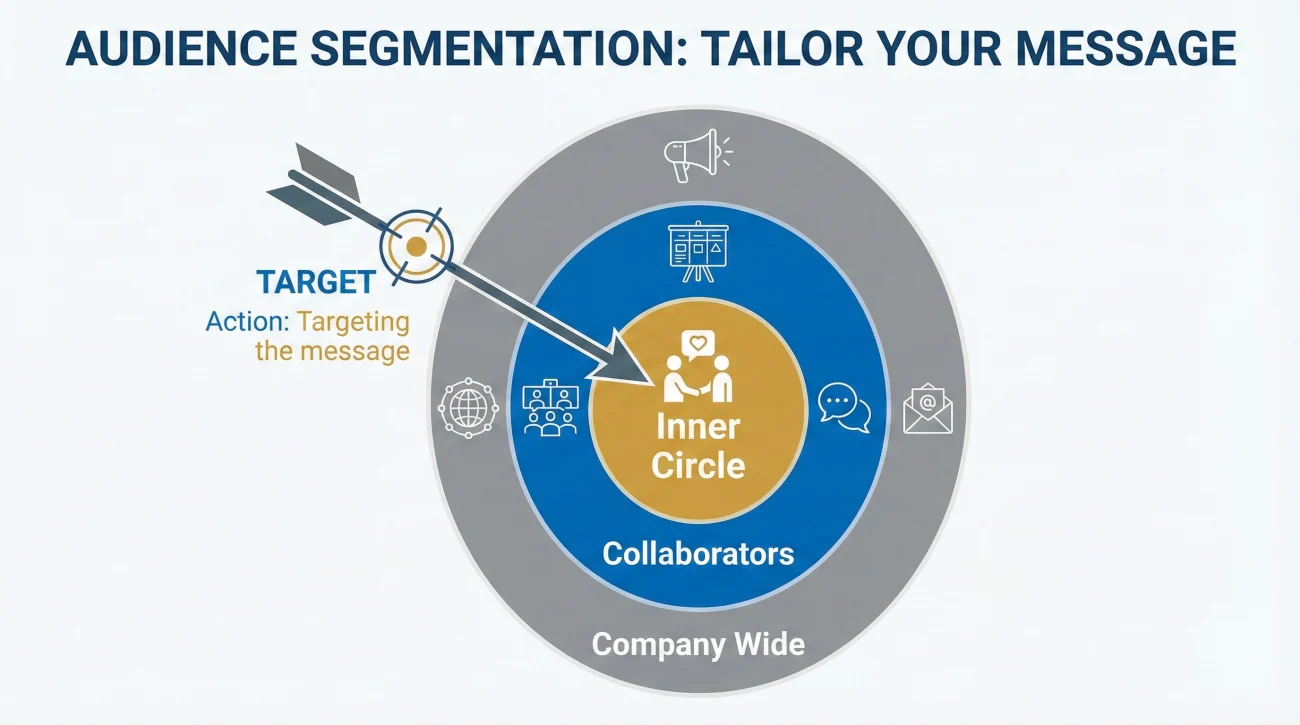
A “Reply All” blast to the entire company is rarely the right move. It feels impersonal to your friends and irrelevant to strangers. A sophisticated announcing resignation to staff strategy involves segmentation.
Tier 1: The “Inner Circle” (Personalized)
These are the people you vent to, lunch with, and trust. Do not insult them with a generic template. They deserve a personal note or a face-to-face conversation. The email is just a formality to exchange non-work contact info (phone numbers, personal emails).
If the email itself feels too formal for what that person actually meant to you, the personal note is where the real goodbye happens — these heartfelt thank-you messages can help you find the words the template can’t.
Tier 2: The Collaborators (Professional Warmth)
People you work with daily but aren’t close friends with. They need to know logistics (who is taking over your projects) mixed with gratitude. This is where your templates work best.
Tier 3: The “Outer Circle” (The Farewell Blast)
If you work at a large company, this is the generic email sent to a large distribution list. Keep it brief, positive, and purely functional. Its only purpose is to say “I’m gone, here is who to contact.”
The Architecture of a Perfect Goodbye Email
Your resignation email to colleagues is not a manifesto. It is not the place to settle scores, air grievances, or brag about your salary bump. It is a tool for relationship preservation.

The 4 Pillars of Content
- The Timeline: State clearly that you are leaving and when your last day is. Ambiguity creates anxiety.
- The Transition: Direct them to the person taking over your workload. This signals that you care about the team’s success even after you leave.
- The Gratitude: Mention specific things you enjoyed (the culture, the projects, the people). Even if you hated the job, compliment the people.
- The Call to Action (CTA): Provide LinkedIn profile links or personal email addresses. Make it easy for them to find you.
The “Toxic Traps” to Avoid
Avoid these common pitfalls that can tarnish your reputation in the final hour:
- ❌ The “Mic Drop”: “I’m out of here, good luck with the mess!” (Passive-aggressive).
- ❌ The Humble Brag: “I’m sad to leave but excited to join Google as a VP…” (Unless asked, keep the destination vague or modest).
- ❌ The Novel: No one wants to read 1,000 words about your emotional journey. Keep it under 200 words.
- ❌ Negative “Truth Bombs”: “I hope the management improves for your sake.” (Save it for the exit interview or your diary).
7 Calibrated Resignation Announcement Templates
Select the template that matches the specific audience segment you are addressing. These scripts are designed to strike the perfect balance of warmth and professionalism.

Template 1: The “Team Player” (Immediate Department)
Best for: The core team you work with daily. Warm, grateful, and focused on continuity.
Subject: Moving On – [Your Name]
Hi Team,
I’m writing to let you know that I will be moving on from my position at [Company Name], with my last day being [Date].
I want to say a huge thank you to all of you. Working with this team has genuinely been the highlight of my time here. I’m so proud of what we accomplished on [Project Name] and will miss our daily collaboration.
Over the next week, I’ll be working closely with [Successor’s Name] to hand over my responsibilities. Please feel free to reach out to me before [Last Day] if you have any questions on pending items.
I’d love to stay in the loop with your future successes. You can find me on LinkedIn [Link] or reach me at [Personal Email].
Let’s grab a coffee before I head out!
Best,
[Your Name]
Template 2: The “Work Bestie” (Casual & Personal)
Best for: People you actually like and hang out with. Drop the corporate speak.
Subject: So… some news 🥺
Hey [Name],
As you might have heard, I’m wrapping up my time at [Company Name]. My last day is [Date].
Honestly, you made the tough days bearable and the good days great. I’m going to miss our [coffee runs/chats/inside jokes]. I’m excited about my next step, but definitely sad to be leaving you behind in the trenches!
I’m not disappearing, though. You have my number, but here is my personal email just in case: [Email].
Let’s definitely do [lunch/happy hour] before I go.
Best,
[Your Name]
Template 3: The “Client Reassurance” (External Partners)
Best for: Clients, vendors, or external stakeholders. The goal here is stability, not emotion.
Subject: Transition Update regarding [Account Name] – [Your Name]
Dear [Client Name],
I am writing to inform you that I will be moving on from [Company Name], effective [Date].
It has been a privilege working with you on [Project/Account]. I want to ensure you that you are in excellent hands. [Successor Name] (cc’d here) will be taking over your account. They are fully briefed on our history and your current goals, and I am confident they will continue to provide the support you need.
We will be conducting a formal handover call next week to ensure nothing falls through the cracks.
Thank you for the partnership and trust you placed in me.
Sincerely,
[Your Name]
Template 4: The “Short & Sweet” (Company Wide)
Best for: Large distribution lists where you don’t know everyone personally.
Subject: Farewell from [Your Name]
Hi Everyone,
I wanted to share that I will be leaving [Company Name] on [Date] to pursue a new opportunity.
I’ve enjoyed my time here and am grateful for the chance to have worked with such a talented group of people. I wish the company nothing but continued success.
If you’d like to stay in touch, feel free to connect with me on LinkedIn: [Link].
All the best,
[Your Name]
Template 5: The “Remote Worker” (Virtual Goodbye)
Best for: Fully remote teams where “dropping by the desk” isn’t an option.
Subject: Signing off – [Your Name]
Hi Team,
It’s strange to say goodbye without being in the same room, but I wanted to let you know that my last day with [Company Name] will be [Date].
Despite the distance, I’ve felt incredibly connected to this team. Thank you for making the remote culture so supportive and collaborative. I’ve learned a ton from our Zoom calls and Slack threads.
I’m organizing my files in [Shared Drive Link] for the handoff. I’ll be online until [Time] on [Last Day] if anyone wants to hop on a quick call to say bye.
Hope to cross paths virtually in the future!
Cheers,
[Your Name]
Template 6: The “Project Handoff” (Functional Focus)
Best for: Cross-functional teams where your departure impacts active workflows.
Subject: Departure & Project Transition Plan – [Your Name]
Hi Team,
I’m writing to let you know I’m leaving [Company] on [Date]. Before I go, I want to clarify the transition plan for our active projects:
* Project Alpha: [Name] is taking lead. Status doc is here: [Link]
* Q3 Report: I will finalize this before Friday.
* Pending Invoices: [Name] has access to the portal.
Thank you for the collaboration. It’s been great working with you all.
Best,
[Your Name]
Template 7: The “High Road” (Leaving on Bad Terms)
Best for: When you hated the job but need to remain professional. It is brief, polite, and offers zero ammunition.
Subject: Moving On – [Your Name]
Colleagues,
I am writing to let you know that [Date] will be my final day at [Company Name].
I appreciate the opportunities I’ve had during my time here and wish the team well in future endeavors.
For any future inquiries regarding my role, please direct them to [Manager’s Name].
Regards,
[Your Name]
The LinkedIn Protocol: When to Post Publicly
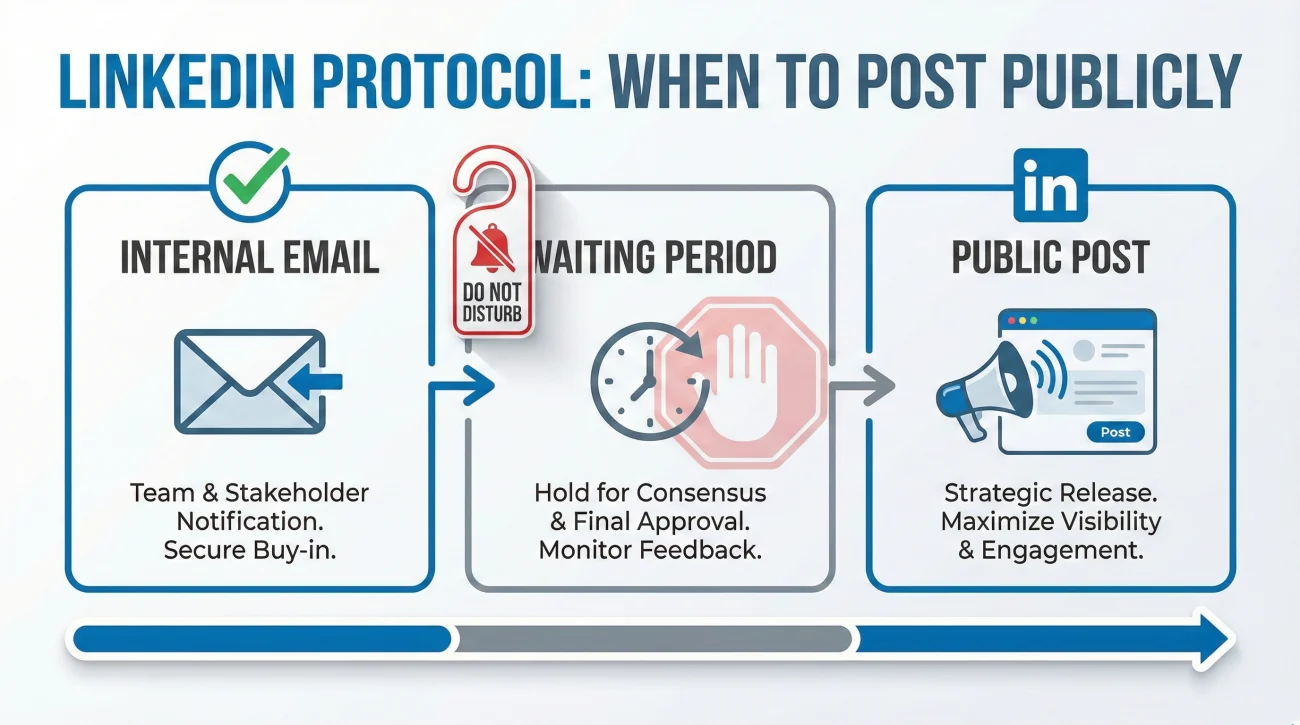
In the digital age, your resignation announcement email to team is often followed by a LinkedIn post. However, the timing here is critical to avoid looking unprofessional.
🪙 The Golden Rule: Do not post on LinkedIn until after you have sent your internal emails. Ideally, wait until your last day or even the week after you leave.
Why? Posting publicly while you are still sitting at your desk can make it look like you have mentally checked out. It also invites headhunters to call you on your work line, which is disrespectful to your current employer. Save the “I’m happy to announce…” post for your first day at the new job, or a “Grateful for the chapter closed…” post for the Monday after you leave.
When you are ready to update your LinkedIn presence after you leave, refresh your LinkedIn Headline with proven templates that match your new role and career direction.
❓ FAQ
📧 Should I BCC everyone or use the main distribution list?
🤐 What if I don’t want to tell people where I’m going?
👋 Is it rude to just leave without an email?
🍷 Should I organize my own goodbye drinks?
Final Thoughts
Your resignation email to coworkers is the closing argument of your tenure. It is the final impression you leave on the jury of your peers. While it is tempting to rush through it in the excitement of a new job, taking twenty minutes to craft a thoughtful, segmented, and gracious message is an investment in your future.
The world is incredibly small. The junior analyst you say goodbye to graciously today might be the hiring manager reviewing your resume five years from now. Treat every goodbye as a “see you later,” and you will build a network that supports you for decades.
For more specific scenarios, browse our resignation email examples. If you need to revisit the start of this process, check our guide on how to write a resignation email, or return to the homepage for more career strategy.
⚠️ Legal Disclaimer: The resignation templates, email samples, and professional guidance provided in this guide are for informational purposes only and do not constitute legal advice. Employment laws and contract requirements vary by jurisdiction and individual circumstances. Please review your employment agreement and consult your HR department and/or a qualified attorney to ensure compliance with applicable laws and policies.