- Context: In regulated or traditional industries, a resignation email is a formal record that may be reviewed by HR, Legal, and leadership.
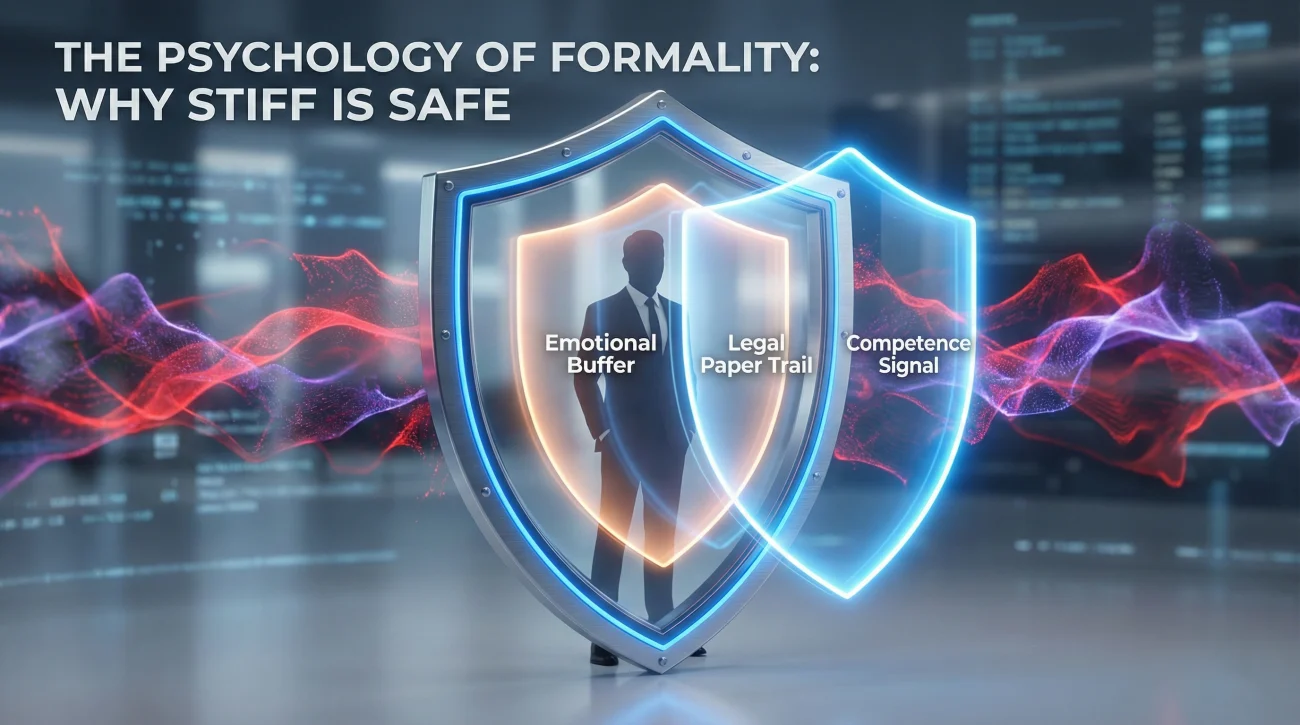
- Why formality works: It creates emotional distance, locks in a clear effective date as a paper trail, and signals executive-level competence.
- When to go formal: Old-guard sectors, Director or VP roles and above, or any cold or hostile manager relationship.
- The 4 pillars: A memo-style subject line, a first-sentence resignation statement with “effective [Date],” restrained gratitude, and a continuity or handover pledge.
- Execution: Use classic fonts in black, “Dear Mr./Ms. [Last Name]” with “Sincerely” or “Respectfully,” and attach a signed PDF if the environment expects it.
The Protocol of Departure: Mastering the Professional Resignation
In the casual era of tech startups and remote work, formality is often mistaken for stiffness or lack of personality. However, in established industries – Law, Finance, Healthcare, Government, and Academia – formality is not just a style; it is the language of respect and risk management. A professional resignation email in these contexts is not merely a notice; it is a legal document, a piece of evidence, and a final testament to your executive presence.
When you resign from a senior position or a traditional corporation, your email is scrutinized by more than just your boss. It enters a formal chain of custody involving Legal counsel, HR compliance officers, and potentially the Board of Directors. A casual “I’m leaving, thanks for everything!” note in these environments does not signal “cool”; it signals “risk” and “amateurism.”
This comprehensive guide is your masterclass in corporate etiquette. We will deconstruct the anatomy of a formal resignation, identifying exactly when to deploy high-level protocol, how to create a protective “paper trail,” and providing templates that safeguard your reputation in the most conservative boardrooms.
For a broader overview of resignation mechanics, refer to our foundational guide on how to write a resignation email.
The Psychology of Formality: Why “Stiff” is Safe
Why do we use such rigid language in formal resignations? It serves a specific psychological and legal function.
1. Emotional Distancing
Formality creates a buffer. By using standard business language (“I hereby resign” vs. “I’m quitting”), you depersonalize the event. This prevents emotional outbursts from your manager and signals that the decision is a business transaction, not a personal rejection. It lowers the temperature in the room.
2. The “Paper Trail” Strategy
In litigious industries, ambiguity is dangerous. If you say “I’m thinking of leaving around the 15th,” a bad employer might claim you never officially resigned or that you abandoned your post. A formal email with the phrase “effective [Date]” creates an indisputable legal timestamp. It proves you gave proper notice, protecting your payout of accrued benefits and bonuses.
3. Signaling Competence
How you leave is the final impression of your competence. A sloppily written resignation suggests you have “checked out.” A precisely drafted, formal document signals that you remain in control and are operating at a high professional standard until the very last minute.
The “High-Stakes” Context: When Formality is Mandatory
Not every exit requires a tie. But knowing when to wear one is crucial. You must elevate your tone from “standard” to “formal” in the following scenarios.
1. The “Old Guard” Industries
Certain sectors operate on a bedrock of hierarchy and documentation. In these worlds, a casual email is a breach of protocol.
- ⚖️ Legal & Compliance: Law firms, audit bureaus, regulatory bodies.
- 💰 Finance: Investment banking, private equity, insurance, wealth management.
- 🏛️ Public Sector: Government agencies, military, diplomatic corps, tenured academia.
- 🏥 Healthcare: Hospital administration, senior medical staff, clinical directors.
2. The Seniority Threshold
As you climb the ladder, your resignation affects more stakeholders.
Junior Roles: Standard polite email is sufficient.
Director/VP+: Formal resignation is mandatory. Your departure impacts strategy, budgets, and team morale. Your email must reassure the organization of stability and continuity.
3. The “Cold” or “Hostile” Relationship
If your relationship with your manager is strictly transactional, strained, or toxic, do not attempt warmth. Retreat to formality. Formality is a shield. It creates a professional distance that prevents emotional messiness and protects you from accusations of unprofessionalism. It gives them nothing to attack.
Deconstructing the Formal Email: The 4 Pillars
A formal resignation email is stripped of all fluff. It is precise, unemotional, and legally watertight. It must contain four specific pillars.

Pillar 1: The “Unmissable” Header
In a formal context, ambiguity is the enemy. Your subject line must look like an official memo, not a chat ping. It ensures the email is prioritized and archived correctly.
Correct: “Formal Resignation Notice – [Your Full Legal Name] – [Title]”
Incorrect: “Resignation”, “Update”, or “Bad News”
Pillar 2: The Declaration of Fact
Do not “bury the lead.” The first sentence must state the action and the date definitively. Use the phrase “effective [Date]” to establish the legal timeline for payroll and benefits termination.
“I am writing to formally resign from my position as Director of Operations, effective October 15, 2023.”
Pillar 3: The “Statuesque” Gratitude
In formal writing, gratitude is expressed with dignity, not effusiveness. Avoid exclamation points, emojis, or slang. Focus on “opportunities,” “development,” and “tenure.”
“I am grateful for the opportunities for professional development I have experienced during my tenure with the firm.”
Pillar 4: The Continuity Pledge
Senior leaders worry about gaps and dropped balls. Your email must proactively address the handover to calm these fears immediately.
“I will work to ensure a seamless transition of my fiduciary responsibilities and client accounts prior to my departure.”
7 Executive-Level Resignation Templates
Select the template that matches the gravity of your role. Ensure you remove any bracketed placeholders. For more standard options, browse our resignation email examples.

1. The “Standard Corporate” (The Safe Choice)
Best for: Mid-to-senior roles in large, traditional companies (Fortune 500).
Subject: Formal Resignation Notice – [Full Name]
Dear Mr./Ms. [Manager’s Last Name],
Please accept this letter as formal notification that I am resigning from my position as [Job Title] at [Company Name]. My final day of employment will be [Date].
This was not an easy decision, as I have greatly valued my time with [Company Name]. I appreciate the professional opportunities I have been afforded and the relationships I have built within the department over the past [Number] years.
I am fully committed to ensuring a smooth transition. Over the next [Number] weeks, I will finalize my outstanding projects and document my workflows for my successor to ensure no momentum is lost.
Respectfully,
[Your Full Name]
2. The “Executive Departure” (Director/VP Level)
Best for: Leadership roles where you must reassure the organization of continuity and stability.
Subject: Resignation – [Full Name] – [Executive Title]
Dear [Manager’s Name],
I am writing to formally submit my resignation as [Job Title], effective [Date].
After careful consideration, I have decided to pursue a new opportunity that aligns with my long-term strategic goals. I am proud of what our division has achieved over the past [Number] years, particularly the [Mention Key Achievement].
My priority now is business continuity. I have prepared a comprehensive transition plan for my direct reports and key accounts, which I am ready to review with you. I will do everything necessary to ensure the department remains stable during this interim period.
Sincerely,
[Your Full Name]
3. The “Compliance & Legal” (Regulated Industries)
Best for: Banking, Law, or roles with strict non-compete/NDA clauses. This template explicitly acknowledges your obligations.
Subject: Formal Resignation – [Full Name] – [License/ID Optional]
Dear Mr./Ms. [Last Name],
Please accept this letter as my formal resignation from the position of [Job Title]. In accordance with my employment contract, I am providing [Number] weeks’ notice, with my final day being [Date].
I remain cognizant of my post-employment obligations regarding confidentiality and non-solicitation, and I intend to honor them fully.
I will facilitate the transfer of all client files and sensitive data in compliance with company protocol before my departure. Please advise on the preferred method for returning company assets.
Regards,
[Your Full Name]
4. The “Academic/Institutional” (Tenure & Term)
Best for: Professors, Researchers, or University Admin. Acknowledges the academic calendar and student obligations.
Subject: Resignation – [Full Name] – [Department]
Dear Dean [Last Name],
I am writing to formally resign my position as [Title] in the Department of [Name] at [University Name], effective at the conclusion of the current semester, [Date].
I have accepted a position at another institution. I am committed to fulfilling my teaching and advising responsibilities through the end of the term, including the submission of final grades and the completion of committee work.
I appreciate the academic support I have received during my tenure here and wish the department continued success.
Sincerely,
[Your Full Name], Ph.D.
5. The “Board Member” (Fiduciary Duty)
Best for: Resigning from a Board of Directors or Committee. Focuses on governance transition.
Subject: Resignation from Board of Directors – [Full Name]
Dear [Board Chair Name],
I hereby tender my resignation as a Director of [Organization Name], effective [Date].
Due to [brief reason, e.g., increasing professional commitments], I feel I can no longer dedicate the necessary time to fulfill my fiduciary duties to the standard the Board deserves. It has been an honor to serve this organization.
I will ensure all committee materials are handed over to the Secretary prior to my departure and am happy to assist in onboarding my replacement.
Respectfully,
[Your Full Name]
6. The “Formal Remote” (Global/Distributed)
Best for: Remote employees in large multinational corps where the email is the primary record and logistics are complex.
Subject: Formal Resignation Notice – [Full Name] – [Employee ID]
Dear [Manager’s Name],
I am writing to formally resign from my remote position as [Job Title], effective [Date].
I will follow all company protocols regarding the return of IT assets and data security. My equipment will be shipped back by [Date] per HR instructions. I have uploaded all my active files to the shared server [Link].
Thank you for the opportunity to contribute to the [Team Name] team.
Best regards,
[Your Full Name]
7. The “Strictly Business” (Short & Cold)
Best for: When you want absolutely zero emotion or when leaving a difficult/hostile environment professionally. Gives them nothing to criticize.
Subject: Resignation Notice – [Full Name]
Dear [Manager’s Name],
Please accept this email as my formal resignation as [Job Title]. My last day of employment will be [Date].
I will ensure my tasks are handed over and my files are organized before my departure. Please let me know the process for the final exit interview.
Regards,
[Your Full Name]
The Aesthetics of Authority: Formatting Rules
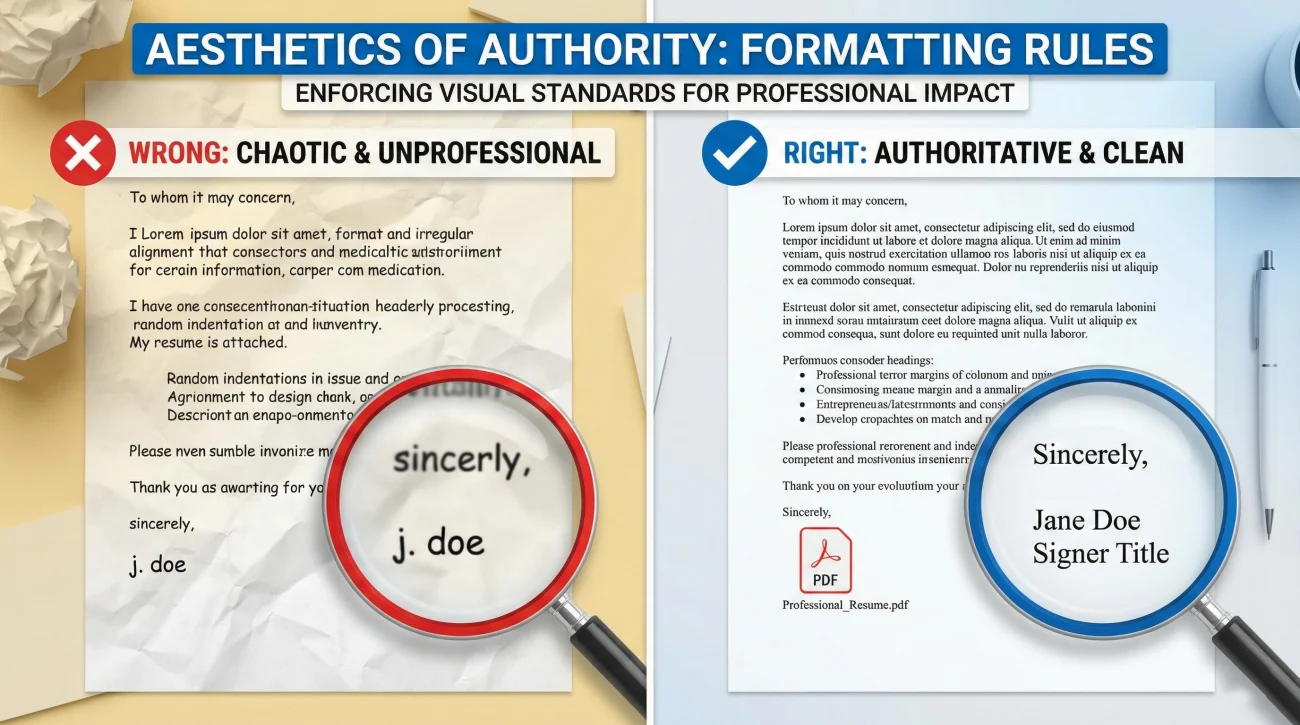
In formal communication, how it looks is as important as what it says. Violating visual norms screams “amateur.”
1. The Typography
Do not use the default email font if it is casual (like Comic Sans or a colorful font). Stick to the classics:
Fonts: Arial, Calibri, Times New Roman, or Helvetica.
Size: 11pt or 12pt (Easy to read on all devices).
Color: Black only. No grey, no blue.
2. The “Bookends” (Salutation & Sign-off)
Opening: Always use “Dear Mr./Ms. [Last Name].” Never use “Hi [First Name]” in a formal resignation, even if you call them by their first name daily. The email is a record for HR, not a chat with a friend.
Closing: “Sincerely” or “Respectfully” are the only two acceptable options. Avoid “Best,” “Cheers,” or “Warmly.”
3. The PDF Attachment
In highly formal sectors (Law, Gov), the email body is just the delivery mechanism. You should attach a PDF version of your resignation letter, signed and on a clean letterhead (if applicable). This mimics the old-school physical letter.
“Please find attached my formal letter of resignation.”
❓ FAQ: Nuances of Formal Resignation
📧 Should I CC HR on this email?
🖊️ Do I need to physically sign the letter?
🤐 Should I mention why I am leaving?
🗓️ What if my contract requires 3 months’ notice?
🤝 Can I negotiate my notice period in a formal email?
Final Thoughts
A professional resignation email is a career insurance policy. It creates a pristine administrative record that protects your reputation long after you have left the building. By adhering to strict protocol, you signal that you are a professional who operates with integrity and class, regardless of the circumstances.
You have worked hard to build your standing. Don’t let a casual email undermine it at the finish line. When in doubt, always choose the path of greater formality.
For further resources on career transitions, visit our homepage.
⚠️ Legal Disclaimer: ResignSmartly provides general informational guidance about resignation, workplace communication, notice periods, handovers, and career transitions. Content does not constitute individualized legal advice. Employment laws, contracts, workplace policies, and individual circumstances vary, so review the requirements that apply to your situation and consult an appropriate qualified professional when needed.