- Two Track Exit: Keep manager communication for relationships and continuity, keep HR communication for documentation and payroll compliance.
- Order Of Operations: Tell your manager first, then send written notice to manager, then send a separate written notice to HR.
- Data Payload: Include full legal name, employee ID, exact last day date, personal email and phone, mailing address, role and department.
- Template Coverage: Use copy paste versions for standard HR notice, CC manager plus HR, sensitive HR first cases, immediate departure, and benefits inquiry.
- Money And Risk: Confirm PTO payout rules, equity vesting and option windows, bonus clawbacks, benefits end date and COBRA timing, and treat exit interviews as a risk managed conversation.
The Definitive Guide to Writing a Resignation Email to HR
Writing a resignation email to HR is the “black box” of the exit process for many employees. While your conversation with your manager is about relationships, transition plans, and preserving your professional network, your communication with Human Resources is a fundamentally different beast. It is a legal trigger and an administrative necessity. It initiates the complex machinery of your departure: stopping payroll, terminating benefits, calculating vacation payouts, generating tax documents, and starting the clock on post-employment legal obligations.
Many professionals mistakenly believe that telling their manager verbally or sending a quick note to their boss is sufficient. In many organizations, this is a dangerous assumption. In corporate structures, the clock on your “notice period” often doesn’t officially start ticking until HR receives written notification. Failing to send this specific, separate human resources resignation email can lead to significant headaches: delayed final paychecks, lapses in health insurance coverage, complications with unemployment eligibility (in rare cases), or leaving you in a legal grey area regarding your official termination date.
Furthermore, HR is the gatekeeper of your “permanent record.” The tone, content, and precision of your formal resignation letter to HR will determine how you are classified in the system (e.g., “Eligible for Rehire” vs. “Do Not Rehire”) and what is communicated during future background checks. This guide serves as your comprehensive administrative playbook. We will demystify the HR resignation process, explain exactly what data points must be included to avoid payroll errors, dive deep into the financial implications of your exit (equity, bonuses, PTO), and provide copy-paste templates for every scenario.
HR vs. Manager: The Two-Track Exit Strategy
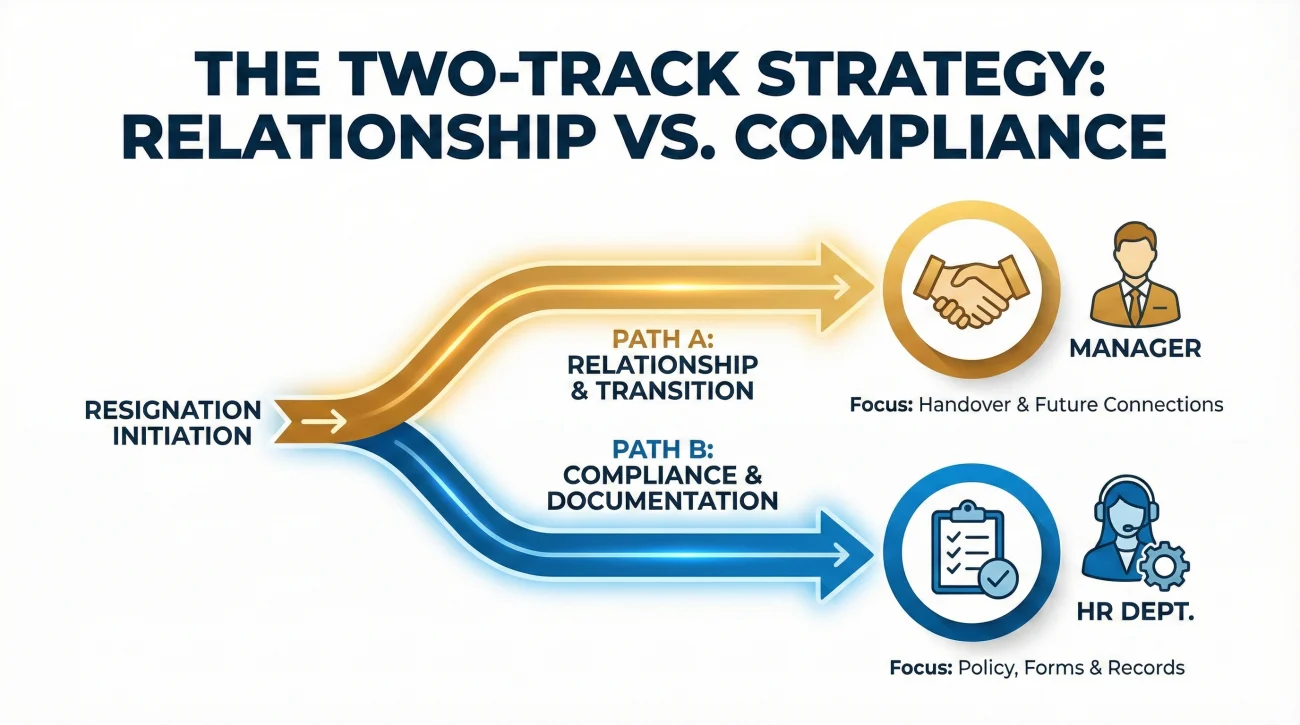
To execute a flawless exit, you must treat your resignation as a two-track process. Track A is “The Work” (focused on your Manager). Track B is “The Paperwork” (focused on HR). Mixing these two tracks is the most common mistake departing employees make.
The Strategic Distinction
To Your Manager: The goal here is relationship preservation. You discuss how to hand over projects, who will take over your clients, and how to minimize disruption to the team. The tone is warm, grateful, and collaborative. You want them to be a lifelong reference.
To HR: The goal here is documentation and compliance. HR professionals view your email to hr for resignation as a data input source for the Human Capital Management (HCM) system. They do not need to know that you “loved the team culture but felt stifled by the lack of growth.” They need to know your exact last day so they don’t overpay you (which creates a tax nightmare for you later) or underpay you (which is a legal liability for them).
| Feature | Manager Email | HR Email |
|---|---|---|
| Primary Function | Business Continuity & Relationship | Legal Compliance & Payroll Processing |
| Key Information | Project status, transition plan, gratitude | Employee ID, Official Last Day, PTO balance |
| Tone | Personal, Warm, Narrative | Clinical, Professional, Brief, Data-Driven |
| Future Impact | Affects your LinkedIn recommendations | Affects your background check & rehire eligibility |
The Order of Operations
Ideally, the sequence of events should be strictly followed to avoid political fallout:
- Step 1: Verbal Notice to Manager. Schedule a 1:1. Break the news personally. Never let HR tell your boss you quit before you do.
- Step 2: Written Notice to Manager. Send the formal “for the record” email to your boss immediately after the meeting.
- Step 3: Written Notice to HR. Send the separate administrative email to HR (or CC them on the manager email if the culture permits).
⚠️ Warning: Sending an email to HR before talking to your boss is considered a major professional faux pas. It blindsides your manager when HR reaches out to them to confirm the exit, damaging trust instantly. The only exception is if you are resigning due to a serious conflict with that specific manager (e.g., harassment, safety issues).
The HR Resignation Data Checklist
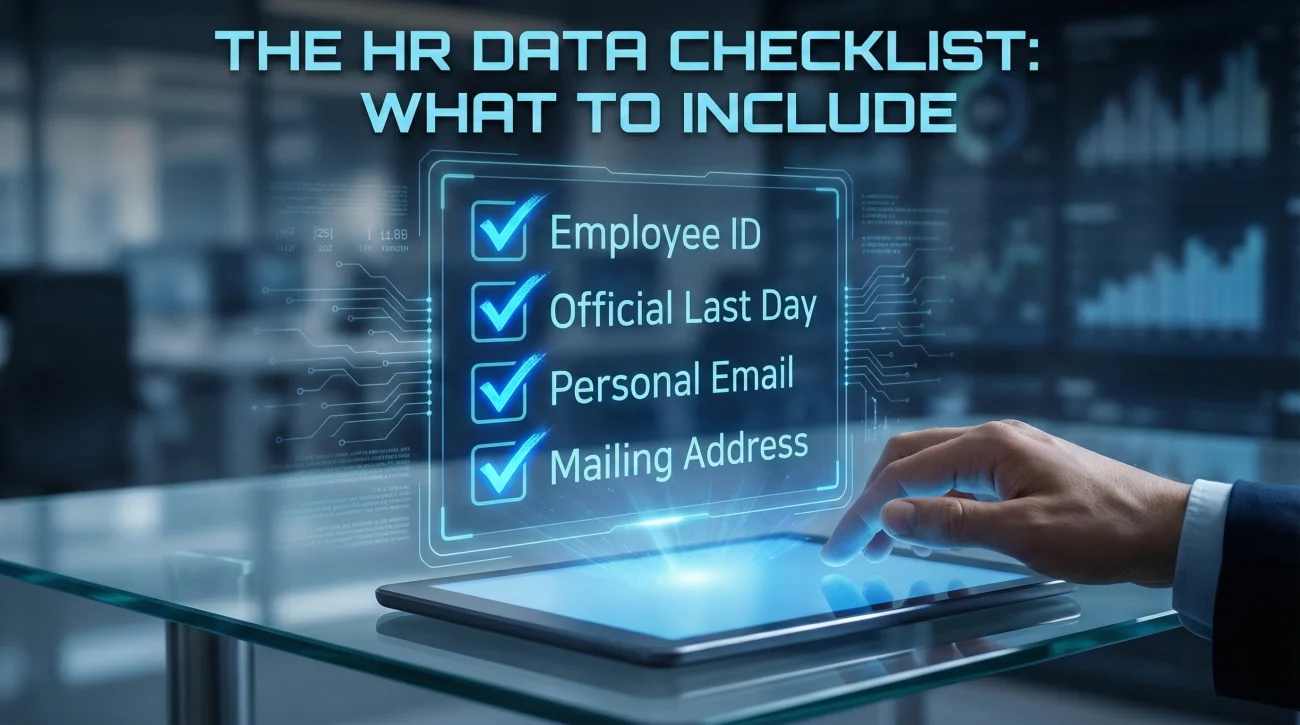
HR departments receive hundreds of emails a day. If your resignation email is vague (“I’m quitting in a few weeks”), it will get flagged for manual follow-up, delaying your exit processing. To ensure a “one-touch” processing experience, your email must include the following data payload:
- ✅ Full Legal Name: Use the name on your payroll checks, not your nickname. If you go by “TJ” but your payroll name is “Thomas Jefferson Smith,” use the latter.
- ✅ Employee ID Number: If you have access to your pay stub or HR portal, find this number. Including it prevents errors, especially if there is another employee with a similar name.
- ✅ Official Last Day: State the specific date (e.g., “Friday, October 14th, 2025”). Do not say “two weeks from today” or “mid-October.” Ambiguity leads to payroll errors.
- ✅ Personal Contact Info: Your work email will be deactivated immediately upon your departure. You must provide a permanent personal email (Gmail/Outlook) and phone number for receiving W-2s, COBRA packets, and final documents.
- ✅ Mailing Address: Confirm the physical address where your final check (if paper) or legal notices should be mailed. If you have moved recently, this is the time to update it.
- ✅ Position Title & Department: Helps HR route your file to the correct Business Partner quickly.
Resignation Email Templates for HR (Copy & Paste)
These templates range from standard notifications to complex scenarios. Choose the one that fits your exit strategy and customize the bracketed information.
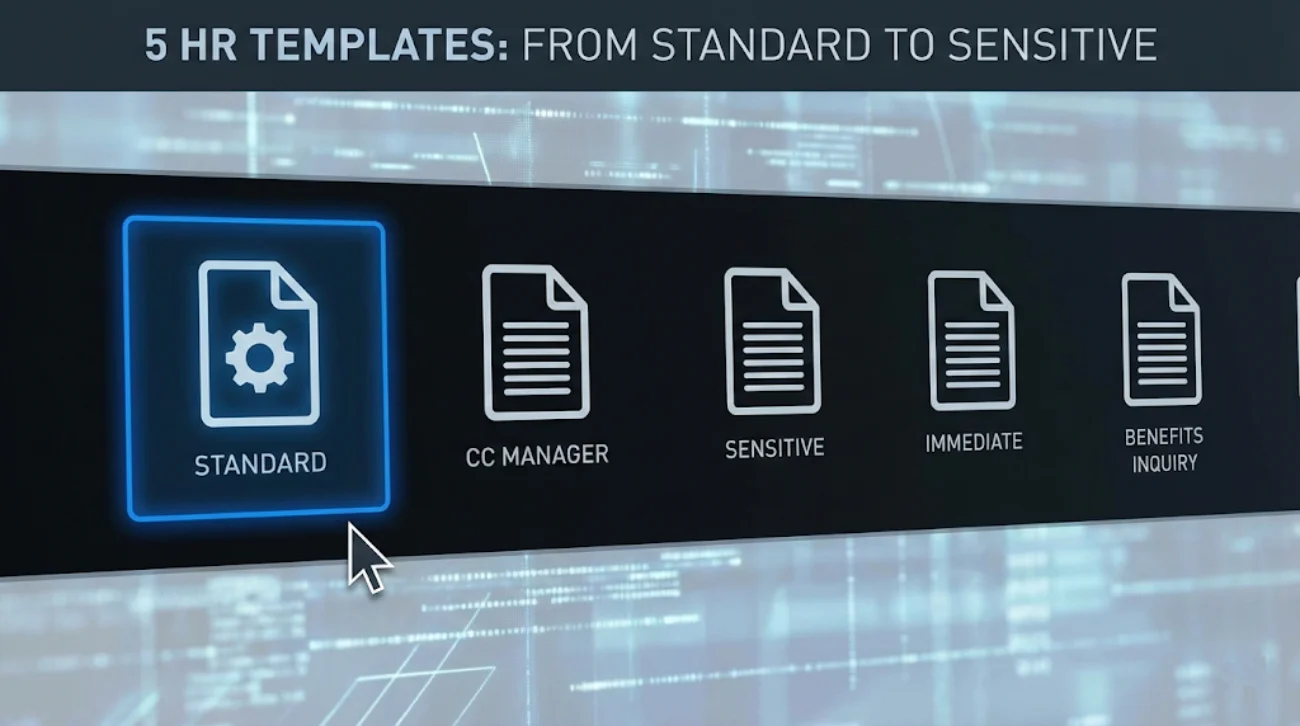
1. The “By the Book” (Standard Notification)
Use this template when you have already spoken to your manager, the relationship is good, and you just need to file the necessary paperwork to start the offboarding clock.
Subject: Resignation – [Your Full Legal Name] – Employee ID [Number]
Dear Human Resources Team,
Please accept this email as formal notification of my resignation from my position as [Job Title] in the [Department Name] department at [Company Name]. I have already informed my manager, [Manager Name], of my decision verbally and in writing.
My final day of employment will be [Day of Week], [Date].
Administrative Details for Processing:
Employee ID: [Number]
Personal Email: [Email Address] (for future correspondence)
Personal Phone: [Phone Number]
Current Mailing Address: [Full Address]
Please let me know the specific process for returning company assets (laptop, badge, keys) and when I can expect information regarding my final paycheck and benefits termination.
Thank you for your assistance during this transition.
Sincerely,
[Your Name]
2. The “Efficiency Play” (CC Manager & HR)
This is the most common modern method for corporate environments. You write one email to your manager and Copy (CC) HR on it. It kills two birds with one stone and ensures everyone is on the same page regarding the timeline. This is the optimal resignation email cc hr strategy.
To: [Manager Name]
CC: [HR Representative Name] OR [HR General Email]
Subject: Formal Resignation – [Your Name]
Dear [Manager Name],
As we discussed earlier today, please accept this email as formal notice of my resignation. My last day will be [Date].
I am grateful for the opportunity to have worked with this team and appreciate the support you have provided during my tenure. I will ensure all my projects are handed over smoothly and that [Colleague Name] is fully trained on my workflows before I depart.
To HR (CC’d): Please consider this my official notice for your records. Please advise on next steps regarding benefits, the return of equipment, and offboarding documentation.
Best regards,
[Your Name]
3. The “HR First” (Sensitive/Conflict/Harassment)
Use this template only if you cannot talk to your manager first. This might be due to harassment, safety concerns, a toxic environment, or if your manager is on extended leave. This flags HR immediately that this is not a standard exit and may require intervention.
Subject: CONFIDENTIAL: Resignation Notification – [Your Name]
Dear [HR Contact Name/HR Director],
I am writing to formally resign from my position as [Job Title], effective [Date].
Due to sensitive circumstances regarding my current work environment/direct management, I am notifying HR directly before informing my manager. I would appreciate a brief, confidential conversation to discuss the appropriate protocol for communicating this to my team and handling my notice period effectively.
Please let me know when you have a moment to speak today. I can be reached at [Phone Number].
Sincerely,
[Your Name]
4. The “Immediate Departure” (No Notice)
For emergencies where you cannot work another day (medical crisis, family emergency, or unsafe working conditions). HR needs to know immediately to stop payroll processing to avoid overpayment. This serves as an urgent formal resignation letter to hr.
Subject: URGENT: Immediate Resignation – [Your Name] – Employee ID [Number]
Dear HR Team,
Please accept this letter as notice of my resignation, effective immediately today, [Date].
Due to unforeseen personal circumstances that require my full attention, I am unable to provide the standard two-week notice period. I apologize for the abrupt nature of this departure and any disruption it may cause.
Please send information regarding my final paycheck, COBRA benefits, and tax documents to my personal email: [Email Address]. I will arrange to return my company equipment via [Mail/Drop-off] by [Date].
Sincerely,
[Your Name]
5. The “Benefits Inquiry” (Complex Offboarding)
Use this if you have specific, high-value concerns about 401(k) vesting, stock options, or PTO payouts that need answering immediately so you can plan your finances.
Subject: Resignation and Benefits Inquiry – [Your Name]
Dear HR Team,
I am writing to formally resign from my position as [Job Title], effective [Date]. I have informed my manager, [Manager Name].
To ensure a smooth departure, I have a few specific questions regarding my final compensation packages:
- ❓ PTO Payout: I currently show [Number] hours of accrued PTO. Can you confirm this balance and that it will be included in my final check?
- ❓ 401(k): What is the procedure for rolling over my account, and when will the final employer match be posted?
- ❓ Stock Options: I have unvested options; can you confirm the exercise window post-termination (e.g., 90 days)?
- ❓ Expense Reports: I have pending expenses in the system. What is the deadline for approval?
Thank you for your assistance in clarifying these details.
Best regards,
[Your Name]
The Financial Deep Dive: Don’t Leave Money on the Table
Resigning to HR isn’t just about saying goodbye; it’s about securing your assets. Corporate compensation is complex, and leaving without understanding the rules can cost you thousands of dollars. Your email to HR is your first step in clarifying these figures.

1. The PTO (Paid Time Off) Payout
The Law: In the US, there is no federal law requiring employers to pay out unused vacation time. However, many states (like California, Colorado, Illinois, Massachusetts) view earned vacation time as “wages” that must be paid out upon separation.
The Trap: Many companies differentiate between “Vacation Time” (paid out) and “Sick Time” (usually lost). Others have “Unlimited PTO” policies, which often means zero payout because nothing is “accrued.”
Action: Check your employee handbook before you send the email. If you are in a “use it or lose it” state/policy, and you have 3 weeks of vacation, consider taking the vacation before you resign (if ethical and permitted).
2. Stock Options and Equity Vesting
If you have stock options (ISOs/NSOs) or Restricted Stock Units (RSUs), your resignation date is critical.
Vesting Cliffs: Check your vesting schedule. If you vest on the 15th of the month, and you resign on the 14th, you could lose a massive tranche of equity. Always set your last day after a vesting cliff.
The 90-Day Rule: For standard stock options, you typically have 90 days after your last day of employment to “exercise” (buy) them. If you don’t, they expire and go back to the company. Make sure you have the cash on hand to buy them if they are valuable.
3. Signing Bonuses and Relocation Clawbacks
Did you receive a signing bonus or relocation package when you joined? Most come with a “clawback” clause, stating that if you leave within 12 or 24 months, you must repay the gross amount (including the taxes you already paid!).
Action: Review your original offer letter. If you are one month away from the 12-month mark, wait. Leaving early could cost you $5,000 – $20,000 in immediate debt to the company.
The Exit Interview: A Strategic Decision
HR will likely ask for an exit interview. This is not a casual chat over coffee; it is a data collection exercise for the company’s risk management. Be extremely careful.
Should You Participate?
Participate If: You are leaving on good terms, the culture is healthy, and you genuinely want to help the company improve for your friends who remain.
Decline If: You are leaving a toxic environment, fear retaliation, or simply want to move on without reliving trauma. You are rarely legally obligated to attend an exit interview.
What to Say (and What to Keep Quiet)
HR serves the company, not you. Information shared in exit interviews is not confidential in the way doctor-patient privilege is. It can be shared with executives or legal teams if it flags a liability.
| ✅ Say | ❌Don’t say |
|---|---|
| “I found a better opportunity for growth.” (Vague, positive, unassailable.) | “My boss is incompetent and everyone hates him.” (Specific, unverifiable, potential bridge-burner.) |
| “I suggest reviewing the compensation bands for the department to remain competitive.” (Professional feedback.) | “This place is a sinking ship.” (Emotional, unprofessional.) |
❓ FAQ: Resigning to Human Resources
📧 Can I just tell my manager and skip the email to HR?
💰 When will I get my final paycheck?
🚫 Can HR reject my resignation?
📞 What will HR tell future employers during a reference check?
Final Thoughts: The Administrative Finish Line
Resigning to HR is the final administrative hurdle of your employment marathon. While it lacks the emotional weight of telling your boss, it carries significantly more financial and legal weight. A clean, precise, and data-rich email ensures that you get paid every cent you are owed, your benefits transition smoothly, and your permanent personnel file is marked “Eligible for Rehire.”
Treat this email not as a goodbye letter, but as a business transaction. Keep it brief, keep it accurate, and keep it professional. Once you hit send, you have officially cleared the path for your next adventure.
For more specific templates, browse our resignation email examples or read our complete guide on how to write a resignation email.
⚠️ Legal Disclaimer: The resignation templates, email samples, and professional guidance provided in this guide are for informational purposes only and do not constitute legal advice. Employment laws and contract requirements vary by jurisdiction and individual circumstances. Please review your employment agreement and consult your HR department and/or a qualified attorney to ensure compliance with applicable laws and policies.