- Core Idea: A no notice resignation is a last resort used for survival situations, not convenience or anger.
- Red Line Test: Only justify it for urgent danger, medical collapse, illegal orders, catastrophic family crisis, wage theft.
- Reality Check: Expect financial loss and legal exposure, bonuses, clawbacks, PTO forfeiture, contract risk, and reputation damage.
- How To Execute: Do a quiet pre flight checklist, then write with zero ambiguity, zero apology, zero explanation.
- Aftermath And Recovery: Plan for instant lockout, return property with proof, then use a calm values pivot story and alternative references later.
For the full notice process and more examples, see our guide to resignation letter with notice period.
The Nuclear Option: Anatomy of a No-Notice Exit
In the polite, scripted theater of corporate life, there is a social contract we all implicitly sign: you smile, you endure the grind, you give two weeks’ notice, and you leave with a handshake. It is a ritual designed to preserve order. But sometimes, the theater catches fire. Sometimes, you find yourself in a situation so toxic, so dangerous, or so morally compromising that the script no longer applies. This is the moment you reach for the resignation letter with no notice.
Quitting on the spot – often called “burning bridges” – is the professional equivalent of pulling the emergency brake on a speeding train. It is violent, it is jarring, and it stops the machinery of your employment instantly. It is not a decision to be made because you are annoyed, bored, or simply found a better offer that starts tomorrow. It is a survival mechanism. Whether you are fleeing an abusive manager who throws staplers, escaping a safety hazard that OSHA ignored, or facing a personal crisis that eclipses all professional obligations, walking out is a definitive statement: “My well-being matters more than your schedule.”
This guide is not for the faint of heart, nor is it for the impulsive. It is for those standing on the precipice, trembling with adrenaline, deciding whether to jump. We will strip away the HR niceties and look at the brutal, unvarnished reality of a no-notice exit. You will learn exactly when it is justified, how to survive the immediate legal and financial fallout, and exactly what to write in a no notice resignation letter to end the relationship with cold, clinical precision.
The Psychology of the Walkout: Panic vs. Strategy

Before we discuss the “how,” we must address the “why.” Most no-notice resignations happen in a state of high emotional arousal – panic, rage, or despair. This is the danger zone. Decisions made in anger are rarely strategic.
The “Snap” Moment
Psychologists refer to the “hijacking” of the amygdala – where emotional response overrides logical reasoning. You might be tempted to scream “I quit!” in the middle of a meeting. Do not do this. A verbal resignation is messy and legally ambiguous. Even if you are leaving today, you must do it with the calculation of a chess player, not the chaos of a brawler.
Ask yourself the “24-hour rule”: If I wait 24 hours, will I still want to walk out instantly, or will I be willing to work a two-week notice? If the answer is “I physically cannot enter that building again,” then you are ready to proceed with a same-day resignation letter.
The Red Line: When Is Burning Bridges Justified?
Let’s be brutally honest: leaving without notice will damage your reputation. In a connected world, people talk. Recruiters share databases. Therefore, you must ensure that your reason for pulling the ripcord is unassailable. This is the difference between being marked as “unprofessional” and being understood as a “victim of circumstance.”
The “No-Choice” Scenarios
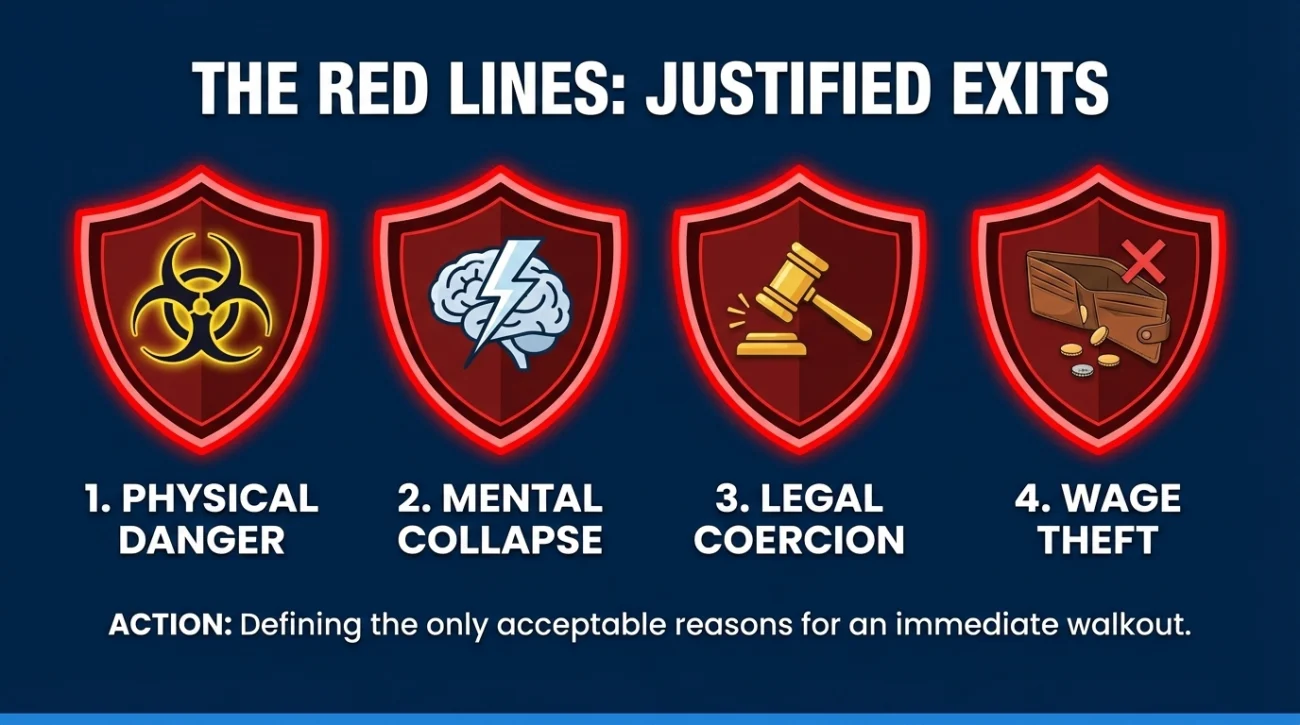
There are specific situations where society and reasonable future employers agree that staying even one more hour is impossible. In these cases, a no-notice letter is your shield.
- 🛑 Imminent Physical Danger: If your workplace lacks basic safety protocols, exposed wiring, chemical leaks, or if you have been threatened with physical violence by a coworker or customer, you have zero obligation to return. Your safety is non-negotiable.
- 🧠 Clinical Mental Health Collapse: We are not talking about “stress” or “burnout.” We are talking about a clinical crisis where a medical professional advises you that returning to that environment poses an immediate threat to your sanity or life. If a doctor says “stop,” you stop.
- ⚖️ Legal Coercion: If your boss orders you to do something illegal – falsify financial records, lie to federal investigators, or break safety laws – you must leave immediately. Staying makes you an accomplice.
- 💔 Catastrophic Family Emergency: A sudden tragedy – a severe accident, a terminal diagnosis of a child or spouse – that requires your full, undivided attention 24/7. In the face of life and death, quarterly reports become meaningless dust.
- 💸 Wage Theft: If the company has stopped paying you, or if your paychecks are bouncing. The employment contract is already broken by them; you are simply acknowledging it.
The “Impulse Control” Trap
Conversely, do not use this nuclear option for convenience. If you leave simply because you found a better job that wants you to start tomorrow, or because you are “fed up” with a micromanaging boss, you are making a massive strategic error. That is not an emergency; that is impatience. And impatience is expensive.
The Price You Pay: A Financial & Legal Deep Dive
Before you send that quitting on the spot letter, you need to look at the ledger. The cost of this decision is high, and you need to be willing to pay it. It’s not just about “losing a reference.” It’s about dollars and cents.
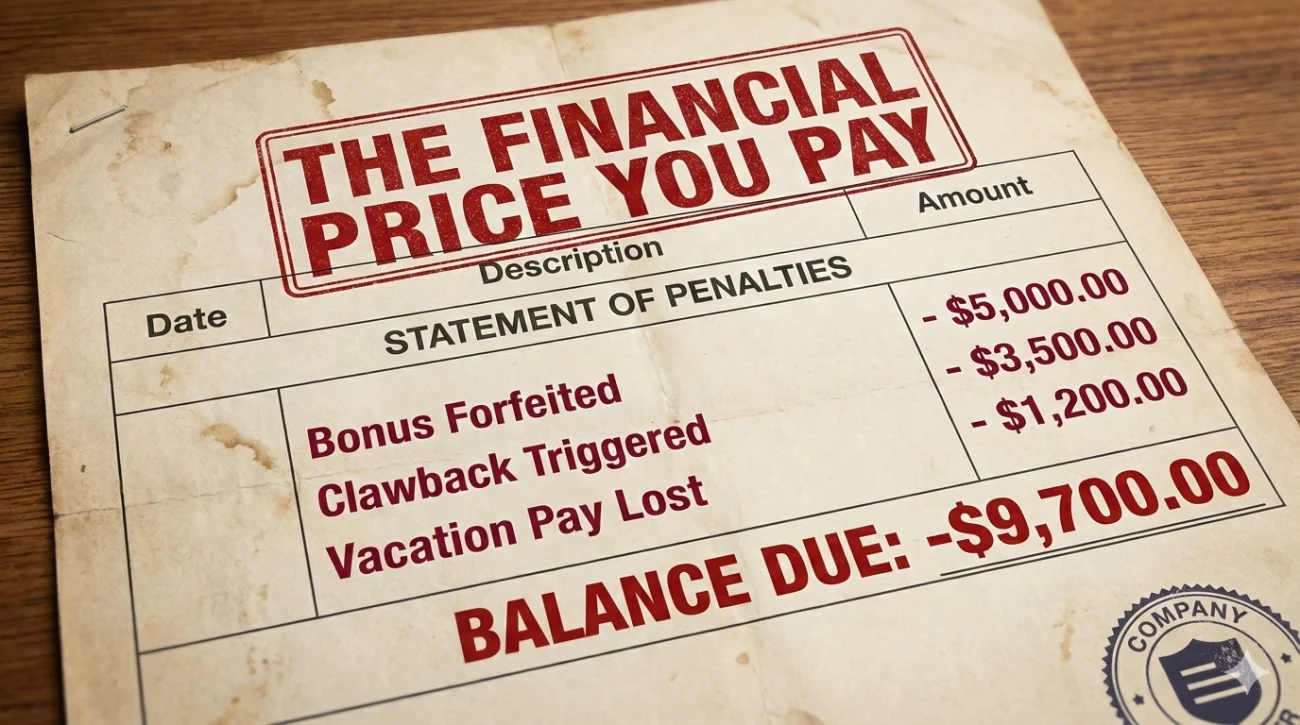
1. The Financial Bloodbath
The “Good Standing” Bonus Trap: Check your compensation agreement. Many quarterly bonuses, commissions, or profit-sharing checks require you to be “employed and in good standing” on the date of payout. “Good standing” often explicitly means “has not resigned” or “is not serving a notice period.” By walking out today, you could be vaporizing thousands of dollars that were days away from hitting your account.
Clawbacks: Did you receive a signing bonus? A relocation package? Tuition reimbursement? Most of these come with a 12-to-24-month repayment clause. If you leave early – especially without notice – the company will likely send you a bill for the full amount immediately. They can sometimes deduct this from your final paycheck (depending on state law).
Vacation Payouts: In states like California or Colorado, accrued vacation is considered earned wages and must be paid out. However, in many other states, companies are allowed to set their own policy. A common policy clause is: “Accrued PTO will be forfeited if the employee fails to provide and work a full two-week notice.” You are walking away from free money.
2. The Legal Exposure
Breach of Contract: If you are an executive or a specialized professional with a written employment contract (not just an offer letter), that contract likely stipulates a notice period. Walking out is a breach. While lawsuits against mid-level employees are rare (because damages are hard to prove), it is not impossible. If your sudden departure causes a specific project to fail, costing the company millions, you could be sued for damages.
Tortious Interference: If you walk out and immediately try to take clients with you, or encourage others to walk out, you open yourself up to “tortious interference” claims. When you leave without notice, you must be cleaner than clean. Do not touch a single client file.
The 1-Hour “Pre-Flight” Checklist
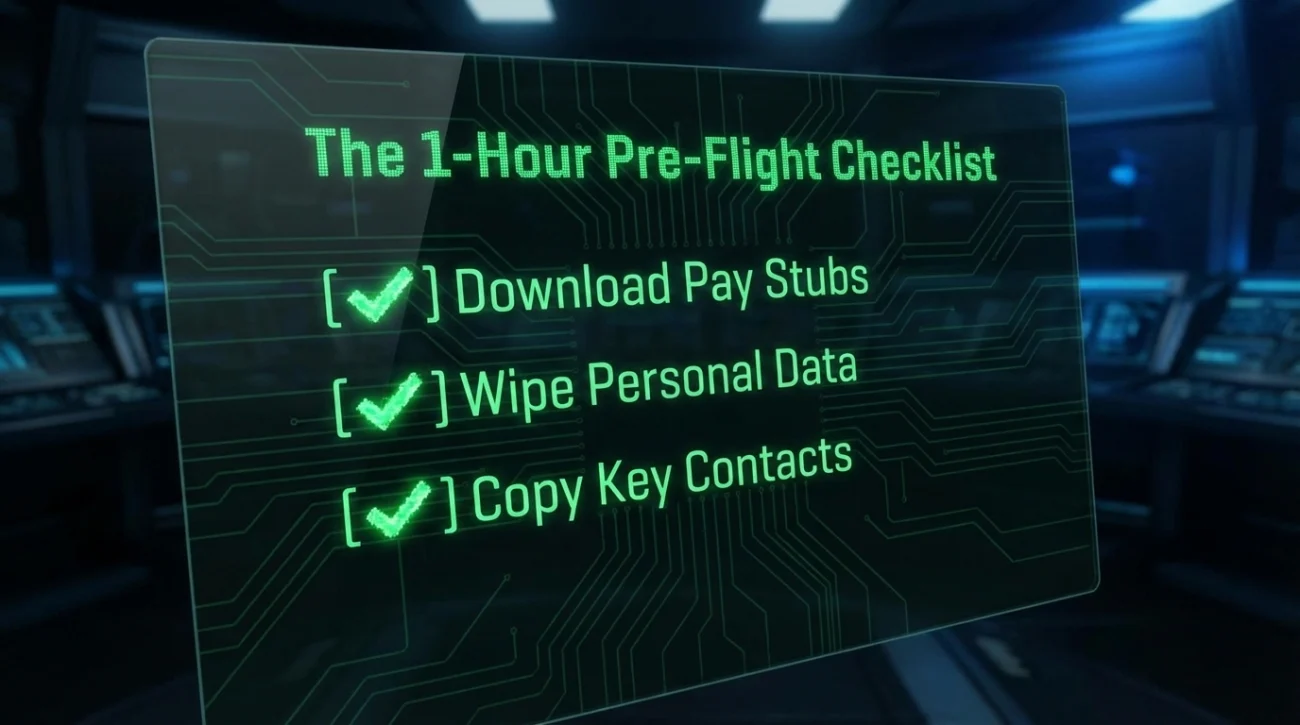
Once you decide to leave, you must act quickly but quietly. Do not signal your intent until you are ready to send the letter. The moment you send it, your access will likely be cut within minutes.
- 📁 Download Personal HR Docs: Log in to the HR portal. Download your last 6 months of pay stubs, your W-2s/1099s for previous years, and your performance reviews. You will need these for taxes and future background checks.
- 🧹 Sanitize Your Digital Workspace: Delete personal files from your laptop. Clear your browser history and saved passwords. Remove your personal Google account from Chrome. Do not wipe the computer (that looks suspicious); just remove your life from it.
- 📞 The “Lifeboat” Contacts: Quietly copy the email addresses or phone numbers of the few colleagues you trust and want to keep in your network. Do not export the whole company directory (that is data theft). Just write down the 3-5 names that matter.
- 📦 The Physical Exit: If you are in the office, discreetly pack your personal items (photos, mug, jacket). Do not make a scene. If anyone asks, you are “taking some things home to clean.”
The Art of Cold Brevity: Writing the Letter
When you resign with notice, you write with warmth and gratitude. When you resign without notice, you write with ice. This is a transaction, not a conversation. Your goal is legal clarity, not emotional closure.
The 3 Rules of the No-Notice Letter:
- 1. Zero Ambiguity: “I am resigning effective immediately.” Do not say “I plan to…” or “I am thinking about…”
- 2. Zero Apology: If the situation is bad enough to warrant this, you have nothing to apologize for. Apologies imply guilt. You are not guilty; you are leaving.
- 3. Zero Explanation: Do not list your grievances. Do not explain your health history. “Personal reasons” is a complete sentence. Anything you write can be used against you in an unemployment hearing.
Templates for the Immediate Exit
Use these templates when you need to sever ties instantly. Choose the one that fits your specific trigger.
The “Toxic Environment” Exit
Use this when you are leaving due to harassment, abuse, or an unsafe culture. It documents the “why” without opening a debate.
[Your Name]
[Your Email]
[Your Phone]
[Date]
[Manager’s Name]
[Title]
[Company Name]
Dear [Manager’s Name],
I am writing to formally resign from my position as [Job Title], effective immediately. Today, [Date], is my final day of employment.
This decision is not made lightly. However, due to the ongoing [unsafe working conditions / untenable work environment] that I have previously brought to management’s attention, I can no longer continue my employment.
I will return my badge and laptop to the front desk today. Please mail my final paycheck and any benefits information to my home address on file.
Regards,
[Your Name]
The “Medical Emergency” Exit
For when your health collapses and work is no longer physically possible.
Dear [Manager’s Name],
Please accept this letter as notification that I am resigning from my role as [Job Title] at [Company Name], effective immediately.
Due to a sudden and serious medical emergency, I am unable to continue working. My priority at this time must be my health and recovery.
I have left my key files on the shared drive to assist the team in my absence. I regret that I cannot provide the standard notice period, but the circumstances are beyond my control.
Sincerely,
[Your Name]
The “Bare Bones” (Legal Minimum)
Use this when you want to say absolutely nothing that could be used against you. This is the safest legal option.
To [HR Department / Manager],
I am resigning from my position as [Job Title], effective immediately. My last day of work is today, [Date].
I will return all company property via courier within 48 hours.
Please direct all future correspondence regarding my final compensation to my personal email address.
[Your Name]
The First 48 Hours: Managing the Fallout
Once you hit send, the silence will be deafening, followed immediately by chaos. Here is how to handle the immediate aftermath.
1. The Digital Lockout
Expect your access to Slack, Email, and Salesforce to be cut within 15 to 30 minutes. This is standard IT security protocol. Do not take it personally. If you forgot to download a personal file, it is likely gone forever.
2. The Angry Phone Call
Your manager might call you immediately, furious. Do not answer. You are no longer an employee. You have no obligation to explain yourself to someone who is screaming. Let it go to voicemail. If they leave a threatening message, save it – that is evidence. Reply only via email (paper trail) to arrange the return of property.
3. Returning the Property
Do not hold their laptop hostage. It gives them leverage to withhold your pay or sue you. Return it immediately. However, do not go back to the office alone if you feel unsafe. Use a courier service (FedEx/UPS) with a tracking number and signature required. Take photos of the equipment in the box before you seal it to prove it was in good condition.
The Long Game: Career Rehabilitation
The hardest part of a no-notice resignation isn’t leaving; it’s explaining it 6 months later in an interview. You have a gap, and you have a reference black hole. Here is how to fix it.
How to Answer “Why Did You Leave?”
You cannot lie, but you do not have to tell the ugly truth. Never badmouth the old company. Use the “Values Pivot.”
“I found myself in an environment where the operational practices no longer aligned with my professional standards. I realized that to maintain my own integrity and quality of work, I needed to step away immediately. It was a difficult decision, but it allowed me to refocus on finding a role – like this one – where I can contribute to a culture I believe in.”
This phrasing shows you have high standards, not that you are difficult.
The Reference Workaround
You cannot use your manager as a reference. Instead, find a “Peer Ally.” Was there a colleague you worked well with? A client who loved you? Ask them to be a personal reference. “I know I left suddenly, but would you be willing to speak to the quality of my work while I was there?”
❓ FAQ
⚖️ Can they sue me for quitting on the spot?
In most “at-will” states, no. You cannot be forced to work (that is slavery). However, if you have a contract, or if your sudden departure causes demonstrable financial loss (tortious interference), they could sue for damages. It is rare, but possible.
💸 Do I lose my vacation pay?
This is the most common penalty. In many states, companies are only required to pay out accrued vacation if their policy says so. Many policies explicitly state: “Vacation payout is forfeited if employee does not provide two weeks’ notice.” You are likely walking away from that money.
🚫 Will this ruin my career?
It will likely ruin your relationship with that specific company, but it won’t ruin your entire career. Careers are long. People understand that bad fits happen. If you have a solid track record elsewhere, one abrupt exit will be seen as an anomaly, not a pattern.
🤐 Should I do the exit interview?
Absolutely not. If you are leaving without notice, decline the exit interview. Nothing you say can help you now. It can only be used to build a legal case against you or justify denying your unemployment claim. Ghost the interview.
Final Thoughts: Survival First
A resignation letter with no notice is a weapon of last resort. It is ugly, it is messy, and it is painful. But sometimes, it is necessary. Do not let “professionalism” become a shackle that keeps you in a dangerous or abusive situation.
If you must walk, walk tall. Do it with legal precision, remove yourself from the harm, and then never look back. Your career can recover from a sudden stop; your mental and physical health are far harder to repair.
⚠️ Legal Disclaimer: ResignSmartly provides general informational guidance about resignation, workplace communication, notice periods, handovers, and career transitions. Content does not constitute individualized legal advice. Employment laws, contracts, workplace policies, and individual circumstances vary, so review the requirements that apply to your situation and consult an appropriate qualified professional when needed.