- Leadership Signal: Your resignation email response shapes your reputation, team morale, and whether leavers become advocates or critics.
- Silence Gap: Reply within 24 hours with a holding acknowledgment to prevent anxiety, rumors, and resentment.
- 4-Step Framework: Acknowledge & validate, Express specific gratitude, Confirm last day and logistics, End future-oriented and supportive.
- Hard Scenarios: Keep counter-offers verbal first, Be firm on short notice with task triage, Set boundaries for competitor exits and data access.
- After-Send Checklist: Loop in HR, Book a 1:1 transition plan, Align the team announcement, Capture tribal knowledge, Close with a respectful send-off.
The Strategic Impact of Your Resignation Email Response
Your resignation email response reveals more about your leadership maturity than months of routine management. How you handle an employee’s departure – the speed, tone, and professionalism of your reply – shapes your reputation, influences team morale, and determines whether departing employees become lifelong advocates or vocal critics.
Most managers handle resignations reactively. They delay responding out of disappointment, write terse acknowledgments that feel cold, or worse, they ghost the employee entirely to avoid an awkward conversation. While these reactions are understandable – losing talent is disruptive and often feels personal – they create lasting damage to professional relationships and organizational health.
The way you respond affects more than just the departing individual. Your remaining team watches closely to see how you treat people who leave. Potential hires research your company culture through exit reviews on Glassdoor or LinkedIn. Alumni networks buzz about which leaders handled departures with grace and which burned bridges unnecessarily.
This comprehensive deep-dive guide provides strategic frameworks, psychology-backed approaches, and field-tested templates for crafting a professional resignation email response. Whether you are losing a star performer or managing a difficult exit, these strategies ensure you protect your reputation and model leadership excellence.
Why the “Silence Gap” Defines Your Leadership Brand

The period between receiving a resignation and sending your reply – often called the “Silence Gap” – is where leadership is tested. In those first 24 hours, your emotional intelligence is on public display. A delayed manager reply to resignation email creates a vacuum that is often filled with anxiety (“Are they mad at me?”) or resentment (“They don’t care that I’m leaving”).
The Alumni Network Effect
We often view resignation as an “end.” In the modern workforce, it is merely a transition. A resignation email reply that is gracious and supportive converts a former employee into a corporate alumni. These individuals often become:
- ✅ Boomerang Employees: Returning later with new skills and experiences (and lower onboarding costs).
- ✅ Brand Ambassadors: Referring top talent to your organization because they remember a positive exit.
- ✅ Future Clients or Partners: Facilitating business opportunities in their new roles.
Conversely, a dismissive response signals that your loyalty was conditional solely on their utility to you. That narrative spreads quickly in professional circles, especially in niche industries where everyone knows everyone.
Psychological Safety for the Remaining Team
Your current employees are observing this process. If they see a colleague treated with coldness or hostility upon resigning, it erodes psychological safety. They begin to fear their own potential exit, leading to “quiet quitting” or secretive job hunting. A professional response demonstrates that you value people as individuals, not just as economic resources.
The Psychology of the Manager: Overcoming “Loss Aversion”

Before you type a single word, it is crucial to understand your own emotional state. When a key employee resigns, managers often experience “Loss Aversion” – a psychological bias where the pain of losing something is felt twice as powerfully as the pleasure of gaining something.
This triggers a “fight or flight” response, leading to common mistakes:
- The “Betrayal” Narrative: Feeling that the employee is “ungrateful” after all the mentoring you provided.
- The Panic Response: Worrying immediately about workflow gaps rather than the human element.
- The Freeze: Delaying the response because you don’t know what to say.
Strategic Shift: View the resignation not as a personal rejection, but as a graduation. Your role as a leader is to produce talent that outgrows the nest. When you reframe the exit this way, writing a professional response to resignation letter becomes natural rather than forced.
How to Respond to a Resignation Email: The 4-Step Framework
Regardless of the circumstances – whether the departure is a shock or a relief – every professional response should follow a structured approach to minimize legal risk and maximize relationship value. We break this down into four non-negotiable components.
| Phase | Strategic Purpose | Tone Checklist |
|---|---|---|
| 1. Acknowledge & Validate | Creates a “paper trail” for HR and stops the employee’s anxiety about whether you received the news. | Neutral to Warm |
| 2. Express Gratitude | Reinforces the relationship and validates their tenure. Specificity here proves you were paying attention. | Appreciative |
| 3. Clarify Next Steps | Reduces chaos. Sets clear expectations for the notice period, handover, and exit logistics. | Direct & Practical |
| 4. Future Orientation | Leaves the door open (if desired) and ends the interaction on a high, professional note. | Supportive |
Step 1: The “Holding” Acknowledgment (The Speed Rule)
Speed is respectful. Respond within 24 hours maximum. If you need time to process emotions or consult HR about a counter-offer, send a “holding response” immediately. This prevents the employee from feeling ignored or ghosted.
Example:
“Received. Thank you for letting me know. Let’s touch base this afternoon to discuss details.”
Step 2: Specific Gratitude (The Relationship Rule)
Generic thanks (“Thanks for your work”) feel robotic. If you want to maintain the relationship, mention a specific project or trait. This signals that you actually saw them.
Better:
“I’ve truly appreciated your leadership on the Q3 Migration Project – we couldn’t have done it without your attention to detail.”
Step 3: The Logistics Handshake (The Clarity Rule)
This is where you switch from “Leader” to “Manager.” You must confirm the last day to prevent payroll disputes and set immediate expectations for the notice period.
Step 4: The Open Door (The Network Rule)
Unless the employee was toxic, always end with a wish for their future success. The world is small; burning a bridge costs you more than it costs them.
Transactional vs. Relational Responses: A Comparison
The difference between a “good enough” manager and a “great” leader often lies in the nuance of their communication. Observe the difference below.
| Feature | Transactional Response (Average Manager) | Relational Response (Strategic Leader) |
|---|---|---|
| Focus | Focuses on the inconvenience to the company. | Focuses on the employee’s career progression. |
| Tone | Cold, bureaucratic, defensive. | Warm, professional, supportive. |
| Outcome | Employee leaves feeling undervalued; unlikely to refer others. | Employee leaves as an advocate; likely to return or refer talent. |
| Key Phrase | “Please ensure all assets are returned.” | “We want to ensure your transition is as successful as your tenure.” |
The Counter-Offer Dilemma: Should You Fight to Keep Them?
When a star employee resigns, the instinct is often to offer more money immediately. However, this must be handled carefully in your email response.
| Pros of Counter-Offering | Cons of Counter-Offering |
|---|---|
| ✅ Retention: Keeps institutional knowledge and avoids recruitment costs. | ❌ Temporary Fix: 80% of employees who accept counter-offers leave within 6 months anyway (the underlying issues remain). |
| ✅ Morale: Shows the team you fight for top talent. | ❌ Precedent: Teaches the team that the only way to get a raise is to threaten to quit. |
| ✅ Continuity: Prevents project disruption. | ❌ Trust Issues: You may subconsciously view them as a “flight risk” moving forward. |
Advice: Do not make the counter-offer in the email. Use the email to set up a meeting: “Before we finalize your exit, I’d love to discuss the reasons behind your decision to see if there is anything we can address.”
Professional Resignation Email Reply Templates
Below are curated templates designed for specific scenarios. Note how the tone shifts from “Warm” to “Strictly Professional” depending on the context, yet never crosses into hostility.
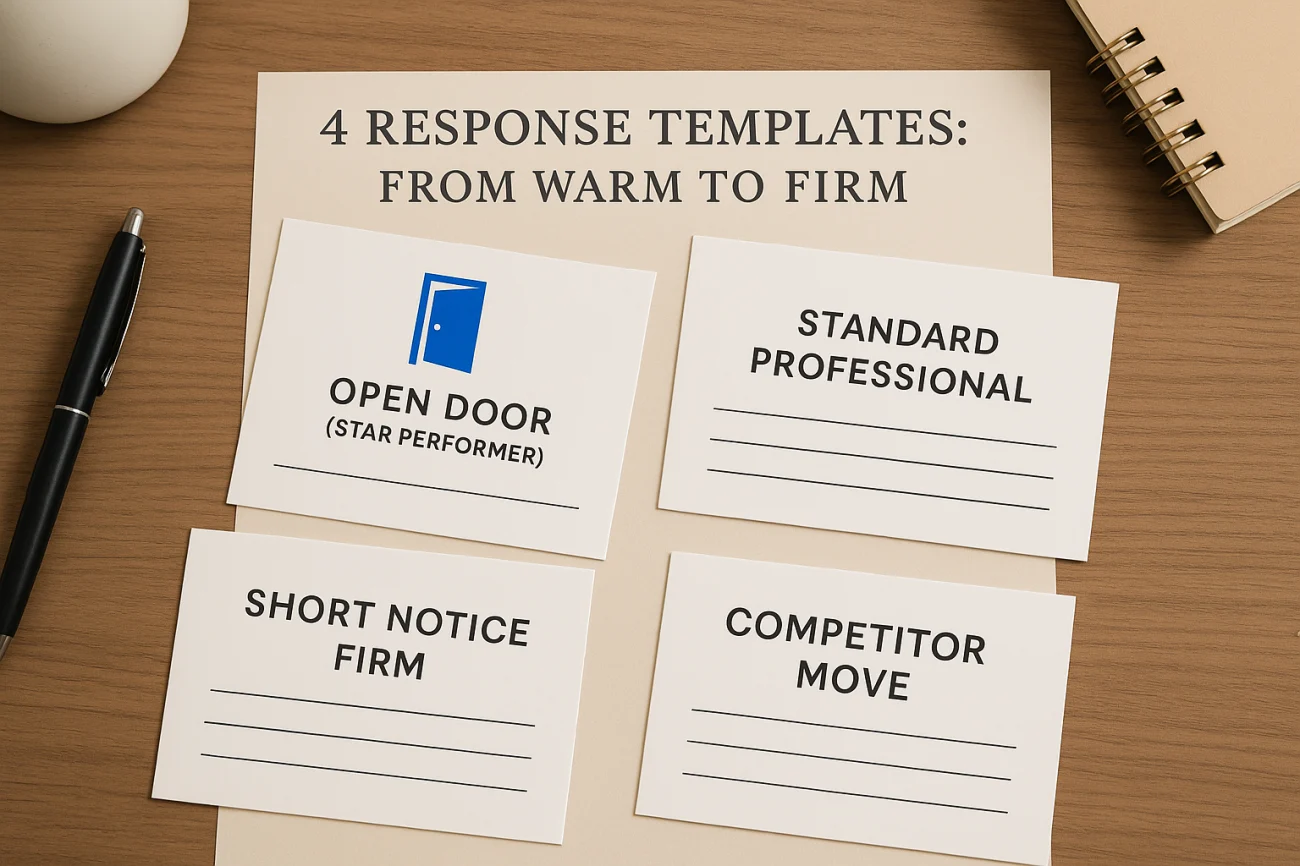
1. The “Open Door” Response (For High Performers)
Use this when losing a top-tier employee you would rehire in a heartbeat. The goal is to establish a boomerang path.
Subject: Re: Resignation – [Employee Name]
Hi [Employee Name],
Thank you for letting me know. While I am genuinely saddened to see you go, I am equally excited for this next step in your career journey.
I want to acknowledge the significant impact you’ve had on [Team Name]. Your leadership on the [Specific Project] and the way you mentored [Name/Junior Staff] set a standard of excellence that will remain after you leave.
I accept your resignation effective [Last Working Date]. Let’s meet tomorrow to discuss a transition plan that ensures your projects land softly. I want your final weeks here to be as positive as your tenure has been.
Please know the door is always open. We would welcome the opportunity to work with you again in the future. Until then, I am happy to provide a strong reference if needed.
Warm regards,
[Your Name]
Why it works: It balances the personal “I’m saddened” with professional support, and explicitly mentions the “open door,” planting the seed for a future return.
2. The Standard Professional Response (Neutral)
This is your go-to template for average performers or shorter-tenured employees where the relationship is good but not close.
Subject: Re: Resignation Acceptance – [Employee Name]
Dear [Employee Name],
I have received your resignation letter and accept it effectively [Last Working Date]. Thank you for giving us the standard notice period.
We appreciate the contributions you have made to the department during your time with [Company Name]. To ensure a smooth handover, please compile a status report of your pending tasks by [Day of week].
HR will be in touch shortly regarding your exit interview and equipment return logistics.
We wish you the very best in your next endeavor.
Sincerely,
[Your Name]
Why it works: It protects the company by confirming the date and notice period without being overly emotional. It focuses on the tactical requirements of the exit.
3. The Response to Short Notice (Urgent & Firm)
When an employee leaves without the standard notice period, your resignation email reply must balance disappointment with operational urgency.
Subject: Re: Resignation Notice
Hi [Employee Name],
I have received your resignation. While your notice period is shorter than we typically require, I understand that your new position necessitates an immediate start. We accept your resignation effective [Date].
Given the compressed timeline, we need to prioritize the handover process immediately. Please focus solely on [Critical Task A] and [Critical Task B] for your remaining days.
Please make yourself available for a handoff meeting with [Colleague Name] at [Time] today.
Best regarding your transition,
[Your Name]
Why it works: It acknowledges the breach of protocol (short notice) without being aggressive. It immediately pivots to crisis management (prioritizing tasks).
4. Moving to a Competitor (Protective)
In this scenario, professionalism is paramount, but so is data security. The tone should be polite but boundary-setting.
Subject: Re: Resignation
[Employee Name],
Thank you for notifying me of your resignation. I accept your departure date of [Date].
Since you are moving to a competitor in the [Industry Sector], per company policy, we will need to adjust your access to sensitive client data during the notice period. HR will reach out to you directly regarding the specific protocols for your remaining time and to review your non-compete obligations.
Thank you for your service to the team. We wish you success in your future career.
Regards,
[Your Name]
The “After-Send” Protocol: A Manager’s Checklist
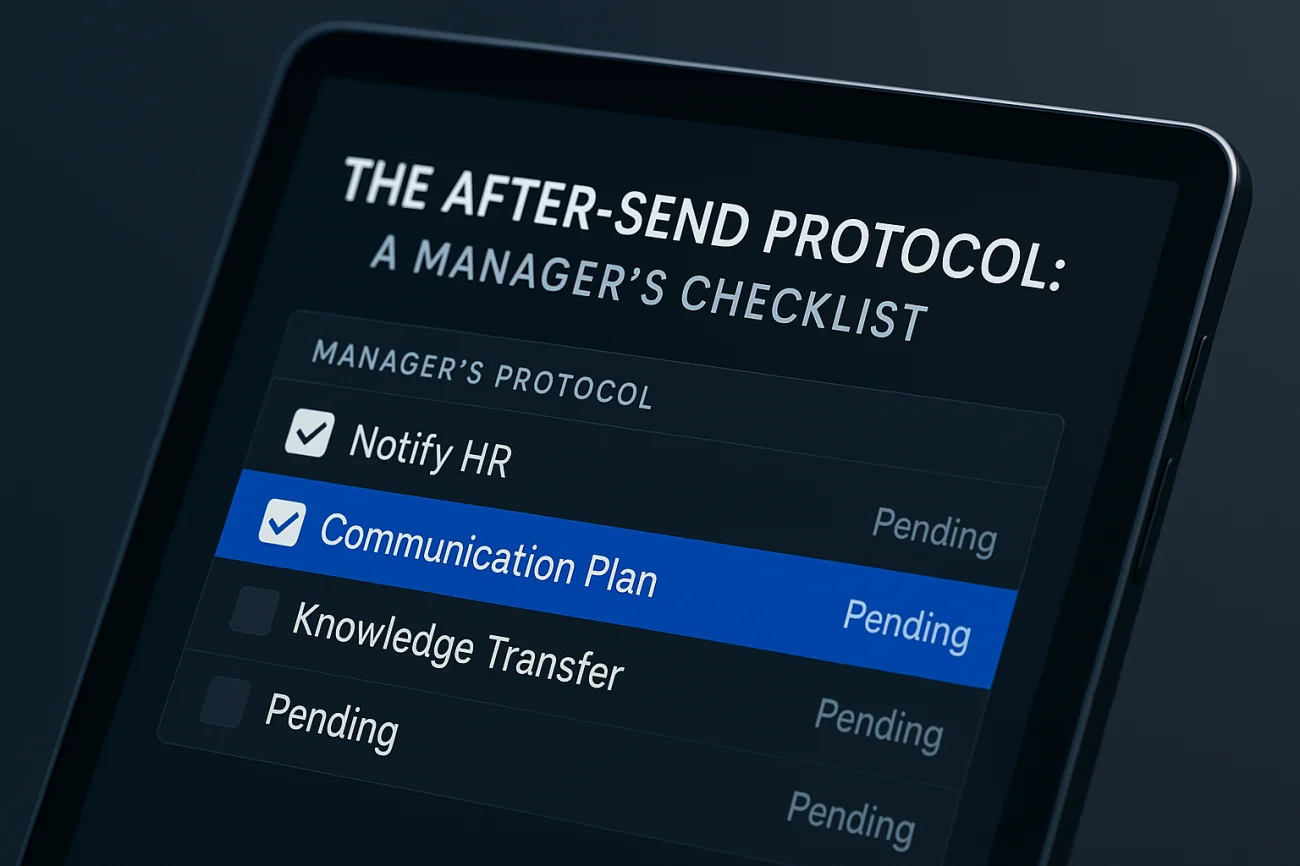
Sending the email is only step one. Use this checklist to ensure nothing falls through the cracks.
- ✅ HR Notification: Forward the resignation immediately to HR to trigger payroll and offboarding workflows.
- ✅ Transition Meeting: Schedule a 1:1 within 24 hours to separate “emotional processing” from “tactical handover.”
- ✅ Communication Plan: Agree with the employee on how and when to tell the rest of the team. Never steal their thunder or let the rumor mill beat you to it.
- ✅ Knowledge Transfer: Identify the “tribal knowledge” that lives only in their head and document it.
- ✅ The Send-off: Unless the departure is contentious, organize a simple farewell. It signals to the remaining team that leaving is a normal, respectful part of business.
❓ FAQ: Handling Complex Resignation Dynamics
💰 Should I mention a counter-offer in my email response?
😡 How do I respond if I am angry or feel betrayed?
📝 Is a verbal resignation enough, or do I need an email?
👋 What if they want to leave earlier than the notice period?
📧 How do I respond to a “Rage Quit” or unprofessional resignation email?
Final Thoughts
Ultimately, a resignation email response is not just an administrative task; it is a strategic branding exercise. Every employee who leaves is a potential ambassador, a potential client, or a potential boomerang hire. By treating the departure with the same professionalism as the onboarding, you protect the organization’s reputation and demonstrate high-level leadership integrity.
Don’t let the stress of backfilling a role cloud your judgment. Use the templates above to respond with grace, clarify the logistics quickly, and focus your energy on the transition ahead. For more tools on managing team transitions and offboarding checklists, explore the resources at ResignSmartly.
⚠️ Legal Disclaimer: ResignSmartly provides general informational guidance about resignation, workplace communication, notice periods, handovers, and career transitions. Content does not constitute individualized legal advice. Employment laws, contracts, workplace policies, and individual circumstances vary, so review the requirements that apply to your situation and consult an appropriate qualified professional when needed.