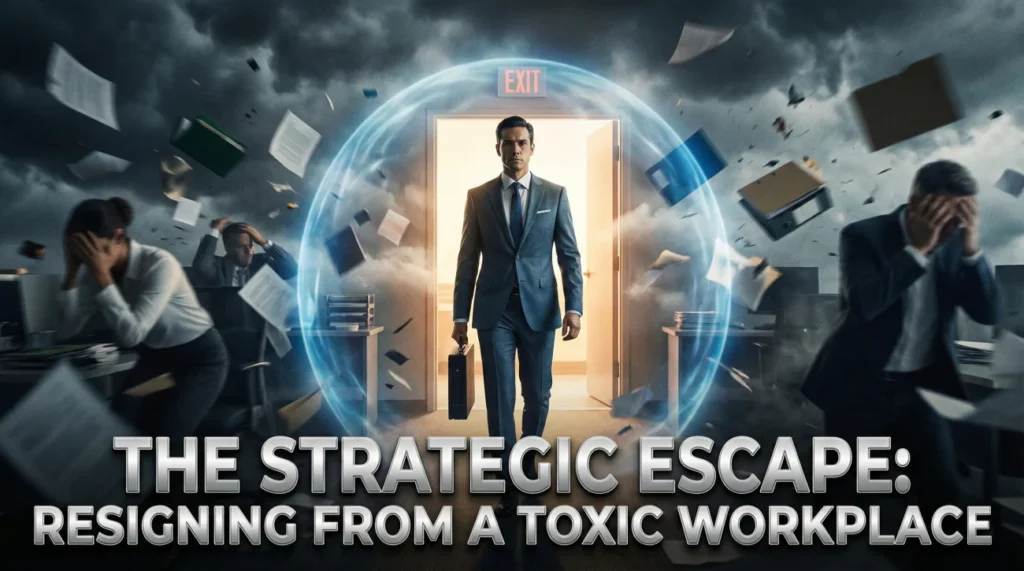
- Core Shift: This resignation is a rescue mission, your priority is safety, sanity, and legal protection, not preserving feelings.
- Grey Rock Rule: Do not J.A.D.E. (Justify, Argue, Defend, Explain), keep every line boring, factual, and attack-proof.
- Digital Go Bag: Assume access gets cut fast, sanitize devices, secure legal portfolio copies, document evidence, and collect trusted contacts first.
- Template Choices: Use a maximum safety notice, an effective immediately exit for emergencies, a medical shield, or an HR-only paper trail version.
- Final Two Weeks: Become a “phantom,” keep a daily CYA recap (BCC yourself), use sick leave if needed, and protect pay and references.
The Strategic Escape: Writing a Resignation Email for a Toxic Workplace
Resigning from a standard job is a professional courtesy; sending a resignation email for a toxic workplace is a rescue mission. When you are exiting an environment plagued by gaslighting, harassment, bullying, or chronic dysfunction, the standard rules of corporate etiquette do not apply. Your priority shifts entirely from “preserving relationships” to “preserving your sanity, safety, and legal standing.”
In toxic environments, abusive managers often view a toxic workplace resignation letter not as a business transaction, but as a personal betrayal. They may attempt to guilt-trip you (“After all I did for you?”), bait you into a screaming match, or actively sabotage your departure to ruin your reputation. Therefore, your resignation cannot be a simple notification; it must be a tactical shield.
This comprehensive deep-dive guide will teach you the art of the “Grey Rock Resignation” – a psychological strategy designed to make you uninteresting and attack-proof. We will provide legally safe sample resignation letters for toxic workplaces, a pre-resignation security checklist, and a survival guide for your final two weeks.
The Psychology of the Exit: Breaking the Trauma Bond
Before you draft your resignation letter for a hostile work environment, it is crucial to understand why this feels so difficult. Many employees in toxic workplaces experience “Trauma Bonding” – a psychological response where intermittent reinforcement (a mix of abuse and occasional praise) creates a powerful, addictive loyalty to the abuser.
You might catch yourself thinking:
- “If I leave now, I’m abandoning the team to suffer alone.”
- “Maybe I’m overreacting; it’s not that bad.” (The Gaslighting Effect)
- “I need to explain to them why I’m leaving so they can change.”
The Hard Truth: You cannot fix a toxic culture by leaving it. Your toxic workplace resignation email is a legal notice, not a therapy session or a manifesto for change. The most professional thing you can do is remove yourself from the equation with surgical precision.
Phase 1: The “Digital Go-Bag” (Before You Hit Send)

In a healthy company, you resign and then wrap up. In a toxic company, you must assume that the moment you send your resignation email, your access will be cut, you will be escorted out, or your files will be deleted. You need a “Digital Go-Bag” prepared 24 hours before you resign.
The Stealth Checklist
- 🔒 Sanitize Your Presence: Clear browser history, cache, and saved passwords on all work devices. Log out of personal Gmail, LinkedIn, and banking apps.
- 📂 Secure Your Portfolio: Legally save copies of work you created (that doesn’t violate NDA/Confidentiality) to a personal drive. You will not get a chance later.
- 📝 Document Everything: If you have experienced harassment or illegal activity, forward those specific emails to your personal address now. Once access is cut, that evidence is gone.
- 🤝 Connect with Allies: Get personal phone numbers of the few coworkers you trust. You may not be able to say goodbye publicly.
- 💰 Check Your Finances: Assume they might walk you out immediately and potentially delay your final check (illegal, but it happens). Be financially prepared for a gap.
Phase 2: The “Grey Rock” Strategy for Toxic Bosses
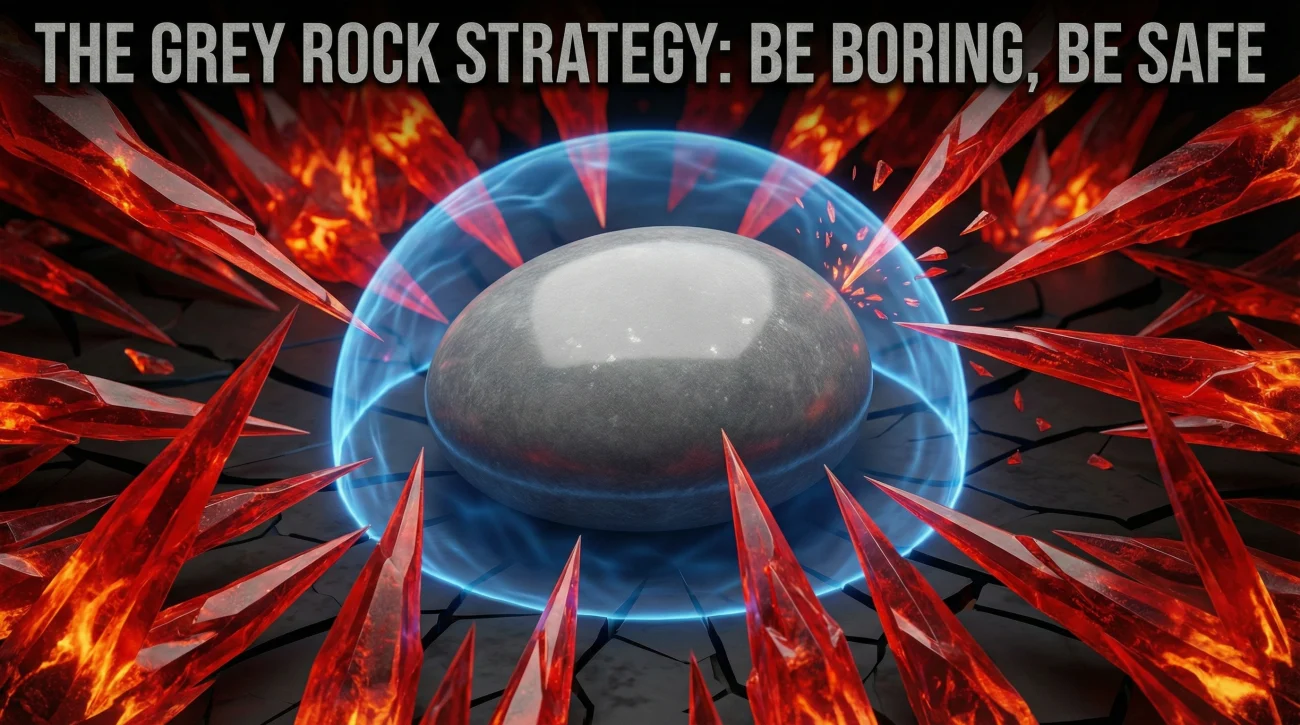
The “Grey Rock” method is a strategy primarily used to deal with narcissists and sociopaths, but it is incredibly effective when writing a resignation email to a bad boss. The goal is to make yourself as unresponsive, boring, and non-threatening as a grey rock. When you stop providing emotional reactions (fuel), the toxic person loses interest.
Avoid the “J.A.D.E.” Trap
In a toxic dynamic, you likely feel a desperate need to be understood. You want to explain why you are leaving so they know how much they hurt you. This is a trap. Do not Justify, Argue, Defend, or Explain.
| Toxic Trap | Standard Response (Weak) | Grey Rock Response (Strong) |
|---|---|---|
| The Guilt Trip “I can’t believe you’re doing this during our busy season.” | “I feel bad, but I have to put my health first…” | “I understand the timing is not ideal. My last day is [Date].” |
| The Bait “Is this because of what I said in the meeting?” | “Yes, that was really hurtful and unprofessional.” | “I have decided to pursue another opportunity.” |
| The Inquisition “Where are you going? Who offered you a job?” | “I’m going to [Competitor] because they offer remote work.” | “I am not sharing details at this time. I want to focus on my handover.” |
Phase 3: Sample Resignation Letters for Toxic Workplaces
These templates are designed to be impenetrable. They meet all legal requirements for notice without offering an inch of emotional ground for them to attack. Choose the toxic workplace resignation letter sample that fits your specific situation.

Template 1: The “Grey Rock” (Maximum Safety)
Best for: High-conflict bosses, narcissists, or litigious environments. It is boring, cold, and legally perfect.
Subject: Resignation – [Your Name]
Dear [Manager’s Name],
Please accept this email as formal notification that I am resigning from my position as [Job Title]. My final day of employment will be [Date].
I will ensure that all company property is returned and my current tasks are documented before my departure.
Regards,
[Your Name]
Template 2: Resignation Email Effective Immediately (Emergency)
Best for: Environments impacting your mental health or physical safety where you cannot stay another day. Note: Check your contract regarding notice periods, but health comes first.
Subject: Resignation Effective Immediately – [Your Name]
Dear [Manager’s Name],
Please accept this email as notice of my resignation from the position of [Job Title], effective immediately. Today, [Date], is my last day.
I have returned my badge and laptop to [Front Desk/HR]. Please forward any final paperwork regarding my employment and final paycheck to my personal email address.
Regards,
[Your Name]
Template 3: The “Medical/Personal” Shield
Best for: When you need to shut down all conversation. No HR department wants to touch a potential medical liability, so they usually back off.
Subject: Resignation – [Your Name]
Dear [Manager’s Name],
I am writing to resign from my position as [Job Title], effective [Date].
Due to personal health reasons that require my full attention, I am unable to continue in my role. I appreciate your understanding of my need for privacy during this time.
I will do my best to facilitate a smooth handover during my remaining time.
Sincerely,
[Your Name]
Template 4: The “Paper Trail” (To HR Only)
Best for: Sending to HR when your boss is the problem. This establishes a record without making specific accusations in the resignation itself.
Subject: Resignation – [Your Name]
Dear Human Resources,
Please accept this email as formal notice of my resignation from my position as [Job Title], effective [Date].
I would like to request an exit interview with an HR representative to discuss the circumstances regarding my departure. Please let me know when you are available.
Best regards,
[Your Name]
Phase 4: Surviving the Notice Period (The Final 2 Weeks)
If they don’t walk you out immediately, the next two weeks can be hellish. Abusive managers often escalate their behavior when they lose control over you (an “Extinction Burst”). Here is your survival guide.

1. Be a “Phantom”
Be present physically, but absent emotionally. Do your work, but do not engage in banter, lunch, or meetings that aren’t mandatory. Arrive exactly on time, leave exactly on time. Do not offer to do “extra” to be nice.
2. The “CYA” (Cover Your Assets) Log
If your boss tries to sabotage you (e.g., claiming you stole data or didn’t finish work), you need proof. Send a daily recap email to your boss (and BCC yourself):
“Hi [Boss], just updating you that today I finished the X report and uploaded it to the shared drive. Tomorrow I will focus on Y. Let me know if priorities change.”
This creates a timestamped record that you were working professionally until the end.
3. Use Your Sick Leave
If the hostile work environment becomes abusive, remember: mental health is health. If you have accrued sick days, use them. You are not obligated to tolerate abuse for a paycheck.
Phase 5: Legal & Financial Protection
Toxic workplaces are often litigious. Protect yourself from potential backlash.
Constructive Dismissal
If you are forced to quit because the environment was intolerable (e.g., harassment, safety violations, wage theft), this is called “Constructive Dismissal.” In many jurisdictions, you may still be eligible for unemployment benefits even though you “quit.” Document everything if you plan to go this route.
The Reference Problem
The biggest fear is: “They will give me a bad reference.”
- The Reality: Most large companies have a strict policy of only confirming dates of employment and job titles to avoid defamation lawsuits.
- The Workaround: Do not list your toxic boss as a reference. List a sympathetic colleague, a client, or a manager from a different department.
- The Narrative: In future interviews, when asked why you left, say: “It wasn’t a good cultural fit, and I wanted to find a place where I could contribute more effectively.” Never badmouth the ex-employer.
❓ FAQ
🤬 What if my boss screams at me after I resign?
📧 Should I BCC myself on the resignation email?
📝 Should I tell the truth in the exit interview?
⚖️ Can they withhold my final paycheck?
Final Thoughts
Leaving a toxic workplace is an act of self-preservation. It is normal to feel fear, guilt, or even “Trauma Bonding.” Recognize these feelings as symptoms of the environment you are in, not facts about your character.
Use the “Grey Rock” templates to build a wall between you and the toxicity. Your goal is not to win the argument; your goal is to get out. Once you are free, the clarity will return. Stay boring, stay safe, and walk away. You are not quitting; you are surviving.
For more specific scenarios, browse our resignation email examples. If you need a refresher on the basics, check our guide on how to write a resignation email, or return to the homepage.
⚠️ Legal Disclaimer: ResignSmartly provides general informational guidance about resignation, workplace communication, notice periods, handovers, and career transitions. Content does not constitute individualized legal advice. Employment laws, contracts, workplace policies, and individual circumstances vary, so review the requirements that apply to your situation and consult an appropriate qualified professional when needed.