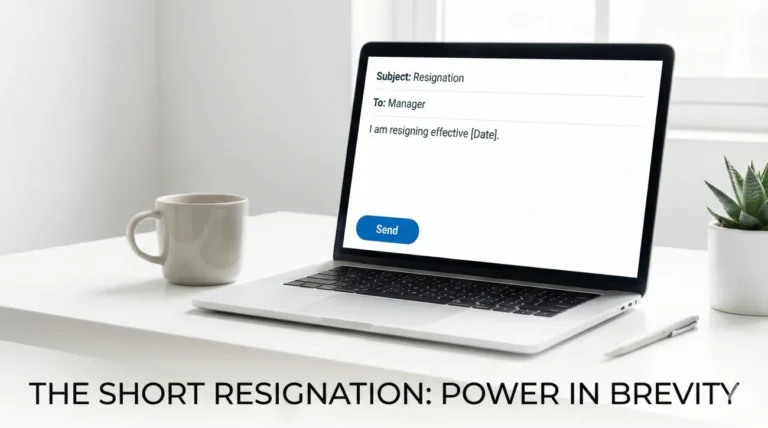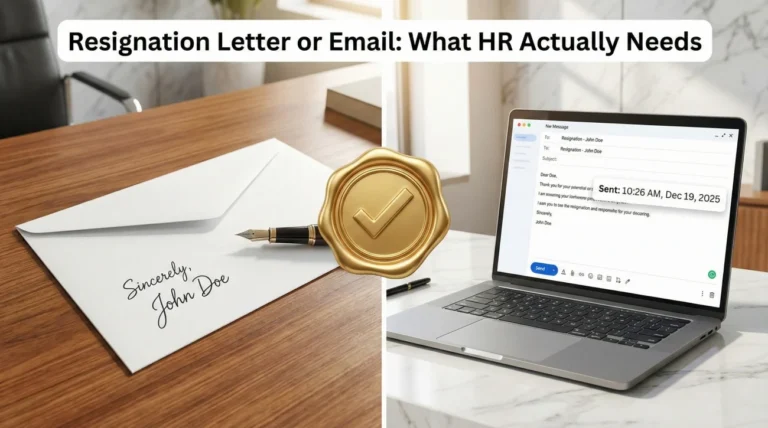

- Strategic Safety Net: Two-week notice protects your references, rehire eligibility, and reputation through the “exit impression” effect.
- Money And Benefits: Proper notice can protect PTO payout and helps you confirm exactly when insurance and access end.
- Date Accuracy: “Two weeks” means 14 calendar days, and if day 14 lands on a weekend, list the prior Friday unless you work weekends.
- Correct Protocol: Talk to your manager first, then send the email as the official record with a clear last-day date.
- Golden Handover: Use the next 10 business days to document work, hand off clients, train coverage, avoid common bridge-burners, and prepare for counter-offer or garden leave.
The Strategic Exit: Why the Two-Week Notice is Your Career’s Safety Net
Resigning is not just about leaving a job; it is about protecting your legacy. The two-week notice is the bridge between your past achievements and your future reputation. Execute it well, and you solidify your status as a professional. Botch it, and you risk years of hard work for a moment of impatience.
In the high-stakes world of career management, the resignation email with two weeks notice is the universal “Gold Standard.” It is the non-negotiable etiquette that separates a strategic departure from a bridge-burning exit. While you may be eager to sprint toward your new opportunity, the next 10 business days are arguably the most critical of your tenure.
This guide goes beyond simple templates. We will dissect the psychology behind the two-week notice, the legal and financial implications of cutting it short, and provide a day-by-day roadmap to ensure your exit is as flawless as your entrance. Whether you are leaving a toxic environment or a dream job, this is your playbook for the perfect goodbye.
For a broader overview of resignation mechanics, refer to our pillar guide on how to write a resignation email.
The 3 Pillars of the Two-Week Notice: Strategy, Not Charity
Many employees view the notice period as a “favor” to the company. This is a strategic error. The two-week notice primarily serves you, protecting your long-term interests in three specific ways.

1. The “Exit Impression” Bias
Psychologically, humans suffer from “Recency Bias” – we remember the end of an experience more vividly than the middle. You could be a top performer for five years, but if you leave your manager scrambling with zero notice, that chaos becomes your legacy. When future employers call for a reference check, the question “Did they provide proper notice?” is standard. A “No” answer here is a massive red flag, signaling unreliability.
2. The “Boomerang” Strategy
The corporate world is shrinking. The company you leave today might acquire the company you join tomorrow. Or, you might want to return in five years as a VP with a higher salary. Most HR systems have a checkbox for “Eligible for Rehire.” Leaving without a professional 2 weeks notice resignation email often results in that box being unchecked, permanently blacklisting you from the organization.
3. Protecting Your Payouts (PTO & Benefits)
This is the tangible cost. In many states and company handbooks, the payout of accrued vacation time (PTO) is conditional upon providing proper notice. If you quit immediately, you could be walking away from thousands of dollars in earned leave. Furthermore, giving notice allows you to clarify when your health insurance terminates (usually end of month), preventing gaps in coverage.
The Logistics: How to Calculate Your Last Day Accurately
Ambiguity creates friction. HR needs a precise date to terminate system access and process your final paycheck. Do not make them guess.
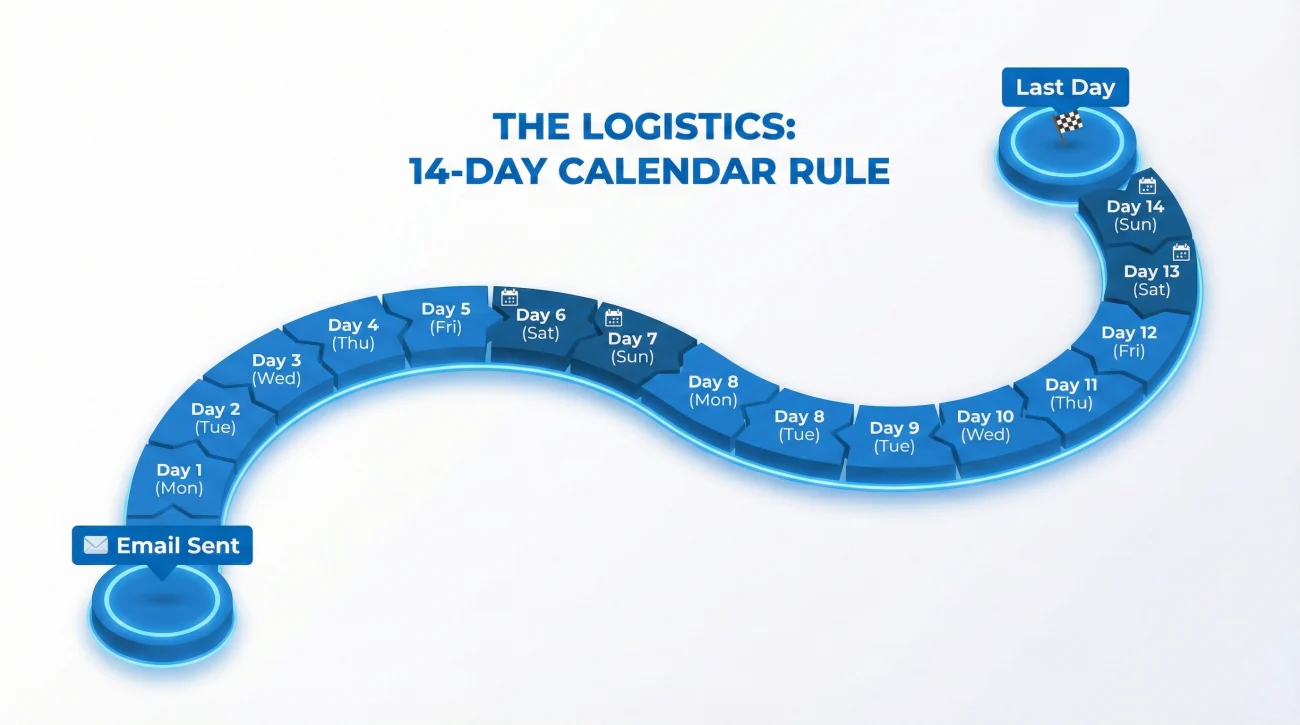
The 14-Day Calendar Rule
The standard “two weeks” refers to 14 calendar days, not 10 work days.
Formula: [Date of Resignation Email] + 14 Days = [Last Day].
- 📅 Scenario A (Monday Resignation): If you resign on Monday, November 1st, your last day is Monday, November 15th.
- 📅 Scenario B (Friday Resignation): If you resign on Friday, November 5th, your last day is Friday, November 19th.
The Weekend Strategy
If your 14th day falls on a Saturday or Sunday, professional courtesy dictates you list the Friday before as your last working day (unless you work weekends). HR prefers this for payroll processing.
Pro Tip: Do not resign on a Monday morning if you haven’t prepared. Use the weekend to draft your transition documents so you can hit the ground running on Day 1 of your notice period.
The Protocol: Talk First, Send Second
The single biggest mistake employees make is hitting “Send” before having the conversation. Resignation by email notification alone (without a meeting) is viewed as cowardly and disrespectful, especially for mid-to-senior roles.
The Correct Order of Operations:
- Schedule the Meeting: “Do you have 10 minutes for a quick chat?”
- Deliver the News Verbally: “I wanted to let you know personally that I’ve accepted a new opportunity…”
- Hit Send: “I’ve just sent my formal letter to you and HR to make it official.”
This approach allows your manager to process the emotion privately before the machinery of HR kicks in.
6 Professional Two-Week Notice Templates
Choose the template that matches the tone of your relationship and your specific exit scenario. For more specialized templates, browse our full library of resignation email examples.

1. The “Standard Professional” (The Safe Bet)
Best for: 90% of corporate exits. It is clear, polite, and legally sound.
Subject: Resignation – Two Weeks Notice – [Your Name]
Dear [Manager’s Name],
Please accept this letter as formal notification that I am resigning from my position as [Job Title] at [Company Name]. My last day will be [Date], two weeks from today.
I want to thank you for the opportunity to work with this team. I have enjoyed my time here and appreciate the professional growth I have experienced.
Over the next two weeks, I will focus on wrapping up my current projects and creating a transition plan to hand over my responsibilities to the rest of the team.
Sincerely,
[Your Name]
2. The “Bridge Builder” (High Appreciation)
Best for: Managers you respect and want to keep as lifelong mentors. This strengthens your network.
Subject: Resignation Notice – [Your Name]
Dear [Manager’s Name],
I am writing to formally resign from my role as [Job Title], effective [Date].
This was a difficult decision, as I have truly valued my time working under your leadership. I am incredibly grateful for the mentorship you provided, specifically regarding [mention a specific skill/project]. I am proud of what we achieved with the [Project Name] launch.
I am committed to making this transition as seamless as possible. I have already drafted a handover checklist and am happy to help train my replacement before I depart.
Warmly,
[Your Name]
3. The “Strictly Formal” (For HR/Files)
Best for: Sending directly to HR or if you have a strained relationship with your boss and want zero fluff.
Subject: Formal Resignation – [Your Name] – [Employee ID Optional]
To Human Resources / [Manager’s Name],
Please accept this email as my formal resignation from the position of [Job Title] at [Company Name].
In accordance with the standard notice period, my final day of employment will be [Date].
I will ensure all company property is returned and my tasks are handed over prior to my departure.
Regards,
[Your Name]
4. The “Senior Role” (Strategic Handoff)
Best for: Managers, Leads, or Seniors with complex responsibilities. Focuses heavily on continuity to reassure stakeholders.
Subject: Resignation – [Your Name]
Dear [Manager’s Name],
I am writing to provide my two weeks’ notice of resignation as [Job Title]. My final day will be [Date].
I am proud of what we have achieved together over the past [Number] years. To ensure business continuity, I have prepared a comprehensive transition strategy for my key accounts and am ready to brief the team on outstanding deliverables.
I am happy to assist in the search for my replacement or sit in on interviews during my notice period.
Sincerely,
[Your Name]
5. The “Remote Worker” (Logistics Focus)
Best for: WFH employees where equipment return is a key logistical hurdle.
Subject: Resignation Notice – [Your Name]
Dear [Manager’s Name],
I am writing to resign from my remote position as [Job Title], effective [Date].
Thank you for the opportunity to be part of [Company Name]. I will spend my final two weeks documenting my workflows and uploading all local files to the shared server.
Please let me know the process for shipping back my company laptop and monitor. I can drop them at a courier center on my final day.
Best,
[Your Name]
6. The “Going to Competitor” (Prepare for Walkout)
Best for: When you are joining a direct rival. Be brief, as you may be walked out immediately.
Subject: Resignation – [Your Name]
Dear [Manager’s Name],
Please accept this letter as my resignation from [Job Title]. My intended last day is [Date].
I have accepted a position with another company. I respect the sensitivity of this transition and am happy to assist with a handover, or to wrap up my duties earlier if that is preferred by the company.
Thank you for the opportunity.
Regards,
[Your Name]
The “Golden Handover”: The 10-Day Roadmap
Sending the email is Day 0. What you do in the next 10 business days determines your legacy. Do not succumb to “Senioritis” (checking out early).
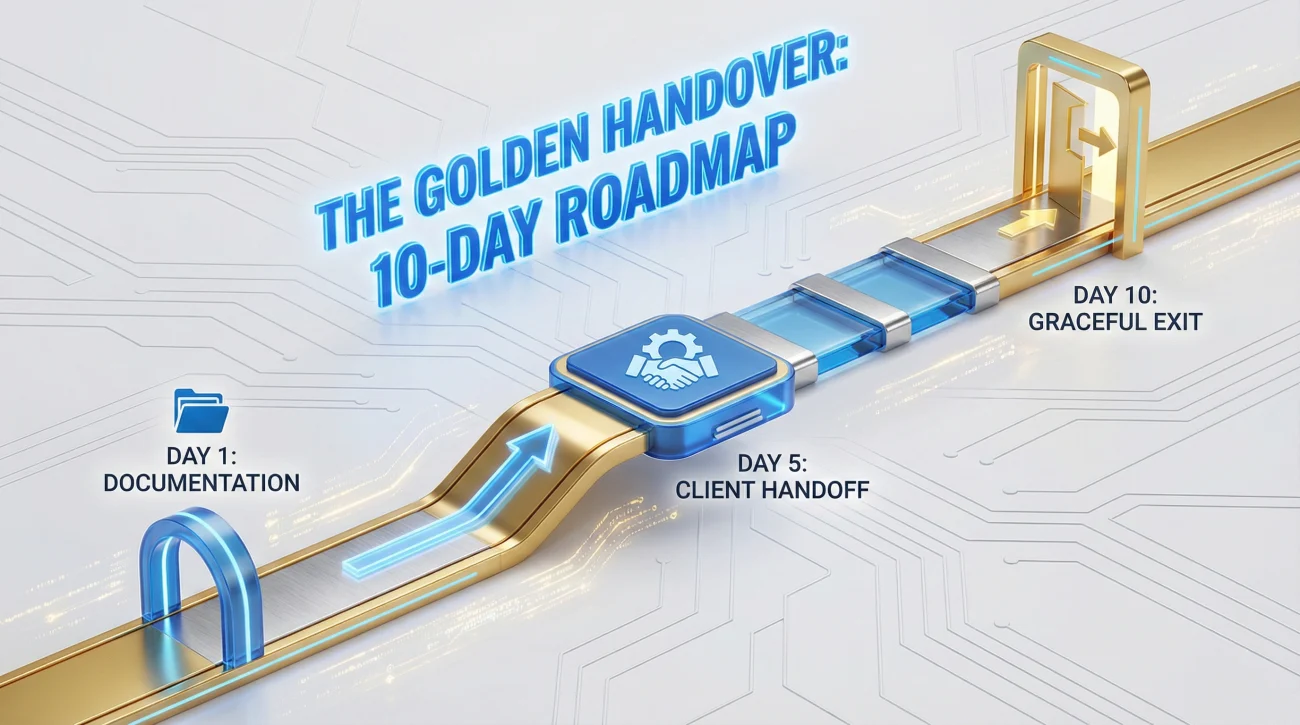
Week 1: Documentation & Communication
- 📝 Day 1-2: The “Bus Factor” Document: Create a master doc with passwords (if allowed), key contacts, and status updates on all active projects. Assume no one knows what you do.
- 🤝 Day 3-4: The Client Handoff: If you face clients, introduce them to your replacement now, not on your last day. “Warm handoffs” prevent client churn and protect your reputation in the industry.
- 🗓️ Day 5: The Calendar Cleanse: Cancel recurring meetings that extend past your last day to save your team from “zombie meetings” (meetings that exist but have no owner).
Week 2: Training & Exit
- 🎓 Day 6-8: Shadow Sessions: Have your replacement shadow you for an hour a day. Record these sessions (Loom/Zoom) so they have a permanent library of “How-To” videos.
- 💾 Day 9: The Digital Wipe: Clear your browser history and remove personal files from the laptop. Do NOT delete business files; that is sabotage.
- 👋 Day 10: The Graceful Exit: Send a separate farewell email to colleagues (bcc: everyone) on your last day. Keep it positive and include your LinkedIn for networking.
Handling the Counter-Offer Trap
During your two-week notice, your current employer may panic and offer you more money to stay. This is the “Counter-Offer.”
The Strategy: Decline Politely.
Statistics show that 80% of employees who accept a counter-offer leave within 6 months anyway. The trust is broken; you are now viewed as a flight risk who can be bought.
Script: “I’m flattered, but this isn’t about money. I’ve made a commitment to the new organization and I intend to honor it. My goal now is just to make sure I leave you in great shape.”
What is “Garden Leave”?
In industries like Finance, Sales, or Tech, you might submit your two-week notice and be told: “Thank you, today is your last day. We will pay you for the two weeks, but please leave now.”
This is called Garden Leave (or Pay in Lieu of Notice). It is not a punishment; it is a security protocol to prevent you from downloading client lists.
Action: Do not be offended. Pack your things quietly, accept the “paid vacation,” and do not log into work systems again. Enjoy the break before your new job starts.
Common Mistakes That Burn Bridges
- ❌ The “Truth Bomb”: Using your exit interview to unload years of grievances. It won’t change the culture, but it will label you as “difficult.”
- ❌ The “Ghost”: Stopping work completely during your notice period. Your team will resent having to pick up your slack while you sit at your desk.
- ❌ The “Poacher”: Trying to recruit your colleagues to join your new company before you have left. This is often a violation of your contract and can lead to legal action.
❓ FAQ: Expert Tactics for the Two-Week Notice
🚪 Can they fire me immediately after I give notice?
🤒 Can I use my sick days during my two weeks notice?
📅 What if two weeks is too long (I need to start sooner)?
🤐 Should I tell my team before my boss?
💼 Do I have to train my replacement?
Final Thoughts: The Long Game
The two-week notice resignation is the final act of your employment performance. It is tempting to slack off, be brutally honest, or check out emotionally. Resist that urge. Be boring, be helpful, and be professional.
Your career is a marathon, not a sprint. The bridges you keep intact today will be the paths you cross tomorrow. You have earned your exit – now execute it with class so that your reputation arrives at your next job before you do.
⚠️ Legal Disclaimer: ResignSmartly provides general informational guidance about resignation, workplace communication, notice periods, handovers, and career transitions. Content does not constitute individualized legal advice. Employment laws, contracts, workplace policies, and individual circumstances vary, so review the requirements that apply to your situation and consult an appropriate qualified professional when needed.