
- The Data is Noisy: Major downward revisions in job numbers (862,000 fewer jobs than reported) have made employers skeptical and risk-averse.
- You Are Being Watched: In a volatile market, quitting without a plan creates a “risk signal.” Recruiters may assume you were pushed out or lack resilience.
- Control the Story: Smart quitting requires preparing three distinct narratives: one for yourself, one for your boss, and one for the market.
When the Numbers Change, the Narrative Matters
In HR, we have a saying during uncertain economic times: “Uncertainty kills hiring.” When companies cannot predict the next quarter, they stop signing offer letters. But there is a deeper layer to this that affects you directly if you are planning to resign.
Recent data revisions have shaken the confidence of the labor market. When government reports retroactively say, “Actually, the economy added far fewer jobs than we thought,” it triggers a psychological shift in hiring managers. They move from “growth mode” to “protection mode.”
For you, the candidate, this changes the game. If you resign today without a rock-solid plan, you are not just a job seeker; you are a potential risk signal. In a market where Reuters reports massive downward revisions and the Financial Times highlights a decoupling between GDP and jobs, your “reason for leaving” is scrutinized more heavily than your skills.
This article explains why the macro data matters to your micro career decisions, and how to craft a resignation narrative that protects you from being labeled a risk.
The “Revision” Reality: Why Employers Are Nervous
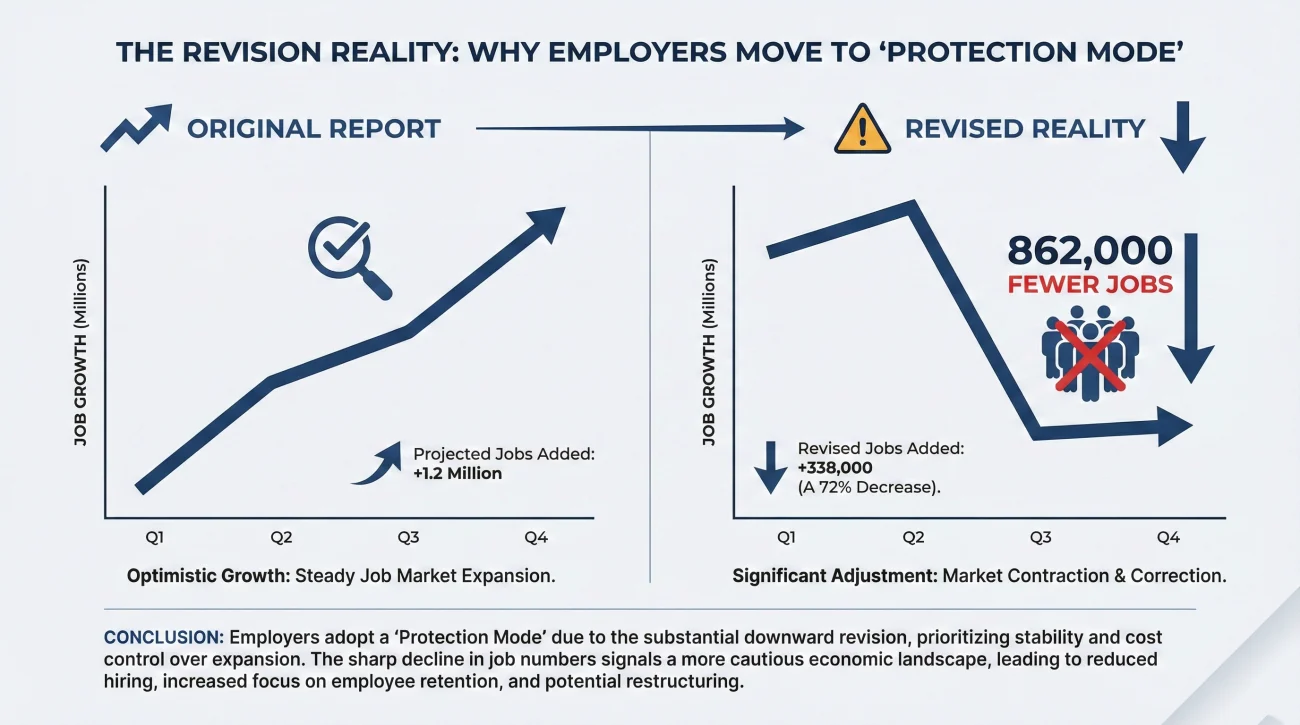
To understand why your interview process feels harder, you have to look at the data the Hiring VP is looking at.
According to BLS data reported by Reuters, employment growth for the 12 months ending in March 2025 was estimated to be 862,000 jobs lower than originally reported. That is a massive “benchmark revision.” Furthermore, the picture for 2025 has been adjusted down to just 181,000 jobs added, painting a much more fragile picture of stability than we previously believed.
Why does this matter to your resignation? Because when hiring managers see that the market is weaker than it looked, they tighten their criteria. They stop taking chances on “interesting” candidates and stick to “safe” bets.
Key Point: The Financial Times has noted a trend where GDP growth is decoupling from job growth. Companies are making money (GDP is up) but they aren’t hiring people to do it (Jobs are flat). This is driven by restructuring for AI and policy uncertainty.
In this environment, a resignation without a next step looks different. Two years ago, it looked like confidence. Today, it creates a “risk signal.”
What Is a “Risk Signal”?
When I review resumes in a cooling market, my brain is trained to look for red flags. A “Risk Signal” is any data point that suggests a candidate might be a bad investment. The biggest signal? Unexplained exits.
If you leave your job today with no new role lined up, a recruiter’s internal monologue often goes like this:
- 🚩 “Did they get laid off and are trying to hide it?”
- 🚩 “Did they have a performance issue?”
- 🚩 “Are they impulsive? Why would they leave a paycheck in this economy?”
Your goal in “Smart Quitting” is to silence these doubts before they even arise.
The 3-Layer Narrative Strategy

To quit safely when the market is noisy, you need to be clearer than the noise. You cannot just have one reason for leaving. You need three distinct versions of your story.
Layer 1: The Internal Story (For You)
This is the brutal truth. You write this down in your private journal. “I am leaving because my boss is toxic,” or “I am burnt out.” Acknowledge this so you don’t carry the emotion into your interviews. Process it, then lock it away.
Layer 2: The Manager Story (For the Bridge)
This is what you say to your current boss to ensure a good reference. It must be professional, grateful, and logistical.
“I have learned a great deal here, but I have decided to take a short break to focus on professional development / family matters before my next move. I want to ensure a smooth handover over the next two weeks.”
Layer 3: The Market Story (For the Recruiter)
This is the most critical layer. This is what you tell the outside world. It must remove the “risk signal.” It frames your exit as a strategic choice, not a reaction to failure.
“I quit because the company was chaotic and I didn’t know where it was going.” (Signals: Negative, victim mindset)
“I successfully completed my key projects for the fiscal year. With the market shifting, I decided to step back to upskill in [Specific AI Tool/Skill] so I can target roles that align with where the industry is heading in 2026.” (Signals: Strategic, forward-thinking)
💡 Pro Tip: Never say “I just needed a break.” In a restructure-heavy market (like the FT describes), “needing a break” can sound like “couldn’t handle the pressure.”
The High-Level Safety Checklist
Before you trigger the resignation process, verify you have these assets. They are your shield against the “risk signal” label.
- ✅ Locked References: Have two people ready to vouch for your performance before you resign. If a recruiter doubts your story, these voices are your validation.
- ✅ Documentation of Wins: Save the emails where you were praised. Save the project completion reports. You need hard evidence to counter any “performance issue” assumptions.
- ✅ Exit Timing: Try to leave at a natural endpoint (end of a project, end of a quarter). It reinforces the story that you finished the job, rather than abandoned it.
Final Thoughts
The market is noisy right now. The data revisions are real, and the uncertainty is making employers cautious. But remember: Noise creates opportunity for those who are clear.
If you must resign without a job, do not let the market write your story for you. By preparing your narrative and removing the risk signals, you prove that you are not a casualty of the economy, but a professional navigating it with intent.
❓ FAQ
🚩 Does a resume gap automatically hurt me in this market?
Not automatically, but it invites questions. A gap of 1 to 2 months is normal. A gap of 6 months without a clear “narrative” (like schooling, freelancing, or family care) creates a risk signal.
🗣️ What should I put on LinkedIn if I resign without a job?
Do not leave it blank. Use a placeholder title like “Career Sabbatical” or “Independent Consultant” and list the skills you are learning. Show activity, not stagnation.
📉 Should I mention the bad economy as a reason for leaving?
No. Never blame the economy or the company. It makes you sound passive. Always frame your move as a pull toward something new, not a push away from something bad.
🤝 How do I answer “Why did you leave?” if I was actually fired?
Keep it brief and neutral. “My role changed due to restructuring, and it was no longer the right fit for my strengths.” Then immediately pivot to what you are looking for next.
Sources & Data Context
This article references specific labor market adjustments to highlight the current hiring climate.
- Benchmark Revisions: Data regarding the downward revision of 862,000 jobs through March 2025 is sourced from Reuters.
- Structural Decoupling: Insights on the separation of GDP growth from job growth due to AI and restructuring are referenced from the Financial Times.
⚠️ Legal Disclaimer: ResignSmartly provides general informational guidance about resignation, workplace communication, notice periods, handovers, and career transitions. Content does not constitute individualized legal advice. Employment laws, contracts, workplace policies, and individual circumstances vary, so review the requirements that apply to your situation and consult an appropriate qualified professional when needed.