- Main point: A polite resignation email is a strategic investment that protects your reputation and future network.
- Why tone matters: It supports rehire chances, backchannel references, and signals high EQ under pressure.
- Mindset shift: Move from transactional logistics to relational legacy with specific gratitude and a calm professional close.
- 4-part structure: Warm opening, Specific thanks, Transition pledge, Open-door close with personal contact details.
- Execution playbook: Pick the right template for your scenario, finish strong with a handover doc, and keep exit interviews neutral.
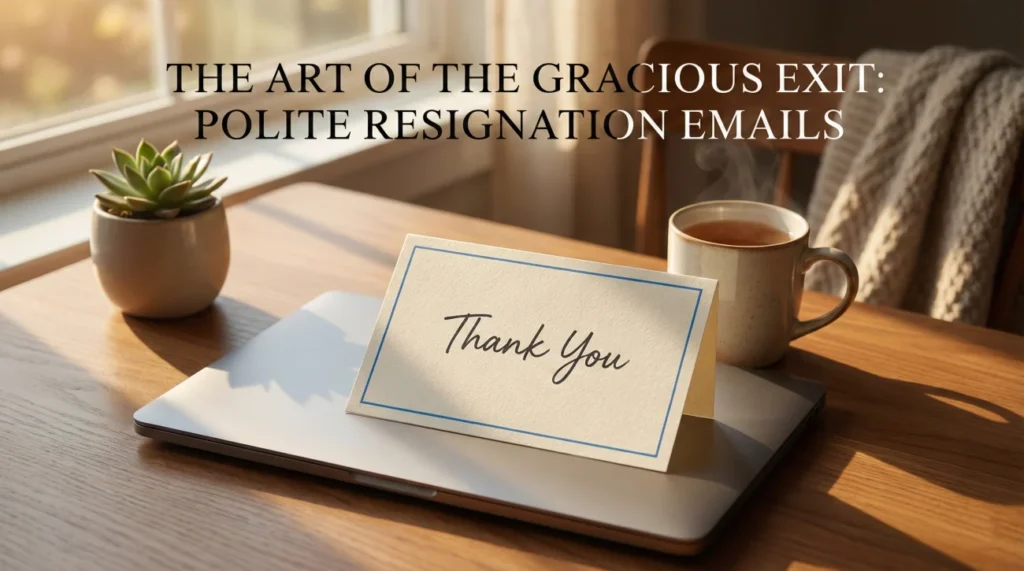
The Strategic Art of the Gracious Exit
Resigning is often viewed as a transactional necessity: you hand in your notice, work your two weeks, and leave. However, seasoned professionals understand that a polite resignation email is actually a high-yield strategic investment. It is the final chapter of your tenure, and thanks to the psychological “Peak-End Rule,” the way you exit often defines your legacy more than the years of hard work that preceded it.
We operate in a hyper-connected professional world. The manager you leave today could be the hiring director at your dream company five years from now. The colleague you support during your transition might refer you to a major client next quarter. In this context, standard brevity is not always a virtue. While a basic resignation letter fulfills the legal requirement, a gracious resignation email builds a permanent bridge, turning former employers into lifelong advocates.
This comprehensive deep-dive goes far beyond the basics of “giving notice.” We will explore the strategic psychology behind a thank you resignation email, provide detailed templates that balance warmth with professionalism, and teach you how to leverage your departure to solidify your professional network for decades to come.
The ROI of Kindness: Why Tone Matters More Than You Think
Why spend time crafting a nice resignation email when you are already mentally checked out? Is it just about manners? No. It is about asset protection. Your professional reputation is the only asset that follows you from job to job, and leaving on good terms (often called “Good Leaver” status) has tangible, calculable benefits.
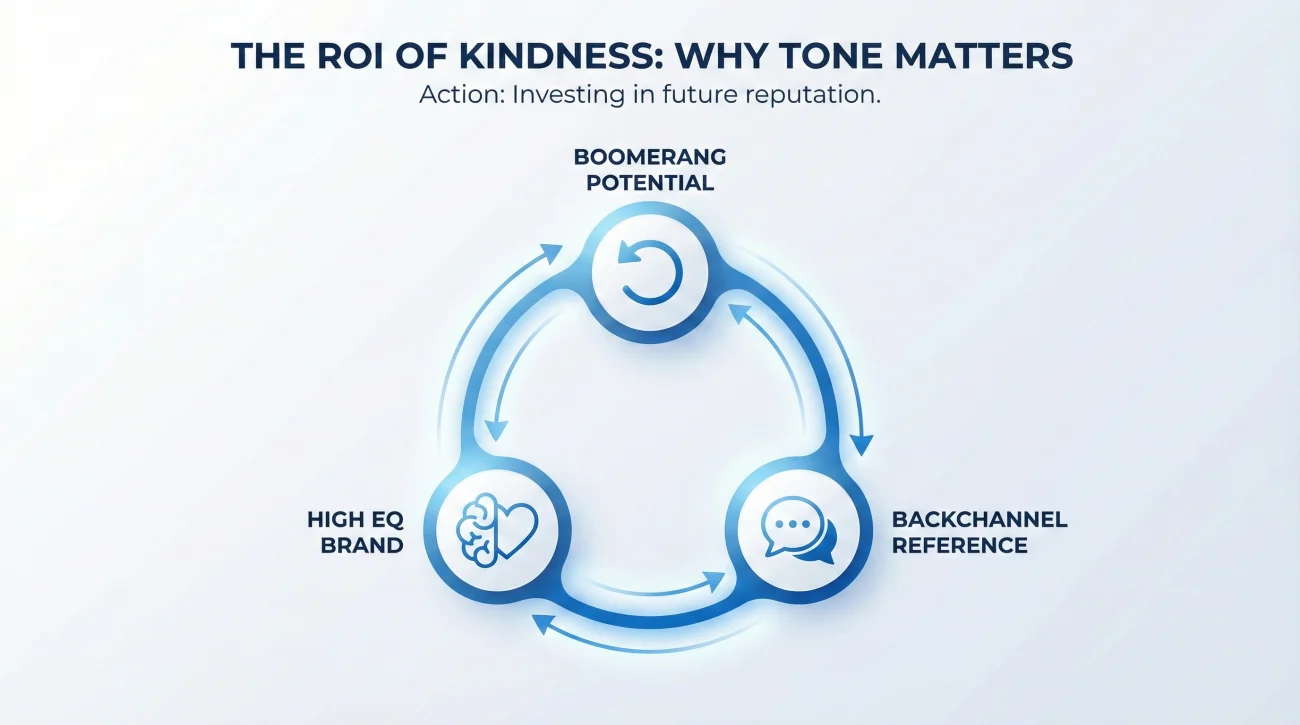
1. The “Boomerang” Effect
Workforce data increasingly shows that “boomerang employees” – workers who leave and later return to a former employer – are becoming a standard recruitment channel. Companies love rehiring alumni because they are known entities with shorter onboarding times. A scorching or indifferent resignation email destroys this safety net instantly. A gracious resignation email, however, keeps your personnel file marked “Eligible for Rehire.”
2. The “Backchannel” Reference Check
You might think you are safe because you didn’t list your old boss as a reference. This is a dangerous misconception. Formal reference checks with HR usually only confirm dates of employment. However, “backchannel” reference checks happen constantly in every industry. A hiring manager looks at your LinkedIn, sees a mutual connection with your former colleague, and sends a DM: “Hey, I see you worked with [Your Name]. What were they like?” Your exit behavior often dictates the answer to that question. If you left with grace, that DM becomes your strongest selling point.
3. Demonstrating High EQ
Drafting an appreciation resignation email demonstrates high Emotional Intelligence (EQ). It shows you can navigate awkward, high-stakes conversations with poise and gratitude – a key leadership trait that recruiters actively look for. It proves you can separate business decisions from personal relationships.
Transactional vs. Relational: A Strategic Comparison
Most employees write transactional resignations – cold, factual, and legally sufficient. To stand out and build social capital, you must shift to a relational mindset. Here is the difference in approach.
| Feature | Transactional Resignation (The Standard) | Relational Resignation (The Strategic) |
|---|---|---|
| Primary Focus | Logistics (Dates, handing over keys) | Relationships, Legacy, and Gratitude |
| Tone | Formal, Cold, Distant, Legalistic | Warm, Personal, Professional, Authentic |
| Typical Content | “I am resigning effective X date. Thank you.” | “I have grown so much here, specifically in [Skill]. I want to ensure my successor succeeds.” |
| Outcome | Ends the employment contract | Maintains the human connection |
The Anatomy of a Gracious Resignation Email
To write a kind resignation email that feels authentic and not like a copy-pasted script, you need to construct it using four specific strategic blocks. Each block serves a distinct psychological purpose.
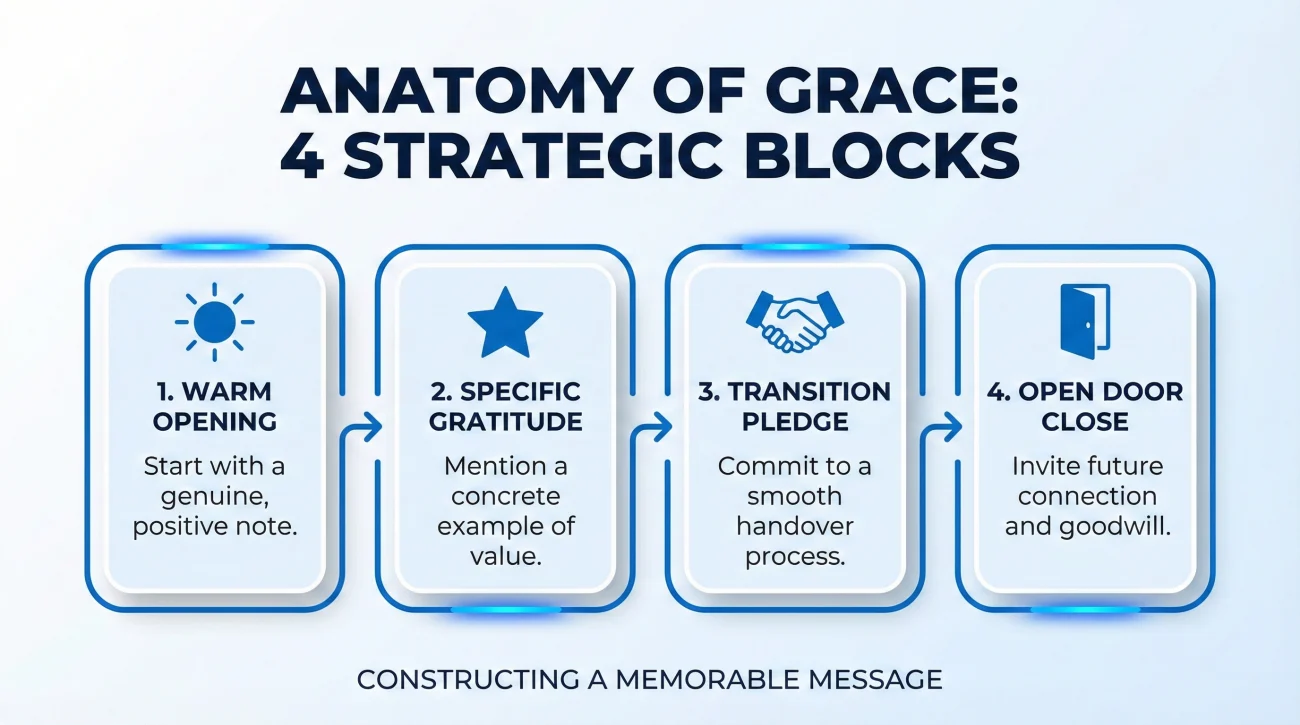
1. The Warm Opening (Softening the Blow)
Start with clarity, but wrap it in warmth. A blunt “I quit” triggers a defensive reaction. Instead, use phrases like “I am writing to share the bittersweet news…” or “It is with mixed emotions that I submit my resignation…” This signals that the decision wasn’t made lightly and that you value the relationship.
2. Specific (Not Generic) Gratitude
This is the secret sauce. Most people write “Thanks for the opportunity.” That is filler text. To be memorable, be specific. Mention a specific project, a skill you learned, or a moment of mentorship.
Generic: “Thanks for everything.”
Strategic: “Thank you for trusting me to lead the Q4 marketing initiative. That experience taught me how to manage cross-functional teams, a skill I will carry forward for the rest of my career.”
3. The Transition Pledge (Alleviating Anxiety)
When a manager reads “I resign,” their immediate thought is “Who is going to do the work?” Alleviate this anxiety immediately. Promise a “smooth handoff.” Offer to train your replacement, create video tutorials, or organize your files. This signals that you care about the team’s continued success even after you are gone.
4. The “Open Door” Close (Future-Proofing)
Explicitly state your desire to stay in touch. Don’t leave it implied. Provide your personal email and LinkedIn URL. Make it easy for them to find you when they have a new opportunity or need a favor.
Master Templates: Leaving with Class in Every Scenario
One size does not fit all. Choose the template that best fits your relationship history with your manager and the specific culture of your company.

Scenario 1: The “Mentor” Farewell (Deep Gratitude)
Use this thank you resignation email when you are leaving a boss who truly invested in your growth. This is about honoring that relationship and acknowledging their impact on your career.
Subject: Resignation – [Your Name] – With Gratitude
Dear [Manager Name],
I am writing to formally notify you of my resignation from my position as [Job Title], effective [Date].
This was an incredibly difficult decision because I have truly valued my time working under your leadership. When I joined the team [Number] years ago, I had limited experience in [Skill]. Thanks to your mentorship, patience, and guidance, I have grown into a confident [Professional Role].
I am specifically grateful for the opportunity you gave me to work on [Project Name]. That experience challenged me in the best ways possible and shaped my professional trajectory. The lessons I learned from you regarding [Specific Leadership Trait] will stay with me throughout my career.
I want to ensure my departure is as seamless as possible for you and the team. I have already started organizing my files and am creating a transition roadmap for my successor. I am fully committed to training the team on my current workflows before my final day.
I hope we can stay in touch. You have been a fantastic manager, and I would love to grab coffee before I head out.
With deep appreciation,
[Your Name]
[LinkedIn Profile Link]
[Personal Email]
Scenario 2: The Standard Professional (Safe & Warm)
This is a polite resignation email suitable for most corporate environments where you had a good, but not necessarily close, relationship. It is professional, respectful, and efficient.
Subject: Resignation Notice – [Your Name]
Dear [Manager Name],
Please accept this email as formal notification that I will be resigning from my position as [Job Title], with my final day being [Date].
I have accepted a new opportunity that aligns with my long-term career goals, but I want to emphasize how much I have enjoyed my time at [Company Name]. The collaborative culture here is special, and I am grateful to have been a part of the [Department] team for the past [Number] years.
My priority for the next [Number] weeks is to ensure a smooth handover of my duties. I am happy to train my replacement, finalize pending documentation, or assist in distributing my workload to the rest of the team to ensure no momentum is lost.
Thank you for the support and opportunities you have shown me during my tenure.
Best regards,
[Your Name]
Scenario 3: Short & Sweet (For Brief Tenures)
If you haven’t been there long (e.g., less than a year), a long, emotional letter can feel disingenuous. Use this nice resignation email to be brief but respectful.
Subject: Resignation – [Your Name]
Hi [Manager Name],
I am writing to let you know that I will be moving on from my role as [Job Title], effective [Date].
I appreciate the opportunity to work with the team and learn more about [Industry/Skill]. I have enjoyed my time here and am committed to ensuring a tidy transition of my current tasks before my departure.
Thank you again for the opportunity.
Sincerely,
[Your Name]
Scenario 4: Leaving for a Competitor (The Diplomat)
When you are going to a rival, you will likely be walked out immediately due to conflict of interest policies. Keep this email professional and devoid of details about your next move to avoid awkwardness.
Subject: Resignation Notice – [Your Name]
Dear [Manager Name],
Please accept this letter as my resignation from [Company Name], effective [Date].
I have decided to pursue a new opportunity in the industry. I want to express my gratitude for the time I have spent here; I have learned a great deal from the team and am proud of the work we accomplished on [Project].
I understand that given my new role, you may prefer for my tenure to end effective immediately. I am prepared for that outcome, but I am also fully willing to work my notice period to assist with the transition if you prefer.
I wish the company nothing but the best.
Regards,
[Your Name]
Scenario 5: Leaving a Toxic Job (The “High Road”)
Resisting the urge to “tell them off” is a power move. Use this gracious resignation email to protect your reputation while escaping a bad situation. It gives them nothing to use against you.
Subject: Resignation – [Your Name]
Dear [Manager Name],
I am writing to formally resign from my position, effective [Date].
After careful consideration, I have decided to move on to a new chapter that better aligns with my current professional needs. While this was a difficult decision, I appreciate the opportunities I have had to contribute to [Company Name] and interact with our clients.
I want to finish strong. I will ensure all my projects are documented and my files are organized for the next person stepping into this role.
Wishing you and the team all the best.
Sincerely,
[Your Name]
Scenario 6: Resigning After Being Passed Over
This is a delicate situation. You want to show that you are leaving for growth, not out of bitterness. This narrative controls how you are perceived.
Subject: Resignation – [Your Name]
Dear [Manager Name],
Please accept my resignation from my position as [Job Title], effective [Date].
As you know, I have been eager to take on more responsibility and advance my career. While I have loved working at [Company Name], I have accepted a Senior [Job Title] role elsewhere that will allow me to take that next step in my professional journey.
I am proud of the work I have done here and am grateful for the support of the team. I will do everything I can to ensure a smooth handoff before I go.
Best regards,
[Your Name]
Scenario 7: The Remote Worker Farewell
For remote roles, where you can’t say goodbye in person, the email carries even more weight. It needs to bridge the digital distance.
Subject: Resignation – [Your Name] – [Remote Team]
Hi [Manager Name],
I am writing to let you know that I will be resigning from my position as [Job Title], effective [Date].
Although we have been working remotely, I have truly felt connected to this team and its mission. I appreciate the flexibility and support you have provided during my time here. It has been a pleasure collaborating with you on [Project] via Zoom and Slack.
I will be uploading all my final project files to the shared drive and recording video walkthroughs of my current processes to help my successor.
I hope we can stay connected on LinkedIn.
Best,
[Your Name]
The “Last Two Weeks” Strategy: Cementing Your Legacy
Sending the email is just the beginning. The two weeks following your resignation are when your reputation is solidified. Do not succumb to “Short-Timer’s Syndrome” – the tendency to slack off once notice is given.
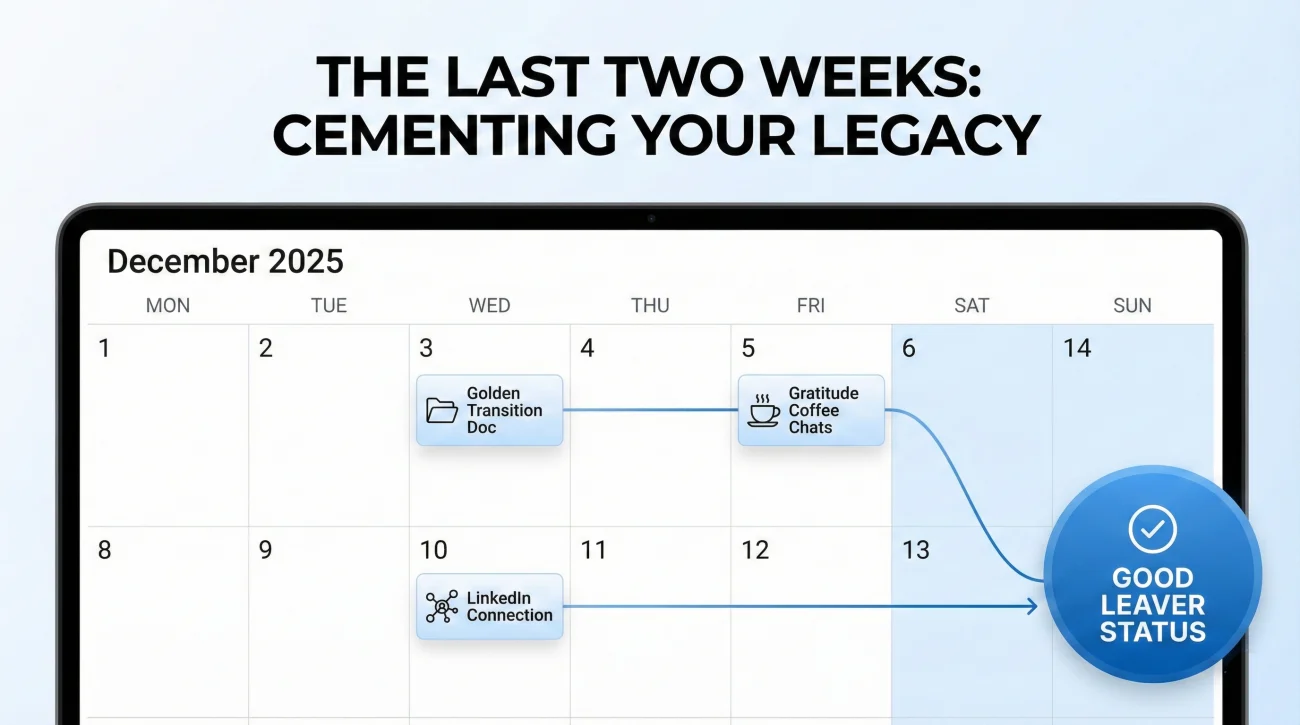
1. The “Golden” Transition Document
Create a folder called “TRANSITION” on your desktop. Put everything in it: process guides, contact lists, login credentials (if allowed), and status reports. Send the link to your boss unprompted. This single act defines you as a professional.
2. The Gratitude Tour
Schedule 15-minute virtual or in-person coffees with people who helped you. Thank them personally. This cements the relationship outside the office walls. Ask for their personal email addresses.
3. The Exit Interview Trap
Keep it bland. If you are leaving, trying to fix the company’s toxic culture in an exit interview usually backfires. The HR file is permanent. Say: “I felt it was time for a new challenge,” and leave it at that. Venting provides emotional relief for 5 minutes but can damage your reputation for 5 years.
❓ FAQ: Gracious Exits & Etiquette
📝 How long should a polite resignation email be?
😰 What if I hate my boss? Do I still have to say thank you?
🗣️ Should I tell my work friends before I email my boss?
🎁 Should I buy a parting gift for my team?
🚫 Can I retract my resignation if they offer me more money?
Final Thoughts
A polite resignation email is more than just good manners; it is good business strategy. By taking the time to craft a message that is gracious, grateful, and professional, you protect your reputation and keep your network intact.
Remember: You are not just closing a door; you are building a bridge that you may need to walk back across one day. In a world where networks are net worth, leave them wishing you were still there, not relieved that you are gone.
For more specific templates on leaving jobs, check our guide on resignation email examples or read our detailed breakdown on how to write a resignation email. For other career transition advice, visit the homepage.
⚠️ Legal Disclaimer: ResignSmartly provides general informational guidance about resignation, workplace communication, notice periods, handovers, and career transitions. Content does not constitute individualized legal advice. Employment laws, contracts, workplace policies, and individual circumstances vary, so review the requirements that apply to your situation and consult an appropriate qualified professional when needed.